


Changing business registration information in 2026 is a mandatory legal procedure when a business makes any adjustments to its registered information such as: company name, registered address, charter capital, business lines, or legal representative. According to the new regulations of the Law on Enterprises and its updated guiding documents up to 2026, enterprises must carry out the procedure to change their Enterprise Registration Certificate (ERC) through the online registration system of the business registration authority.
In reality, many enterprises encounter difficulties in this procedure due to inaccurate documentation, lack of understanding of tax regulations (especially when changing addresses to a different district/province), or not being updated on new points such as the mandatory online submission and electronic processing procedures. This can lead to prolonged processing times, increased costs, or rejection of applications.
This article by Viet An Law will help enterprises:
- Understand when need business registration amendment in Vietnam
- Prepare the right documents for each case
- Understand the 2026 (latest) implementation process
- Know the actual costs and processing time in advance
- Avoid common mistakes that lead to application rejection.
About business registration amendment in Vietnam 2026: Procedures & costs, Viet An Law, having handled thousands of business registration change applications, will be the optimal choice for your enterprise.
Quick summary of enterprise registration amendment procedures
| Information | Content |
| Common changes | Company name, headquarters, charter capital, business lines, legal representative, members, etc. |
| Where to submit | Provincial business registration office |
| Processing time | 03 working days; actual time may be longer if the dossier requires amendments or supplements |
| Submission method | National business registration portal |
| Public announcement fee | 100.000 VND per time |
When is enterprise registration amendment required?
| Change category | Registration required? |
|---|---|
| Company name | Yes |
| Headquarter address | Yes |
| Legal representative | Yes |
| Charter capital | Yes |
| Business lines | Yes |
| Transfer of shares in a joint stock company | Usually no |
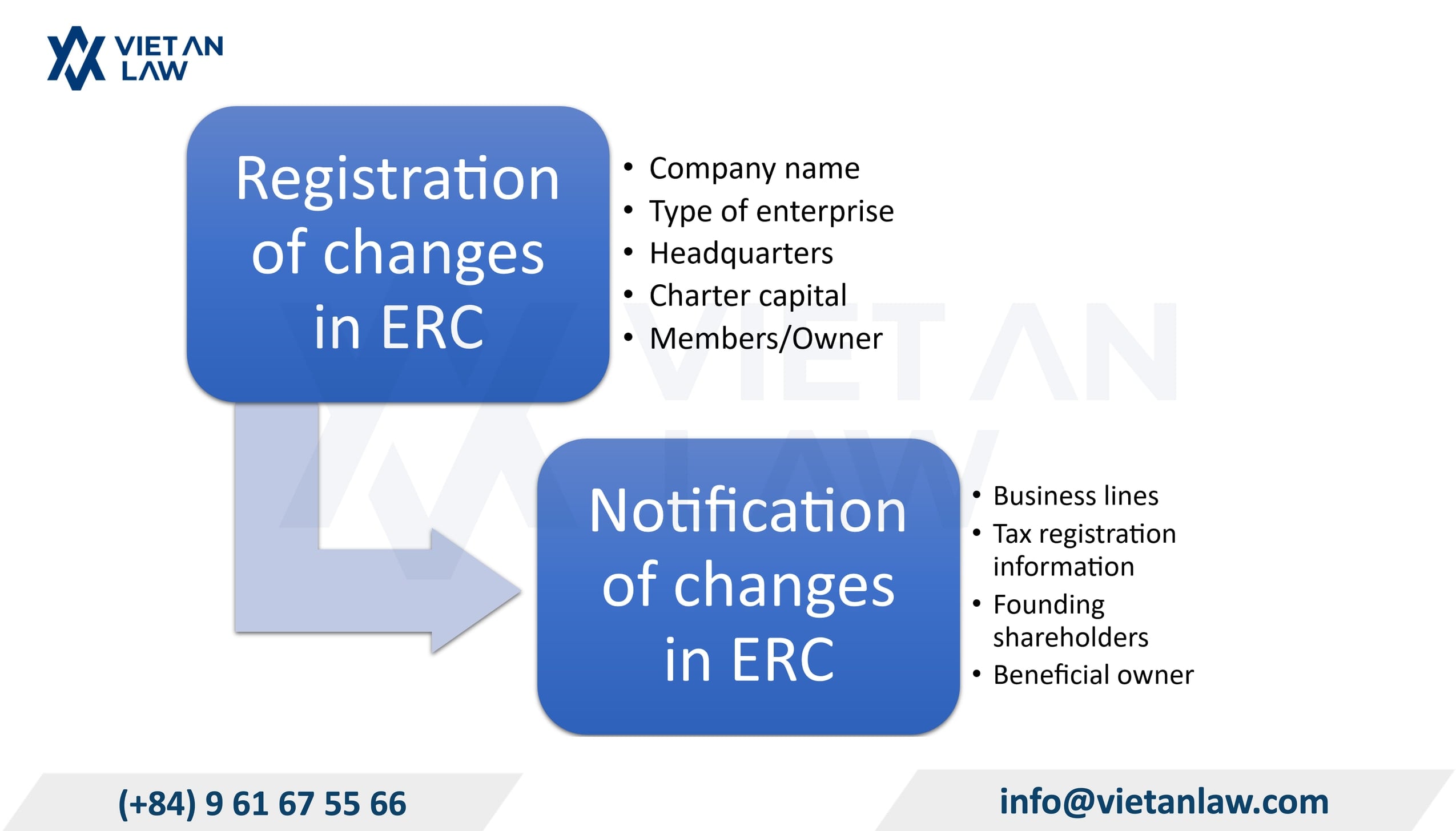
Mandatory changes required
Enterprises need to follow procedures when changing the contents of their ERC, including:
- Business name (Vietnamese, English, abbreviated name)
- Head office address
- Enterprise type
- Charter capital and capital contribution structure
- Legal representative and related information.
In addition, changes in the business registration dossier must also be updated, such as:
- Adding or changing business lines
- Changing tax, accounting information or notification address
- Adjusting shareholder information, especially foreign investors
- Updating information on beneficial owners (applicable from July 1, 2025).
For FDI companies
When FDI enterprises change their information, they not only need to amend their business registration but may also need to amend their Investment Registration Certificate (IRC) if it relates to:
- Business lines
- Investment capital
- Investor
- Project location.
Important Note
- Not all changes require registration. For example:
- Transfers of shares in a joint-stock company usually do not require registration, but must still be declared for tax purposes as required.
Identifying the correct cases requiring change will help enterprises avoid legal violations and save time in processing documents.
Fees for business registration changes Vietnam 2026
The cost of changing enterprise registration depends on the nature of the changes and the method of implementation (doing it yourself or using a service). However, businesses need to be aware of the following basic fees:
Detailed costs for enterprise registration amendment Vietnam
| Category | Fee |
|---|---|
| Public announcement fee | 100,000 VND/time |
| Amendment filing fee | Free (for online submission) |
| Seal carving fee (if changed) | 300.000 – 500.000 VND |
| Service fee (if hired) | 500.000 – 2.000.000 VND |
| Other expenses (invoices, signage…) | Depending on actual needs |
Potential costs
Depending on the circumstances, enterprises may incur additional costs:
- Costs for changing electronic invoices
- Costs for updating bank information
- Costs for adjusting subsidiary licenses (travel, transportation, etc.)
- Tax costs (if there is a capital transfer).
Actual total cost
Average: from 100,000 – 2,000,000 VND. Complex cases (FDI, major changes): may be higher.
How to optimize costs
- Prepare accurate documents from the start
- Submit applications online to avoid fees
- Use legal services if changes are complex.
Comparison of business registration amendments: Vietnam vs. FDI enterprises (2026)
| Criteria | Vietnam enterprises | FDI enterprises |
|---|---|---|
| Handling authority | Business registration office (Department of Finance). | Business registration office + Investment registration authority |
| Related licenses | ERC | ERC and IRC |
| Amendment procedures | Only ERC amendments are required | May require amendments to both ERC and IRC |
| Dossier | Simple, with fewer documents | More complex, involving investment-related factors |
| Processing time | ~ 03 working days | 5–15 days or longer |
| Additional obligations | Minimal | May require investment approval |
| Capital change cases | Approval is generally not required (for most cases) | Must register for capital contribution or share purchase |
| Change of investors | Not applicable | Mandatory procedures with the Investment authority |
Understanding the differences helps enterprises prepare the right documents from the start and avoid lengthy processing times.
Required dossiers for ERC amendment in Vietnam (2026)
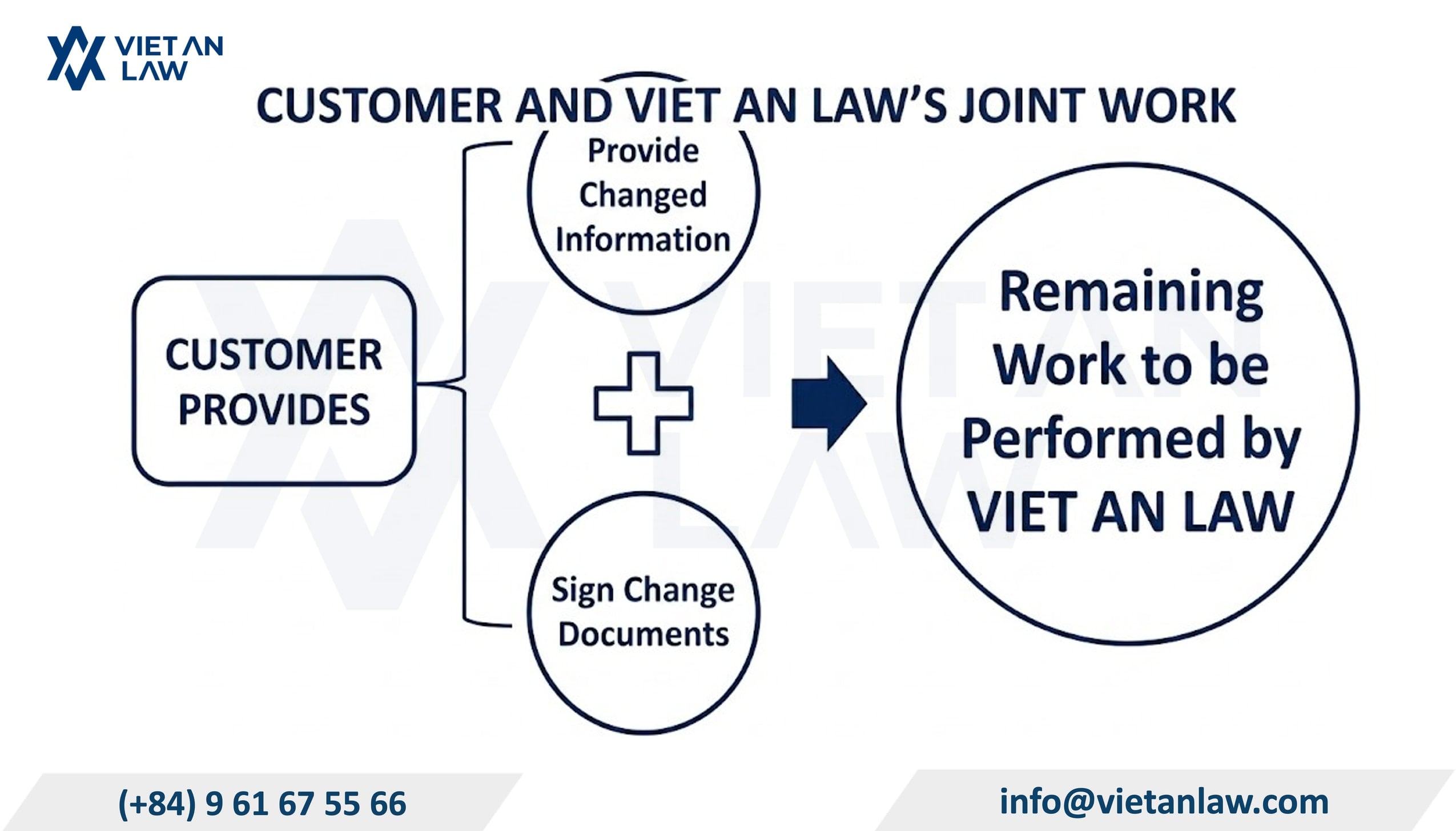
According to Decree 168/2025/ND-CP, the procedures for changing business registration in 2026 have been simplified. Many cases do not require meeting minutes or personal documents if verification using a unique identification number is available. Specific requirements will vary depending on the content of the application.
Notes on the application:
- Submit the application 100% online
- Use the correct form as prescribed
- Provide accurate information to avoid rejection of the application.
Common mistakes to avoid when you amend business registration Vietnam
During the process of changing business registration, many enterprises encounter basic errors that lead to rejection or prolonged processing times. Understanding these common mistakes will help you save costs and avoid legal risks.
Incorrect application form
- Using the wrong form according to Circular 68/2025/TT-BTC
- Missing signatures, missing decisions, or inconsistent information.
This is the most common error that causes applications to be rejected from the start.
Failure to process tax obligations upon address change
- Failure to finalize taxes upon relocating to a different district/province
- Lack of confirmation from the tax authority
According to the 2026 regulations, this is a mandatory condition before submitting the application.
Incorrect or incomplete information in the declaration
- Incorrect business lines
- Incorrect information of the legal representative
- Incorrectly updated registered office address.
This error causes the application to require multiple revisions, prolonging the processing time.
Not familiar with online application procedures:
- Submitting through the wrong portal or using the wrong account
- Uploading documents in the wrong format.
From 2026, all procedures must be completed online.
Failure to update after changes
After completing the procedures, many enterprises forget:
- To update information with the bank
- To change invoices and digital signatures
- To notify partners.
This can easily lead to inaccurate information and legal risks.
Effective ways to avoid mistakes
- Prepare documents using the correct format and check them carefully before submitting.
- Clearly identify tax obligations (especially when changing address).
- Use legal services if you lack experience.
Latest company registration amendment Vietnam procedures 2026
The procedure for changing business registration in 2026 follows a standard process, depending on the specific changes to the enterprise. Notably, according to the new regulations, 100% of the documents must be submitted online, shortening processing time but requiring accurate documentation. Below are the detailed steps:
Step 1: Complete tax obligations (if changing address)
Enterprises only need to complete this step when relocating to a different district or province.
- Finalize or settle tax obligations with the current tax authority.
- Obtain confirmation of tax obligation completion before relocating.
- For new enterprises or those that have recently completed tax settlements, only confirmation of tax obligations is required.
This is an important new requirement in 2026; failure to complete this step will result in rejection of the application.
Step 2: Prepare the dossiers for changing the business registration
Enterprises need to prepare documents corresponding to each change, such as:
- Change of company name
- Change of registered office address
- Change of charter capital
- Change of business lines
- Change of legal representative.
If using a service, the consulting firm will assist in drafting legally compliant dossiers, minimizing errors.
Step 3: Submit online application & fees
According to Decree 168/2025/ND-CP, business registration must be done online:
- Submit application at: National Business Registration Portal
- Use electronic identification account
- Pay information publication fee via bank transfer
Note: Business registration authorities will no longer accept paper applications from 2025.
Step 4: Receive the results of the business registration change
- Processing time: approximately 3 working days if the application is valid
- Results received:
- New enterprise registration certificate
- Or confirmation of information change
From July 1, 2025: only electronic copies will be issued, no more paper copies.
Step 5: Re-engrave the seal (if necessary)
Enterprises need to change their seal when:
- Changing the company name
- Changing the type of business
- Changing the address to a different province or district.
Enterprises can decide on the seal design themselves and no longer need to notify government agencies as before.
Critical compliance notes for updating business registration information in 2026
When carrying out business registration amendment procedures, each change has its own legal requirements. Without a clear understanding, businesses can easily have their applications rejected or face tax and legal risks. Below are some important points to pay special attention to:
Notes on changing a company name
- The new name must not be identical to or confusingly similar to an already registered enterprise name.
- Ensure consistency with the brand: domain name, trademark, and identity.
- Changing the name entails other changes such as: company seal, invoices, and subsidiary licenses.
Enterprises should think carefully before deciding to change their name.
After changing the company name
- Re-engrave the company seal
- Update the company signboard
- Notify the tax authorities to adjust invoices
- Update information with banks and insurance companies
- Adjust subsidiary licenses (travel agency, trademark, etc.)
- Amend the articles of incorporation and notify partners.
Notes on changing the registered office address
- The address must be clear, verifiable, and contactable.
- It cannot be located in a residential building.
- Avoid using invoices with the old address during the transition period.
Incorrect address may result in tax code suspension or rejection of documents.
After changing the registered office address
- Re-engrave the company seal (if the change is to a different district/province)
- Update the company signboard and articles of incorporation
- Adjust invoice information with the tax authorities
- Update bank, insurance, and related licenses
- Notify partners of the new address.
Notes when adding business lines
- The correct industry code must be applied according to the 4-digit industry classification system.
- Conditional business lines must meet all conditions before operation.
- If there is no industry code, a detailed description according to legal regulations is required.
This is a common error that leads to multiple revision requests for the application.
After changing business lines
- Meeting the conditions for conditional business lines
- Amending the company charter
- Registering for electronic invoices if retail sales occur (applicable from 2025)
Notes on changing charter capital
Increasing capital:
- Capital must be contributed in the correct form (bank transfer for organizations).
- Notification of change must be made within 10 days.
- Business license tax obligations may arise.
Decreasing capital:
- Can only be done after a minimum of 2 years of operation.
- Proof of prior capital contribution must be provided.
- Ensure that the business does not violate the statutory capital requirements.
Errors at this stage can easily lead to requests for explanation from the regulatory authority.
After changing the registered capital
- Update the financial statements (equity capital)
- Amend the company’s charter.
Notes on transferring capital/shares:
- Joint-stock companies usually do not need to register changes.
- However, personal income tax must be declared.
- Even in the case of gifts or transfers of 0 VND, tax must still be paid.
This is a tax risk that many enterprises overlook.
After changing the capital contribution structure
- Update the shareholder/member register
- Amend the company’s charter
- Declare and pay personal income tax.
Notes on changing the legal representative
- The new legal representative must meet all legal requirements.
- The new representative must not have their tax identification number locked or be subject to any restrictions.
- Information must be updated with banks, insurance companies, and partners.
- Sub-licenses must be adjusted if applicable.
This is a sensitive matter that directly affects the business operations.
After changing the legal representative:
- Update bank account
- Notify partners and relevant authorities
- Amend company charter
- Adjust subsidiary licenses (if any).
Special notes
Understanding the important points when changing business registration helps to:
- Avoid having your application rejected or experiencing delays in processing
- Minimize legal and tax risks
- Ensure the business operates stably after the change.
Updating after the change is mandatory to:
- Avoid inaccuracies in legal information
- Minimize tax and contractual risks
- Ensure the business operates continuously and legally.
Important note
Frequently asked questions about business registration amendment in Vietnam (2026)
Can business registration changes be done online?
Yes. Enterprises are required to submit applications online through the National Business Registration Portal.
Does changing business registration require tax settlement?
Yes. When moving to a different address under the tax authority’s jurisdiction. No tax settlement is required if the name, business sector, or other information is changed.
How long does it take to change business registration?
3 working days if the application is valid.
What are the costs for changing business registration?
From 100,000 to 2,000,000 VND, depending on the changes and services used.
Is it necessary to reissue VAT invoices?
No reissuance is required, but the information must be updated with the tax authority.
Where can I look up business change information?
On the National Business Registration Portal.
What should I keep in mind when changing the legal representative?
The new representative must be legally qualified and need to keep their information updated with the bank and its partners.
Comprehensive all-inclusive business registration amendment services at Viet An Law
Viet An Law provides a comprehensive business registration amendment service for 2026, assisting enterprises in quickly handling all related legal procedures without needing to work directly with government agencies.
Scope of services
We provide comprehensive support for common changes:
- Company name change
- Head office address change
- Capital increase/decrease change
- Legal representative change
- Change/addition of business lines
- Capital transfer, ownership structure change.
Ngoài ra, Luật Việt An còn hỗ trợ:
In addition, Viet An Law also provides support in:
- Drafting documents in accordance with the latest legal regulations
- Representing clients in submitting documents and working with the business registration authority
- Monitoring the progress and handling requests for additional documents
- Advising on procedures after changes: taxes, invoices, banking, sub-licenses
- Confirming tax obligations when relocating to a different district/province.
Benefits of using the service
- Fast completion of procedures (3–5 days)
- Minimizes the risk of rejected or erroneous documents
- No need for travel, saving time
- Legally sound advice, updated with the latest regulations (2026)
- Optimizes costs for enterprises.
Why do enterprises choose Viet An Law?
With experience handling over 1000+ business registration change applications annually, Viet An Law not only provides legal information but also offers practical solutions – fast and accurate processing from the first submission.
Our team of experienced lawyers helps enterprises:
- Avoid legal risks
- Shorten processing time
- Ensure 100% accuracy of documents.
Contact for quick consultation: 09 61 37 18 18 (Zalo / WhatsApp)
Contact Viet An Law now for free consultation and to complete the business registration change procedures quickly, legally, and cost-effectively.