On December 31, 2025, the Government issued Decree No. 359/2025/ND-CP amending and supplementing a number of articles of Decree 181/2025/ND-CP guiding the Law on Value Added Tax. Decree 359 officially takes effect on January 1, 2026, marking many important adjustments related to subjects not required to declare VAT, conditions for VAT refund, and handling of transitional tax refund dossiers. Below, Viet An Law will update the new points of Vietnam VAT 2026: Decree 359/2025 Amendments to Decree 181.
New points of Decree 359/2025 Amendments to Decree 181
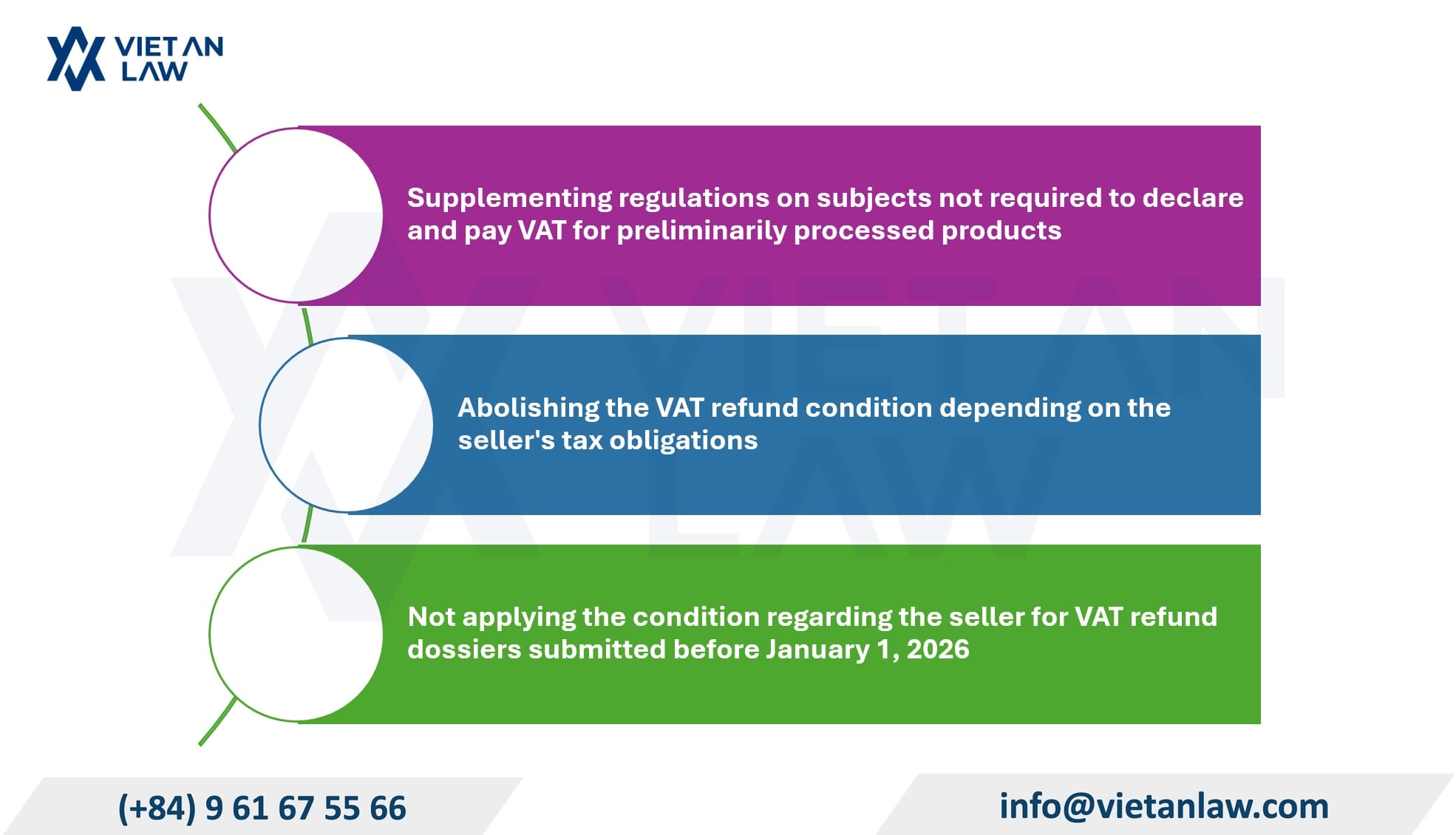
Decree 359/2025/ND-CP focuses on three main groups of changes
Clause 1, Article 1 of Decree 359/2025/ND-CP adds Clause 1b after Clause 1, Article 4 of Decree 181/2025/ND-CP to clearly classify taxable and non-taxable cases for preliminarily processed products.
Enterprises, cooperatives, and cooperative unions paying VAT under the deduction method when selling the following products:
to other enterprises, cooperatives, and cooperative unions at the commercial business stage are not required to declare and pay VAT, but are still allowed to deduct input VAT.
This is a very important new point, helping to reduce the pressure of tax declaration at the intermediary stage in the agricultural supply chain.
If the above subjects sell preliminarily processed products to:
Then VAT must still be calculated at a tax rate of 5% according to regulations.
Business households, individuals, enterprises, or economic organizations paying VAT under the direct method when selling preliminarily processed products at the commercial stage will calculate VAT at the rate of 1% on revenue.
Abolishing the VAT refund condition depending on the seller’s tax obligations
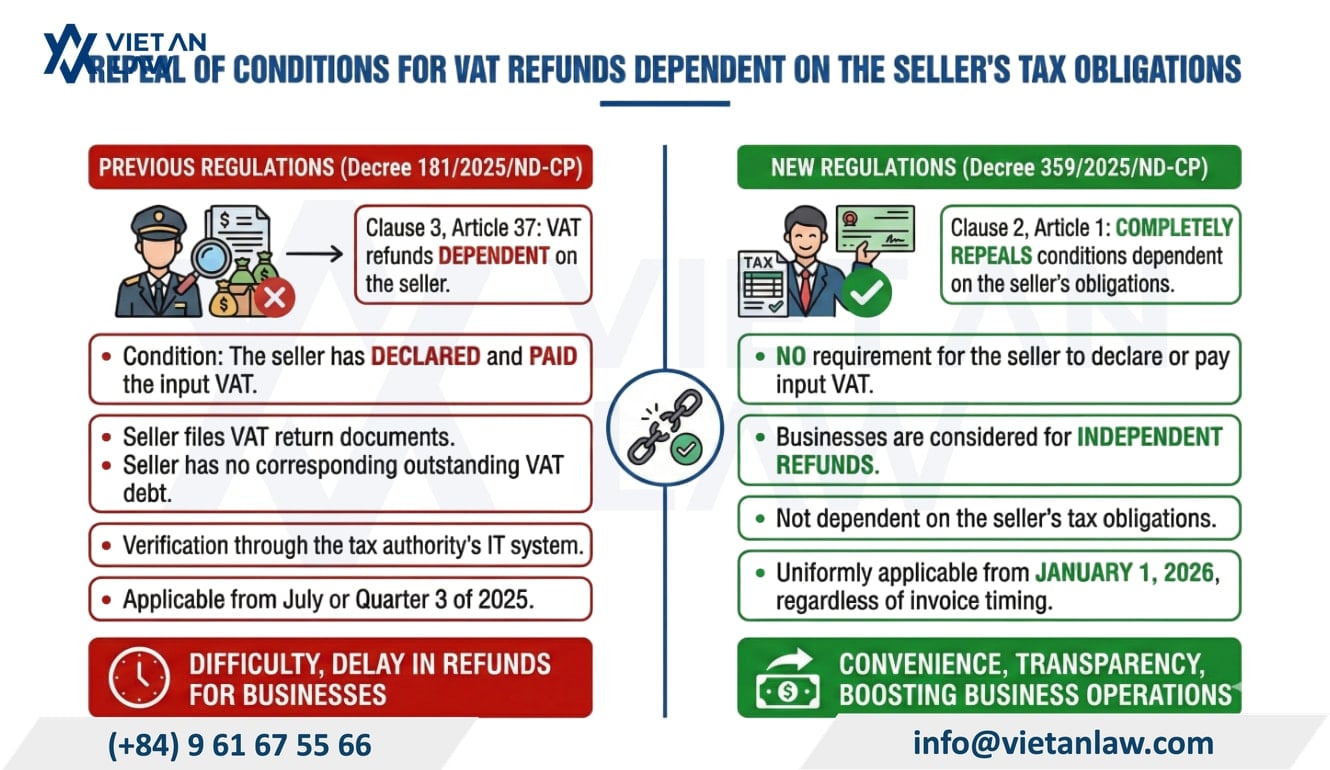
Previously, Clause 3, Article 37 of Decree 181/2025/ND-CP stipulated that business establishments were only refunded VAT if the seller had declared and paid VAT for input invoices, with conditions such as:
Accordingly, Clause 3, Article 39 of Decree 181/2025/ND-CP stipulated the time to start applying the VAT refund condition from July or the third quarter of 2025. In reality, this regulation caused buyers to have their tax refund rights “suspended” simply because the seller delayed declaration or still owed taxes, even though the transaction was real and legal.
The new regulation in Clause 2, Article 1 of Decree 359/2025/ND-CP abolished the value-added tax refund condition stipulated in Clause 3, Article 37 and Clause 3, Article 39 of Decree 181/2025/ND-CP.
Accordingly:
This is considered a major reform step in the VAT refund policy, helping to reduce risks and compliance costs for enterprises.
Clause 2, Article 2 of Decree 359/2025/ND-CP stipulates:
“2. Business establishments falling into the case of tax refund prescribed in Article 15 of the Law on Value Added Tax that have submitted value-added tax refund dossiers and have been received by the tax administration agency before January 1, 2026, but the tax administration agency has not yet issued a Tax Refund Decision or a Decision on tax refund cum offsetting state budget revenues, do not have to meet the condition that the seller has declared and paid value-added tax as prescribed for the invoices issued to the business establishment requesting the tax refund.”
Thus, according to the new regulations in Decree 359/2025/ND-CP, for VAT refund dossiers:
they also do not have to meet the condition that the seller has declared and paid VAT.
This transitional provision helps definitively resolve backlogged dossiers, preventing enterprises from continuing to be “stuck” due to applying the old regulations.
The issuance of Decree 359/2025/ND-CP brings many positive impacts:
Abolishing the condition requiring the seller to declare and pay VAT before allowing the buyer to get a tax refund has resolved one of the long-standing obstacles in the practical application of tax laws.
Previously, purchasing enterprises had absolutely no control over the seller’s tax obligations, but had to bear the risk of being denied a tax refund if the seller delayed declaration or still owed taxes. Decree 359 has clearly separated the tax responsibilities among subjects, ensuring that the buyer’s right to a tax refund does not depend on the behavior of a third party.
This is especially meaningful for export enterprises, large-scale manufacturing enterprises, and enterprises with multi-tiered supply chains.
Expanding the group of subjects not required to declare and pay VAT for unprocessed or preliminarily processed agricultural, forestry, and fishery products has:
This is a change that helps significantly simplify compliance, especially for enterprises purchasing and distributing agricultural products operating on a large scale with high transaction frequencies.
Decree 359/2025 clearly demonstrates a trend of stabilizing tax policy, avoiding changing tax refund conditions in a suddenly tightened direction that causes “shock” for enterprises. Not applying the condition regarding the seller for tax refund dossiers submitted before January 1, 2026, but not yet resolved, shows the consistency and receptiveness of the management agency, while helping enterprises be more proactive in planning cash flows and financial plans.
The new regulation has reduced tax barriers at the commercial stage, thereby:
Instead of controlling tax refunds through “cross-binding” conditions between buyers and sellers, Decree 359/2025 creates conditions for tax authorities to:
This approach aligns with modern tax management trends, reducing pressure on both taxpayers and management agencies, while improving the efficiency of tax fraud prevention.
Enterprises should take note to avoid the following errors:
No. Decree 359 does not adjust the 8% VAT rate reduction policy but focuses on non-declarable subjects and tax refund conditions.
Business households continue to apply the direct declaration method as prescribed, not calculating by the presumptive method, with a percentage rate on revenue depending on the industry.
Taxpayers can download the declaration form at the electronic portal of the General Department of Taxation or contact a tax agent to be provided with an updated form.
The VAT rate is determined by the time the invoice is issued, regardless of the time the contract is signed.
Above is the update on Vietnam VAT 2026: Decree 359/2025 Amendments to Decree 181. During implementation, if any difficulties or obstacles arise, taxpayers can contact Tax Agent – Viet An Law Firm for the best advice, guidance, and support.