5 Tips for Starting an LLC or Joint-Stock Company in Vietnam
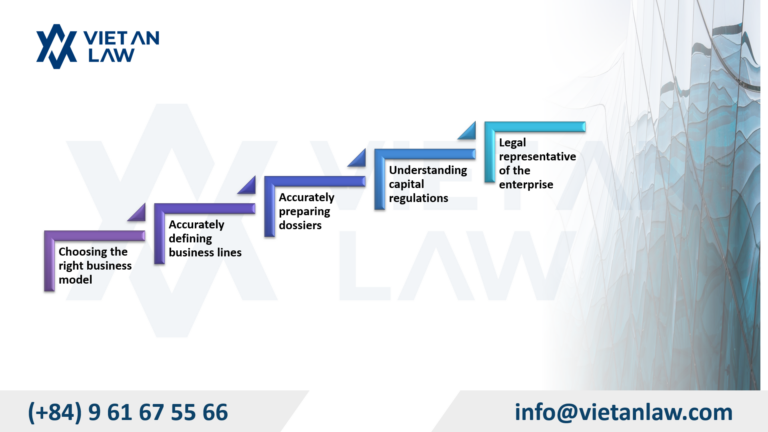
Starting and establishing a business is a crucial step for anyone aspiring to build a business career. Among the types of enterprises in Vietnam, the limited liability company (LLC) and the joint-stock company are two of the most popular models due to their legal, capital, and organizational advantages. However, for the company establishment process to proceed smoothly and in accordance with regulations, it is essential to understand some key points before you begin. The following article by Viet An Law will help businesses understand the 05 key considerations when establishing an LLC or a joint-stock company, from choosing the right business model to completing crucial legal procedures. The 05 considerations include:
05 tips for starting an LLC or joint-stock company in Vietnam
The choice of the most suitable business model for a startup will depend on various factors such as business objectives, investment capital, legal liability, establishment procedures, and the investment sector. Therefore, the appropriate business model will vary depending on each specific case.
Limited liability company with two or more members (LLC)
Advantages
Separate legal personality: The enterprise has a legal personality, so a clear distinction is made between the company’s assets and the members’ assets.
Transfer of contributed capital: When a member wishes to transfer their capital contribution, the other members of the company have a pre-emptive right to repurchase that portion of capital.
Disadvantages
Liability transfer to the company: As members are only liable for their capital contribution to the enterprise, this transfers the risk to the enterprise itself.
Limited capital mobilization: This business model’s ability to raise capital is quite limited as it is not permitted to issue shares.
Single-member limited liability company (single-member LLC)
Advantages
Limited liability: The company member is only liable within the scope of the company’s charter capital.
Ease of management: With a small number of members, management and control are straightforward.
Disadvantages
Limited capital mobilization: The company is not permitted to issue shares, so its ability to raise capital is not high.
Strict legal regulations: This model is subject to tight legal regulations.
Joint-stock company
Advantages
Separate legal personality: The company has a legal personality, so shareholders are only liable within the scope of their contributed capital. This helps mitigate risks for shareholders when they invest in the company.
Significant capital mobilization: The company has the right to issue securities, which provides a large capacity for capital mobilization, making it easy for the company to expand its business activities.
Flexible membership: There is no maximum limit on the number of members, so the scope of participants in a joint-stock company is very broad.
Disadvantages
Complex management: As a joint-stock company has no limit on the number of shareholders, its organization, management, and administration are far more complex than other business models.
Strict legal control: This model is subject to strict legal control.
Limited executive power: The authority of the company’s executives is restricted in some cases and requires approval from the general meeting of shareholders.
Accurately defining business lines
Accurately defining business lines is one of the five key considerations when establishing an LLC or a joint-stock company.
According to Article 07 of the Enterprise Law 2020, businesses are not restricted in the number, size, or registered business lines, but they must identify their main business line.
In practice, however, when establishing a company, people tend to register many industry codes to avoid having to go through procedures for adding business lines later. Registering randomly can cause unnecessary difficulties, wasting time and effort during the business registration process.
For example, an enterprise registers a security service business line (not its main business line) with a charter capital of 10 billion VND. However, this is a conditional business line that requires a minimum legal capital of 1 million USD (equivalent to approximately 23 billion VND). Since the enterprise fails to meet the legal capital requirement, its business registration application will surely be rejected. This forces the enterprise to spend more time correcting and resubmitting the application, causing unnecessary delays in the establishment process.
Before drafting the business registration dossier, organizations can refer to Decision No. 36/2025/QD-TTg on the Vietnamese economic classification system to create a list of intended business lines. In addition to clearly stating the name of the industry, the enterprise must ensure it accurately records the corresponding four-digit industry code.
If the company wants to provide more detailed information about its activities, it can select a specific four-digit industry code and then provide a clear description of the detailed business activity below it. However, this detailed description must be consistent with the scope of the selected four-digit industry code. For example, industry name: Manufacturing of beds, cabinets, tables, and chairs (Details: Manufacturing of beds, cabinets, and chairs from wood, metal, other materials); Industry Code: 3101 – 3102 – 3109.
Conditional business lines: For business lines that are subject to conditions as stipulated in other legal normative documents, the business line must be recorded according to the regulations in those documents. For example: Industry name: Real estate consulting, brokerage, and auctioning, land use right auctioning (Details: Real estate brokerage services; Real estate consulting; Real estate management; Real estate exchange floor; (Based on: article 55, article 61, article 67 of the Law on real estate business 2023)); Industry Code: 6821.
Preparing a complete and accurate dossier
The fundamental dossier for establishing an LLC or a joint-stock company is largely similar. However, each business model has its own specific characteristics and unique considerations.
When preparing the establishment dossier for a joint-stock company or an LLC, it is crucial to prepare all the required documents and ensure the information is valid and accurate. Special attention should be paid to the company charter, the list of members/shareholders, the application for enterprise registration, and the personal identification documents of the legal representative and the authorized person.
For a limited liability company (LLC)
Application for enterprise registration: This is the official document for registering the establishment of the company.
Company charter: This specifies the terms of operation and the rights and obligations of the members.
List of members: This must include the full personal information of the members (for an LLC with two or more members).
List of the enterprise’s beneficial owners.
Copy of ID card/citizen identification card/passport of the members/legal representative, except for cases where individual shareholders already have a personal identification number.
Documents proving charter capital: If the charter capital is contributed in the form of assets, valid proof is required.
Power of attorney for Viet An Law.
For a joint-stock company
Application for enterprise registration: Similar to an LLC.
Company charter: This specifies the terms of operation and the rights and obligations of shareholders.
List of founding shareholders: Must include the full personal information of the founding shareholders.
List of the enterprise’s beneficial owners.
Copy of ID card/citizen identification card/passport of shareholders: To verify the identity of the shareholders, except where individual shareholders already have a personal identification number.
Documents proving charter capital: If the charter capital is contributed in the form of assets, valid proof is required.
Power of attorney (if any): If the person submitting the dossier is not the legal representative.
Resolution on the establishment of a joint-stock company: The official document demonstrating the decision to establish the company.
Notarized copies of related documents (if any): For example, the establishment resolution or enterprise registration certificate of contributing organizations.
General Considerations
Notarized copies: All copies of personal identification documents must be notarized.
Accurate and complete information: Errors in the dossier can lead to a rejection of the registration.
Prepare a complete dossier before submission: Avoid having to supplement documents after submission.
Submit to the correct address: Submit the dossier to the department of Finance (formerly the department of Planning and Investment) where the company’s head office is located.
Online submission (if available): Some provinces and cities allow for online submission of dossiers.
Understanding capital regulations
Noting on capital regulations when starting an LLC or a joint-stock company
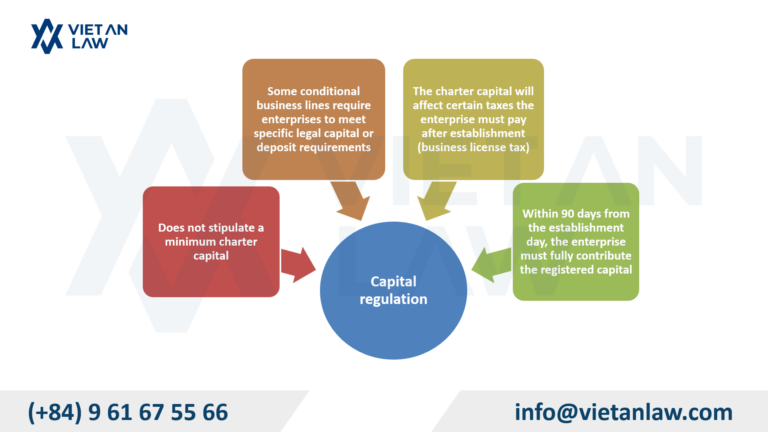
Currently, the law does not stipulate a minimum charter capital for establishing a business, except for cases where the business registers a conditional business line. In such instances, it must meet the charter capital, legal capital, or deposit requirements for that specific industry. For example: A tourism company must deposit at least 250,000,000 VND at a bank.
Note: Within 90 days from the date of establishment, you must fully contribute the registered capital or proceed with the procedure to reduce the charter capital. However, most businesses fail to fully contribute the committed capital within this 90-day period, which could lead to penalties if a government agency conducts an unexpected inspection.
Legal representative of the enterprise
When establishing a company, the enterprise needs to identify its legal representative—the person authorized to act on behalf of the company to carry out tasks such as signing documents and contracts, and who is legally responsible for all of the company’s activities.
Depending on the type of enterprise, the legal representative can hold positions such as Director/General Director, Chairman of the members’ council (for an LLC), or Chairman of the board of Directors (for a joint-stock company).
Currently, the law does not regulate the minimum capital that a legal representative must own in the enterprise. Accordingly:
An individual can be the legal representative for multiple companies.
The legal representative can contribute capital or simply be hired to hold this position; they are not required to be a shareholder or a contributing member.
This concludes Viet An Law’s advice on the 05 key considerations when establishing an LLC or a joint-stock company. If customers have any related questions or need legal advice concerning their business, please contact Viet An Law for the best support.
Fast & Reliable Legal Assistance
Fill out the form below and get connected with a lawyer quickly.
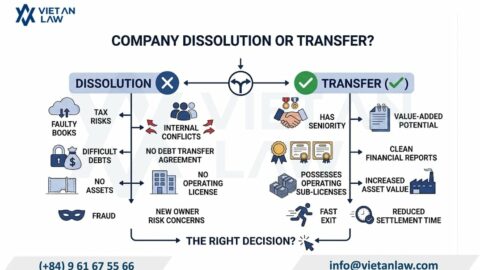
Company dissolution vs transfer in Vietnam: Compare costs, tax obligations, and legal risks. Expert analysis to help you choose the optimal exit strategy for your business.
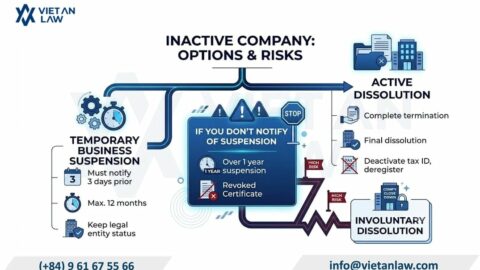
Inactive company Vietnam? Learn whether to suspend or dissolve your business. Expert guide on legal consequences, procedures, and optimal solutions for non-operating enterprises.
Discover the 6 employment contracts exempt from social insurance Vietnam under the 2024 Social Insurance Law. Learn legal exemptions, compliance risks, and cost optimization strategies for businesses.
Vietnam's draft Commercial Law 2026 removes the 8% contract penalty cap, allowing unlimited breach penalties. Learn how this affects your contracts, liquidated damages clauses, and dispute strategy.
Complete guide to drafting a Non-Disclosure Agreement (NDA) in Vietnam 2026. Learn essential clauses, common mistakes, legal requirements & professional NDA drafting services for businesses.