Recently, the National Assembly officially announced that starting from July 1, 2026, female employees giving birth to their second child will be entitled to 7 months of maternity leave. The Law, comprising 8 chapters and 30 articles, shall take effect on July 1, 2026. The promulgation of the Law on Population will elevate the efficacy of the 2003 Ordinance on Population to a new level, establishing a solid legal framework for national population policies in the new development phase. Notably, several new regulations carry significant impacts, such as extending maternity leave for employees, prioritizing social housing purchases, and establishing financial regimes for childbirth. Below, Viet An Law will update the noteworthy new contents of the 7-month maternity leave expansion for second child from 2026 in Vietnam.
Currently, under Clause 1, Article 139 of the 2019 Labor Code, female employees are entitled to 6 months of maternity leave before and after childbirth, with the prenatal leave period not exceeding 2 months. In the case of multiple births, the mother is entitled to an additional month for each child, starting from the second child.
According to the new regulations in Point a, Clause 1, Article 13 of the 2025 Law on Population, from July 1, 2026, female employees giving birth to their second child are entitled to 7 months of maternity leave:
“Article 13. Maintaining replacement fertility
…1. Measures to maintain replacement fertility:
…a) Extending maternity leave upon the birth of the second child: Women shall be entitled to an additional 01 month of leave;”
Simultaneously, Clause 1, Article 28 of the 2025 Law on Population stipulates:
“1. To amend and supplement Clause 1, Article 139 of the Labor Code as follows:
…In the case a female employee gives birth to her 02nd (second) child, the mother shall be entitled to an additional 01 month of leave.”
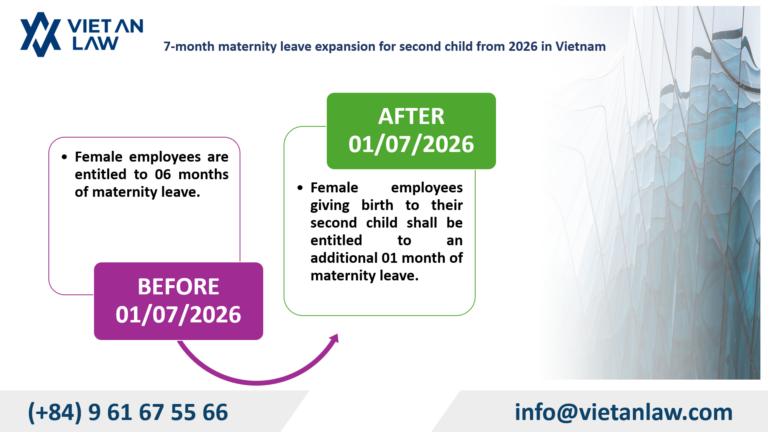
Thus, it can be observed that starting from July 1, 2026, the maternity leave duration for female employees will be extended in the case of a second childbirth.
Specifically, in addition to the standard 6-month maternity leave under Clause 1, Article 139 of the 2019 Labor Code, a female employee giving birth to her second child shall be entitled to an additional 01 month of leave, increasing the total maternity leave period to 07 months. This regulation differs from the previous mechanism, which only granted an additional month for multiple births (calculated from the second child onwards). The benefit has now been expanded to include cases where a mother has her second child in a separate birth. This reflects a humane policy, contributing to the support of maternal and child health during the postpartum period.
Currently, under Article 53 of the 2024 Law on Social Insurance, a male employee participating in compulsory social insurance is entitled to 05 working days of leave under the maternity regime when his wife gives birth.
However, according to the new provisions in Point a, Clause 1, Article 13 of the 2025 Law on Population, from July 1, 2026:
“Article 13. Maintaining replacement fertility
…1. Measures to maintain replacement fertility:
…a) Extending maternity leave upon the birth of the second child: […] men shall be entitled to an additional 05 working days of leave when their wives give birth;”
Simultaneously, Clause 2, Article 28 of the 2025 Law on Population stipulates:
“2. To amend and supplement Point c, Clause 2, Article 53 of the Law on Social Insurance as follows:
…c) In cases where the wife gives birth to twins or gives birth to her 02nd (second) child, [the husband] shall be entitled to 10 working days of leave. In the case of triplets or more, an additional 03 working days of leave shall be granted for each child, starting from the third child onwards.”
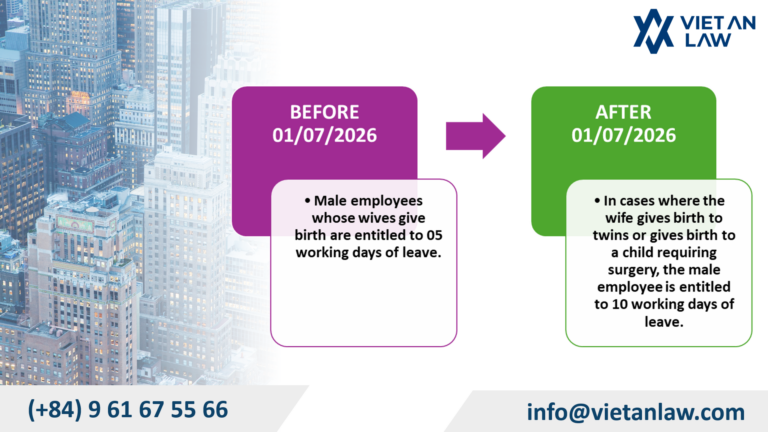
Accordingly, from July 1, 2026, male employees whose wives give birth to their second child will be entitled to 10 working days of leave, double the current entitlement. This is a significant adjustment, reflecting a humane policy and encouraging male participation in family care during the postpartum period.
According to Point c, Clause 1, Article 13 of the 2025 Law on Population: “Priority shall be given to purchasing or renting social housing in accordance with the law on housing for women who give birth to exactly 02 children, or men who have 02 biological children and are unmarried or whose wives are deceased.” This policy aims to encourage replacement fertility and support families directly raising two young children.
Simultaneously, Clause 3, Article 28 of the 2025 Law on Population stipulates:
“3. To amend and supplement Point dd, Clause 1, Article 79 of the Law on Housing as follows:
…đ) In cases where an individual is eligible for multiple support policies, they shall enjoy the policy with the highest benefit level; in cases where multiple individuals meet the same standards and conditions, support shall be provided in the following order of priority: persons with meritorious services to the revolution, relatives of martyrs, persons with disabilities, persons relocated for resettlement in the form of purchasing or lease-purchasing social housing, women who have given birth to exactly 02 children or men who have 02 biological children and are unmarried or whose wives are deceased, and women.”
As such, the new regulation not only adds priority benefits for the aforementioned groups but also places them in a relatively high priority position in the social housing approval process. This demonstrates a sustainable population support policy while maintaining a humane approach by creating conditions for families raising two children to access stable and suitable housing.
According to Point b, Clause 1, Article 13 of the 2025 Law on Population:
“Financial support for childbirth shall be provided to women from ethnic minorities; women who give birth to exactly 02 children before the age of 35; and women in localities with low fertility rates.”
The financial support policy for childbirth applies to three categories of subjects:
Accordingly, from July 1, 2026, when the 2025 Law on Population officially takes effect, the three aforementioned groups will enjoy financial support regimes for childbirth. The specific amounts, forms, and sources of support shall be regulated in detail by the Government in guiding documents.
It is evident that these regulations are designed to encourage the birth of exactly 02 children during reproductive age, while focusing on groups at risk of declining fertility or those facing socio-economic difficulties. Thereby, the policy aims to:
According to Article 6 of the 2025 Law on Population, the following acts are strictly prohibited:
Thus, fetal gender selection in any form is prohibited, except for gender determination used for the diagnosis and treatment of gender-linked genetic diseases as regulated by the Ministry of Health. Any person who commits acts of forcing, compelling, encouraging, motivating, or counseling abortion for gender reasons shall be prohibited.
Furthermore, under Clause 2, Article 15 of the 2025 Law on Population, medical practitioners who commit acts of announcing, notifying, or disclosing information about fetal gender to clients shall have their practice suspended.
These new regulations are enacted to mitigate the imbalance of the sex ratio at birth, which is currently a concerning issue in Vietnam. Tightening the list of prohibited acts, especially in the field of reproductive healthcare and medical activities, contributes to protecting the rights of unborn children, promoting gender equality, and moving towards sustainable population development.
To adapt to population aging and an aged population, Chapter IV of the 2025 Law on Population introduces numerous important and comprehensive policies across various fields, such as:
These policies demonstrate the State’s efforts in building a sustainable social security system, adapting to changes in population structure, and ensuring that the elderly are better cared for, supported, and protected in the context of increasing average life expectancy.
It is evident that the Law on Population 2025 marks a fundamental shift, moving the focus of population policy from family planning to population and development. The Law establishes an overarching policy framework related to labor, employment, wages, social insurance, health insurance, education, healthcare, housing, and other policies aimed at increasing fertility rates and achieving sustainable replacement fertility.
The above is an update on the new regulations officially effective from July 1, 2026, regarding the 7-month maternity leave expansion for second child from 2026 in Vietnam. Should you have any related inquiries, please contact Viet An Law for the best advice and support!