Legal Shift: Abolishing 38 Conditional Business Lines in Vietnam 2026
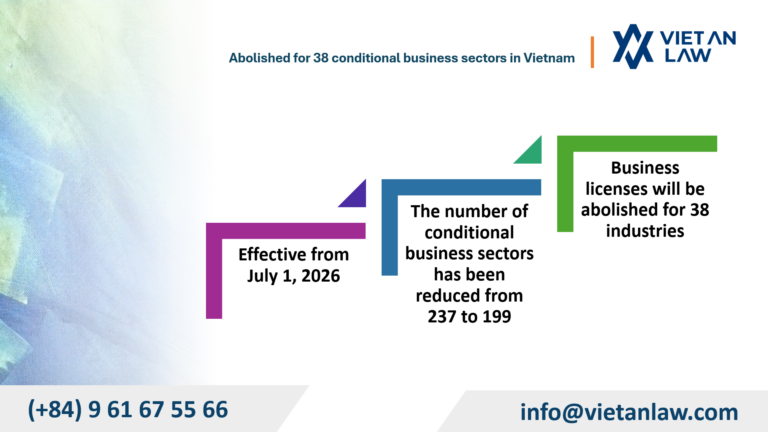
On the morning of December 11th, the National Assembly passed the amended Investment Law. Accordingly, the Law officially reviews and reduces 38 conditional investment and business sectors and adjusts the scope of 20 sectors, in line with the spirit of Resolution 68-NQ/TW on improving the business environment. This list of conditional investment and business sectors will officially be applied from July 1st, 2026. Below, Viet An Law Firm will update some notable new points regarding the legal shift: abolishing 38 conditional business lines in Vietnam 2026.
The spirit of Resolution 68-NQ/TW on the right to freedom of business
The guiding principles of Resolution 68-NQ/TW of 2025 on the development of the private economy have put forward solutions to ensure the right to freedom of business :
“Citizens and businesses are free to conduct business in sectors not prohibited by law. The right to conduct business can only be restricted for reasons of national defense, national security, public order, social safety, social morality, the environment, and public health, and this must be stipulated in law.”
Accordingly, the regulation of conditional investment and business sectors will shift from a “pre-approval” mechanism to a “post-approval” mechanism, moving sectors currently subject to investment and business conditions that apply to output products and services to those that can be controlled by technical standards and regulations issued by competent authorities.
Currently, the list of conditional investment and business sectors and professions stipulated in Appendix IV issued with the Investment Law of 2020 and through amendments and supplements in 2022, 2024, and 2025 includes 237 conditional business sectors and professions.
However, according to the new regulations amended on December 11, 2025, effective from July 1, 2026, Appendix IV of the 2025 Investment Law has abolished 38 conditional business sectors. Thus, from July 1, 2026, only 199 conditional business sectors will remain.
Specifically, this includes:
In the fields of finance, accounting, and commerce.
Business of providing tax filing services: Discontinued because the State has shifted to a post-audit mechanism; the service is primarily focused on assisting with tax declarations and no longer carries high risks.
Customs clearance services business: Customs procedures are digitized and transparent; there is no need to maintain conditions restricting market entry.
Insurance support services: These are simple support services (not insurance sales), which can be adjusted according to market conditions without requiring licensing.
Commercial inspection services business: The quality of inspections will be assessed through a competitive mechanism and compensation liability, without the need for restrictive conditions.
Temporary import and re-export of goods subject to excise tax: Business conditions do not help achieve management objectives; control can be achieved through customs regulations and risk assessment.
Temporary import and re-export of frozen food: This is an activity within the course of business, not an independent industry; risks can be controlled each time procedures are completed, and no fixed business conditions are required.
Temporary import and re-export of used goods: The main issue is environmental control, so technical standards should be used instead of business conditions.
Energy auditing: Can be managed using industry standards, without the need for separate business conditions.
Printing and minting money: This is a state monopoly and should therefore be removed from the list of conditional business activities (not a business line for enterprises).
Storage services business: Data storage activities are regulated by specialized laws; excluded from the list as they are not related to traditional business objectives and conditions.
Cultural, social and health sectors
Employment services business: Low impact on the public interest; disputes can be resolved through civil and competition law; insufficient grounds to consider it a conditional business sector.
Study abroad consulting services: Negligible risks; current conditions are not suitable for management objectives; service quality is self-assessed by the market.
Cosmetic surgery services business: Transferred entirely under the Law on Medical Examination and Treatment, no longer requiring the conditions stipulated in the Investment Law.
Businesses providing performing arts services, fashion shows, and beauty/model contests: Only need to manage each event individually; no specific “business” requirements are required for the industry.
Construction and transportation sector
Labor outsourcing services: The main risks relate to labor relations and are fully regulated in the Labor Code; no business conditional barriers are needed.
The business of providing warranty and maintenance services for automobiles: This is a standard technical service activity, and the market can naturally assess the quality.
Construction, modification, repair, and restoration of inland waterway vessels : Safety control is carried out at the final product registration stage; no license is required for the manufacturing enterprise.
Ensuring maritime safety: Operations are governed by industry standards rather than business conditions.
Towing services: The law has tightly controlled the final product, eliminating the need for specific business conditions for the service provider.
New shipbuilding, conversion, and repair: Similar to the above.
Ensuring flight operations: Transition to management under specialized aviation laws, eliminating the need to remain listed in the Investment Law.
Multimodal transport: Procedures and standards are clear; remove them to facilitate trade.
Architectural services: Only require individual professional licenses as per specialized laws; business registration requirements for enterprises are removed.
Construction activities of foreign contractors: Managed by bidding conditions and contractor capacity; it is not appropriate to maintain business conditions under the Investment Law.
The profession of providing construction investment cost management services: This is a technical and management service sector based on registration standards and certifications; it does not require any “business conditions”.
Apartment building management and operation services business: The investor will choose the competent unit themselves; no prior licensing hurdles are required.
Technology and the land sector
Data center services business: To attract technology investment, cybersecurity management risks are controlled by specialized laws.
Business services for inspection, calibration, and testing of measuring instruments and measurement standards: This falls under the field of standards and metrology; it is managed through technical means rather than licenses.
Business activities related to the construction of information technology infrastructure and software development for land information systems: State control is exercised through technical standards and bidding processes; no specific business conditions are required.
Land database construction service: Similar to the above.
Agriculture, forestry, and fisheries sector
Cultivating and raising wild plants and animals listed in the CITES Appendix and the endangered, rare, and precious list: There is already a CITES licensing mechanism and conservation management under specialized laws; no business conditions are required in the Investment Law.
Raising common wild animals: Continue to be managed with separate CITES permits, removed from the list of business conditions.
Import, export, re-export, transit, and domestic trade of natural specimens listed in the CITES Appendices: Managed by origin control and administrative penalties; no business conditions required.
Import and export of breeding, rearing, and artificially cultivated specimens listed in the CITES Appendices: Similar to the above.
Processing, trading, transporting, advertising, displaying, and storing specimens of listed species: Similar to the above.
Food businesses under the management of the Ministry of Agriculture and Rural Development: Transition to management based on food safety standards (establishment registration), no business conditions required.
Business providing quarantine services for animals and animal products: Managed by quarantine standards; no business license required.
Accordingly, the National Assembly also assigned the Government to publish the List of conditional investment and business sectors requiring licensing and certification before conducting investment and business activities, and the List of conditional investment and business sectors requiring a shift in the method of managing business conditions from licensing and certification to publishing business requirements and conditions for post-inspection management.
Impact of the regulation legal shift: abolishing 38 conditional business lines in Vietnam 2026
Economic and market impacts
Reduced compliance costs and barriers to entry: Businesses will save time and initial licensing costs, making it easier to enter the market. This stimulates competition, innovation, and accelerates startups.
Increased competition and pressure for innovation: With many barriers removed and the number of suppliers increasing, businesses are forced to improve quality, lower prices, or innovate services/products to survive.
Attracting investment (especially FDI in technology and services): Abolishing conditions for technology industries, data centers, and IT services to create an attractive environment for foreign investors, in line with the digital economic transformation strategy.
Impact on state administration
A strong shift from “pre-audit” to “post-audit”: The State will manage many sectors through inspection, auditing, and sanctions after operations have commenced, requiring strengthened monitoring systems, data, and inspection capacity. This is the spirit clearly stated when reviewing Appendix IV and shifting the management mechanism.
The need to amend/synchronize specialized laws: Many sectors whose conditions in the Investment Law have been abolished still require specialized management mechanisms (e.g., food safety, CITES, aviation, vehicle inspection). Therefore, laws, decrees/technical standards must be updated to avoid management gaps.
Impact on consumers and society
Benefits: wider selection, competitive pricing. Consumers will have more suppliers, potentially lower prices, and a wider range of services.
Risks: quality, consumer protection. With an open market mechanism, some businesses with weak capabilities may provide substandard services/technologies; there is a need for post-inspection mechanisms, violation handling, and effective and transparent complaint channels.
Regulations on sectors and professions prohibited from investment and business activities from March 1, 2026.
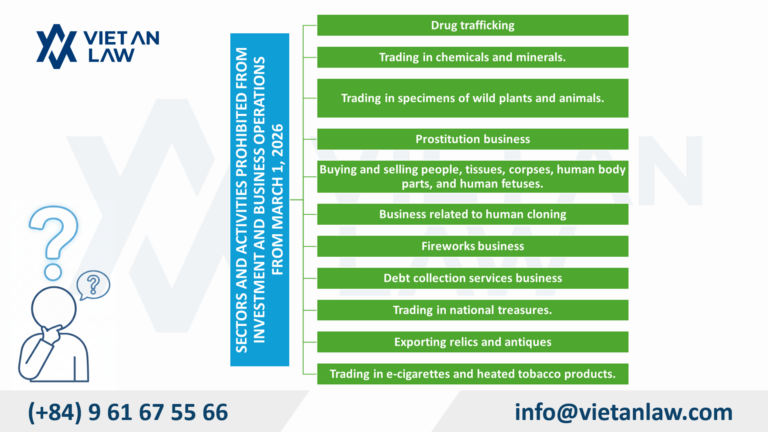
Accordingly, Article 6 of the 2025 Investment Law stipulates the following sectors and professions prohibited from investment and business activities from March 1, 2026:
The following business and investment activities are prohibited:
Trading in narcotic substances as specified in Appendix I issued with the 2025 Investment Law;
Trading in chemicals and minerals as specified in Appendix II issued with the 2025 Investment Law;
Trading in specimens of wild plants and animals originating from natural exploitation as stipulated in Appendix I of the Convention on International Trade in Endangered Species of Wild Plants and Animals; specimens of endangered, rare, and precious forest plants, forest animals, and aquatic species of Group I originating from natural exploitation as stipulated in Appendix III issued with the 2025 Investment Law;
Prostitution business;
Buying and selling people, tissues, corpses, human body parts, and human fetuses;
Business activities related to human cloning;
Trading in firecrackers;
Debt collection services business;
The business of buying and selling national treasures;
Exporting relics and antiques;
Business in e-cigarettes and heated tobacco products.
Thus, the new regulations have officially banned the business of e-cigarettes and heated tobacco products. With this provision, the National Assembly has tasked the Government with regulating the handling of investment projects for the production of electronic devices for e-cigarettes and heated tobacco products in Vietnam solely for export, which have been registered or approved in writing by competent State agencies in accordance with the law before January 1, 2025.
The above is an update on the legal shift: abolishing 38 conditional business lines in Vietnam 2026. For any related questions or to request advice on business licenses, please contact Viet An Law Firm for the best consultation and support!
Fast & Reliable Legal Assistance
Fill out the form below and get connected with a lawyer quickly.
Learn the 2026 cases of work permit revocation Vietnam under Decree 219/2025: contract termination, incorrect job roles, fake documents, and enterprise closure. Essential guide for FDI compliance.
Whether foreigners working remotely in Vietnam need a work permit depends on the nature of their work, their duration of residence, and their labor relationship with entities in Vietnam. In…
Official work permit application form 2026 (Form No. 01) under Decree 219/2025/ND-CP for Vietnam. Download template, filling instructions, and avoid common mistakes.
Legal services for foreigners in Vietnam: visas, work permits, TRC, FDI company setup, marriage, contracts & dispute resolution. 20 years experience, transparent costs.
Expert service to change outward investment certificate in Vietnam under Law on Investment 2025. Handle offshore investment adjustments, forex registration & Ministry of Finance procedures efficiently.