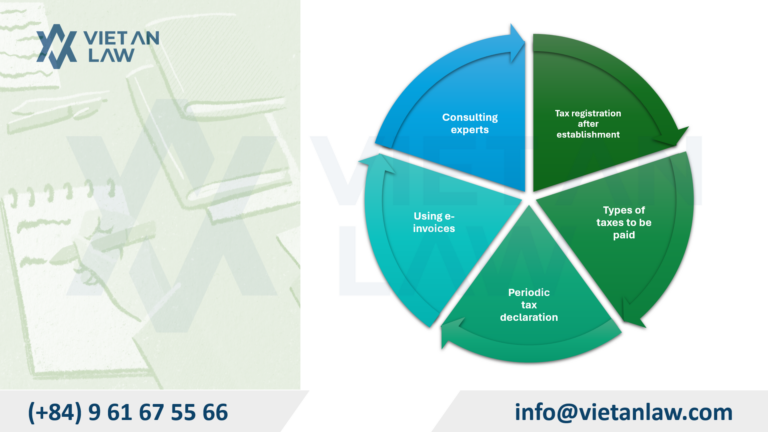
Establishing a company is an important step to officially begin business operations. However, besides preparing legal documents, choosing an organizational structure, and building a business plan, tax obligations are also a factor that cannot be overlooked. A clear understanding of the types of taxes to be paid, declaration methods, and payment deadlines will help businesses avoid errors, penalties, and maintain legal credibility. Particularly for a Limited Liability Company (LLC), a popular enterprise model in Vietnam, understanding tax regulations from the beginning will help the operational process be efficient and compliant with the law. Below are 5 Tax Facts Before Starting a Company in Vietnam for new businesses.
Table of contents
Hide
Tax Registration and Related Information Immediately Following Establishment
After completing the business registration procedures and being issued the Business Registration Certificate (BRC), a Limited Liability Company (LLC) must conduct its initial tax registration with the direct managing tax authority. This is the first crucial step in the process of complying with tax laws, laying the foundation for all subsequent declaration and payment obligations.
Step 1: Open a bank account and notify the Department of Finance
The enterprise needs to open at least one payment account at a commercial bank under the company’s name.
Afterward, notify the Department of Finance of the bank account via the National Business Registration Portal.
Step 2: Declare and submit the business license tax declaration form
Although immediate payment is no longer required, newly established enterprises still need to submit the business license tax declaration form within 30 days from the date the BRC is issued (or the commencement date stated in the documents).
The declaration is made through the General Department of Taxation’s electronic tax system (https://thuedientu.gdt.gov.vn).
Step 3: Register to use e-invoices
According to current regulations, businesses are required to use e-invoices when selling goods or providing services.
It is necessary to contact an e-invoice provider (approved by the tax authority), sign a contract, and announce the issuance of e-invoices on the tax system.
Step 4: Submit the initial tax registration file (if additional submission is required)
At some local tax sub-departments, businesses need to submit the initial tax registration file either in person or online.
The file may include: the initial tax declaration form, decisions on the appointment of the director and chief accountant, registration of the accounting method, fiscal year, fixed asset depreciation method, signature samples, the company seal, etc.
Step 5: Make the first tax declaration
After completing the above procedures, the business must determine and declare Value Added Tax (VAT) and Personal Income Tax (PIT) according to the correct declaration period (monthly or quarterly).
In cases where no revenue has been generated, the tax declaration form must still be submitted on time to avoid administrative penalties.
Understanding the Types of Taxes Payable After the Company Becomes Operational
Business License Tax
Applicable entities: All enterprises, business households, and production/business organizations are required to pay the business license tax.
Tax rates: Based on the charter capital stated in the Business Registration Certificate:
Over 10 billion VND: 3,000,000 VND/year
10 billion VND or less: 2,000,000 VND/year
First-year exemption: Newly established enterprises (during their first financial year of operation) are exempt from the business license tax for the first year, according to the provisions of Decree No. 22/2020/ND-CP.
Value Added Tax (VAT)
Applicable entities: Most enterprises engaged in selling goods or providing services.
Declaration methods:
Deduction method: Applied to enterprises with an annual revenue of 3 billion VND or more, or those who voluntarily register. The enterprise is entitled to deduct input VAT.
Direct method on revenue: Applied to small enterprises below the revenue threshold that do not meet the conditions for the deduction method.
Common tax rates: 10%, with other rates including 0% (for exports) and 5% (for certain special sectors like agriculture, healthcare, etc.).
Corporate Income Tax (CIT)
Applicable entities: Enterprises that generate profit after deducting reasonable and valid expenses.
Standard tax rate: 20% on taxable income.
Incentives: Certain industries and locations may be eligible for preferential tax rates of 10% or 15%, or tax exemptions and reductions in the initial years.
Enterprises need to accurately determine revenue, expenses, and taxable profit to correctly calculate their CIT liability.
Personal Income Tax (PIT)
Applicable entities: When a company has employees (including the director as the legal representative who receives a salary), the enterprise is responsible for withholding and declaring PIT on a monthly/quarterly basis.
Payable amount: Depends on the employee’s income after allowances are deducted (e.g., family circumstance relief, insurance…).
Enterprises must declare fully and pay on schedule to avoid violations.
Other taxes and fees (if any)
Depending on the industry, location, and operational activities, an enterprise may be subject to other taxes and fees, such as:
Natural resources tax, environmental protection tax: For mining and production industries with environmental impacts.
Environmental protection fees for wastewater and emissions.
Fees for using infrastructure in industrial parks and export processing zones.
Product declaration fees, quarantine fees (for the food and medical sectors).
Declare Taxes Periodically and On Time to Avoid Penalties
Enterprises must adhere to the deadlines for declaring and paying taxes:
Type of declaration
Deadline
Method of declaration
VAT, PIT (monthly/quarterly)
Before the 20th of the following month
Electronically via the tax system
Annual tax finalization
Before March 31st of the following year
Electronically via the tax system
Annual financial statements
Before March 31st of the following year
Submit to the tax authority and the business registration office
Mandatory Use of E-invoices
Currently, 100% of businesses are required to use e-invoices, specifically:
Register for the issuance of e-invoices on the General Department of Taxation’s portal;
Select an e-invoice software provider that has a digital signature (token) and a system connected to the tax authority;
Carefully check the seller’s and buyer’s information, tax code, goods, and invoice symbol before issuance.
Practical note: Many new businesses that have not yet generated revenue still need to register for e-invoices to avoid being classified as high-risk by the tax authority and subject to sudden inspections.
It is advisable to consult with experts or a tax consulting firm
To mitigate risks and ensure compliance with regulations, collaborating with a tax expert or a professional accounting and tax consulting firm is a necessary strategic decision, especially in the early startup phase. Specifically, consulting with experts offers the following benefits:
Avoiding errors in tax declaration, payment, and finalization
Saving time and effort in handling administrative procedures
Advising on legal tax optimization methods
Assisting in resolving issues that arise with the tax authority
Accurately updating on new tax policies
Frequently Asked Questions:
Do businesses with no revenue need to declare taxes?
→ Yes. Even if a business has no business operations, no revenue, or no incurred expenses, it must still fulfill its periodic tax declaration obligations as required by law.
Specifically, you must submit a tax declaration form with the figures marked as “0” (no activity). Failure to declare, even when no tax is generated, can still result in administrative penalties for “not submitting the declaration on time.” This ensures transparency and allows the tax authority to monitor the business’s operational status.
If a company has no employees, does it have to pay Personal Income Tax (PIT)?
→ No. If the company does not make any salary or wage payments to any individual, it does not have to pay PIT.
However, you must still declare PIT monthly or quarterly (depending on the business’s scale), noting that there was “no activity.” This is a mandatory declaration duty. Failure to declare, even with no tax generated, can also result in penalties for violation.
If I haven’t issued any invoices, do I still need to register for e-invoices?
→ Yes. According to current regulations in Decree 123/2020/ND-CP and Circular 78/2021/TT-BTC, all businesses must register to use e-invoices immediately after being issued a tax code and before issuing their first invoice.
Not having any sales activities or not yet issuing invoices does not exempt a business from the obligation to register for e-invoices. When a transaction occurs, the business is only permitted to issue e-invoices that have been accepted by the tax authority. Without registration, the business cannot legally issue invoices.
The above is some advice from Viet An Law on the 5 Tax Facts Before Starting a Company in Vietnam. If you have any questions about this service or other legal issues related to tax, please contact us immediately for timely support.
Fast & Reliable Legal Assistance
Fill out the form below and get connected with a lawyer quickly.
Learn how to start a sporting goods business in Vietnam with our complete guide. Covers business registration, legal requirements, capital needs, and company formation procedures.
Change Business Registration in Saigon Ward, HCMC guide. Complete procedures, required documents, timelines, and online submission process for enterprises in 2025.
Hai Phong City merger 2025 guide: Complete information on business registration, company formation procedures, and administrative updates after the merger with Hai Duong province.
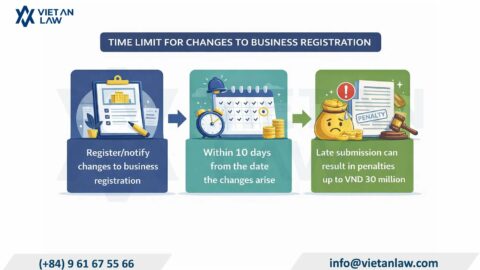
Enterprise Registration Change in Xuan Hoa Ward, HCMC guide for 2026. Learn mandatory procedures, 10-day deadlines, online filing requirements, and avoid penalties up to 30M VND.
Landscape company establishment business lines in Vietnam: Complete guide on required business codes, conditions, procedures, and registration steps for 2025.