


Moving into 2026, the deployment of facial recognition attendance cameras is no longer merely an HR technology matter. This has become a significant legal risk within the landscape of workplace surveillance in Vietnam for businesses that overlook privacy rights. With the Vietnam Personal Data Protection Law 2025 (effective January 1, 2026) and the stringent sanctions under Decree No. 330/2026/ND-CP, businesses that collect employee images without authorization may face fines of up to tens of millions of VND, or even penalties calculated as a percentage of revenue. This article helps businesses understand the legal boundaries and how to deploy workplace CCTV and facial recognition systems in compliance with employee personal data protection requirements.
CCTV and facial recognition at work: data protection rules in Vietnam 2026
Benefits for optimizing HR management
Applying AI camera systems to access management and control brings practical improvements to business operations:
- Complete elimination of buddy punching: Direct scanning of biometric characteristics fully closes traditional loopholes for fraud, such as borrowing access cards or asking colleagues to clock in on one’s behalf by fingerprint.
- Automated payroll: Facial recognition data is synchronized instantly with HR software, creating a closed-loop process that ensures accurate reconciliation of working hours, minimizes manual errors and saves time for the HR department.
- Effective security monitoring: The system serves as a proactive layer of protection, analyzing behavior in context and issuing instant alerts upon detecting strangers (Unknown Detection) or unauthorized individuals entering internal areas.
Risks of infringing employee privacy
At the same time, this technological shift poses serious challenges to the security of personal information:
- Risk of data leaks and deepfake fraud: Unlike access cards or passwords, which can be changed, biometric characteristics are permanent identifiers. If a company’s database is breached and leaked, cybercriminals may use AI algorithms to generate hyper-realistic deepfake images and videos to impersonate employees for financial fraud or to bypass other security systems.
- Sensitive nature of the data: Facial images constitute highly sensitive biometric personal data and are subject to strict legal protection. This differs fundamentally from conventional security cameras, which merely recorded wide-angle footage and tracked pixel movement without extracting or digitizing individual identities. Compelling employees to provide such data requires the business’s server infrastructure to meet extremely rigorous security standards in order to avoid privacy violations.
Legal updates on workplace CCTV monitoring and employee personal data protection in Vietnam 2026
The enactment of the Vietnam Personal Data Protection Law 2025 (officially effective from January 1, 2026) marks a significant turning point in tightening the legal framework governing the collection and processing of biometric data in the workplace. Businesses deploying CCTV and facial recognition attendance systems must strictly comply with its core provisions, particularly the legal requirements under Article 25 and Article 32:
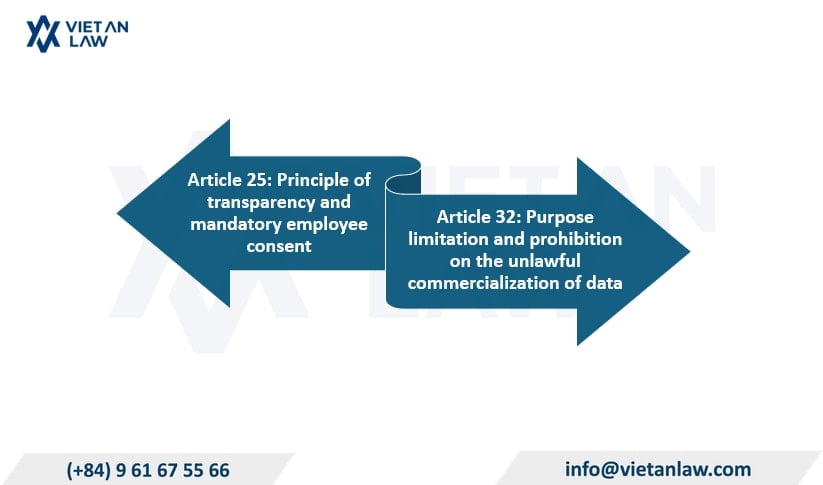
- Article 25: Principle of transparency and mandatory employee consent
- Right to be informed: Businesses must under no circumstances install facial recognition cameras covertly or surreptitiously put them into operation under the guise of ordinary security cameras. Employees must be clearly and transparently notified in writing of the installation locations, the type of data collected (facial biometric data), how the system operates and the data retention period.
- Voluntary consent: Facial data may only be collected with the employee’s voluntary, explicit and demonstrable consent.
- Article 32: Purpose limitation and prohibition on the unlawful commercialization of data
- Use strictly for the stated purpose: Biometric data collected through AI camera systems may only be used for the purposes initially notified to employees by the business (namely, internal security monitoring and the reconciliation of attendance and payroll data). Any unilateral expansion of the purpose of use (for example, using AI cameras to assess employees’ work attitude or emotions, or to measure individual performance in an excessive manner) without additional consent is deemed a violation of the law.
- Privacy protection and prohibition of profiteering: The Law places particular emphasis on the confidentiality obligations of the data controller. Employees’ facial data must under no circumstances be shared, transferred or sold to any third party (such as advertising companies, technology partners or data brokers).
Comparison table: management of facial recognition attendance systems before and after 2026
| Criteria | Before 2026 | After 2026 |
| Employee consent | Not expressly required; typically limited to a general notice. | Clear notice of the purpose and scope, together with employee consent, is mandatory (Article 25). |
| Retention of facial data | Retained indefinitely on attendance devices/servers. | Biometric data must be deleted as soon as the employee leaves the company. |
| Security and access control | Loosely managed; camera viewing rights widely shared. | Encryption is mandatory and administrator access is restricted. Data leaks may result in criminal prosecution or severe administrative penalties. |
| Penalties for violations (organizations) | Sanctions did not comprehensively cover the field of personal data. | Decree No. 330/2026/ND-CP applies: heavy fines, confiscation of the means used to commit the violation, mandatory data deletion, and fines of up to 5% of revenue. |
Stringent penalties under Decree No. 330/2026/ND-CP in Vietnam
- Heightened penalty framework: Decree No. 330/2026/ND-CP establishes more stringent administrative sanctions to deter organizations and businesses that violate regulations on cybersecurity and personal data protection. Collecting, storing and processing data for improper purposes or without adequate protective measures are all subject to new fines that are significantly higher than those under previous regulations.
- Organizational responsibility: Businesses are required to upgrade their security systems and data governance processes. Regulatory authorities will conduct inspections and directly sanction legal entities that fail to meet basic information security standards.
Risks in processing employee biometric data and HR management
- Fines of up to 5% of revenue: For serious violations, particularly those involving sensitive personal data, organizations may face substantial fines of up to 5% of their total revenue in the preceding fiscal year.
- Suspension of system operations: In addition to fines, competent authorities may impose additional penalties, including the revocation of the right to use licenses or the suspension of information systems and data processing systems for one to three months, disrupting the business’s entire operations.
- Data leaks and failure to delete former employees’ data: The highest legal risk lies in the management of employee biometric data (such as fingerprints, facial recognition data and iris scans). A business’s leakage of such information, or its failure to thoroughly delete employees’ biometric data after they leave, constitutes a particularly serious violation, triggering the immediate application of the highest penalty brackets together with accompanying suspension measures.
The 4-step checklist for lawful workplace CCTV monitoring in Vietnam
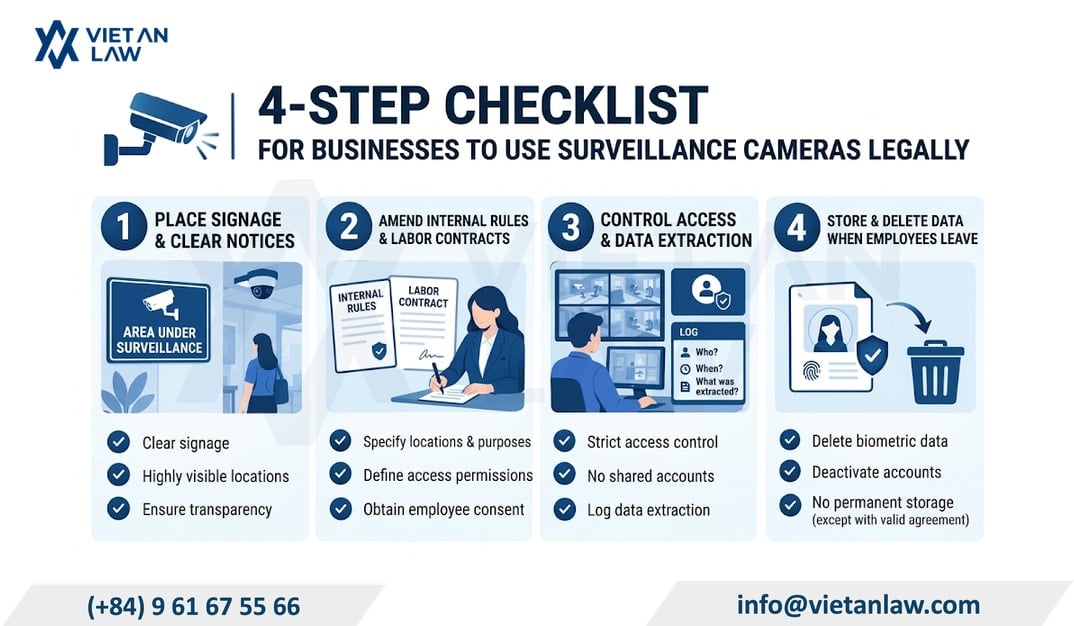
Post signage and provide clear notice
- Signs reading “CCTV in Operation” must be posted in clearly visible locations before individuals enter the recording area. This ensures transparency and upholds the right of employees and customers to be informed that their images are being collected.
Amend internal labor regulations and employment contracts
- Businesses should set out in their internal labor regulations detailed provisions on camera installation locations, purposes of use, and the persons authorized to access the footage.
- A procedure must be in place for employees to sign a written agreement or give direct consent (in writing or electronically) permitting the business to monitor and process their personal images in the workplace.
Control data access and extraction
- Enforce strict administrator access rights for the camera system; shared accounts and password sharing among managers are strictly prohibited.
- All data extraction activities (videos, images) must be logged in the system (who extracted the data and when) and carried out solely for the security purposes originally notified.
Data retention and deletion upon employee departure
- Businesses must destroy and completely delete employees’ biometric data (facial and fingerprint data) and deactivate all related accounts immediately upon termination of the employment contract.
- Such personal data must under no circumstances be retained permanently in the system unless another valid legal agreement has been concluded between the parties following the employee’s departure.
Legal advisory for personal data processing service for businesses in Vietnam of Viet An Law
To avoid substantial fines for breaching data protection regulations, while safeguarding their reputation and brand image in the eyes of partners and employees alike, businesses should promptly review their entire process for collecting, storing, and processing employee biometric data. Any gap in this process may lead to serious legal consequences and public relations crises.
Do not let latent legal risks hinder your company’s growth and digital transformation. Explore our article: Legal Advisory Services for Personal Data Processing, delivered by our team of highly qualified lawyers. We will work alongside your business to review contracts, develop internal policies that meet legal standards, and establish an HR data management system in full compliance with State regulations, ensuring safe, transparent and sustainable operations.
The above is Viet An Law’s article on workplace CCTV and Facial recognition: employee data protection requirements. Should you have any questions, please contact Viet An Law for assistance!