


The year 2026 marks a major turning point in the process of labor law compliance in Vietnam, especially for foreign direct investment companies. The simultaneous change of three major systems, i.e. labor, insurance, tax, and then combined with the operation of the national digital data infrastructure has created a dual impact on actual labor costs for foreign-invested companies. Grasping the new regulations promptly is a vital factor to ensure employment law compliance and optimize operational costs. The article below by Viet An Law will analyze in detail the focal legal issues regarding Vietnam labor law compliance 2026: costs and key considerations for FDI companies that businesses need to note.
Summary of labor cost change milestones in Vietnam in 2026
| Timeline | Legal basis | Main impact on FDI personnel costs |
| 2026 tax period | Personal Income Tax Law 109/2025/QH15 |
|
| 01/01/2026 | Employment Law 74/2025/QH15 | Expand subjects of compulsory social insurance. |
| Decree 293/2025/ND-CP |
|
|
| 01/07/2026 | Decree 161/2026/ND-CP |
|
| Decree 337/2025/ND-CP | Operate the national electronic employment contract platform and issue a unique identification ID. |
Legal basis for current Vietnam labor laws in 2026
Based on the foundation of the Labor Code 2019, the new system of documents regulating from 2026 includes the following legal documents:
- Social Insurance Law No. 41/2024/QH15.
- Employment Law No. 74/2025/QH15.
- Personal Income Tax Law No. 109/2025/QH15 (along with Resolution 110/2025/UBTVQH15).
- Important specialized guiding decrees: Decree 158/2025/ND-CP, Decree 274/2025/ND-CP, Decree 293/2025/ND-CP, Decree 337/2025/ND-CP, Decree 374/2025/ND-CP, Decree 219/2025/ND-CP.
First major change: expanding compulsory insurance subjects in Vietnam
Previously, companies in Vietnam could access workers whose forms of work fell outside the compulsory social insurance regulations, especially in some cases of short-term, part-time employment. However, from 2026, this method has been significantly narrowed, affecting overall employment compliance costs.
- According to the Social Insurance Law 2024 and guiding documents: Compulsory participants now include people working under employment contracts of full 01 month or more, regardless of whether the form of contract conclusion is a service or collaborator contract; and applies concurrently to individuals who are business household heads with business registration.
- According to Article 31 of the Employment Law 2025: Correspondingly expand the subjects participating in unemployment insurance. Specifically, the law clearly stipulates: Contracts with other names but with content showing paid work, salary, and the management, administration, and supervision of one party still belong to the subjects of compulsory insurance participation.
🡪 Legal consequence: Functional agencies will look at the nature of the labor relationship (having management, administration, salary payment) rather than depending on the name of the contract (for example: service contract, collaborator contract).
To understand the exceptions, businesses can refer to the consultancy article of Viet An Law regarding “6 Types of Employment Contracts Exempt from Social Insurance in Vietnam” on our website at: https://vietanlaw.com/6-types-of-employment-contracts-exempt-from-social-insurance-in-vietnam/
Risks of misclassifying labor relationships in Vietnam – the service contract trap
In the initial establishment phase, many FDI companies often sign a “service contract” or “consulting contract” with individuals to reduce insurance costs and simplify procedures. However, as mentioned, the name of the contract will no longer be the deciding factor, replaced instead by the nature of the transaction contract, which is a crucial element of FDI labor compliance from 2026.
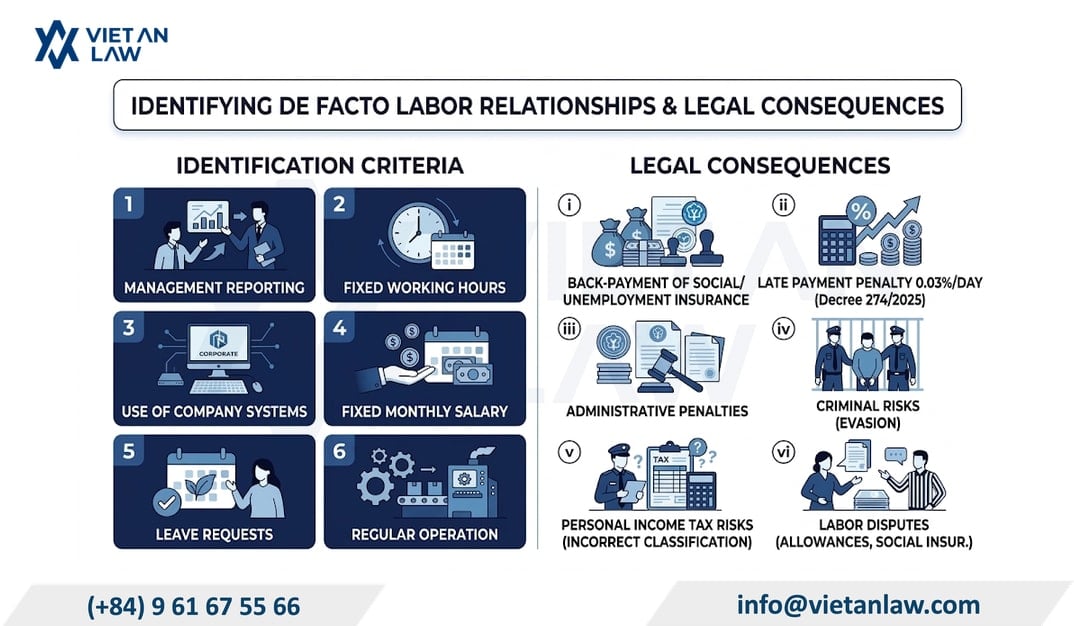
Set of criteria for identifying actual labor relationships (Risk signs):
- The individual must periodically report work to the company management;
- Being bound by fixed working hours (for example: 8 am to 5 pm);
- Using assets, email systems, or working tools provided by the company;
- Receiving remuneration of a fixed, regular monthly nature;
- Having to comply with the company leave request process;
- Undertaking regular, core operational functions of the enterprise.
Legal risk consequences:
- Retrospective collection of the entire unpaid amount of social insurance, unemployment insurance, and health insurance;
- Calculating late payment interest of 0.03% per day according to Decree 274/2025/ND-CP;
- Administrative penalties for violations of labor and insurance laws;
- Facing criminal risks for the crime of evading social insurance, health insurance, and unemployment insurance payments;
- Personal income tax risks (having to recalculate due to the incorrect application of the progressive tax schedule instead of a 10% deduction);
- Potential risk of prolonged labor dispute resolution regarding severance allowance and insurance benefits.
Note from Viet An Law: It is necessary to clearly distinguish late payment (Article 38) from evasion of payment (Article 39) under the Social Insurance Law 2024. The defining boundary is exceeding 60 days from the required payment date according to regulations. Decree 274/2025/ND-CP sets out specific regulations on 04 cases that are not considered evasion, which businesses should understand well to explain when necessary.
Second major change: impact of regional minimum wage increase regulations in Vietnam 2026
Decree 293/2025/ND-CP stipulates the new regional minimum wage levels. The specific increase levels are recorded in the update article: Statutory Minimum Regional Wages in Vietnam – Viet An Law.
Impact of the regional minimum wage increase regulations on corporate costs:
Increase the unemployment insurance contribution ceiling.
Unemployment insurance contribution limit = 20 × Regional minimum wage (Clause 2, Article 34 of the Employment Law 2025).
Thus, when the regional minimum wage increases (for example, Region I up to 5.31 million VND), the unemployment insurance contribution ceiling will increase to 106.2 million VND. High-paying companies (even without personnel receiving the minimum wage) will still incur increased unemployment insurance contribution costs for senior personnel.
Transitional regulations in merged areas: A particularly important point that many manufacturing FDI companies overlook is that if the enterprise is located in an area that has just undergone an administrative unit merger adjustment, causing the new regional minimum wage to be lower than the level being applied at the time of December 31, 2025, the employer is obliged to continue applying the higher old level for employees recruited from December 31, 2025, and earlier. This requires careful attention to labor regulations for FDI companies.
Third major change: From July 1, 2026, Vietnam applies new social insurance and personal income tax ceilings
The second half of 2026 witnesses the second budget fluctuation of the year. Many new regulations taking effect have impacted corporate labor costs, especially for enterprises utilizing many foreign experts and senior managers.
Social insurance and health insurance contribution limit according to the new statutory base wage
According to Decree 161/2026/ND-CP, the statutory base wage has increased to 2.53 million VND, leading to the compulsory social insurance and health insurance contribution ceiling increasing to the level of 50.6 million VND/month (Point d, Clause 1, Article 31 of the Social Insurance Law 2024).
New personal income tax schedule and Resolution 110/2025/UBTVQH15
- The tax schedule under the provisions of the Personal Income Tax Law 2025 is shortened from 7 brackets down to 5 brackets, and the threshold subject to the highest tax rate of 35% is raised to over 100 million VND/month.
- The family deduction level increases to 15.5 million VND (taxpayer) and 6.2 million VND (dependent), making tax accounting services essential for adjusting internal payroll structures accurately.
Fourth major change: digitalization of labor management in Vietnam: regulations and compliance
From 2026, the method of post-inspection regarding labor at enterprises will shift its approach based on a digital data platform.
- Centralized data system: Decree 337/2025/ND-CP and Circular 08/2026/TT-BNV stipulate that the national electronic employment contract platform will issue 01 unique ID code for each employment contract. The contract must be sent to the platform within 24 hours of when the parties complete signing and be stored for 10 years.
- Data interconnection: Employment contract data will be automatically interconnected with the systems of the social insurance agency, the tax agency (for payroll reconciliation and personal income tax finalization), the business registration agency, and the work permit issuance data.
- Shift in control focus: Enterprises can no longer manage personnel, insurance, and tax records in a disjointed manner. The inspection question will shift from questioning if this record is compiled correctly to questioning if the data from the 6 systems match each other.
Guidelines for employment law compliance in Vietnam 2026
Compliance obligations for senior managers and foreign experts in Vietnam
Senior personnel are always the most complex puzzle during corporate law consultancy for the FDI sector due to multinational remuneration structures.
For a foreign director, a legal representative (whether resident or non-resident), and a manager receiving salary from the parent company, the enterprise needs to cross-check the following factors regarding foreign worker compliance in Vietnam:
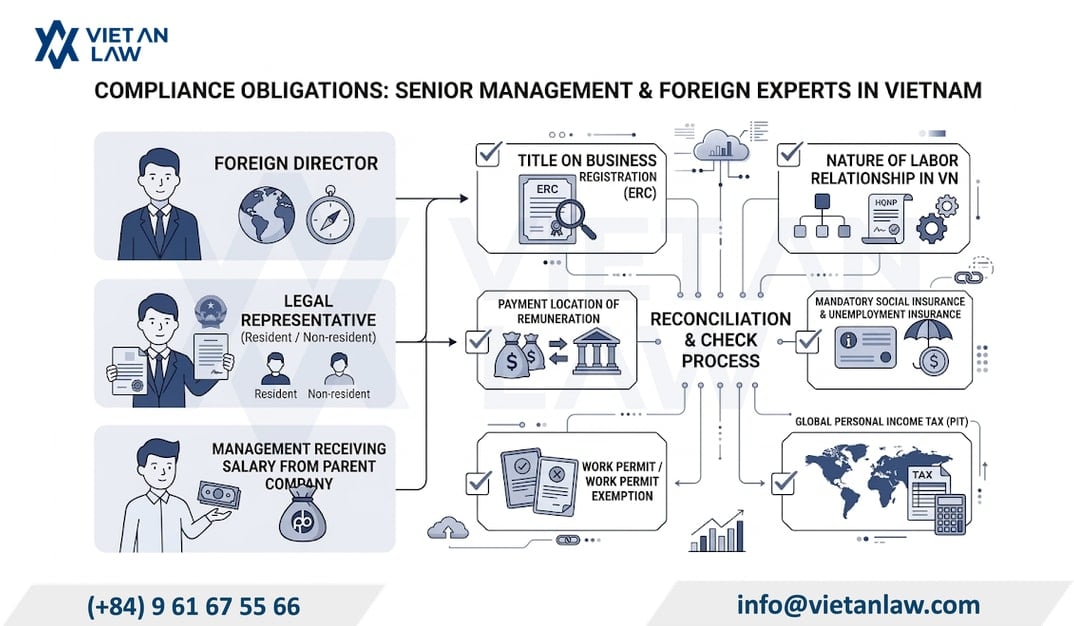
Reviewing net and gross salary levels
The net salary contract is an extremely common method in FDI enterprises. When the regulations on insurance ceilings, family deductions, and tax schedules change simultaneously, enterprises applying net salaries must recalculate the entire payroll process.
There will be two different sets of calculation parameters within the same year of 2026. Therefore, enterprises must urgently review the terms in the employment contracts and offer letters to clearly determine who bears this increased cost portion.
New regulations on work permits in Vietnam
Decree 219/2025/ND-CP (replacing Decree 152/2020 and Decree 70/2023) brings many new points:
- Integrating the step of explaining the demand for using foreign workers directly into the work permit application dossier.
- Shortening the processing time to 10 working days.
- Expanding the scope of work permit exemption for experts working under 90 days/year, but tightening the regulation of requiring advance notice of at least 03 working days.
- Strictly regulating the requirement of 03 years of experience for the chief executive officer position.
- Making online dossier submission mandatory.
Labor compliance in M&A activities and project due diligence in Vietnam
In the context of FDI capital flows shifting through M&A transactions, labor risks at the target company can pose major risks to the entire transaction.
The responsibility to pay the past insurance debts of the employees of the target company will be pushed to the buyer if thorough due diligence is not conducted.
Therefore, the buyer needs to inspect the following crucial contents:
- The ratio of registered employment contracts and social insurance participation compared to actual usage.
- The nature of the independent contractor/individual consulting contract group.
- The exact matching among the actually paid payroll, the personal income tax declaration data, and the salary base for social insurance contributions.
- The legality of the management team and foreign experts (work permits).
- Compliance with the regional minimum wage across the years.
- Specific quantification of outstanding labor financial obligations.
Risk handling in the sale and purchase agreement (SPA): designing tight binding clauses, for example: making the remediation of insurance debt a Conditions Precedent clause before the Closing Date; establishing an Escrow / Holdback fund to offset risks; and requiring Reps / Warranties along with a specific compensation mechanism.
Labor compliance review roadmap – recommendations from Viet An Law
To proactively adapt to the labor law changes from 2026, the tax accounting services and internal legal departments of FDI enterprises need to immediately implement a 5-step process:
- Step 1: Compile a comprehensive list of all individuals currently providing labor for the enterprise (including personnel on the payroll and the group of collaborators, individual contractors, and seconded experts).
- Step 2: Evaluate the nature of the legal relationship for each atypical group based on the criteria for identifying actual labor relationships.
- Step 3: Conduct a cross-check of 06 sets of records: Contracts – Payroll – Personal income tax finalization – Social insurance records – Enterprise registration – Work permits.
- Step 4: Quantify in numbers the outstanding financial obligations in the past and project the labor budget costs in 2026 based on the 2 main change milestones (01/01 and 01/07).
- Step 5: Prepare a dossier to rectify errors. Note: The review minutes, remediation plan, and supplementary submission documents are extremely important legal documents proving goodwill in compliance, helping to mitigate aggravating factors during inspections.
Frequently asked questions when consulting on labor laws in Vietnam
Does our company have to pay social insurance when signing a collaborator contract paying a monthly fixed-task remuneration?
According to the new regulations, if the collaborator contract contains content showing regular payment and that individual is subject to the management, administration, and supervision of the company (such as regulating working hours, reporting progress), the nature of this relationship will be determined by functional agencies as a labor relationship, leading to compulsory participation in social insurance and unemployment insurance.
When is the national electronic employment contract platform mandatory for all enterprises?
According to the roadmap, the system will go into operation from July 1, 2026. However, actual implementation will need further monitoring. Enterprises need to prepare digital signature infrastructure and internal processes to ensure the capability for automatic reporting and synchronization of employment contracts to the state system within 24 hours.
How does an FDI company director paid by the parent company abroad declare personal income tax in Vietnam?
This individual must determine their residence status in Vietnam. If they are a resident individual, income from the parent company abroad (arising due to executive work in Vietnam or globally) must all be aggregated to declare and pay personal income tax in Vietnam, unless otherwise stipulated in the agreement on the avoidance of double taxation.
Why choose the labor compliance review service at Viet An Law?
As regulations on labor, insurance, and tax intersect increasingly complexly, enterprises need a consulting unit with a comprehensive vision. The services of Viet An Law bring outstanding advantages:
- Interdisciplinary capacity: A team of experts seamlessly combining labor lawyers and tax accounting service experts, ensuring all legal and financial risks are synchronously separated.
- Understanding FDI characteristics: Experience in handling the complex remuneration structure of foreign experts, work permit issues, and employment contracts.
- Early prevention: Establishing internal control mechanisms, helping enterprises create a standard source of personnel record data, and passing interdisciplinary inspections most safely.
The Vietnamese labor market in 2026 is transforming strongly towards transparency, professionalism, and digitalization. Proactively reviewing and establishing an internal compliance system before management agencies conduct inspections is the best corporate protection strategy. Contact Viet An Law to receive an in-depth legal labor review service, accompanying FDI enterprises to develop sustainably and manage the full scope of Vietnam employment law compliance in 2026: costs and key considerations for FDI companies.