


(from 10/9/2026)
The upcoming enforcement of Decree 283/2026/ND-CP brings critical updates to the penalties for violations of working hours and rest periods in Vietnam 2026, making it essential for employers and human resources departments to take immediate note. Accordingly, enterprises must review their arrangements for working hours, rest periods, overtime, and annual leave to ensure compliance with the law, thereby limiting the risk of committing labor law violations on working time and incurring administrative sanctions. To navigate these changes, reviewing every labor contract and collective labor agreement is highly recommended, and seeking professional labor law consultancy can provide proactive protection.
What are working hours and rest periods in Vietnam?
- Working hours are understood as the period during which an employee must perform their labor obligations within the employment relationship based on the provisions of the law.
- Rest periods are understood as the period during which an employee is not required to perform their labor obligations within the employment relationship in accordance with the provisions of the law, a labor contract, or a collective labor agreement.
Accordingly, working hours are regulated with maximum limits, while rest periods are regulated with minimum limits.
Working hours under the Vietnamese Labor Code 2019
Working hours are stipulated in Section 1, Chapter VII of the Labor Code 2019 as follows:
Normal working hours
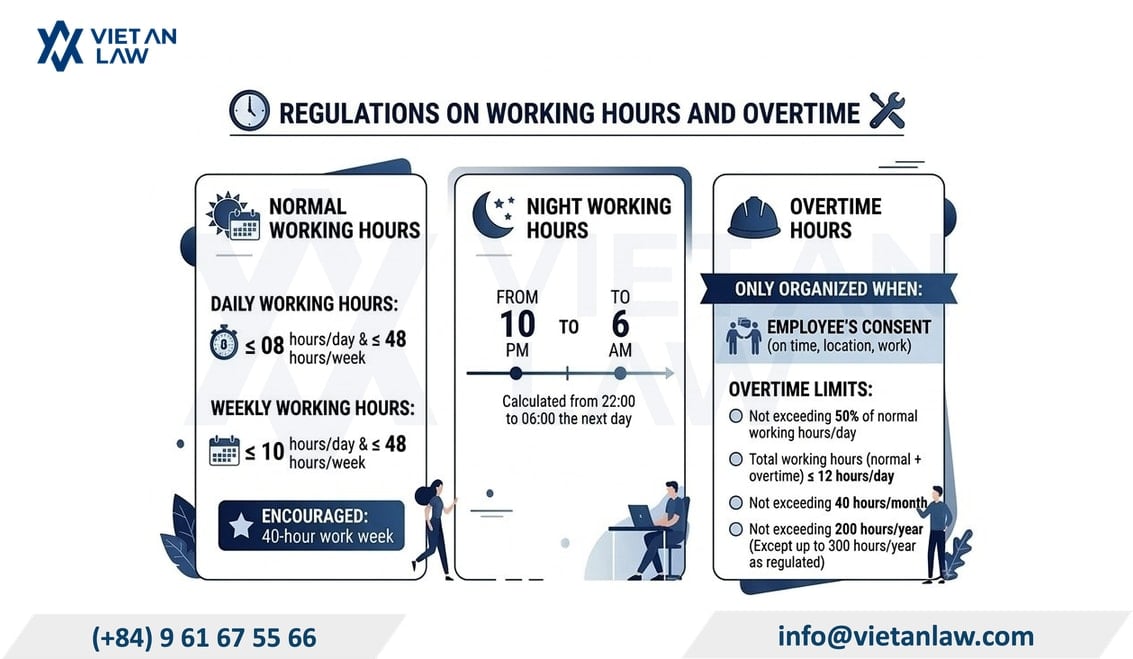
- Working by day: Not exceeding 08 hours per day and 48 hours per week.
- Working by week: Not exceeding 10 hours per day and 48 hours per week.
- The state encourages employers to apply a 40-hour work week.
Night working hours
Night working hours are counted from 22:00 to 06:00 the following morning.
Overtime working hours
An employer may utilize employees to work overtime when fully meeting the following requirements:
- The employer may only organize overtime work when satisfying legal conditions, which must include the employee’s consent regarding the overtime hours, location, and nature of the work.
- Overtime hours must strictly observe the following limits:
- Not exceeding 50% of normal working hours in one day;
- The total of normal working hours and overtime hours not exceeding 12 hours/day;
- Not exceeding 40 hours/month;
- Not exceeding 200 hours/year, except for certain cases where up to 300 overtime hours per year are permitted by law, such as: manufacturing and processing of textiles, garments, leather, shoes, electrical and electronic products for export; processing of agricultural, forestry, salt, and aquatic products; generation and supply of electricity, telecommunications, oil refining; water supply and drainage; and other specified sectors.
Rest periods under the Vietnamese Labor Code 2019
Rest periods are prescribed in Section 2, Chapter VII of the Labor Code 2019 as follows:
Rest breaks during working hours
An employee working 06 hours or more in a day is entitled to a continuous rest break of at least 30 minutes.
If working at night, they are entitled to a continuous rest break of at least 45 minutes.
Rest breaks between shifts
An employee working in shifts is entitled to a rest break of at least 12 hours before transitioning to another shift.
Weekly rest
Every week, an employee is entitled to a continuous rest break of at least 24 hours. In special cases where the labor cycle makes weekly rest impossible, the employer is responsible for ensuring that the employee receives an average of at least 04 days of rest per month.
Public holidays and new year holidays
- New Year Holiday: 01 day (the 1st of January of the solar calendar);
- Lunar New Year Holiday: 05 days;
- Victory Day: 01 day (the 30th of April of the solar calendar);
- International Labor Day: 01 day (the 1st of May of the solar calendar);
- National Day: 02 days (the 2nd of September of the solar calendar and 01 adjacent day before or after);
- Hung Kings Commemoration Day: 01 day (the 10th of March of the lunar calendar).
Annual leave
An employee who has worked for a full 12 months for an employer is entitled to annual leave with full pay as stipulated in the labor contract as follows:
- 12 working days for employees working under normal conditions;
- 14 working days for minor employees, employees with disabilities, and individuals doing heavy, hazardous, or dangerous work or occupations;
- 16 working days for individuals doing especially heavy, hazardous, or dangerous work or occupations.
For employees who have worked for an employer for less than 12 months, the number of annual leave days is proportionate to the number of months worked.
Increased annual leave based on seniority
For every 05 full years of working for one employer, the employee’s number of annual leave days shall be correspondingly increased by 01 day.
Personal leave and unpaid leave
An employee is entitled to take personal leave with full pay while being obligated to notify the employer in the following cases:
- Marriage: 03 days off;
- Biological child or adopted child marrying: 01 day off;
- Death of a biological father, biological mother, adoptive father, adoptive mother; biological father, biological mother, adoptive father, adoptive mother of the spouse; spouse; biological child, or adopted child: 03 days off.
An employee is entitled to take 01 day of unpaid leave and must notify the employer upon the death of a paternal grandfather, paternal grandmother, maternal grandfather, maternal grandmother, or biological sibling; or the marriage of a father, mother, or biological sibling.
An employee may negotiate with the employer to take additional unpaid leave.
Penalties for violations of working hours and rest periods in Vietnam from September 10, 2026
From September 10, 2026, the penalties for working hours violations and rest period infractions will be applied according to the new provisions in Article 24 of Decree 283/2026/ND-CP. Compared to Article 18 of Decree 12/2022/ND-CP, the fine levels for each basic group of violations remain unchanged; the notable point is the regulation concerning the competent authority to receive notifications when an employer organizes overtime work of over 200 hours to 300 hours in a year, which has been shifted from the Department of Labor, War Invalids and Social Affairs to the Department of Home Affairs. Specifically:
| Content of violation | Fine level |
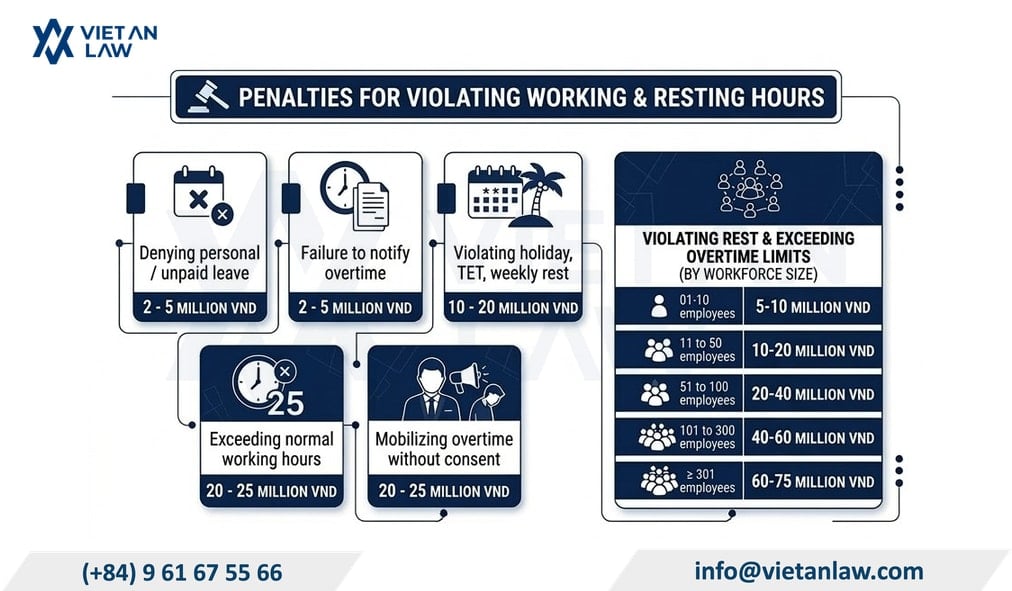
| Failing to ensure employees can take personal leave or unpaid leave | 2 – 5 million VND |
| Failing to notify in writing regarding the organization of overtime work from over 200 hours to 300 hours per year | 2 – 5 million VND |
| Violating regulations on weekly rest, annual leave, public holidays, and New Year holidays | 10 – 20 million VND |
| Implementing normal working hours that exceed the legally prescribed number of hours | 20 – 25 million VND |
| Mobilizing employees to work overtime without their consent, except in cases under Article 108 of the Labor Code | 20 – 25 million VND |
| Failing to ensure rest breaks during working hours or rest breaks between shifts; mobilizing overtime work exceeding the prescribed hours: | (See applicable tiers below) |
| – Violation involving from 01 to 10 employees | 5 – 10 million VND |
| – Violation involving from 11 to 50 employees | 10 – 20 million VND |
| – Violation involving from 51 to 100 employees | 20 – 40 million VND |
| – Violation involving from 101 to 300 employees | 40 – 60 million VND |
| – Violation involving 301 employees or more | 60 – 75 million VND |
Note: The above monetary fines are the penalty levels applicable to individuals. For enterprises, the penalty level is equal to twice the monetary fine applicable to individuals.
Therefore, an enterprise committing working time violation penalties from September 10, 2026, could face fines of up to 150 million VND.
Five issues enterprises must note regarding working hours and rest periods in Vietnam
To limit the risk of being penalized when Decree 283/2026/ND-CP takes effect on September 10, 2026, employers and human resources departments should proactively review all procedures for managing working hours and rest periods, paying special attention to the following issues:
Ensuring work schedules do not exceed normal working hours
Enterprises need to inspect how shifts, crews, and actual work schedules of employees are arranged to ensure they do not exceed the normal working hours in accordance with working hours and rest periods regulations under the law.
Complying precisely with the registration and approval process for overtime work
The organization of overtime work must be implemented in exact accordance with the conditions, procedures, and limits on overtime duration. Enterprises should establish a clear procedure from the proposal and approval stages to the recording of overtime hours to avoid fines for overtime violations.
Ensuring complete records demonstrating employee consent when working overtime
This is a matter that requires special attention because mobilizing employees to work overtime without their consent, except in cases permitted by law, can result in administrative sanctions. Therefore, enterprises must retain complete documents and records proving the consent of the employees.
Arranging full and compliant weekly rest, annual leave, public holidays, and New Year holidays
Enterprises must review leave schedules and the actual arrangement of days off for employees, ensuring the right to weekly rest, annual leave, and public and New Year holidays in accordance with the law.
Accurately determining the working time to calculate annual leave days
When determining the working time to calculate the number of annual leave days, enterprises must check to ensure they do not omit periods that the law stipulates as working time for the purpose of calculating annual leave days.
A single error in shift scheduling, recording overtime, managing days off, or determining annual leave can trigger legal risks and the threat of penalties for working hours violations for the enterprise. Therefore, the human resources department should proactively review the timekeeping, approval, and management processes for overtime work, as well as the arrangement of days off and the calculation of annual leave before Decree 283/2026/ND-CP comes into effect on 10/9/2026.
Frequently Asked Questions
Which time periods are still counted to determine annual leave days?
According to Article 65 of Decree 145/2020/ND-CP, several of the following periods are still considered working time for calculating annual leave days:
- Vocational training and apprenticeship time if the employee subsequently works for the employer;
- Probationary time if the employee continues to work after probation;
- Personal leave with pay as prescribed;
- Unpaid leave agreed to by the employer, cumulative up to 01 month per year;
- Leave due to occupational accidents or occupational diseases, cumulative up to 06 months;
- Sick leave, cumulative up to 02 months per year;
- Maternity leave periods;
- Time spent performing duties of the grassroots-level employee representative organization that the law counts as working time;
- Time of work suspension or leave not due to the fault of the employee;
- Time the employee is temporarily suspended from work but subsequently concluded to have not violated regulations or not subjected to disciplinary action; and other similar periods.
Are employees entitled to monetary payment if they have not taken all their annual leave?
According to Clause 3, Article 113 of the Labor Code 2019, in cases where an employee resigns or loses their job without having taken annual leave or without having fully utilized their annual leave days, the employer shall pay their salary for the untaken days. Therefore, not every instance where an employee has remaining annual leave automatically qualifies for conversion into monetary payment; it must be assessed correctly against the cases prescribed by law.
Are employees entitled to increased annual leave days based on seniority?
Yes. According to Article 114 of the Labor Code 2019, for every 05 full years of working for one employer, the employee’s number of annual leave days shall be correspondingly increased by 01 day. Enterprises must calculate all regulated working time to guarantee the accurate determination of the number of annual leave days the employee is entitled to enjoy.
Are employees entitled to compensatory rest if a weekly rest day coincides with a public or New Year holiday?
Yes. According to Clause 3, Article 111 of the Labor Code 2019, if a weekly rest day falls on a public or New Year holiday, the employee is entitled to take a compensatory weekly rest day on the following working day. Enterprises must pay attention to working hours and rest periods regulations when building work schedules and holiday leave schedules for employees.
The above is an update on the penalties for violations of working hours and rest periods in Vietnam 2026. Viet An Law always accompanies and supports enterprises through labor law consultancy, as well as in drafting a employment contract, internal labor regulations, a collective labor agreement, working and overtime management procedures, and human resources policies suitable for current legal regulations!