


A personal data breach is a risk businesses must pay particular attention to when collecting, storing and using information about clients, employees and partners. A single incident may lead to data loss, exposure of sensitive information, complaints, financial damage and legal liability. In 2026, businesses need to proactively build procedures for detecting, containing, notifying and remedying incidents in accordance with the Vietnam Law on Personal Data Protection 2025 and its guiding documents. Preparing a response procedure in advance helps businesses limit damage and ensure legal compliance. This article, “Personal data breach response in Vietnam: a practical guide for businesses”, by Viet An Law Firm will help clients better understand personal data breach in Vietnam: response procedures, legal duties and practical steps.
What is a personal data breach? Common situations businesses in Vietnam face
A personal data breach is a situation in which personal data is disclosed, accessed, used, copied or disseminated without authorisation, or is lost due to technical incidents, human error or deliberate attacks.
In business operations, data breaches may occur in many forms:
- Exposure of client information: Client lists, phone numbers, addresses and transaction histories are disseminated.
- Exposure of HR data: Employee records, salary information, bank accounts or health data are accessed without authorisation.
- Cyberattacks: Hackers break into client management systems, servers or internal databases.
- Misdirected information: Employees send emails, payslips or files containing personal data to the wrong recipients.
- Third-party incidents: Software providers, cloud storage providers or data processing partners fail to ensure information security.
Businesses should note that not all incidents originate from hackers. Inappropriate access rights, weak passwords or uncontrolled data sharing can also lead to violations.
Personal data breach in Vietnam: response procedures in 7 steps
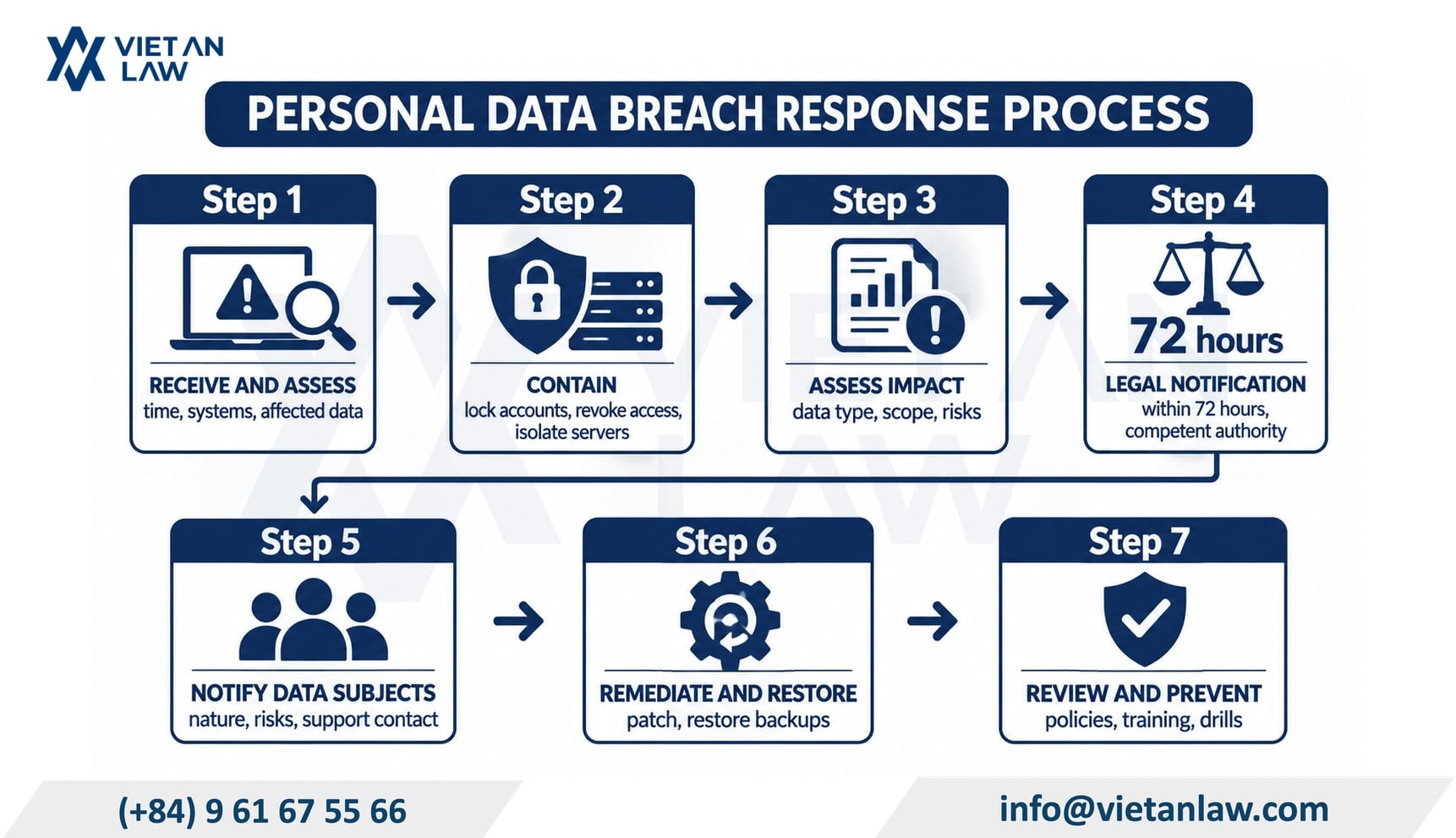
As set out in “Personal data breach response in Vietnam: a practical guide for businesses”, when a personal data breach is discovered or suspected, businesses need to implement personal data breach response procedures immediately, while controlling the technical incident and determining their legal obligations.
Step 1: Receive information and make a preliminary assessment of the incident
Businesses should record the time of detection, the systems involved, the types of data at risk, the source of detection and any unusual signs.
The information should be forwarded to the IT department, the legal department, the unit in charge of personal data protection and the person authorised to handle the incident.
At this stage, businesses should prepare a written record of the incident and preserve system logs and related evidence. Containment should not be delayed simply because the full cause has not yet been identified.
Step 2: Contain and stop the data breach
The goal is to prevent data from being further accessed, copied or disseminated. Businesses may:
- Lock accounts showing signs of intrusion;
- Revoke unauthorised access and change authentication credentials;
- Isolate affected servers or devices when necessary;
- Suspend data-sharing flows that may continue to cause leaks;
- Coordinate with technology providers to control the incident.
These measures should be implemented in a controlled manner to avoid losing evidence needed for investigation and determination of liability.
Step 3: Assess the scope and level of impact
After controlling the immediate risk, businesses need to determine which data has been affected, the number of individuals involved and the possible consequences.
| Criteria | Points to review |
| Type of data | Identification, contact, financial, biometric or sensitive data |
| Scope | Number of individuals, records and systems affected |
| Status | Data viewed, copied, disseminated, modified or lost |
| Cause | Human error, security vulnerability, misconfiguration or cyberattack |
| Risks | Fraud, identity theft, account takeover or financial loss |
| Parties involved | The business, data processors, suppliers and partners |
The assessment results should be documented as the basis for determining remedial measures, notification obligations and the responsibilities of each party.
Step 4: Determine notification and reporting obligations under the law
This is the step where businesses must pay particular attention to data breach legal obligations to avoid violations due to late notification or incorrect procedures.
Under Article 23 of the Law on Personal Data Protection No. 91/2025/QH15, the personal data controller, the personal data controller-processor and third parties, upon discovering a violation that may harm the interests protected by law, must notify the specialised personal data protection agency no later than 72 hours after discovery. Where a personal data processor discovers a violation, it must promptly notify the personal data controller or the personal data controller-processor.
In addition, Decree 356/2025/ND-CP details a number of articles and measures to implement the Law on Personal Data Protection. Businesses should check the specific provisions on types of incidents, obligated entities, and the content and form of notification to comply correctly.
- Businesses should carry out the following tasks:
- Determine the business’s legal role in data processing activities;
- Assess the nature of the violation and the risk of impact on data subjects;
- Identify the receiving authority, deadline and content of notification for the specific case;
- Prepare a dossier describing the incident, the scope of impact and remedial measures;
- Keep evidence of reporting, notification and coordination in handling the incident.
Even if the full scope of the incident has not yet been determined, businesses should proactively assess data breach legal obligations from the moment of discovery rather than waiting for the technical investigation to end before considering notification.
Step 5: Notify and support affected data subjects
Where required by law or where measures are needed to protect the rights of affected persons, businesses should provide clear and accurate notice of the incident.
The content of a personal data breach notification may include:
- The nature of the incident and the time of detection;
- The groups of data likely to be affected;
- Risks to the rights and interests of individuals;
- Measures the business has taken;
- Guidance on protecting accounts, monitoring transactions or recognising fraud;
- A contact point for receiving feedback and support requests.
Businesses should not provide unverified information, conceal the incident or claim that the data is completely safe without a basis.
Step 6: Remedy the cause and restore systems
After stopping the incident, businesses need to address the root cause to limit the risk of recurrence. Tasks may include patching security vulnerabilities, updating software, changing authentication credentials, scanning for malware, restoring data from secure backups and assessing system integrity.
If the incident originated from a supplier or data processor, businesses need to coordinate verification, review contracts and determine the responsibilities of each party.
Step 7: Review responsibilities and prevent recurrence
Once the incident is under control, businesses need to reassess their data governance processes, access rights, backup mechanisms and information security monitoring in line with the requirements on personal data protection in Vietnam.
Recommended measures include:
- Reviewing personal data protection policies;
- Updating incident intake and handling procedures;
- Training employees on information security;
- Reviewing contracts with partners and suppliers;
- Completing compliance records, processing logs and related assessment documents;
- Conducting regular incident response drills.
For businesses that do not yet have a procedure or are unsure about their legal obligations, personal data processing legal advice from Viet An Law Firm can help review the responsibilities of the parties, identify compliance requirements and build a response plan suited to actual operations.
Legal bases businesses should note when a personal data breach occurs in Vietnam
Key legal documents businesses should review when building an incident handling procedure include:
| Legal document | Relevant content |
| Law on Personal Data Protection No. 91/2025/QH15 | Rights of data subjects, data protection obligations and breach notification |
| Decree 356/2025/ND-CP | Administrative penalties for violations in the field of cybersecurity and personal data protection |
| Decree 330/2026/ND-CP | Administrative penalties for violations in the field of cybersecurity and personal data protection |
The Law on Personal Data Protection and Decree 356/2025/ND-CP take effect from January 1, 2026. Decree 330/2026/ND-CP takes effect from August 19, 2026. Businesses need to check the documents applicable at the time of the incident and the specific conduct to determine their obligations, penalty levels and remedial measures.
Risks and business responsibilities for data breaches in Vietnam
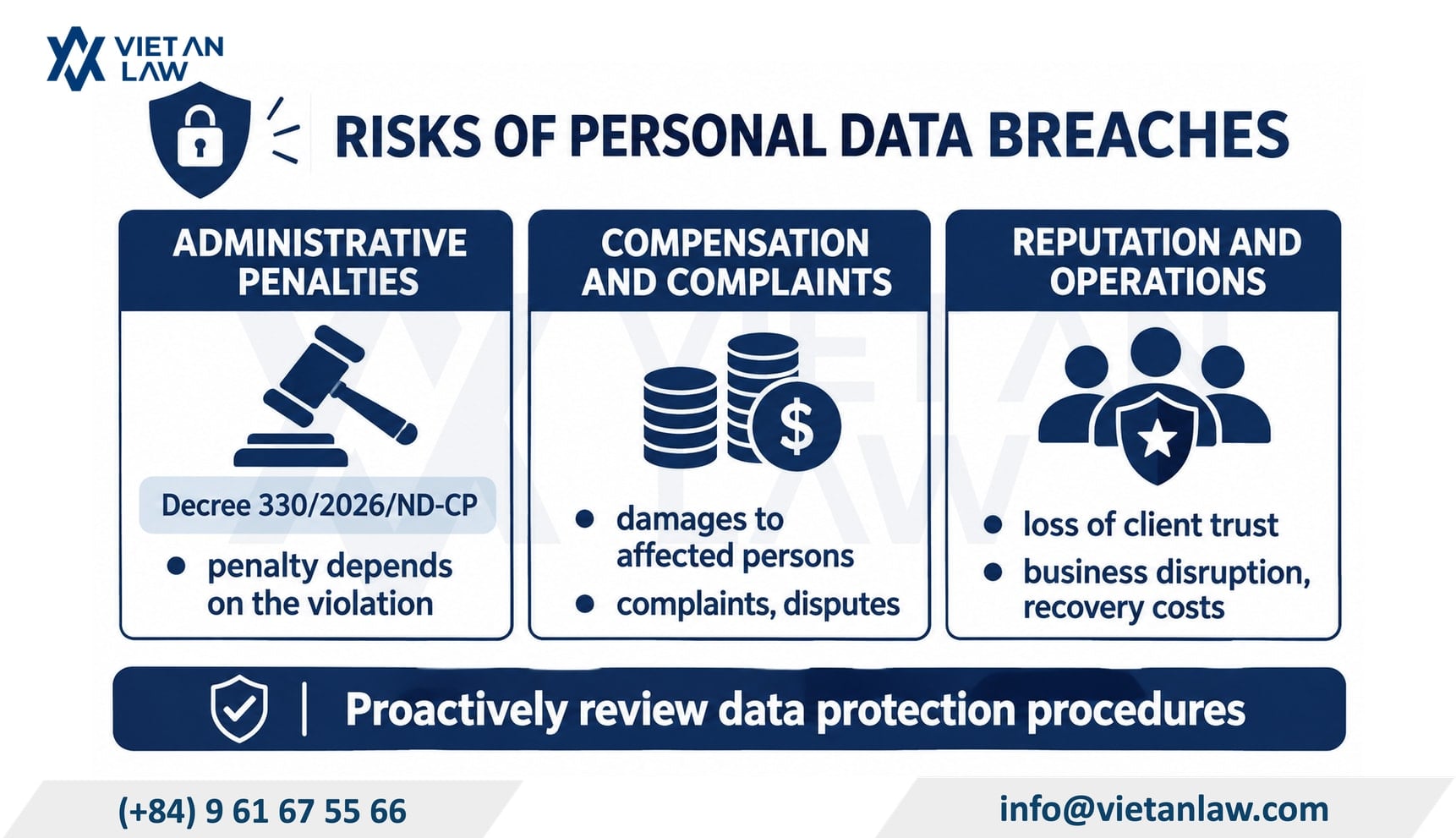
Administrative penalties
Decree 330/2026/ND-CP provides for violations and corresponding sanctions in the field of cybersecurity and personal data protection. The penalty level depends on the specific conduct, the violating entity and related circumstances.
Not every breach automatically leads to the same penalty. However, businesses may incur liability if they violate data protection obligations, fail to comply with mandatory requirements or fail to comply with notification rules where applicable.
Compensation for damage and handling of complaints
If the violation causes damage and meets the conditions for liability under the law, businesses may have to compensate affected persons. The matter may also involve complaints, contractual disputes or requests to remedy consequences.
Impact on reputation and business operations
An incident may reduce client trust, affect relationships with partners, disrupt operations and incur remediation costs. Therefore, businesses need a data breach incident response plan covering technical, legal and communication aspects.
To limit these risks, businesses should proactively review their data protection procedures instead of acting only after an incident has occurred. Where an in-depth assessment of liability, records and remedial plans is needed, businesses may refer to Viet An Law Firm’s personal data protection legal advisory services in Vietnam for support in building solutions in line with current regulations.
Checklist for data breach incident response preparation in Vietnam
- Businesses should proactively prepare the following documents and measures:
- An inventory of personal data being collected and stored;
- A list of systems, accounts and persons with access rights;
- Procedures for receiving, classifying and handling incidents;
- Emergency contact points between departments;
- Procedures for preserving evidence and system logs;
- Incident notification and report templates in line with regulations;
- Data backup and recovery plans;
- Rules for coordination with partners and suppliers;
- Employee training and response drill plans;
- Compliance records and assessment documents related to personal data protection.
If these documents are not yet complete, businesses should prioritise reviewing systems containing sensitive data, client data and HR data first.
Frequently asked questions
What should a business do immediately upon discovering a personal data breach?
The business needs to record the incident, contain and stop unauthorised access, preserve evidence, assess the scope of impact and determine its notification obligations under the law.
What is the deadline for personal data breach notification?
Under Article 23 of the Law on Personal Data Protection No. 91/2025/QH15, for violations that may cause harm in the cases prescribed by law, the deadline for notifying the specialised agency is no later than 72 hours after discovery. Businesses need to check the conditions of application and the relevant detailed regulations.
Is a business responsible if data is leaked by a supplier?
This depends on the role of each party, their obligations under the law and the contract, and the actual circumstances. Hiring a third party to process data does not automatically exclude the business’s legal liability for the obligations it must perform, which is a key aspect of business responsibilities for data breaches.
How can a business be penalised for exposing personal data?
The penalty depends on the specific violation under current law, including Decree 330/2026/ND-CP. In addition to fines, businesses may have to take remedial measures and compensate for damage where there are grounds.
Does Viet An Law Firm support building personal data breach handling procedures?
Yes. Businesses may refer to Viet An Law Firm’s personal data processing legal advice for support in reviewing obligations, completing personal data breach response procedures, assessing risks and building compliance records suited to their actual situation.
Personal data protection legal advisory services in Vietnam at Viet An Law Firm
- Handling a personal data breach is not only a technical matter but also involves notification obligations, business liability, the rights of data subjects and legal compliance records.
- Viet An Law Firm supports businesses in reviewing their legal obligations on personal data protection in Vietnam, assessing risks in data processing activities, finalising internal policies and procedures, reviewing contracts with partners, advising on incident handling and proposing compliance solutions suited to their operating model.
Clients who would like more detailed advice beyond this guide of Personal data breach response in Vietnam: a practical guide for businesses, please contact Viet An Law Firm for the best support!