(+84) 9 61 67 55 66
info@vietanlaw.vn

Vietnam PIT Deduction Levels from January 01, 2026

(for Dependents and Taxpayers)

In the context of economic volatility and the significant increase in the Consumer Price Index (CPI) over recent years, the adjustment of personal income tax policies has become a focal point of discussion at National Assembly sessions. Recently, the National Assembly officially adopted Resolution 110/2025/UBTVQH15, adjusting the family deduction levels for personal income tax, replacing the current Resolution 954/2020/UBTVQH14. This change not only reflects the Government’s efforts in alleviating the burden on the people but also ensures equity in tax obligations. As a specialized legal consultancy firm, Viet An Law respectfully presents to our clients and readers a detailed analysis of the new regulations, specifically the changes in deduction levels for dependents and taxpayers effective from January 01, 2026, to assist individuals and enterprises in proactively managing financial plans and ensuring legal compliance.

Table of contents

Hide

    Context of adjustment and necessity of the new PIT Policy in Vietnam

    • Legal Regulation: The Government is responsible for submitting adjustments to family deduction levels to the Standing Committee of the National Assembly when the Consumer Price Index (CPI) fluctuates by more than 20% compared to the time the law took effect or the time of the most recent adjustment.
    • Reality of Price Fluctuations: Since 2020, the CPI has increased beyond the 20% threshold, rendering the former deduction levels (11 million VND for the taxpayer and 4.4 million VND for each dependent) no longer consistent with actual living expenses;
    • Reducing Burden on Employees: Maintaining the old levels while costs for living, healthcare, and education have risen sharply has created significant pressure on wage earners.
    • Policy Objectives: The new Resolution on deduction levels for dependents and taxpayers is expected to stimulate domestic consumption and provide practical support for the livelihoods of millions of citizens.

    Vietnam PIT Deduction Levels from January 01, 2026 for Dependents and Taxpayers

    According to the new regulations under Resolution 110/2025/UBTVQH15, effective from January 01, 2026, the deduction levels for calculating Personal Income Tax (PIT) are significantly increased as follows:
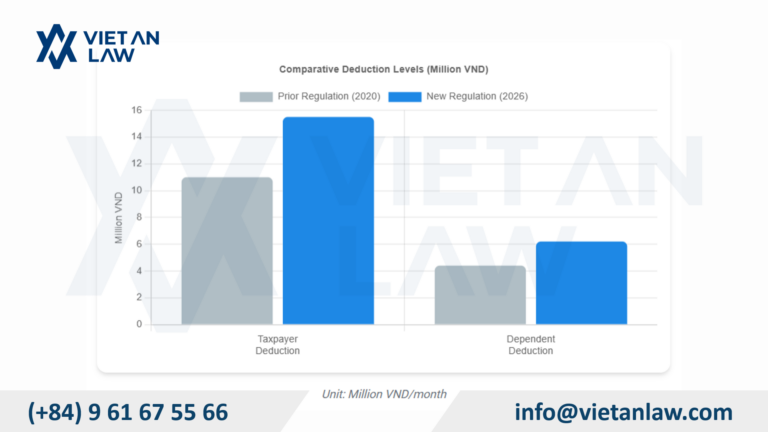
    Vietnam PIT Deduction Levels

    Details of the New Family Deduction Level Applicable to the Taxpayer

    The most notable point in this amendment is the substantial increase in the deduction level for the taxpayer personally, specified through the following key contents:
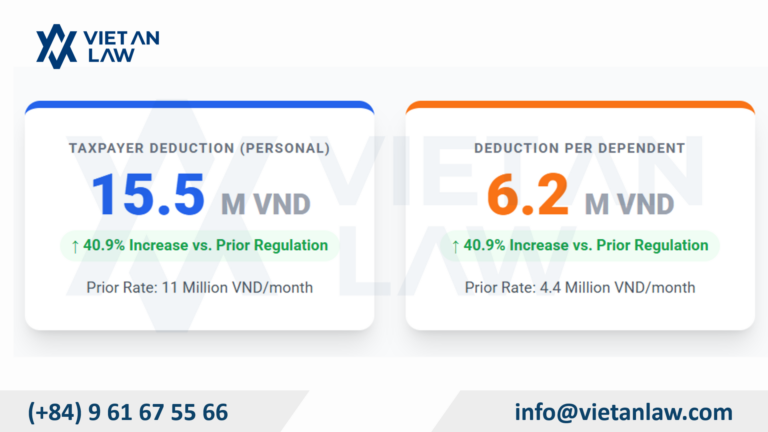
    • The family deduction level for the individual taxpayer increases from 11 million VND/month to 15.5 million VND/month pursuant to Resolution 110/2025/UBTVQH15;
    • Converted to an annual basis, the deduction level for the taxpayer shall be 186 million VND/year;
    • Change in Tax Threshold: If an individual has no dependents, such an individual shall only begin to be liable for personal income tax when their average monthly income exceeds 15.5 million VND (after deducting compulsory insurance contributions such as Social Insurance, Health Insurance, and Unemployment Insurance);
    • The increase compared to the regulations in Resolution 954/2020/UBTVQH14 is approximately 40.9%. This is a significant figure, considerably higher than the accumulated CPI inflation rate, demonstrating the State’s major effort to ensure that the real income of citizens is not eroded by inflation and taxation.

    New Vietnam PIT Deduction Levels from 2026

    Changes in Deduction Levels for Dependents

    Parallel to raising the deduction level for the taxpayer, the deduction level for each dependent has also been adjusted upwards accordingly. Specifically, the deduction level for each dependent (including children, elderly parents, spouses unable to work, etc.) shall increase from 4.4 million VND/month to 6.2 million VND/month.

    Consequently, the deduction levels for dependents and taxpayers from January 01, 2026, will create a much wider income “safety zone” below the taxation threshold.

    Example: An employee has an income of 30 million VND/month and supports 2 small children. Previously, they bore a relatively high tax burden; however, under the new regulations, this burden will be significantly reduced or even fully exempted, depending on insurance contributions.

    • Old Level (pre-2026): Self 11 million + 2 children (4.4 x 2) = 19.8 million.
    • New Level (from 2026): Self 15.5 million + 2 children (6.2 x 2) = 27.9 million.

    The difference of over 8 million VND in the total combined deduction will help employees save a considerable amount of monthly tax to reinvest in their daily lives.

    Thus, the new deduction levels from 2026 have significantly raised the safety zone below the taxation threshold for employee income compared to the old regulations applicable from 2020, specifically:
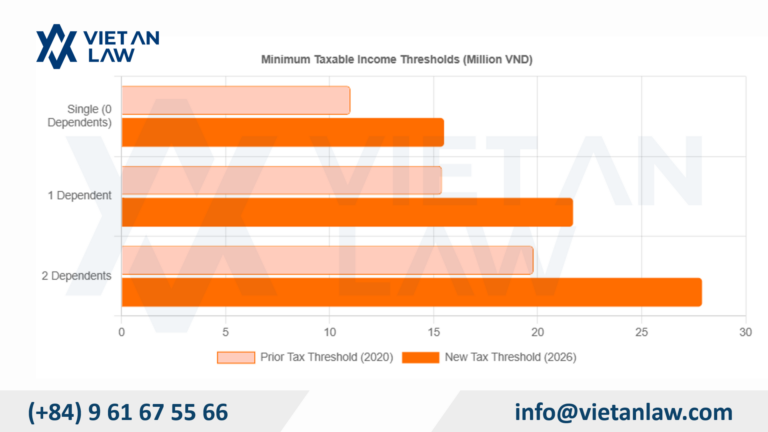
    • Single: Income > 15.5 million is taxable.
    • 1 small children: Income > 21.7 million is taxable.
    • 2 small children: Income > 27.9 million is taxable.

    Minimum Taxable Income Thresholds

    Direct Impact on Disposable Income of Employees in Vietnam

    The application of new deduction levels will fundamentally alter the calculation of the partially progressive tax. The groups benefiting most are those with upper-middle incomes and those with multiple dependents.

    Let us examine a specific example to clearly see the impact: Ms. A has a total income from salary of 25 million VND/month, pays 10.5% compulsory insurance (approximately 2.6 million VND), and supports 1 small child.

    • Under Old Regulations: Assessable income after insurance is 22.4 million. Subtracting the deduction for self (11 million) and child (4.4 million), the taxable income is 7 million VND. Ms. A must pay tax at Level 2 (10%), approximately 700,000 VND.
    • Under New Regulations: Assessable income after insurance remains 22.4 million. However, the new total family deduction is 15.5 million (self) + 6.2 million (child) = 21.7 million. The taxable income is only 700,000 VND. Ms. A only has to pay tax at Level 1 (5%) with a very small amount, approximately 35,000 VND, a reduction of up to 95% compared to the old law.

    Note: The partially progressive tax tariff for calculating PIT is also updated from 7 levels down to 5 levels according to the regulations of the Amended Law on PIT 2025, with tax rates of 5%, 15%, 25%, 30%, and 35% (the final tax rate level – 35% – applies to the portion of taxable income exceeding 100 million VND/month).

    Clearly, the policy change regarding deduction levels for dependents and taxpayers from January 01, 2026, has assisted employees like Ms. A in retaining the majority of their income.

    Conditions and Procedures for Registering Dependents in Vietnam

    Although the deduction levels have increased, the regulations regarding the conditions for determining dependents essentially remain strict to prevent tax evasion. Taxpayers must note to prepare complete dossiers to lawfully enjoy the benefits from the new deduction levels for dependents and taxpayers.

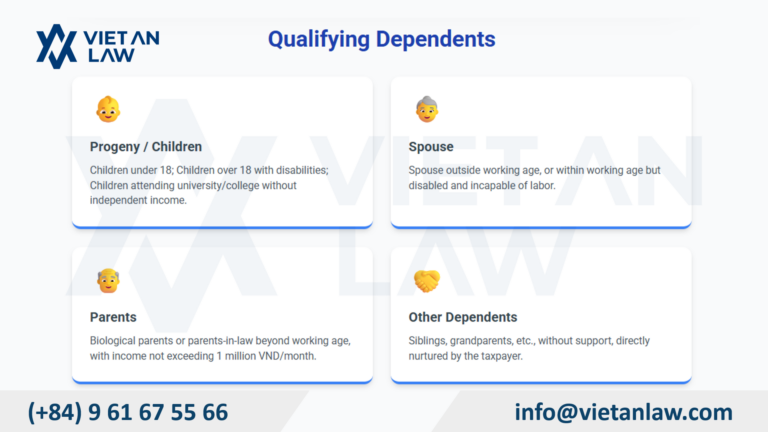
    Common categories of dependents pursuant to Point d, Clause 1, Article 9 of Circular 111/2013/TT-BTC include:

    • Children: Biological children, adopted children, children born out of wedlock, stepchildren of the husband or wife (under 18 years of age; or over 18 years of age but disabled and incapable of work; or currently studying at university/college/vocational school without income or with average monthly income not exceeding 1 million VND);
    • Spouse: Must meet the condition of being outside working age; or within working age but disabled, incapable of work, and having no income or having an average monthly income not exceeding 1 million VND;
    • Biological parents, parents-in-law; step-parents; legal adoptive parents: Must meet similar conditions regarding age, ability to work, and income;
    • Other individuals without support whom the taxpayer is directly nurturing: Such as siblings, grandparents, aunts, uncles, nieces, nephews (where the taxpayer is the grandparent, aunt, or uncle).

    Enterprises and Human Resources (HR) departments need to note to update their payroll systems and notify employees to review their dependent dossiers. Tax codes of dependents must be registered accurately for the tax system to record the deduction level of 6.2 million VND/month starting from the tax period of January 2026.
    Qualifying Dependents

    Important Notes for Enterprises and Taxpayers in Vietnam

    Besides the increase in family deduction levels, the Amended Law on Personal Income Tax passed on December 10, 2025 (effective from July 01, 2026) also brings other adjustments that parties need to note to ensure rights and obligations:

    • Other Synchronized Changes: The amended Law also adjusts the partially progressive tax tariff (reducing the number of levels or adjusting tax rates) and raises the revenue threshold subject to tax for business households to 500 million VND/year;
    • Effective Timing: Taxpayers must note that the deduction levels for dependents and taxpayers from January 01, 2026, apply to the tax period of 2026 onwards. The tax finalization for 2025 (performed in early 2026) still applies the old levels (11 million and 4.4 million);
    • Responsibility to Update: Enterprises need to proactively update accounting software and payroll spreadsheets. Withholding tax must be performed accurately according to the new norms starting immediately from January 2026 to avoid over-withholding, affecting the cash flow of employees.

    To ensure compliance with legal regulations and optimize lawful tax benefits, taxpayers and enterprises need to clearly understand the details regarding dossiers proving dependents as well as the new tax calculation method.

    Viet An Law is proud to be a leading prestigious unit in the field of tax consultancy, accounting, and corporate law. We provide comprehensive services, from finalizing personal income tax returns and reviewing tax dossiers for enterprises to representing clients in performing administrative procedures with tax authorities.

    If clients have any questions regarding the Vietnam PIT Deduction Levels from January 01, 2026, please contact Viet An Law for in-depth, timely assistance.
    Related Acticle

    Regulations on Good Laboratory Practice (GLP) in Vietnam

    Regulations on Good Laboratory Practice (GLP) in Vietnam

    Regulations on Good Laboratory Practice (GLP) in Vietnam updated by Circular 36/2025. Complete guide on GLP principles, compliance inspection, and authority changes for test facilities.
    Drone & UAV Management: Decree 288/2025 Compliance in Vietnam

    Drone & UAV Management: Decree 288/2025 Compliance in Vietnam

    Drone & UAV Management under Decree 288/2025 in Vietnam. Complete compliance guide covering registration, licensing, operator requirements, and flight permits effective November 2025.
    Penalty for Tax and Invoice Violation under Decree 310/2025

    Penalty for Tax and Invoice Violation under Decree 310/2025

    Penalty for Tax and Invoice Violation under Decree 310/2025 explained. New regulations on fines, force majeure cases, and compliance effective January 16, 2026.
    New Regulations for Gold Bar Production Licensing in Vietnam

    New Regulations for Gold Bar Production Licensing in Vietnam

    New regulations for gold bar production licensing in Vietnam explained. Learn about Decree 232/2025 ending state monopoly, application procedures, and compliance requirements.
    Circular 27/2025/TT-NHNN: New Era for Anti-Money Laundering in Vietnam

    Circular 27/2025/TT-NHNN: New Era for Anti-Money Laundering in Vietnam

    Circular 27/2025/TT-NHNN marks a new era for anti-money laundering in Vietnam. Effective November 1, 2025, learn key changes in reporting, KYC procedures, and compliance requirements.

    CONTACT VIET AN LAW

    In Hanoi: (+84) 9 61 67 55 66
    (Zalo, Viber, Whatsapp, Wechat)

    WhatsApp Chat

    whatsapp-1

    In Hochiminh: (+84) 9 61 67 55 66
    (Zalo, Viber, Whatsapp, Wechat)

    WhatsApp Chat

    whatsapp-1

    ASSOCIATE MEMBERSHIP