Vietnam Food Safety Certificate (2026): Procedures & Common Mistakes
Securing a Food Safety Certificateis a mandatory statutory requirement for most food businesses operating in Vietnam. Despite its critical importance, many enterprises and household businesses still face administrative fines ranging from 20 to 60 million VND simply because they misunderstand compliance regulations or prepare applications improperly.
Not merely a legal formality, obtaining a Vietnam Food Safety Certificate (2026): Procedures & Common Mistakes is a vital step that enables your business to operate legally, build customers’ trust, and avoid regulatory penalties. This compliance process is often executed with company formation and trademark registration in Vietnam to ensure full operational readiness.
In this article, Viet An Law provides a comprehensive guide on the procedures, conditions, and common errors that lead to dossier rejections. Whether you are launching a restaurant or a food production facility, this guide will help you save time, reduce costs, and mitigate legal risks right from the start.
Table of contents
Hide
Quick facts about the food safety certificate in 2026
Processing time: Approximately 15-20 working days (if the dossier is valid).
Penalty framework: Fines ranging from 20 to 60 million VND for operating without a license.
Service costs: Starting from 10,000,000 VND.
Validity period: 03 years from the date of issuance.
Mandatory subjects: Restaurants, eateries, and food production or trading facilities.
Quick solutions: Businesses can apply independently or utilise a professional service to expedite the timeframe.
Key note: Many establishments face dossier rejection due to procedural errors or failing physical facility inspections.
Target audience: Individuals or entities preparing to open food and beverage venues or food production businesses.
What is a Food Safety Certificate in Vietnam?
A Food Safety Certificate is a mandatory license issued by competent state agencies to individuals and corporate entities engaged in food production and trading. It serves as a foundational legal requirement, much like trademark registration in Vietnam, to:
Conduct business legally.
Supply products to supermarkets and retail distribution chains.
Avoid administrative sanctions.
Comparing mandatory and exempt Food Safety Licensing in Vietnam
Business Type
Requires Food Safety Licensing
Notes
Restaurants, eateries, cafes
Mandatory
Direct food and beverage services
Collective kitchens, canteens
Mandatory
Large-scale food service
Food production and processing facilities
Mandatory
Involves a manufacturing process
Food retail stores
Mandatory
Trading consumer food products
Supermarkets
Mandatory
Regardless of operational scale
Street food vendors
Not required
Small scale, non-fixed location
Small-scale, non-fixed trading
Not required
No specific physical address
Pre-packaged food
Not required
No on-site processing
Important note:
Even if a facility falls under the exempt category, it must still strictly adhere to all statutory food safety conditions. For instance, establishments selling packaged goods must complete a food product declaration in Vietnam, and venues serving liquor must secure an Alcohol trading license in Vietnam.
Conditions for granting a food safety certificate in Vietnam
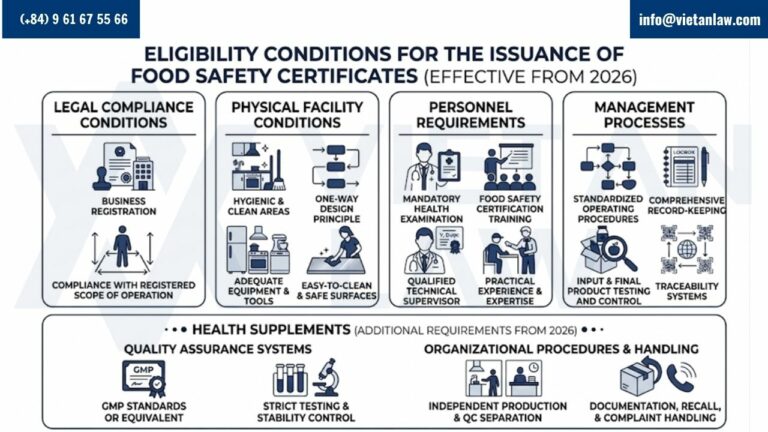
To be granted a Food Safety Certificate, a production or trading facility must satisfy the conditions stipulated in the Law on Food Safety. If any condition is declined, the application may be rejected or subject to supplementary requests.
Mandatory legal prerequisites before evaluation:
Having registered food business lines during the enterprise registration process.
Operating strictly within the registered business scope.
Physical facility conditions
Processing and preservation areas must be kept clean.
Layouts must follow a one-way principle to prevent cross-contamination.
Equipped with adequate and appropriate machinery.
Designed for easy sanitation and guaranteed food safety.
Note: The physical facility condition is a factor when competent authorities conduct on-site inspections to examine the eligibility.
Personnel conditions
For operational staff:
Must possess a valid health examination certificate.
Must have completed food safety knowledge training.
For professional supervisors:
Must hold suitable academic qualifications (Medicine, pharmacy, food technology, etc.).
Must have practical industry experience.
Management process conditions
Maintaining a clear manufacturing process.
Keeping comprehensive operational logs.
Controlling input raw materials and output finished products.
Ensuring full product traceability.
Special conditions for health supplements from 2026
Under the new 2026 regulations, facilities manufacturing health supplements must fulfil additional criteria before executing a food product declaration in Vietnam:
Quality management systems: Implementation of Good Manufacturing Practice (GMP) or equivalent standards.
Quality Control (QC): Strict testing of raw materials and finished goods, and monitoring product stability.
Personnel and organisation: Independent operation between manufacturing and QC departments, staffed by qualified experts.
Record management: Comprehensive archiving of manufacturing documents to ensure traceability.
Incident management: Establishing a product recall protocol and a complaint resolution system.
Conditions will vary depending on the business type: restaurant, production facility, trading venue, or health supplement manufacturer.
Crucially, the licensing authority will conduct a physical inspection at the premises, not merely evaluate the paper dossier.
Common mistakes causing 90% of dossier rejections in Vietnam
In practice, most applications are rejected not due to missing documents but because of improper preparation and a lack of expert consultation. Here are the most common errors that cost enterprises time and money:
Copying facility explanations from the Internet or third parties
Many establishments submit hastily edited online templates. The consequences include:
Failure to reflect the facility’s actual conditions.
Discrepancies discovered during on-site inspections.
Being assessed as unqualified.
Solution:
Draft the explanation accurately based on the current physical layout, clearly describing processing, preservation, and sanitation areas.
Physical facilities failing standards
The paperwork might be flawless, but the actual premises may:
Lack of separation zones as regulations.
Be deficient in required equipment.
Have an incorrect “one-way layout”.
This is the leading reason appraisal teams reject applications during on-site checks. Solution:
Complete all facility renovations before submitting the application.
Utilise a compliance checklist.
Missing health certificates and training records
Common errors include providing health certificates only for the business owner while omitting personnel involved in food handling.
Solution:
All relevant personnel must obtain health certificates from qualified medical institutions.
Incorrect business type identification
Mistakes often stem from errors made during initial company set-up in Vietnam, such as registering a restaurant as a manufacturing facility or preparing the wrong dossier for a retail model.
This leads to incompatible dossiers and prolonged delays.
Solution:
Define the exact business model and applicable regulations right from the start.
Submitting dossiers before passing inspections
Many owners assume they can file the paperwork first and build the facility later. When the appraisal team arrives, incomplete setups and missing equipment result in immediate failure.
Solution:
Ensure the facility is finished and ready before submission.
Consequences of dossier rejection
Losing 15 to 30 additional days to refile the application.
Incurring extra administrative and facility costs.
Delaying grand openings or business operations.
Risking sudden inspections and administrative fines.
Effective dossier preparation methods
Identify the correct specialised management agency: Determine whether the facility falls under the jurisdiction of the Ministry of Health, the Ministry of Industry and Trade, or the Ministry of Agriculture and Rural Development. Coordinate this submission with other sectoral permits, such as your Alcohol trading license in Vietnam.
Standardise the facility explanation under actual operations: This is the most crucial document. It must describe the production floor, processing zones, preservation areas, and restrooms, and detail equipment and proper zoning.
Prepare health and training documents early: Securing these documents takes more time than standard paperwork. Owners should proactively schedule medical exams and enrol direct labourers in authorised training programs early in the setup phase.
Notes to avoid common dossier preparation errors
Using outdated application forms: Utilising obsolete templates or forms directed to the wrong agency leads to immediate rejection or requests for modification.
Superficial explanations: Mechanical copying fails the examination process, especially when the physical inspection reveals stark differences from the submitted paperwork.
Improper health or training certificates: Submitting certificates issued by unauthorised clinics or omitting direct food handlers invalidates the dossier.
Omitting mandatory personnel: Failing to list the exact number of direct labourers will prompt authorities to request supplementary documents, stalling the issuance process.
Real cases: Fines of 25-60 million VND for lacking a food safety certificate in Vietnam
Case 1: Small eatery in Hanoi fined 25 million VND
A small eatery in Hanoi operated for three months without applying for a Food Safety Certificate. During a routine inter-agency inspection, the violation was flagged.
Result:
Fined 25 million VND.
Forced to temporarily suspend business operations.
Cause:
The owner assumed small-scale household businesses were exempt.
Failure to grasp current legal regulations.
Lesson:
Regardless of whether it is a small eatery or a large restaurant, most F&B models strictly require this license prior to opening.
Case 2: The food store fined 60 million VND right after the grand opening
A retail food company opened a store on Ba Trieu Street, Hanoi, without finalising its food safety licensing. Furthermore, the goods preservation area lacked compliant shelving.
Result:
Fined 60 million VND.
Forced to suspend business to rectify the violations.
Cause:
The enterprise believed it could commence operations first and seek permission later.
The Food Safety Certificate is a strict prerequisite for operations, not an administrative formality that can be supplemented post-launch.
Notes for food businesses from these cases
Operating without the certificate incurs high risks of fines from 20 to 60 million VND.
Facilities face business suspension, loss of corporate reputation, and immediate revenue damage from the outset.
Businesses must verify legal conditions before opening and finalise the licensing procedure before commencing any commercial activity.
Detailed procedure for obtaining a Food Safety Certificate in Vietnam
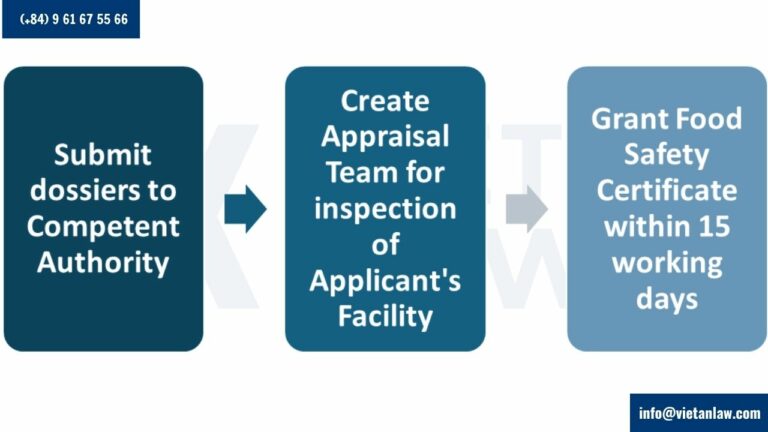
The licensing procedure consists of three fundamental steps:
Step 1: Submit the dossier. Organisations or individuals submit their applications to the competent authority based on sectoral jurisdiction (Health, Industry and Trade, or Agriculture).
Step 2: Dossier appraisal and physical inspection. Within 15 days, authorities will review the paperwork and conduct an on-site evaluation of the premises.
Step 3: Issuance of certificate. If all statutory conditions are met, the certificate is granted. If the facility fails the appraisal, the agency will provide a written response detailing the reasons for refusal.
Validity period of the certificate
The Food Safety Certificate remains valid for 03 years.
Establishments must submit an application for renewal at least 06 months before the expiration date if they intend to continue operating.
Competent authorities will conduct a physical re-inspection, so facilities must maintain continuous compliance.
Examination cost for the Food Safety Certificate in Vietnam
According to Circular 67/TT-BTC, the state appraisal fees are structured as follows:
Food trading establishments: 1,000,000 VND per appraisal.
Food service establishments: Serving under 200 portions incurs a fee of 700,000 VND per appraisal; serving 200 portions or more incurs a fee of 1,000,000 VND per appraisal.
Food production facilities (excluding health supplements): Small-scale facilities pay 500,000 VND per appraisal; other scales pay 2,500,000 VND per appraisal.
Health supplement manufacturing facilities (GMP compliance): 22,500,000 VND per appraisal.
In addition to state fees, businesses must account for related expenses such as training costs, health examinations, and any necessary facility renovations.
Penalties for operating without a Food Safety Certificate in Vietnam
Under Article 18 of Decree 115/2018/ND-CP, as amended by Clause 8, Article 1 of Decree 124/2021/ND-CP, production and trading establishments operating without a valid Food Safety Certificate face administrative fines ranging from 20,000,000 VND to 60,000,000 VND.
Additionally, violators are subject to strict remedial measures. The state will mandate the recall, forced repurposing, recycling, or destruction of food products manufactured or traded without the requisite safety certifications or GMP compliance.
Important notes on applying new Food Safety regulations
Compared to Decree 15/2018/ND-CP, the new Decree 46/2026/ND-CP maintains existing exemptions but introduces a mandatory roadmap for implementing advanced food safety management systems for high-risk products (especially health supplements and food additives).
Covered establishments must build and operate systems such as HACCP, GMP, or equivalent standards before December 31, 2026. This marks a shift from previous regulations, where such systems were merely encouraged.
For facilities that already hold GMP, HACCP, or ISO 22000 certifications and were previously exempt, the new decree requires them to complete the formal Food Safety Certificate procedure within 12 months of the Decree’s effective date.
Note that under Resolution 09/2026/NQ-CP, the enforcement of Decree 46/2026/ND-CP is temporarily suspended until April 15, 2026. Enterprises must closely monitor these legislative timelines to ensure they prepare their food product declaration in Vietnam and their compliance strategies appropriately.
Comprehensive Food Safety Certificate services
With experience processing hundreds of successful applications in the food safety sector, Viet An Law understands the statutory appraisal requirements and helps clients significantly expedite the issuance timeline. We integrate this process with broader corporate needs, including company registration in Vietnam and trademark registration in Vietnam.
Viet An Law’s workflow
Initial consultation: We advise clients on the legal prerequisites, identify the correct competent state agency, and map out a compliance roadmap tailored to their specific food production or trading model.
Dossier preparation: Based on the provided information, Viet An Law drafts a comprehensive application portfolio in strict compliance with the law. We review all documents to ensure legal consistency, minimising the risk of supplementary requests.
Inspection accompaniment: We stand by our clients throughout the state appraisal process, providing expert explanatory support during the physical inspection and guiding the prompt rectification of any minor facility issues.
Result Delivery: Upon completion, Viet An Law retrieves the certificate on behalf of the client, hands over the official results, and provides ongoing advisory on maintaining statutory conditions during business operations.
Service Commitments and Advantages
Viet An Law commits to maximising time savings through a transparent, proactive workflow, greatly reducing the client’s need to interface with multiple state agencies.
Service fees are quoted upfront with no hidden costs, allowing clients to project their legal budgets accurately.
Leveraging our deep practical expertise, we guarantee a high success rate and ensure rapid, legally compliant procedures so you can focus entirely on business growth.
How long does it take to get a Food Safety Certificate?
Approximately 15–20 working days, provided the submitted dossier is entirely valid.
What is the fine for lacking the certificate?
Fines range from 20 to 60 million VND, which can be coupled with forced business suspension.
Do household businesses need a Food Safety Certificate?
Yes, they do, aside from a few specific small-scale exemptions defined by law.
Can I apply for the certificate independently?
Yes, but the dossier is highly prone to errors if the applicant lacks a thorough understanding of the regulatory appraisal process.
Can I submit the application online?
Yes, this depends on the provincial jurisdiction, but a physical on-site appraisal by the authorities remains mandatory.
Viet An Law offers complimentary dossier evaluations to ensure you consult the right regulations from the beginning, avoiding costly rejections. We can help shorten your issuance timeframe to just 15 days.
Contact us immediately for expedited support at 09 61 57 18 18.
Fast & Reliable Legal Assistance
Fill out the form below and get connected with a lawyer quickly.
Navigating the legal framework for the Alcohol Distribution License in Vietnam (2026): Requirements, Procedures & Costs is a critical compliance step for businesses aiming to operate at the highest level…
Environmental company establishment business lines in Vietnam 2025. Complete guide to waste management, wastewater treatment, and environmental services registration procedures.
Employment service business registration business lines in Vietnam explained. Complete guide covering conditions, license requirements, and registration procedures for 2025.
Foreign Loan Reporting Services in Vietnam: Expert guidance on SBV compliance, registration procedures, and monthly reporting requirements for foreign loans under Circular 12/2022.
In the context of accelerating industrialization, modernization, and energy transition, the electrical equipment trading sector is becoming an investment choice for many individuals and organizations. Setting up an electrical equipment…