Update Decree 96/2026/ND-CP Guiding the Vietnam Investment Law 2025
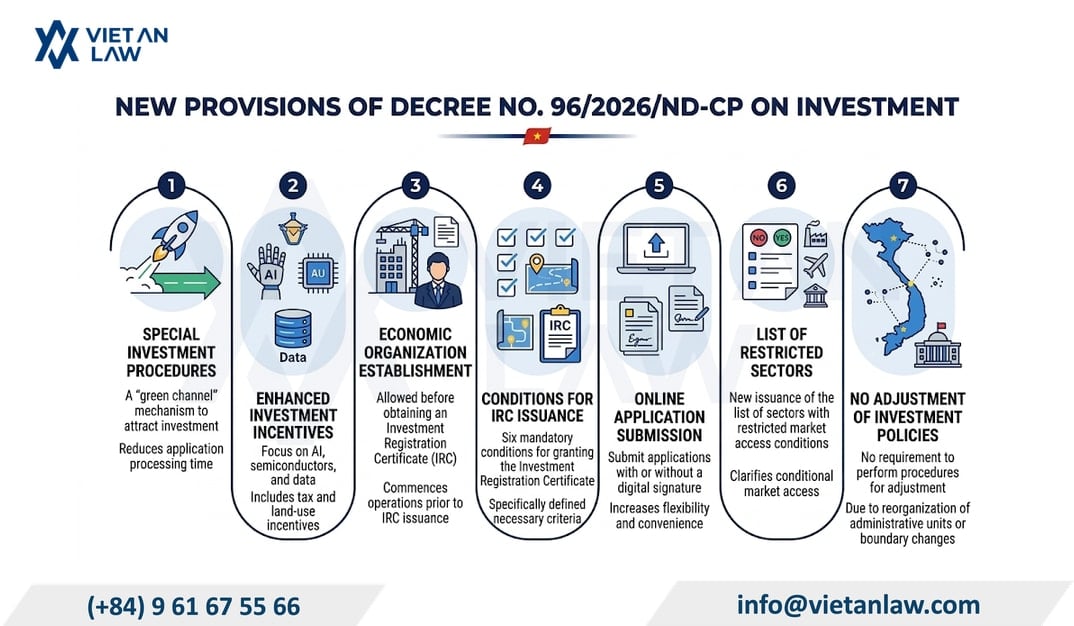
Vietnam’s regulatory landscape is undergoing a significant transformation to streamline project implementation and boost high-tech sectors. Effective March 31, 2026, the newly promulgated Decree 96/2026/ND-CP Guiding the Vietnam Investment Law2025 introduces a modernized legal framework, officially replacing Decree 31/2021/ND-CP, Decree 19/2025/ND-CP, and Decree 239/2025/ND-CP. By addressing historical administrative bottlenecks, this regulation aims to create more favorable conditions for enterprises and foreign investment in Vietnam. Viet An Law summarizes the most notable new points of this regulation, including the “green channel” for special investment procedures, updated investment incentives, and reformed application processes.
Table of contents
Hide
Notable New Points of Decree 96/2026/ND-CP Guiding the Vietnamese Investment Law 2025
Special investment procedures – a “green channel” mechanism to attract investment;
New policies on investment incentives, focusing on artificial intelligence (AI), semiconductors, and data;
Six conditions for granting an Investment Registration Certificate;
Online investment application submission with or without a digital signature;
New issuance of the list of sectors with restricted market access conditions;
No requirement to perform procedures for adjusting investment policies due to the reorganization of administrative units.
Special Investment Procedures: The “Green Channel” to Attract Investment
One of the breakthrough innovations of Decree 96/2026/ND-CP is the concretization of special investment procedures (stipulated from Article 46 to Article 50):
Cases applying special investment procedures: Investors have the right to choose special investment registration for investment projects in industrial parks, export processing zones, high-tech parks, concentrated information technology parks, free trade zones, international financial centers, and functional areas within economic zones, except for projects requiring investment policy approval as prescribed by the Government.
Legal procedure: Instead of undergoing a complex and prolonged appraisal process regarding construction, environment, and fire prevention before licensing as previously required, eligible investors can now opt for registration and commitment. Accordingly, the investor only needs to submit an application enclosed with a written commitment to comply with national technical standards and regulations.
Processing time: Management boards of economic zones and high-tech parks are responsible for evaluating the dossier and issuing the Investment Registration Certificate within 15 working days. This mechanism shifts the management approach from “pre-check” to “post-check,” helping minimize compliance costs and significantly shortening the time to bring a project into operation.
To ensure strict enforcement, the decree also clearly stipulates the inspection and supervision responsibilities of state agencies. If a project fails to meet the commitments after going into operation, the investor will face severe penalties, including the suspension or termination of project implementation. This is a profound shift in regulatory mindset, placing trust in corporate compliance while strictly maintaining legal discipline.
New Policies on Investment Incentives, Focusing on AI, Semiconductors, and Data
Historically, investment incentives were broadly applied across numerous labor-intensive assembly industries without a strict disbursement discipline mechanism. This led to inflated registered capital on paper – aimed at securing land and enjoying tax breaks – while actual capital injection was severely delayed. The new regulation eliminates this loophole through a mandatory disbursement threshold mechanism; only projects with actual capital injections will enjoy investment incentives.
Accordingly, the new decree promulgates a new list of investment incentive sectors applicable from March 31, 2026, specifically as follows:
High-tech, strategic technology, information technology, supporting industries, and environmental industries are expanded to 16 sectors (an increase of 1 compared to before), reflecting the orientation to develop high value-added industries;
Agriculture (8 sectors), environmental protection and infrastructure (6 sectors), and culture, society, sports, and healthcare (11 sectors) continue to remain stable;
Notably, a new group of projects belonging to the list of national important projects and key sector projects approved by the Prime Minister is added, demonstrating a special priority mechanism for projects with large spillover effects.
For Investment Incentive Sectors
Science and technology, electronics, mechanics, materials, and information technology increased to 23 sectors, adding the manufacturing of products on the list of dual-use technologies;
Agriculture increased to 13 sectors, supplementing activities related to the production of raw materials, plant protection products, and veterinary drugs, as well as disease prevention and treatment services for animals and aquatic products;
Environmental protection and infrastructure increased to 25 sectors, introducing new points such as investment in wholesale markets and the production of environmental industrial equipment;
Culture, society, sports, and healthcare are restructured into 8 sectors, but a strategic sector is added: training human resources for science and technology, innovation, and national digital transformation;
Other sectors remain stable across 4 areas.
Strong Decentralization in Determining Investment Incentive Areas
A notable administrative reform is the shift from a centralized mechanism to decentralization:
Instead of the Government promulgating the list of incentive areas as before,
From March 31, 2026, provincial-level People’s Committees are empowered to proactively determine and announce investment incentive areas down to the commune level, while concurrently sending reports to the Ministry of Finance for consolidation and monitoring.
These changes not only expand the scope of incentives but also clearly demonstrate the policy orientation: taking high technology, innovation, and digital transformation as growth drivers, while increasing flexibility for localities in attracting foreign investment in Vietnam.
Allowing Establishment of Economic Organizations Before Obtaining an Investment Registration Certificate
Pursuant to Clause 4, Article 72, within 12 months from the date of establishment, an economic organization must:
Complete procedures to be granted an Investment Registration Certificate to implement an investment project matching its business lines.
Only adjust the enterprise registration content to add other business investment lines after being granted an Investment Registration Certificate.
Thus, instead of requiring an Investment Registration Certificate to establish an economic organization, from March 31, 2026, the economic organization is allowed to be established first, then subsequently supplement and execute the procedures to issue the Investment Registration Certificate within a 12-month period.
The dossier, sequence, and procedures for establishing an economic organization shall comply with the Law on Enterprises or other relevant laws corresponding to each type of economic organization. Crucially, the enterprise registration application includes a commitment to satisfy market access conditions for foreign investors.
Six Conditions for Granting an Investment Registration Certificate
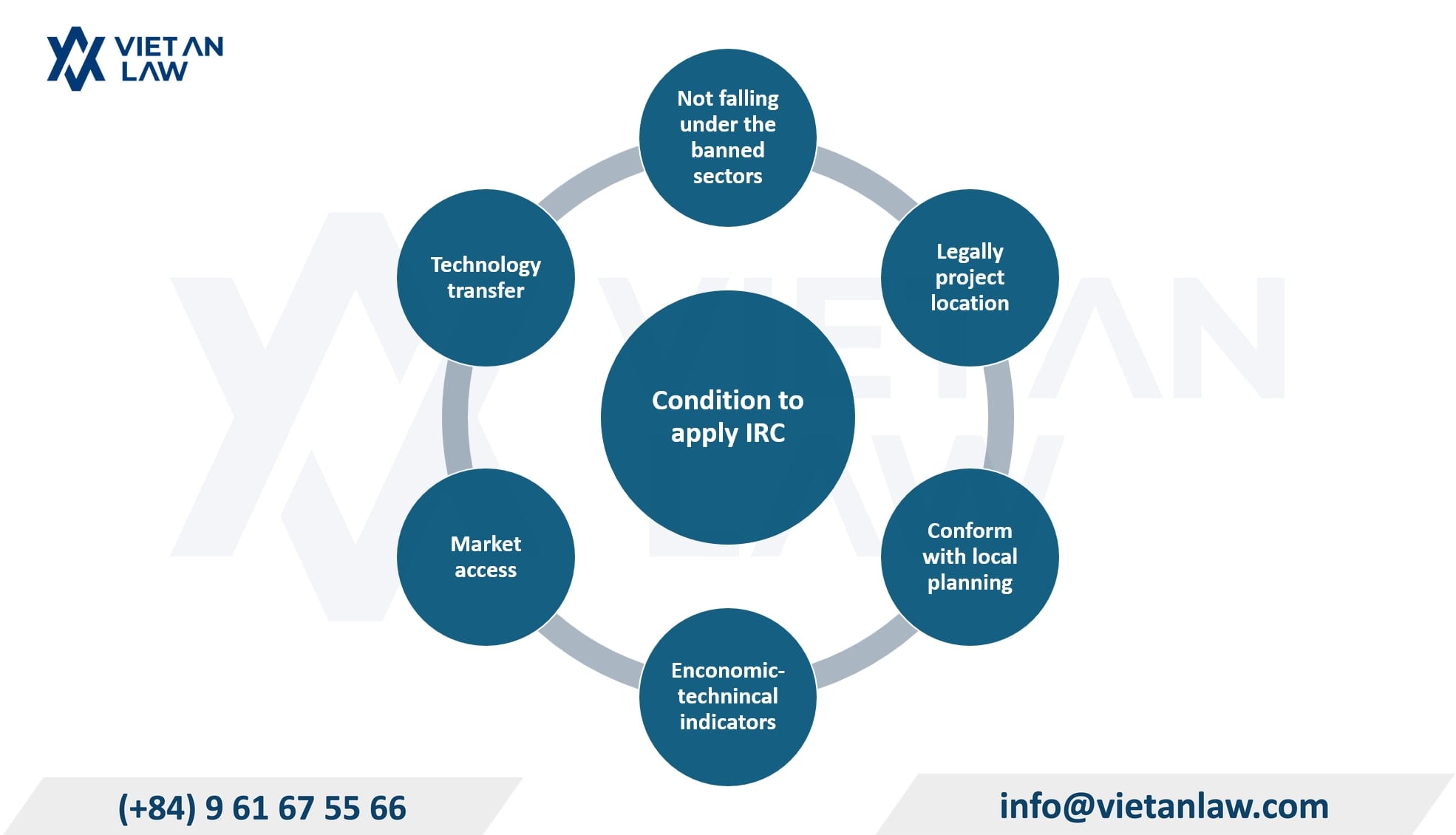
According to Clause 3, Article 39, the investment registration authority grants the Investment Registration Certificate to the investor within 10 working days from the receipt of a valid dossier when the project meets the following conditions:
Regarding business lines: Not falling under the sectors banned from business investment according to Article 6 of the Law on Investment and international treaties on investment to which Vietnam is a member.
Regarding implementation location: Must have documents proving lawful land use rights (extract from the database, copy of the certificate, location lease agreement).
Regarding planning: The project must conform with the national master plan, regional plan, or provincial plan (detailed in Clause 7, Article 32).
Regarding economic-technical indicators: Meeting conditions on investment capital per land area and the number of employees utilized (if stipulated by the locality).
Regarding technology: Meeting requirements on technology utilization for projects subject to technology appraisal under the laws on technology transfer.
Compared to Article 38 of the previous Law on Investment, the new regulation on granting the Investment Registration Certificate concretizes and develops a stricter approach by adding requirements to prove the right to use the location, clarifying criteria for planning conformity, and especially adding technology conditions for certain projects.
Online Investment Application Submission With or Without Digital Signatures
According to Clause 1, Article 42 and Article 43, investors can submit investment dossiers online using a digital signature or without using a digital signature.
Process Using Digital Signatures
Account: Register on the National Investment Information System.
Declaration & File Upload: Enter information and upload digitally signed documents to the System.
Receipt: Receive online via the System immediately after submitting the dossier.
Amendment and supplementation: The registration authority notifies within 5 working days if the dossier is invalid.
Issuance/Adjustment of Certificate: Executed within 10 working days from the date of receiving a complete and valid dossier.
Process WITHOUT Using Digital Signatures
Account: Register on the National Investment Information System.
Declaration & File Upload: Enter information and upload electronic copies (unsigned) to the System.
Receipt: Receive online via the System after completing submission.
Amendment and supplementation: The registration authority notifies within 5 working days if completion is needed.
Notification of eligibility: The registration authority responds on the System when the dossier meets requirements.
Submission of physical dossier: The investor submits the paper copy for verification within 30 days of receiving the notification. Beyond this deadline, the electronic dossier will expire.
Time limit for Certificate issuance: Executed within 10 working days after the physical and electronic dossiers are uniformly verified.
New Issuance on the List of Sectors with Restricted Market Access
Appendix I attached to the decree specifies the list of sectors with restricted market access conditions for foreign investors, specifically:
Absolute Ban on Foreign Direct Investment
There are 23 sectors with no market access for foreign direct investment: press, public opinion polling; notarization, judicial expertise, bailiff services; state monopoly goods/services; investigation, security; blasting; marine fishing, natural forest exploitation; importing used ships for dismantling; and direct collection of domestic waste.
Conditional Access
There are 62 sectors with limitations on investment form or business scope:
Infrastructure/Energy: oil and gas, hydropower, offshore wind power, nuclear, postal and telecommunications, airports, seaports.
NEW – Section B.56: Management and operation of intermediary e-commerce platforms, social networks operating e-commerce, and integrated e-commerce platforms are brought under conditional access.
Bringing e-commerce and social networks into the conditional category reflects regulatory efforts to control manipulation of the retail market, protect user data, and manage cross-border cash flows during project implementation.
No Requirement to Adjust Investment Policies Due to Administrative Unit Reorganization
Article 51 regulates the contents and procedures for adjusting an investment project. Accordingly, it supplements cases where investors carry out procedures for approving the adjustment of investment policies in the following instances:
Changing information on the investment location due to the reorganization of administrative units;
Changing the land use area but remaining at the approved location;
Adjusting the operation term of the investment project due to delays in land handover.
This regulation aims to clarify the scope of adjustments and ensure flexibility during project implementation, while providing investors with a specific legal basis to handle objective fluctuations without interrupting investment activities.
The above is an update on the new regulations under Decree 96/2026/ND-CP Guiding the Vietnam Investment Law 2025. Should clients have any related inquiries or require consultation on investment procedures, please contact Viet An Law for the best advice and support!
Fast & Reliable Legal Assistance
Fill out the form below and get connected with a lawyer quickly.
Landscape company establishment business lines in Vietnam: Complete guide on required business codes, conditions, procedures, and registration steps for 2025.
Immigration consulting company establishment business lines in Vietnam explained. Complete guide to required licenses, registration procedures, and legal business codes for 2025.
Environmental company establishment business lines in Vietnam 2025. Complete guide to waste management, wastewater treatment, and environmental services registration procedures.
Latest Updates on Tax Administration for Associated Transactions in Vietnam 2026. Complete guide covering transfer pricing, CbCR requirements, and compliance obligations.
Enterprise Formation & Registration Services in Binh Duong, HCMC. Expert guidance on company setup, legal compliance, tax incentives, and FDI procedures. Contact us today!