


Is your “Made in Vietnam” identity safe, or is your textile trademark Vietnam legacy at risk of infringement? In the race for sustainable fashion, fabric brand registration is a strategic imperative to stop counterfeiting and protect your creative assets. A robust legal foundation is the only way to turn a design into a lasting, protected brand. Viet An Law offers expert insights into Vietnam’s garment IP regulations, from Nice Agreement classification to the step-by-step procedures for successfully registering textile and yarn brands.
Why is trademark protection for textiles & fabrics in Vietnam essential?
Registering a trademark is a crucial step for businesses operating in the textile, fabric, and yarn sector, offering multiple strategic and legal benefits:
- Legal protection of brand identity against trademark infringement and unfair competition
- Distinctive brand recognition, helping customers easily identify textile and yarn products
- Increased enterprise value, facilitating market expansion and distribution agreements
- Mandatory compliance requirement when exporting textile and yarn products to markets with strict IP enforcement
- Prevention of future trademark disputes arising from prior registrations by third parties
Applicable trademark classes for textiles & fabrics (Nice Classification)
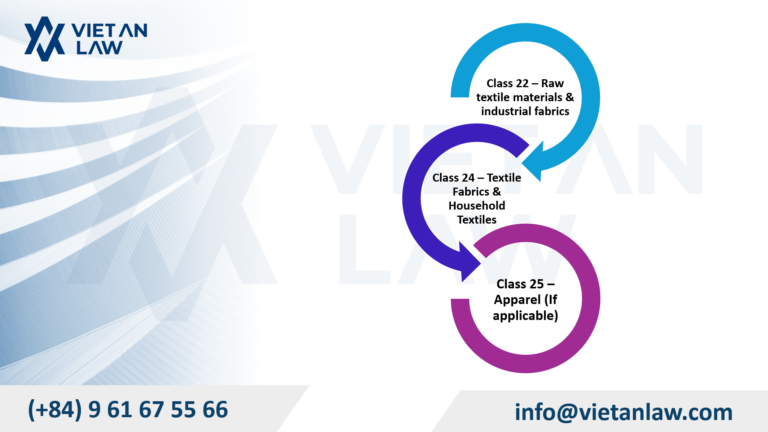
When filing a trademark application, applicants must classify goods and services according to the Nice Classification. For textile, fabric, and yarn products, the most relevant classes include:
Class 22 – Raw textile materials & industrial fabrics
This class covers: Ropes and string; nets; tents and tarpaulins; awnings of textile or synthetic materials; sails; sacks for transport and storage of bulk materials; padding and stuffing materials (excluding paper, cardboard, rubber, or plastics); raw fibrous textile materials and substitutes.
Class 22 primarily includes tarpaulins, ropes, industrial fabrics, padding materials, and raw textile fibers.
Class 24 – Textile Fabrics & Household Textiles
This class includes: Textile fabrics and substitutes for textile fabrics; household linen; curtains of textile or plastic materials.
Class 24 mainly covers woven fabrics, knitted fabrics, and textile coverings for household use.
Class 25 – Apparel (If applicable)
If the business manufactures garments made from its own fabrics or yarn, it is advisable to expand protection to Class 25, which includes clothing, footwear, and headwear.
Selecting the correct trademark class is decisive in determining the scope of protection and avoiding refusal or insufficient coverage.
Legal conditions for trademark protection for textiles & fabrics in Vietnam
Under the Law on intellectual property of Vietnam (amended 2022), a trademark is eligible for protection if it satisfies the following conditions:
Distinctiveness
- Capable of distinguishing goods from those of other entities
- Not identical or confusingly similar to prior registered trademarks
- Not composed solely of descriptive terms such as “cotton fabric,” “high-quality yarn,” “soft silk fabric”
- Not identical or similar to protected trade names or geographical indications
Prohibited Signs
The trademark must not:
- Contravene social ethics or public order
- Reproduce or imitate national flags, national emblems
- Mislead consumers regarding the origin or quality of textile products
- Consist solely of simple geometric shapes or descriptive elements
Required documents for trademark protection for textiles & fabrics in Vietnam
A standard trademark application dossier includes:
- 02 Trademark Application Forms (Form No. 08, Appendix I, Decree 65/2023/NĐ-CP)
- 05 Trademark samples (80 mm x 80 mm)
- Power of Attorney (if filing through a representative)
- Priority documents, if claiming priority
Additional documents for collective trademarks
- Regulations on the use of the collective trademark
Additional documents for certification trademarks
- Regulations on the use of the certification trademark
- Description of the specific characteristics and quality of the fabric/yarn products
- Geographical map (if the mark indicates geographical origin)
- Written approval from the Provincial People’s Committee (if the trademark contains a geographical name)
Trademark protection for textiles & fabrics in Vietnam
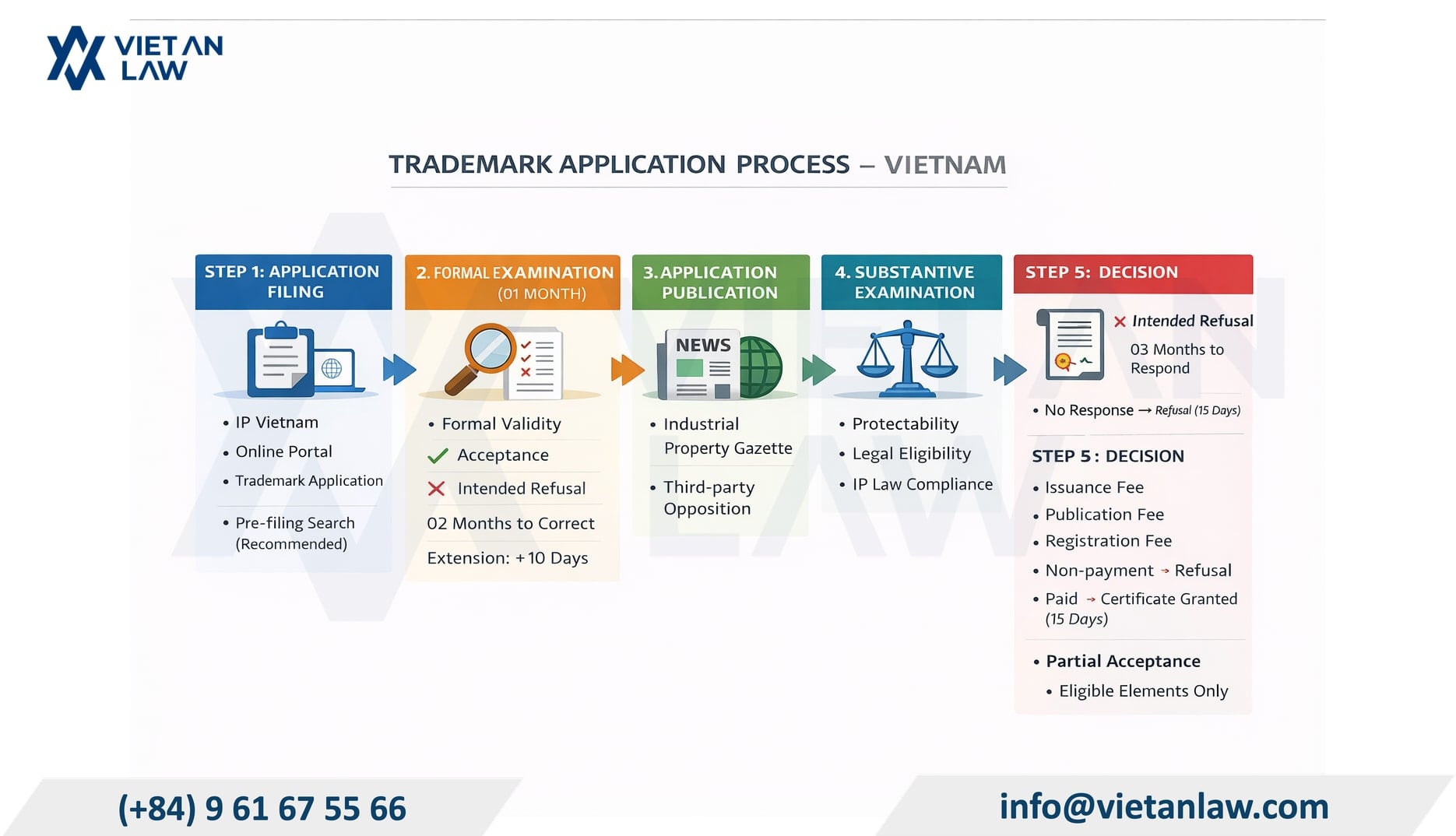
Trademark protection for textiles & fabrics in Vietnam
Step 1: Filing the trademark application
Applicants submit one complete application dossier to the National Office of Intellectual Property Vietnam (NONOIP Vietnam) via the online portal:
https://dichvucong.ipvietnam.gov.vn/ To ensure pre-filing trademark search accuracy and minimize rejection risks, businesses are encouraged to consult Viet An Law for professional support.
Step 2: Formal examination
NOIP Vietnam conducts a formal examination within 01 month from the filing date.
- Valid application: Notice of acceptance is issued
- Invalid application: Notice of intended refusal is issued, allowing 02 months for correction
The examination period may be extended by 10 days if amendments or responses are submitted.
Step 3: Publication of trademark application
Once accepted, the application is published in the Industrial Property Gazette, allowing third parties to file oppositions.
Step 4: Substantive examination
NOIP Vietnam evaluates the protectability and legal eligibility of the trademark under IP law.
Step 5: Decision on grant or refusal of trademark protection
Intended refusal
- Applicant has 03 months to respond or rectify deficiencies
- Failure to respond results in refusal within 15 days
Intended grant
- Applicant must pay:
- Certificate issuance fee
- Publication fee
- Registration fee
- Failure to pay within 03 months leads to refusal
If fully paid, the trademark certificate is granted within 15 days.
Partial acceptance
NOIP Vietnam may grant protection for eligible elements while refusing others, subject to applicant response and fee payment.
Step 6: Publication & registration
After issuance:
- Trademark is published in the Gazette within 60 days
- Recorded in the National Register of Industrial Property
Official fees for trademark protection for textiles & fabrics in Vietnam
Pursuant to Circular 263/2016/TT-BTC and Circular 63/2023/TT-BTC, applicable from 01/01/2024 to 31/12/2025:
- Application filing fee: VND 75,000
- Trademark certificate issuance fee: VND 60,000 per class
- Substantive examination fee: VND 550,000 (up to 6 products/class)
- Search fee: VND 100,000 per class
- Application publication fee: VND 120,000
- Priority claim examination fee (if any): VND 600,000
Practical notes for trademark registration in the textile industry
- Combine word + logo for stronger distinctiveness
- Avoid descriptive material terms (cotton, polyester, silk) as dominant elements
- Consider Madrid System trademark registration for international markets
- Always conduct a pre-filing trademark search to save costs and time
Well-known textile trademarks registered in Vietnam
Vinatex mart
- Owner: Vietnam National Textile & Garment Group
- Certificate No.: 4-0306733-000
- Grant Date: 16/10/2018
- Registered Classes: 23, 24, 40
VIFUTEX (Vinh Phu Textile)
- Owner: Vinh Phu Textile Joint Stock Company
- Certificate No.: 4-0184854-000
- Grant Date: 14/05/2012
- Registered Classes: 22, 24, 36
Bao Loc Silk
- Owner: Bao Loc City People’s Committee
- Certificate No.: 4-0276882-000
- Grant Date: 27/02/2017
- Registered Classes: 23, 24
Should you have any questions or require specific legal consultation regarding textile trademark Vietnam, fabric brand registration, or Vietnam garment IP for textile, fabric, or yarn products, please do not hesitate to contact Viet An Law for prompt and professional assistance.