


In today’s economy, commercializing intellectual property assets through licensing agreements in Vietnam has become an inevitable business trend. However, the concept of licensing, legally defined as the assignment of the right to use copyright, remains relatively novel and is frequently confused with the total transfer of copyright ownership. To assist clients in maximizing commercial interests while mitigating potential dispute risks, Viet An Law provides this comprehensive legal analysis on copyright licensing in Vietnam: Agreements and legal requirements.
What is copyright licensing in Vietnam?
Concept under Law on Intellectual Property
The term “licensing” as commonly understood is legally defined as the copyright assignment.
Pursuant to Article 47, Clause 1 of the Vietnamese Law on Intellectual Property, this refers to the copyright owner granting other organizations or individuals the right to use – for a specific duration – some, or all the economic rights and the right to publish their work.
This transfer of rights may involve granting exclusive or non-exclusive usage rights to organizations or individuals, subject to specific agreements regarding territory, duration, and the scope of exploitation.
Rights subject to licensing and rights not subject to licensing
When executing a copyright license agreement, clients should note the limitations on the rights permitted for transfer:
First, rights for which the right of use may be transferred:
Pursuant to Article 47, Paragraph 1, in conjunction with Article 19, Paragraph 1 and Article 20, Paragraph 1 of the Law on Intellectual Property, the owner is permitted to transfer the right to use the following rights:
- Certain moral rights, including: the right to name the work and the right to publish the work;
- All economic rights, including:
- Making derivative works;
- Performing the work before the public;
- Reproducing the work;
- Distributing or importing the original or copies;
- Broadcasting or communicating the work to the public;
- The right to lease the original or copies of cinematographic works or computer programs.
Secondly, rights for which the right of use may not be transferred:
Pursuant to Article 47, Clause 2, and Article 19, Clauses 2 and 4 of the Law on Intellectual Property, an author is strictly prohibited from transferring the right of use regarding core moral rights. These rights include:
- The right to have one’s real name or pseudonym appear on the work;
- The right to be named when the work is published or used;
- The right to protect the integrity of the work and prevent others from distorting, mutilating, or modifying it in a manner that prejudices the author’s honor or reputation.
Legal regulations on copyright licensing contracts under copyright in Vietnam
For the copyright assignment to be legally valid, the parties are required to execute a contract containing rigorous provisions.
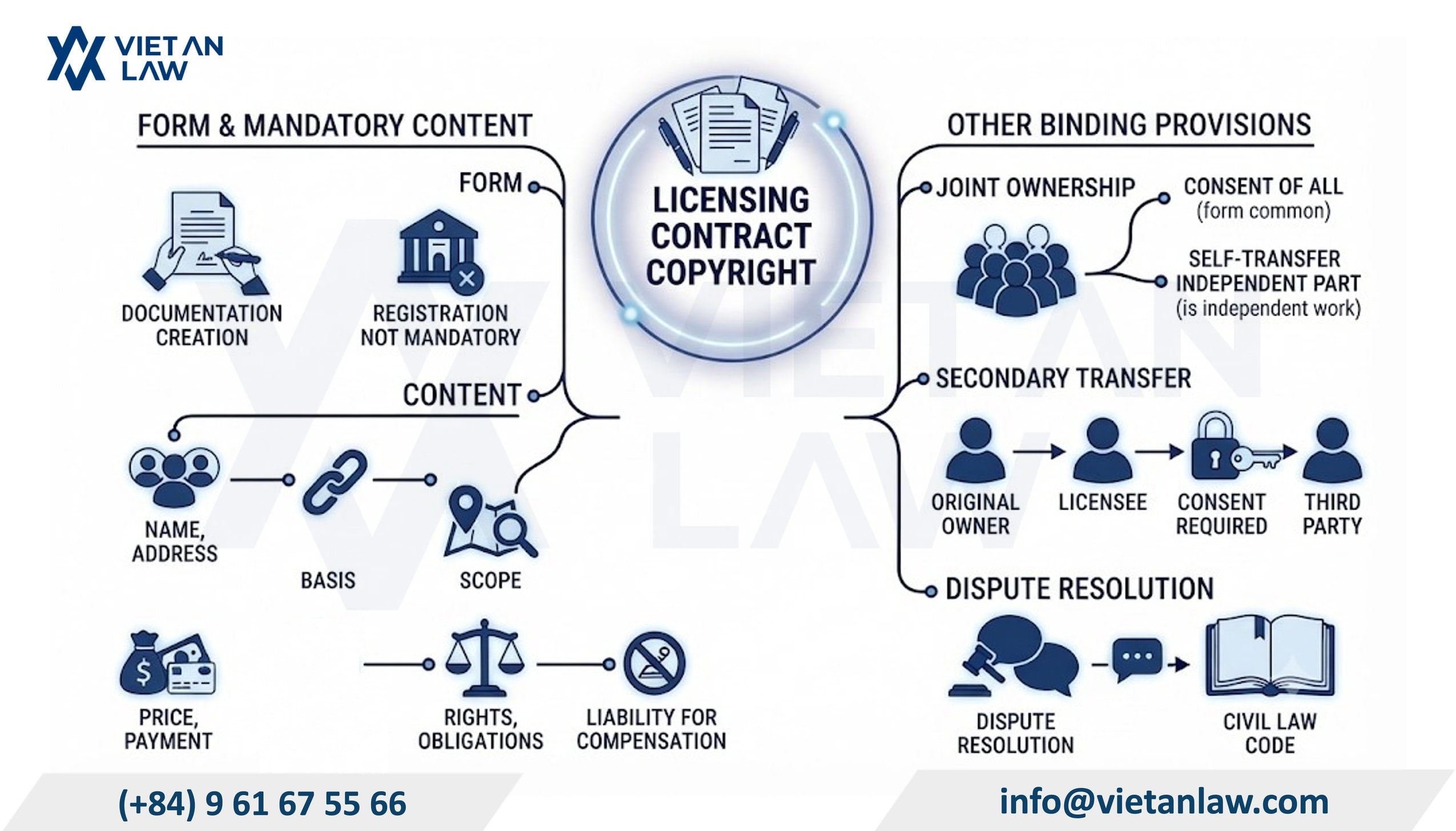
Mandatory form and content of the contract
Pursuant to Article 48 of the Law on Intellectual Property, a copyright license agreement must satisfy the following conditions:
- Regarding form:
- It must be made in writing (as a contract).
- Copyright registration with a state agency is not required for the contract to take effect.
- Regarding essential content:
- Full names and addresses of the parties;
- Basis for the transfer;
- Scope of the transfer;
- Price and payment method;
- Rights and obligations of the parties;
- Liability for compensation due to breach of contract.
Other binding provisions regarding licensing agreements
Viet An Law wishes to draw clients’ attention to certain legal matters regarding the conclusion of contracts:
- Works under joint ownership: Pursuant to Clause 3, Article 47 of the Law on Intellectual Property, if a work has joint owners, the transfer of usage rights requires the agreement of all such joint owners. However, if a work consists of separate parts capable of independent use, the owner of a specific part is entitled to independently transfer the usage rights for that part to another party.
- Secondary transfer rights: Pursuant to Clause 4, Article 47 of the Law on Intellectual Property, an organization or individual that has received a transfer of copyright usage rights may only transfer those rights to a third party with the consent of the original copyright owner.
- Dispute resolution: Pursuant to Clause 2, Article 48 of the Law on Intellectual Property, all matters relating to the performance, amendment, termination, or cancellation of a contract for the transfer of usage rights shall be governed by the provisions of the Civil Code.
Distinguishing between copyright assignment and licensing in Vietnam
In practice, many of Viet An Law’s clients often confuse these two concepts. Below is a detailed comparison table based on legal grounds:
| Criteria | Licensing of copyright | Copyright assignment |
| Legal basis | Article 47 of the Law on Intellectual Property. | Article 45 of the Law on Intellectual Property. |
| Legal nature | The owner permits another organization or individual to use the rights for a specified period of time. | The owner completely transfers their ownership rights to another organization or individual. |
| Change of ownership | The original copyright owner does not lose ownership of the work. The licensee only receives the right to use. | The transferee becomes the new copyright owner. |
| Transferable moral rights | The owner may transfer the right to name the work and the right to publish it, but cannot transfer the right to be named as author or the right to protect the integrity of the work. | The author cannot assign moral rights, with the sole exception of the right to publish the work. |
| Sub-licensing / Transfer to a third party | The licensee may only sub-license to a third party with the consent of the original owner. | The transferee, having become the new owner, has full rights of disposition and may further assign the rights without seeking consent from the previous owner. |
| Forms of transaction | Must be executed in a written contract. | Must be executed in a written contract. |
Exceptions regarding the use of works without a license agreement in Vietnam
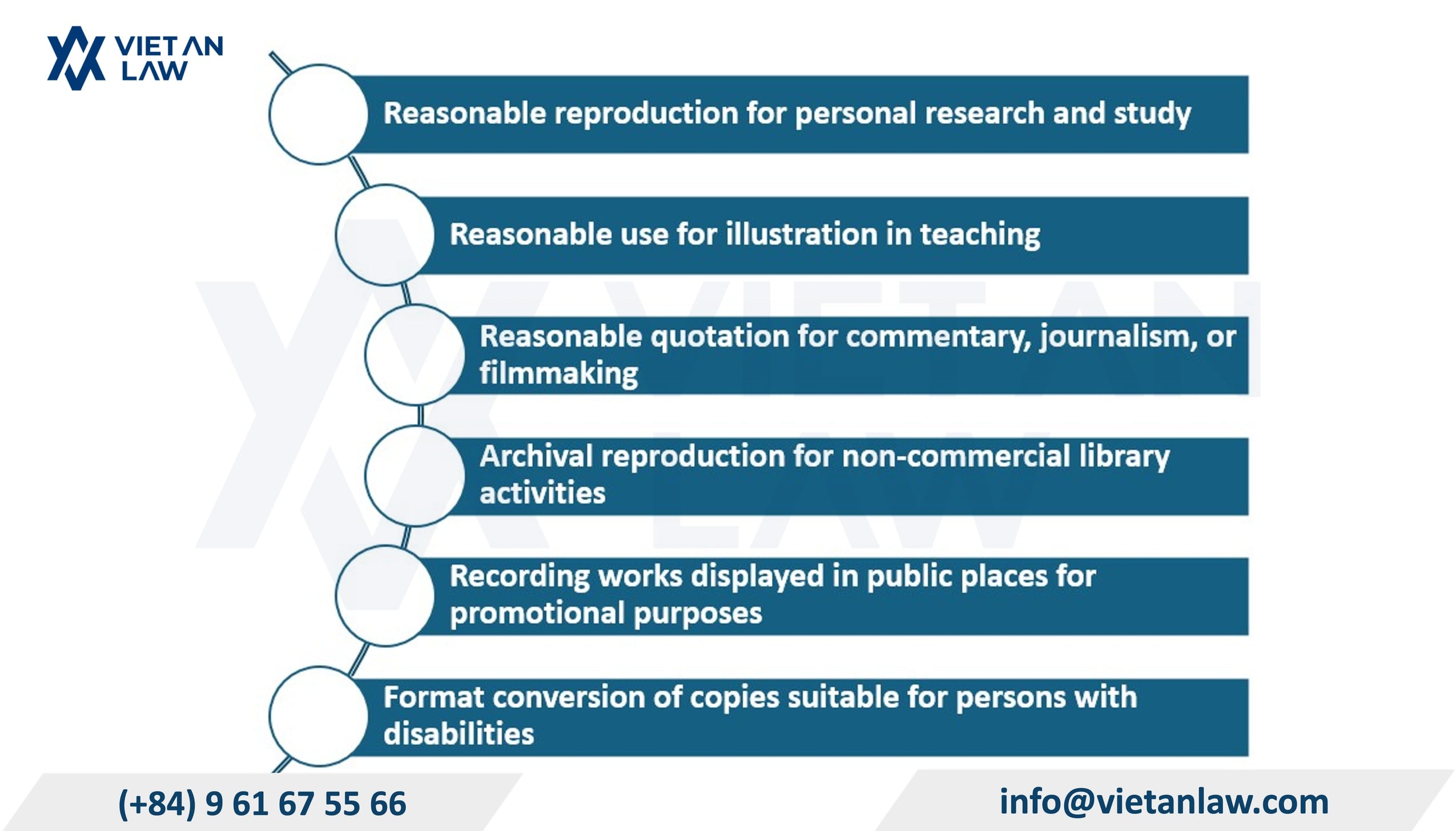
Pursuant to Articles 25 and 25a of the Vietnamese Law on Intellectual Property, the law stipulates certain exceptions allowing you to use published works without seeking permission, signing a license agreement, or paying royalties (though you must still acknowledge the author’s name and the source). Typical cases include:
- Making a single copy or a reasonable portion of a work using reproduction equipment for scientific research or personal study, without commercial intent.
- Reasonable use of a work for illustrative purposes in teaching (including provision via an internal network, provided technical measures ensure access is restricted to learners and instructors).
- Reasonable quotation of a work for commentary, introduction, or illustration within one’s own work, or for journalism or documentary filmmaking, without distorting the author’s original intent.
- Use of a work in non-commercial library activities (such as reproduction for archival preservation or inter-library sharing, subject to restrictions on the number of users).
- Photographing or broadcasting works of fine art, architecture, photography, or applied art displayed in public places for the purpose of image presentation, without commercial intent.
- People with disabilities, their caregivers, or qualifying organizations have the right to reproduce, perform, or communicate works in accessible formats.
Note: Pursuant to Clause 2, Article 25 of the Law on Intellectual Property, the exercise of these exceptions must not conflict with the normal exploitation of the work nor unreasonably prejudice the legitimate interests of the author or copyright owner.
Frequently asked questions about copyright licensing contracts in Vietnam
As the author, do I have the right to unilaterally sign a licensing agreement for all my copyright rights to a partner?
If you are both the author and the owner of the work, pursuant to Article 47, Clause 1 of the Law on Intellectual Property, you have the right to sign an agreement transferring the right to use the economic rights and the right to publish the work. However, pursuant to Article 47, Clause 2, you are not permitted to transfer the right to use moral rights, such as the right to have one’s name attributed to the work and the right to protect the integrity of the work.
Is the payment of royalties mandatory when using work under a licensing agreement?
Pursuant to Article 20, Clause 2 of the Law on Intellectual Property, when exploiting or using economic rights and the right to publish a work, an organization or individual must obtain the owner’s permission and pay royalties as well as other material benefits (if applicable), except in cases of exceptions or limitations to copyright prescribed by law.
Can an agreement transferring the right to use copyright be concluded verbally?
Pursuant to Article 48, Clause 1 of the Law on Intellectual Property, an agreement regarding the use of copyright must be made in writing to be legally valid.
Does the licensee have the right to unilaterally sublicense the work to another company?
Pursuant to Article 47, Clause 4 of the Law on Intellectual Property, the transferee of the right to use may only transfer that right to another organization or individual (a third party) if they have obtained the written consent of the original copyright owner.
If a work is commissioned by a state agency and funded by the state budget, who represents the party signing the agreement authorizing its use? Pursuant to Point a, Clause 1, Article 42 of the Law on Intellectual Property, where a work is created under an order, assigned task, or bidding process involving an agency that utilizes the state budget, the State acts as the representative of the copyright owner. In such cases, in accordance with Clause 3, Article 42, the agency utilizing the state budget for the order, assigned task, or bidding process serves as the State’s representative in exercising the owner’s rights to sign contracts authorizing the use of the work.
Negotiating and drafting a copyright licensing contract requires a deep understanding of Law on Intellectual Property to ensure legal compliance, maximize commercial interests, and prevent dispute risks. Clients requiring in-depth advice, contract reviews, or execution of copyright procedures – including our professional copyright registration service – are encouraged to contact Viet An Law directly for prompt, precise, and effective support from our specialized attorneys.