


Invalidation and cancellation of IP rights in Vietnam are two distinct legal mechanisms applicable to trademarks, patents, industrial designs, and other industrial property objects. Cancellation typically arises from events occurring while the protection title is active, whereas invalidation primarily relates to the protection title failing to meet legal conditions from the very moment of rights establishment. Correctly distinguishing these two mechanisms is vital when a business wishes to protect its intellectual property rights or request the removal of a protection title that affects its legitimate rights and interests. This article by Viet An Law will help you better understand this issue, particularly regarding the invalidation of trademark registration in Vietnam and the cancellation of trademark registration in Vietnam, as well as broader considerations for trademark registration in Vietnam.
What are the cancellation and invalidation of protection titles in Vietnam?
What is the cancellation of a protection title?
Cancellation is when a protection title ceases to be effective from a statutory time or a time decided by the state management agency for industrial property rights.
The grounds for cancellation can arise from the title owner’s failure to maintain rights, voluntary abandonment of rights, or changes related to the subject or object of protection. Specifically for each object such as trademarks, patents, and industrial designs, the grounds for cancellation have distinct differences.
What is the invalidation of a protection title?
Invalidation is applied when the whole or a part of a protection title fails to meet legal conditions regarding the right to register, protection conditions, filing principles, or other requirements right during the rights establishment process.
A special feature is that the invalidated part of the title generates no legal effect from the time the title was issued, which differs from the cancellation mechanism.
Distinguishing between invalidation and cancellation of protection titles in Vietnam
This is an aspect businesses need to pay special attention to when determining a strategy to handle a protection title belonging to a competitor or a third party.
| Criteria | Cancellation | Invalidation |
| Nature | The title is valid but no longer protected | Determines the title or a part of the title fails to meet legal conditions |
| Time of effect | Usually from the time the cancellation ground arises or according to the competent authority’s decision | The invalidated part is void from the time of issuance |
| Typical grounds | Failure to renew, failure to maintain, voluntary abandonment, non-use of trademark | No right to register, object does not meet protection conditions, violation of filing principles |
| Applicable objects | Depending on each type of protection title | Depending on each type of protection title |
| Legal consequences | Protection rights terminate from the statutory time | May result in retroactive loss of effect for the invalidated part |
| Examples | A trademark has not been used consecutively for 5 years without justifiable reasons | The protection title was granted to an individual without the right to register |
| Handling authority | State management agency for industrial property rights | State management agency for industrial property rights |
According to current regulations, invalidation and cancellation can be executed for the whole or a part of the protection title’s validity, depending on the grounds and the identified scope of violation.
Cancellation and invalidation of trademark protection titles in Vietnam
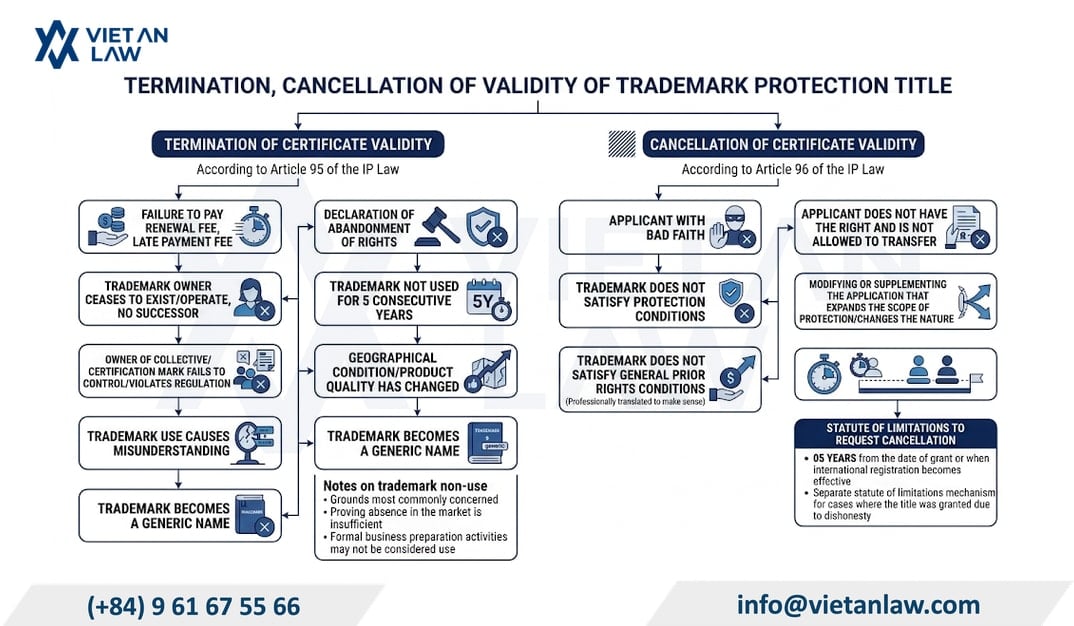
Cancellation of trademark registration certificates
Under Article 95 of the Intellectual Property Law 2005 (amended and supplemented in 2009, 2019, and 2022), a certificate for trademark registration in Vietnam may be completely or partially canceled in numerous cases.
Some notable cases include:
- The title owner fails to pay fees and charges to renew the validity;
- The title owner declares to relinquish industrial property rights;
- The title owner no longer exists or the owner of the trademark registration certificate no longer engages in business activities without a lawful heir;
- The trademark has not been used by the owner or a person permitted by the owner for 5 consecutive years prior to the date of the cancellation request without justifiable reasons;
- The owner of a collective trademark registration certificate fails to control or ineffectively controls the use of the trademark according to the regulations;
- The owner of a certification trademark registration certificate violates the regulations on use or fails to control the use effectively;
- The geographical conditions creating the reputation, quality, or characteristics of the product bearing the geographical indication are changed;
- The use of the trademark misleads consumers regarding the nature, quality, or geographical origin of goods and services;
- The trademark becomes the generic name of the goods or services registered for that exact trademark.
Notes on non-use of trademarks
This is one of the grounds most frequently considered by businesses.
- It is not simply enough to prove that the trademark does not appear on the market to request cancellation. The assessment must be based on regulations regarding acts of trademark use and evidentiary proof.
- Current guiding regulations also note that certain activities which are merely formal, serving business preparation, research, or testing, and do not reflect actual commercial exploitation, may not be considered as trademark use.
Evidence proving non-use of a trademark for 5 years
One of the vital grounds for the cancellation of trademark registration in Vietnam is that the trademark has not been used by the owner or a person permitted by the owner for 5 consecutive years prior to the date of the cancellation request without justifiable reasons.
According to current regulations, assessing whether a trademark is truly used does not rely solely on the trademark appearing on a website, advertising materials, or internal records. The use must reflect actual commercial exploitation activities for the goods and services bearing the trademark. Activities that are merely for business preparation, research, or testing; internal use; or solely displaying the trademark on documents, designs, websites, or advertising means but not associated with bringing goods and services to the market may not be considered as trademark use under current regulations.
In practice, the person requesting cancellation can collect and provide suitable groups of documents and evidence such as:
- Results of surveys and investigations on the usage status of the trademark in the market;
- Information about products and services bearing the trademark at distribution systems;
- Search results from websites, social networks, and e-commerce platforms;
- Documents related to advertising, introducing, or offering goods and services for sale;
- Invoices, vouchers, or relevant commercial information sources;
- Documents from agencies, organizations, or third parties capable of confirming the usage status of the trademark;
- Other documents and evidence proving the trademark has not been commercially exploited during the statutory period.
One should not conclude a trademark is unused solely based on not finding it at a specific store, locality, or sales channel. The assessment needs to be conducted on the overall basis of evidence and the scope of protected goods and services.
For businesses considering requesting the cancellation of a trademark due to non-use for 5 years, investigating and building a system of evidence before submitting the request is of special importance.
Invalidation of trademark registration certificates
A trademark protection title may be invalidated entirely or partially if it falls under the grounds prescribed in Article 96 of the Intellectual Property Law.
Notable cases for the invalidation of trademark registration in Vietnam include:
- The applicant registered the trademark with bad faith;
- The applicant does not have the right to register and is not assigned the registration right by the person having the right to register;
- The trademark does not meet the protection conditions;
- The amendment and supplementation of the application expand the scope of the disclosed object or change the nature of the object;
- The trademark does not meet the first-to-file principle according to legal regulations.
Invalidation of trademarks due to bad faith registration
Under current intellectual property law, a trademark registration certificate can have its validity entirely invalidated when the applicant registers the trademark with bad faith.
Current guiding regulations identify several cases that can be considered as registering a trademark with bad faith, notably including:
- The applicant registers a large quantity of trademarks that are identical or confusingly similar to trademarks being used by others in Vietnam for identical or similar goods and services, exceeding standard business capacity and without evidence of a genuine intention to use;
- At the time of filing, the registered trademark is identical or confusingly similar to a trademark already recognized by relevant consumers in Vietnam as a sign indicating the commercial origin of another person’s goods and services, or to a well-known mark abroad;
- The registration aims to exploit the reputation and goodwill of the trademark for profit;
- The registration is primarily aimed at reselling, licensing, or transferring the registration right to an entity with a related trademark;
- The registration aims to prevent market entry, restrict competition, or commit other acts contrary to fair trade practices.
These criteria are currently specified in the guidelines for executing the procedure to invalidate a protection title.
In cases of trademark invalidation due to bad faith, evidence plays a decisive role. Depending on the case, the requester may need to prove the prior use process of the trademark, the recognition level of the trademark in the market, the relationship between the parties, the act of mass registration, the transaction history, the offers to sell or transfer the trademark, and documents reflecting the actual purpose of the applicant.
Therefore, before requesting the invalidation of a granted trademark, businesses should simultaneously evaluate the legal grounds, registration history, and evidence system to determine the case’s likelihood of success.
Statute of limitations for requesting trademark invalidation
- A special point to note is that for invalidation requests based on the reasons stated in Clause 2, Article 96, the statute of limitations for the request is 05 years from the date the protection title is granted or from the date the international trademark registration takes effect in Vietnam.
- However, for cases where the title was granted due to the dishonesty of the applicant, the statute of limitations mechanism has separate rules under current law.
Invalidation and cancellation of patent protection titles in Vietnam
For patents, it is necessary to distinguish between a patent for invention and a patent for utility solution when determining the maintenance period and cancellation grounds.
Cancellation of patents for invention
Some primary grounds include:
- The title owner fails to pay fees and charges to maintain validity;
- The title owner declares to relinquish industrial property rights;
- The title owner no longer exists without a lawful heir.
Especially for a patent for invention and a patent for utility solution, if the title owner fails to pay the maintenance fees and charges within the prescribed time limit, the validity of the title may automatically terminate from the start date of the next validity year for which the maintenance fee was not paid.
Invalidation of patents for invention
A patent can be wholly or partially invalidated if it fails to meet legal conditions.
The grounds may include:
- The applicant does not have the right to register and is not assigned the registration right by the person having the right to register;
- The patent does not meet the protection conditions;
- The amendment and supplementation of the application expand the scope of the disclosed object or change the nature of the object;
- The patent is not disclosed fully and clearly enough to the extent that a person with average knowledge in the corresponding technical field can implement it;
- The patent is granted a title exceeding the scope of disclosure in the initial description;
- The patent does not meet the first-to-file principle;
- Some cases related to security control over inventions;
- Some cases related to the disclosure of the origin of genetic resources or traditional knowledge about genetic resources according to new regulations.
These grounds show that invalidating a patent can relate directly to the validity of the rights establishment process, rather than simply the owner failing to continue maintaining the rights.
Invalidation and cancellation of industrial design protection titles in Vietnam
Cancellation of industrial design patents
For industrial designs, the cancellation cases may include:
- The title owner fails to pay fees and charges to renew the validity;
- The title owner declares to relinquish industrial property rights;
- The title owner no longer exists without a lawful heir.
The Intellectual Property Law stipulates separately on the renewal mechanism for industrial design patents. Failure to fulfill financial obligations on time can lead to the cancellation of the protection title.
Invalidation of industrial design patents
An industrial design patent may be completely or partially invalidated if:
- The applicant does not have the right to register and is not assigned the registration right;
- The industrial design does not meet the protection conditions;
- The amendment and supplementation of the application expand the scope of the disclosed object or change the nature of the object;
- The industrial design does not meet the first-to-file principle;
- The author of the industrial design does not meet the conditions under current legal regulations.
Therefore, when there are doubts about the validity of an industrial design patent, it is necessary to accurately determine the grounds to choose between a cancellation request or an invalidation request.
Who has the right to request invalidation or cancellation of protection titles in Vietnam?
Organizations and individuals with related rights and interests can execute the procedure to request the state management agency for industrial property rights to consider invalidating or canceling a protection title according to corresponding legal grounds.
Regarding invalidation requests, Article 96 stipulates that organizations and individuals have the right to request the state management agency for industrial property rights to invalidate a protection title when it falls under statutory cases and must fulfill the fee and charge obligations.
In practice, the requester must prove their grounds with suitable documents and evidence. For example:
- Documents proving the title owner does not use the trademark;
- Documents proving the applicant does not have the right to register;
- Documents on the time of trademark use;
- Documents proving the rights of the author;
- Technical records of the patent;
- Documents proving the object does not meet protection conditions;
- Documents on the transfer process of registration rights.
Dossier for requesting invalidation or cancellation of protection titles in Vietnam
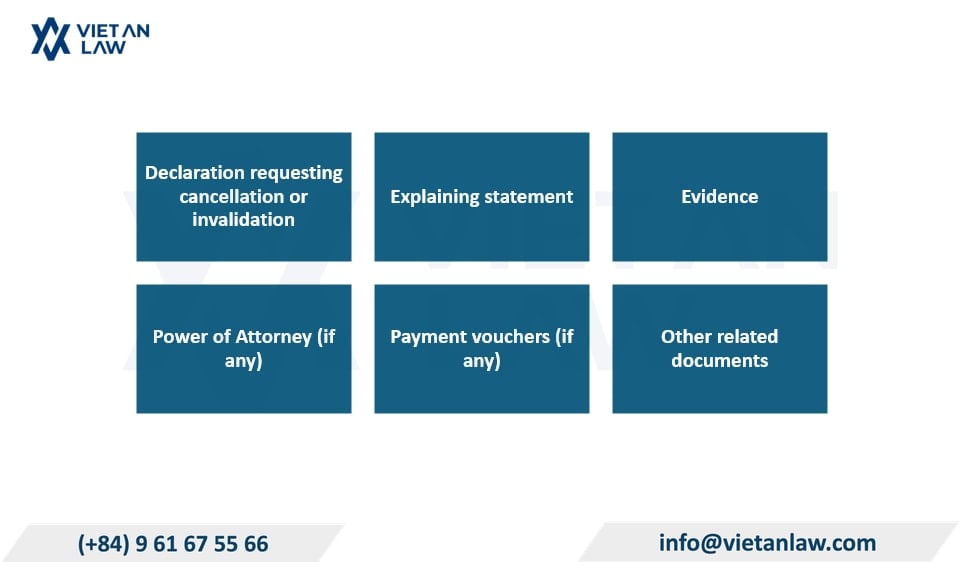
According to the current form system, the requester needs to use the correct declaration form corresponding to the procedure for cancellation or invalidation of a protection title. The National Office of Intellectual Property currently publishes Form 04 – Declaration for cancellation of an industrial property protection title and Form 05 – Declaration for invalidation of an industrial property protection title under the new form system.
Basically, a dossier may include:
- The declaration requesting cancellation or invalidation of the protection title;
- A statement explaining the reasons for the request;
- Evidence proving the grounds for the request;
- A power of attorney if submitting the dossier through a representative;
- Vouchers for payment of fees and charges;
- Other related documents depending on the object and grounds of the request.
Note: The specific composition of the dossier needs to be determined according to each case and the legal grounds the requester utilizes, particularly for dispute cases or requests for partial invalidation of a title.
Process for requesting invalidation or cancellation of protection titles at the Vietnam National Office of Intellectual Property
After determining the grounds and preparing the dossier, organizations and individuals can implement the procedure for cancellation or invalidation of a protection title at the Vietnam National Office of Intellectual Property.
Step 1: Determine the grounds and scope of the request. The requester needs to clearly identify:
- Request for cancellation or invalidation;
- The object is a trademark, patent, industrial design, or another protection title;
- Request against the entirety or a part of the title’s validity;
- Specific legal grounds;
- Scope of goods, services, or object of rights requested for cancellation or invalidation. Identifying the wrong legal mechanism can reduce the effectiveness of the dossier, especially in cases related to unused trademarks, registration rights, or trademark registration with bad faith.
Step 2: Prepare and submit the dossier
According to the current form system, the cancellation procedure uses Form 04 – Declaration for cancellation of a protection title; the invalidation procedure uses Form 05 – Declaration for invalidation of a protection title. The current form system has been updated according to the 2026 regulations.
The dossier needs to clearly reflect the protection title requested for cancellation or invalidation, legal grounds, scope of request, and accompanying evidence.
Step 3: The National Office of Intellectual Property reviews the dossier
For a request from a third party, after the dossier meets formal requirements, the National Office of Intellectual Property notifies the content of the request to the title owner for their opinion.
For a cancellation request, the title owner is assigned a 1-month time limit to respond. When necessary, the National Office of Intellectual Property may continue to collect opinions from the requester or ask parties to supplement documents and information to clarify the case.
For an invalidation request, the title owner is assigned a 2-month time limit to provide an opinion; when necessary, the requester may also be asked to respond to the title owner’s opinion within a 2-month time limit, or parties are asked to supplement evidence.
Step 4: Evaluate evidence and opinions of the parties
The Vietnam National Office of Intellectual Property considers:
- Legal grounds of the request;
- Evidence provided by the requester;
- Responsive opinions and evidence of the title owner;
- Supplemental documents;
- Results of direct exchanges between the parties if organized;
- Other necessary examination results. For complex dispute cases, the quality of the explanatory documents and evidence system significantly influences the handling results.
Step 5: Issue a decision
Based on the dossier and review results, the National Office of Intellectual Property may:
- Decide to completely cancel or invalidate the validity of the title;
- Decide to partially cancel or invalidate the validity; or
- Issue a notice rejecting the request for cancellation or invalidation. The decision on cancellation or invalidation is recorded in the National Register of Industrial Property and published in the Industrial Property Official Gazette according to regulations.
Processing time for cancellation requests in Vietnam
According to current regulations, for a cancellation request submitted by a third party, the handling time in principle is 05 months; a complex case or one with differing opinions between the parties can be extended but not exceeding 07 months from the date of receiving the request application.
For an invalidation request:
- Patent for invention/Patent for utility solution: the handling time is 12 months;
- Industrial design patent, Certificate for registered layout design, Trademark registration certificate, and Geographical indication registration certificate: the handling time is 05 months;
- For complex cases, the time limit can be extended for a maximum of 03 additional months.
The actual time for each case also depends on the status of the dossier, the amendment of shortcomings, requests for supplemental evidence, and the process of exchanging opinions between the parties.
Fees and charges for invalidation and cancellation of protection titles in Vietnam
The rates of fees and charges depend on each procedure and the time of execution. According to information published by the National Office of Intellectual Property, a cancellation dossier may incur charges such as:
- Charge for requesting cancellation;
- Examination fee for the request;
- Registration fee for the decision;
- Publication fee for the decision.
For invalidation, the applied examination fee differs from the cancellation procedure.
Because the fee schedule and dossier forms can be adjusted periodically, businesses should check the applicable fee rates at the time of submitting the dossier instead of using fee rates from old articles or records.
Services for invalidation and cancellation of protection titles in Vietnam by Viet An Law Firm
Requesting the invalidation or cancellation of a protection title is not simply an administrative procedure but in many instances bears the nature of a dispute and depends heavily on legal grounds, evidence strategy, and how the dossier is presented.
Viet An Law provides consulting and client representation services throughout the execution of the procedure, including:
- Searching and evaluating the legal status of the protection title;
- Consulting on choosing between a cancellation request and an invalidation request;
- Evaluating the feasibility of canceling a trademark due to non-use for 5 years;
- Consulting on requests to invalidate a trademark due to bad faith registration;
- Investigating and collecting evidence regarding the trademark’s usage status;
- Evaluating registration rights, protection conditions, and other invalidation grounds;
- Preparing declarations, explanatory statements, and the evidence system;
- Representing in submitting and tracking the dossier at the National Office of Intellectual Property;
- Drafting response opinions against the arguments and evidence of the title owner or requesting party;
- Representing in exchanging and working with the National Office of Intellectual Property during dossier processing;
- Consulting on appeals or subsequent legal measures in case of disputes over the handling decision.
For cases with foreign elements, Viet An Law assists businesses and foreign rights holders in evaluating titles in Vietnam, gathering domestic evidence, and implementing procedures to protect rights under Vietnamese intellectual property law.
Frequently asked questions
How do invalidation and cancellation of protection titles differ?
Cancellation causes the protection right to discontinue from a statutory time or a decided cancellation time; whereas invalidation makes the invalidated part of the title generate no effect from the time the title was granted.
Is a trademark not used for 5 years subject to cancellation?
It can be subject to a cancellation request if the trademark has not been used by the owner or a permitted person for 5 consecutive years prior to the request date without justifiable reasons and meets related legal conditions.
Can I request partial invalidation of a protection title?
Yes. In cases where only a part of the title fails to meet legal conditions, you can request a partial invalidation instead of the entire title. Article 96 of the Intellectual Property Law acknowledges the mechanism for full or partial invalidation.
What needs to be proven when requesting the invalidation of a protection title?
Depending on the object and grounds, the requester must provide documents proving matters such as registration rights, protection conditions, the first-to-file principle, trademark usage status, the creation process of a patent or design, and other grounds prescribed by law.
Should I use Viet An Law’s services when carrying out the invalidation or cancellation procedure?
Yes, especially for cases involving disputes or requests based on extensive evidence. Viet An Law can assist from the step of identifying legal grounds, evaluating evidence, drafting dossiers, to representing you in working with competent authorities, helping businesses minimize errors and become more proactive in protecting their intellectual property rights.
Is a trademark solely appearing on a website considered used?
Not in all cases. Under current guidelines, if a trademark solely appears on a website, documents, designs, advertising means, or other information means without being attached to goods and services and without actual activities of bringing goods and services to the market, it may not be considered as trademark use.
Therefore, when evaluating a non-used trademark for 5 years, it is necessary to consider the nature of actual commercial exploitation rather than merely determining if the trademark appears in the online environment.
How long does the cancellation procedure for a non-used trademark take?
For a request submitted by a third party, the processing time under current regulations is 05 months from the date of request submission. If the case is complex or the title owner has differing opinions from the requester, the time limit can be extended but not exceeding 07 months from the date of receiving the request.
How long does the trademark invalidation procedure take?
A request for invalidating a trademark registration certificate is processed within 05 months from the date of application submission. For complex cases, the processing time limit can be extended for a maximum of 03 additional months.
If the Vietnam National Office of Intellectual Property rejects the request, can I appeal?
Yes. Decisions on full or partial cancellation or invalidation of a protection title and notices of refusal to cancel or invalidate fall under the group of decisions and notices that can be subject to appeal according to regulations on industrial property. Depending on the case, organizations and individuals with related rights and interests can also consider the right to file a lawsuit under legal regulations.
For more detailed advice on the invalidation and cancellation of IP rights in Vietnam, please contact Viet An Law for the best support!