In the context of Vietnam’s rapidly developing economy, establishing a private company is not only the first step to realizing business ideas but also an opportunity for customers to affirm their position in a potential market. However, this process requires a deep understanding of legal regulations, from selecting the appropriate type of business to meeting legal conditions and performing registration procedures accurately and effectively. With over 15 years of experience in corporate legal consulting, Viet An Law is proud to be a reputable unit, providing comprehensive consulting and support services in a single package. This helps customers save time, reduce costs, and ensure full compliance with current legal regulations.
Table of contents
Hide
Popular types of companies
To answer the question about steps to start your own business in Vietnam, the first thing you need to do is choose the type of business that suits your business goals and strategies. According to the provisions of the Law on Enterprise 2020, Vietnam currently has the following popular types of businesses:
Private enterprise: This type of business is owned by an individual who has unlimited liability for all business activities. This type is suitable for customers who want to manage and operate a small-scale business themselves.
Limited liability company (LLC): Includes single-member LLCs and multiple-member LLCs. Owners or members are only liable within the scope of capital contributed to the company, suitable for small and medium-sized enterprises.
Joint stock company: This type requires a minimum of three shareholders and has no maximum limit, suitable for businesses that need to raise large amounts of capital from many different sources.
Partnership: A combination of general partners (unlimited liability) and limited partners (limited liability), often used in professional professions such as law or auditing.
Choosing the type of enterprise should be carefully considered based on the scale, industry, and long-term development orientation of the business. Viet An Law provides in-depth consulting services, supporting customers to evaluate the advantages and disadvantages of each type to make the decision that best suits their actual needs.
Conditions for establishing a company
To solve the issue: Steps to start your own business in Vietnam, customers need to ensure that they fully meet the legal conditions according to current regulations. The basic conditions include:
Subjects establishing enterprises: Individuals and organizations have the right to establish and manage enterprises in Vietnam, except for cases prohibited under Clause 2, Article 17 of the Law on Enterprise 2020 (amended in 2025). Some cases are not allowed to establish enterprises: cadres, civil servants, public employees (except in cases permitted by the law on science, technology, innovation and national digital transformation); people who are being prosecuted for criminal liability, detained, serving a prison sentence, etc.
Enterprise name: The Company name must not be identical or confusing with other enterprise names registered nationwide (Article 14 of Decree 168/2025/ND-CP); must not use words or symbols that violate historical traditions, culture, ethics, and customs; must not use names that violate regulations on enterprise naming in specialized laws (securities, insurance, credit institutions, etc.).
Head office: According to Article 42 of the Law on Enterprise 2020, the head office must have a specific address and cannot be located in apartments that are only used for residential purposes.
Business lines: Enterprises are free to conduct business in industries and professions that are not prohibited by law (Clause 1, Article 7 of Decree 168/2025/ND-CP). For conditional investment and business lines, enterprises are only allowed to conduct business when they meet all conditions and must ensure that they maintain those conditions throughout their operations. When registering for establishment, enterprises choose a level four economic sector in the Vietnamese Economic Sector System to record their business lines.
Charter capital: The Law on Enterprises does not stipulate a minimum charter capital, except for industries that require legal capital, for example: real estate business must have equity capital of not less than 20% of total investment capital for projects with land use scale of less than 20 hectares, not less than 15% of total investment capital for projects with land use scale of 20 hectares or more according to Article 9 of the Law on Real Estate Business 2023.
Legal representative: According to Article 12 of the Law on Enterprise 2020 (amended 2025), the representative must have full civil act capacity, be a permanent resident in Vietnam or have a valid authorization if absent for more than 30 days.
Steps to start your own business in Vietnam
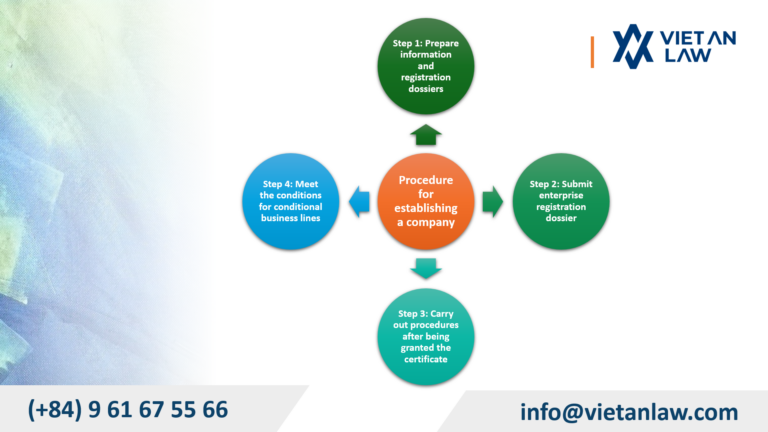
Pursuant to Articles 24, 26, 27, 5, and 20 of Decree 168/2025/ND-CP effective from July 1, 2025, the process of establishing a company includes the following specific steps:
Step 1: Prepare information and registration dossiers
Customers need to prepare all basic information, including company name, head office address, business lines, charter capital, and information of the legal representative. Enterprise registration dossiers include:
Application for enterprise registration according to the form prescribed in Circular 68/2025/TT-BTC.
Company charter, drafted under legal regulations.
List of members or shareholders.
Copies of legal documents of members and legal representatives, such as identity cards, citizen identification cards, or passports.
Investment registration certificate, applicable to foreign-invested enterprises.
Step 2: Submit enterprise registration dossier
The dossier is submitted to the Business Registration Office under the Department of Finance in the area where the enterprise has its head office. Customers submit via the National Business Registration Portal (https://dangkykinhdoanh.gov.vn), which is exempt from fees. Within 03 working days from receiving the dossier, the registration authority will issue an Enterprise Registration Certificate if the dossier is valid or notify in writing of the contents that need to be modified or supplemented if the dossier does not meet the requirements.
Step 3: Carry out procedures after being granted the certificate
After receiving the Enterprise Registration Certificate, customers need to perform the following procedures:
Announcement of enterprise registration content: Within 30 days, businesses must announce information on the National Information Portal, with a publication fee of 100,000 VND/time.
Engrave seal and notify the seal sample to business registration authority (if any).
Submit business license tax declaration (Enterprises no longer have to pay business license fees according to Resolution No. 198/2025/QH15).
Registering value-added tax (VAT) calculation method: Newly established enterprises are allowed to apply the deduction method and print VAT invoices.
Open a bank account.
Register a digital signature: To make tax declarations online.
Step 4: Meet the conditions for conditional business lines
If the enterprise operates in business lines listed under the conditional list in Appendix IV of the Law on Investment 2020 (amended and supplemented in 2025), customers need to apply for sub-licenses, for example, food safety and hygiene certificate for the food production industry or a practice certificate for the legal service industry.
Company establishment service of Viet An Law
Understanding the challenges that customers may encounter in the process of carrying out legal procedures themselves, Viet An Law provides consulting services and full-package company establishment support, helping customers save time, minimize legal risks and ensure full compliance with legal regulations. Specific services include:
Consulting on choosing enterprise type: Our team of experts will analyze the advantages and disadvantages of each type of enterprise, thereby advising on the most suitable solution for your business goals.
Drafting and checking documents: We ensure that the application documents are drafted completely and accurately, avoiding rejection due to omissions or errors.
Submitting dossiers and monitoring progress: Viet An Law represents clients in working directly with state agencies, monitoring progress and handling additional requests if any.
Support post-registration procedures: We support customers in carrying out procedures such as announcing registration content, engraving seals, registering digital signatures, opening bank accounts, and setting up initial accounting systems.
Consulting on conditional business lines: For business lines requiring sub-licenses, we provide licensing services, ensuring that enterprises fully meet the prescribed conditions.
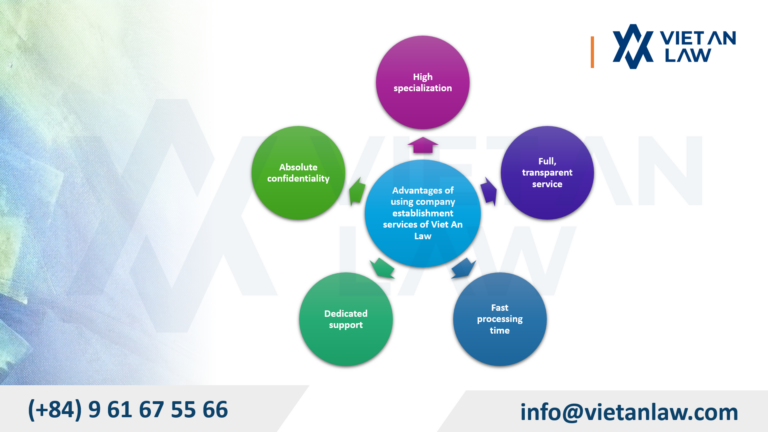
Outstanding advantages of Viet An Law
High specialization: Team of lawyers and legal experts specializing in technology, AI, big data and intellectual property;
Full, transparent service: Commitment to clear quotes, no additional costs outside the contract;
Fast processing time: Within just 03 – 05 working days, customers will receive an Enterprise Registration Certificate;
Dedicated support: Call center, support team via phone, email and social media platforms;
Absolute confidentiality: All client information and documents are strictly confidential according to legal regulations and professional ethics of lawyers.
For more details on steps to start your own business in Vietnam, please contact Viet An Law for detailed advice!
Fast & Reliable Legal Assistance
Fill out the form below and get connected with a lawyer quickly.
Trademark registration for entertainment industry in Vietnam explained. Complete guide covering Class 41 services, application process, costs, and requirements for media brand protection.
Protecting industrial designs for household goods in Vietnam: Complete guide to registration conditions, procedures, and legal requirements for appliance design protection.
Industrial Design Registration for Construction Materials in Vietnam: Complete guide on protecting building products, materials, and equipment under IP Law 2022. Expert filing support available.
Trademark registration for electroplating & metal treatment services in Vietnam. Complete guide to Class 40 protection, filing procedures, and legal requirements under IP Law.