Specialized Court Law: A Turning Point for Vietnam International Financial Center (IFC)
The establishment of a dedicated judiciary is widely regarded as the “missing link” in Vietnam’s bid to host a global financial hub. The Specialized Court Law: A Turning Point for Vietnam International Financial Center represents a landmark institutional leap, establishing for the first time a unique jurisdictional mechanism tailored specifically for global financial and commercial disputes. This legislation was developed based on the core policies of the Party and the legislative orientation of the National Assembly, specifically aligned with Resolution No. 222/2025/QH15 regarding the establishment of International Financial Centers (IFCs) in Vietnam.
Table of contents
Hide
The necessity of a Specialized Court at the IFC in Vietnam
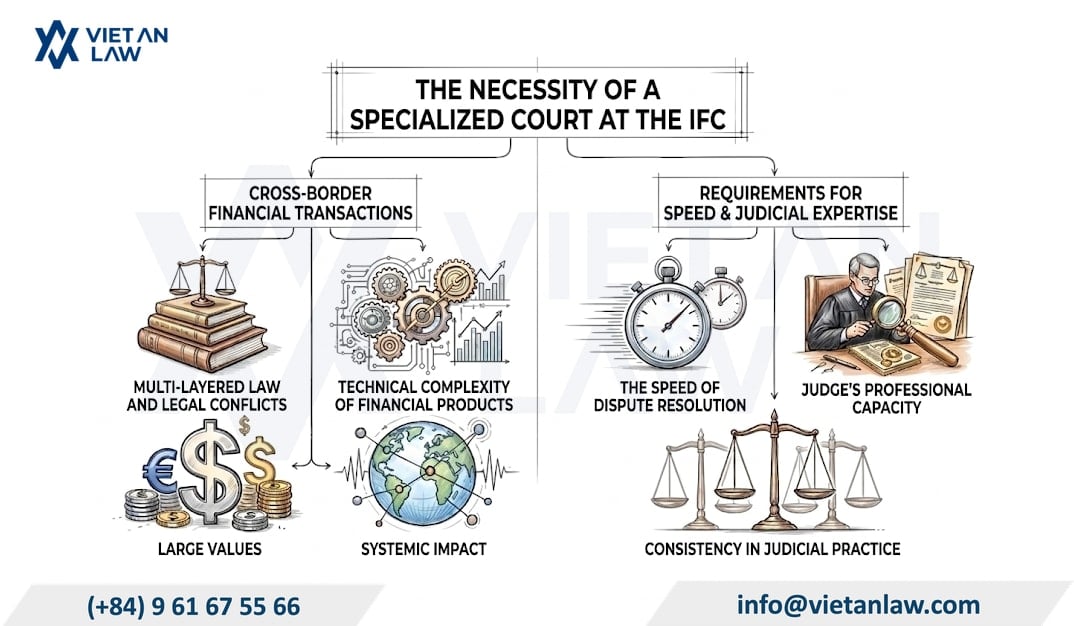
The complexity of modern global finance demands a departure from traditional judicial models. The specialized court serves as a necessary condition for the IFC to function effectively rather than a mere optional luxury.
The complex nature of cross-border financial transactions
Multi-layered law and legal conflicts
International financial transactions are often governed simultaneously by:
National laws where the transaction arises;
The governing law of the contract (which may be foreign law);
International treaties or commercial customs.
This leads to a high risk of conflict of laws, requiring a presiding body capable of interpreting and applying diverse legal systems—a requirement that traditional civil courts struggle to meet fully.
Technical complexity of financial products
Many disputes within an IFC do not merely revolve around payment obligations but involve:
Derivatives, futures contracts, and options;
Structured finance;
Financial technology (Fintech) and digital assets. Evaluating these disputes requires in-depth knowledge of market operating mechanisms, risk management, and asset valuation—skills that fall outside the scope of general adjudication.
Large dispute values and systemic impact
Financial disputes often involve massive valuations that can trigger chain reactions affecting:
Market liquidity;
The reputation of financial institutions;
Investor confidence. Therefore, a judicial mechanism with high stability and predictability is required to prevent market volatility.
Requirements for speed and deep expertise of judges
The speed of dispute resolution – a vital factor for financial markets
In the financial sector, the timing of dispute resolution is critical because:
Capital flows and assets fluctuate continuously;
Prolonged litigation increases opportunity costs and risks.
A specialized court with summary procedures, dedicated judges, and flexible procedural mechanisms will significantly shorten resolution times.
Requirements for the professional capacity of judges
Judges at the IFC must possess:
Expertise in banking, finance, and capital markets;
An understanding of international customs and global trade law;
The ability to evaluate technical evidence and complex financial reports.
This differs fundamentally from traditional civil courts in Vietnam, where judges handle a wide variety of cases and find it difficult to accumulate deep industry-specific expertise.
Consistency in judicial practice
With a team of dedicated judges, the system of case law and judicial guidance will:
Create stable legal standards;
Help businesses better predict risks;
Reduce future disputes.
This serves as the foundation for building legal trust—the core element of a successful IFC.
New features in the Vietnam Law on Specialized Courts at the International Financial Center 2025
Against the backdrop of deep international economic integration via the CPTPP and EVFTA agreements, the Law on Specialized Courts at the International Financial Center (Law No. 150/2025/QH15, passed on December 11, 2025, effective from January 1, 2026) marks a major milestone in Vietnam’s judicial reform.
Notable new highlights of the Law include:
Jurisdiction of the Court
The Specialized Court at the International Financial Center is a court within the People’s Court system, organized and operating under the provisions of this Law, with the jurisdiction to adjudicate and resolve cases at the International Financial Center.
Specifically, the Specialized Court has the authority to resolve the following cases, except those related to public interests or State interests:
Investment and business cases between members who at least one is a member of the International Financial Center;
Requests related to arbitration resolving disputes involving IFC members in accordance with the law on commercial arbitration;
Other cases related to investment and business activities at the International Financial Center where at least one party is an IFC member, as prescribed by the Supreme People’s Court.
Procedural process
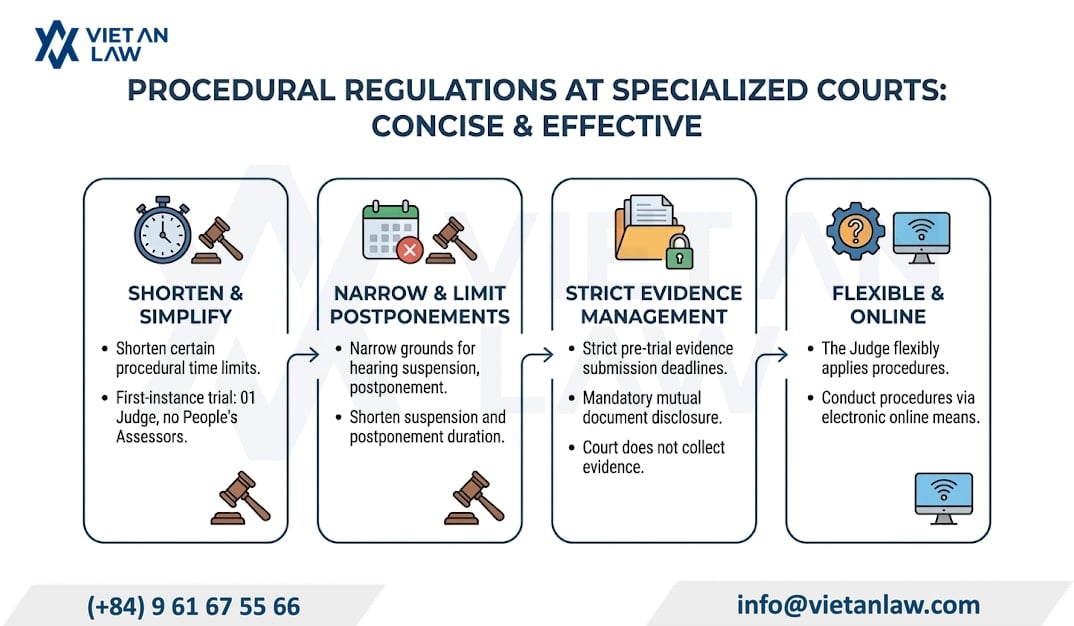
The procedural regulations at the Specialized Court are designed to be fast, efficient, and streamlined, reducing time and eliminating unnecessary steps compared to standard civil procedures. Furthermore, it incorporates principles of the adversarial system traditional to Common Law jurisdictions, specifically:
Shortening and Simplification
Shortening several procedural time limits;
Simplifying the first-instance trial panel to a single Judge without the participation of People’s Assessors (lay assessors).
Narrowing and Limiting Postponements
Narrowing the circumstances under which a trial may be suspended or adjourned;
Shortening the duration of such suspensions or postponements.
Strict Evidence Management
The time limit for submitting documents and evidence must not exceed the trial preparation period, except for justifiable reasons.
Any document or evidence provided by one party must be sent to the remaining parties. If a party fails to provide the evidence to the other parties, the Court will not use that evidence as a basis for resolving the case;
The Court does not collect evidence on its own. The Court bases its judgment on the documents and evidence provided by the parties that have been examined by the Court and the results of the adversarial process at the trial.
Flexibility and Online Proceedings
When a Judge deems it necessary, they may decide to apply or not apply specific procedural steps during the case resolution;
Implementing online procedural steps in an electronic environment.
Other regulations on language and the participation of foreign lawyers
The Law stipulates that the language and scripts used before the Specialized Court shall be English or English accompanied by a Vietnamese translation. This policy provides a superior and flexible framework for adjudication, consistent with the provisions of Resolution No. 222/2025/QH15.
Representatives of parties participating in proceedings at the Specialized Court may be Vietnamese lawyers or foreign lawyers holding valid practicing certificates issued by competent foreign agencies or organizations.
Experience from major IFCs (Dubai, Singapore, London)
Dubai In Dubai, the DIFC Courts system operates independently, uses English, and applies many common law principles. This mechanism creates great confidence for international investors.
Singapore Singapore established the Singapore International Commercial Court (SICC) with international judges and flexible processes, helping the nation become a leading dispute resolution hub in Asia.
London In London, the Commercial Court within the English court system is renowned for its independence and case law, making it a popular choice for international financial disputes.
Impact of the Specialized Court Law on the investment environment in Vietnam
The issuance of Specialized Court Law is expected to bring several benefits:
Reducing legal risks in large-scale financial transactions;
Enhancing the regional standing of Vietnam’s IFC.
Specifically, if implemented in Ho Chi Minh City—the country’s largest financial center—this model can become an essential foundation for Vietnam to compete with regional IFCs.
Note: Procedural Rules of Specialized Court will be issued before April 2026
The Specialized Court will be located in Ho Chi Minh City. To implement this, the Supreme People’s Court has issued a plan to ensure that the establishment, organization, and operation of this new court model are synchronized and effective.
The Supreme People’s Court is required to develop detailed guiding documents, including:
A Resolution of the Council of Justices of the Supreme People’s Court issuing the Procedural Rules of the Specialized Court, to be completed before December 31, 2026.
A Circular on the order, procedures, and application files for the appointment, reappointment, and dismissal of Specialized Court Judges, to be completed before March 31, 2026.
The Specialized Court Law: A Turning Point for Vietnam International Financial Center marks a new era for Vietnam’s legal system. Should clients have any related questions or require detailed legal advice, please contact Viet An Law for the best support and consultancy!
Fast & Reliable Legal Assistance
Fill out the form below and get connected with a lawyer quickly.
Protecting industrial designs for household goods in Vietnam: Complete guide to registration conditions, procedures, and legal requirements for appliance design protection.
Effective from March 1, 2026, the Law on Restructuring and Bankruptcy 2025 will officially come into force, replacing the Law on Bankruptcy 2014. This law marks a significant development in…
Foreign Loan Reporting Services in Vietnam: Expert guidance on SBV compliance, registration procedures, and monthly reporting requirements for foreign loans under Circular 12/2022.
Expert criminal lawyer services in HCMC by Viet An Law Firm. Experienced defense counsel for all criminal proceedings—investigation, trial, appeals. Contact us today.
Expert Dispute Resolution Lawyer & Litigation Services in Vietnam. Viet An Law handles civil, commercial, labor disputes with proven strategies. Protect your rights today.