


In an era of deep economic integration and booming international trade, the demand for logistics services, particularly customs brokerage, is surging. Setting up a customs service business in Vietnam is not only a strategic move to capture market trends but also plays a vital role in supporting enterprises with import-export activities, saving time and costs while ensuring full legal compliance. So, how can you establish a professional, legal, and efficient customs agency? In the following article, Viet An Law provides a detailed guide on the essential requirements and procedures for launching a successful customs service company.
What is customs services business?
According to Clause 23, Article 3 of the Law on Customs 2014, customs procedures are the tasks that customs declarants and customs officers must perform with respect to goods and means of transport. Among these, customs brokerage agents are identified as customs declarants.
Therefore, it can be understood that customs service business refers to the activities of customs brokerage agents, within the scope of authorization as agreed upon in the contract signed with the owner of goods for export or import, acting on behalf of the owner to perform all or part of the obligations of the customs declarant.
Subject matter requirements for setting up a customs service business
Based on Article 20 of the Law on Customs 2014, entities permitted to conduct customs clearance agency services must be enterprises that have been granted an Enterprise Registration Certificate with the business line of freight forwarding or customs clearance agency services.
Procedures for applying for an Enterprise Registration Certificate
- Company registration dossiers include:
- Application for enterprise registration;
- Company charter;
- List of founding shareholders and foreign investor shareholders of a joint-stock company; List of members of a multiple-member limited liability company;
- List of beneficial owners;
- Legal documents of individuals who are members, shareholders, legal representatives of the company, and authorized representatives of capital contributions (In cases where the application includes personal identification numbers and has been cross-referenced with the national population database, it is not necessary to attach the personal legal documents of these individuals);
- Copy of the establishment decision, business registration certificate or equivalent document and power of attorney for the capital manager (if it is an organization);
- Investment registration certificate already issued;
- Power of attorney authorizing Viet An Law to carry out the enterprise registration procedures.
- Receiving agency: Business registration agency under the Department of Finance where the enterprise’s head office is located;
- Application submission method: Enterprises submit applications through the National Business Registration Portal at the website: https://dangkyquamang.dkkd.gov.vn/;
- Processing time: 3 working days from the date of receipt of a valid application;
- Result: Enterprise registration certificate.
Some business lines for companies providing customs services
To be permitted to act as a customs brokerage agent, a company must register its business activities as a freight forwarding or customs brokerage service. According to Decision 36/2025/QD-TTg, a company providing customs services needs to register the following main business line: Code 5231 (Intermediate services for freight transport).
In addition, the following industry codes can be registered:
- Code 5210 (Warehousing and storage of goods);
- Code 5221 (Direct support services for railway transport);
- Code 5222 (Direct support services for waterway transport);
- Code 5224 (Cargo handling);
- Code 5225 (Direct support services for road transport);
- Code 5229 (Other support services related to transport).
Requirements for establishing a customs brokerage agency
Based on Article 20 of the Law on Customs 2014, a company providing customs brokerage services must meet the following conditions:
Human resource requirements
Customs clearance agents must be Vietnamese citizens who meet the following requirements:
- Possess a college degree or higher in economics, law, or engineering;
- Hold a customs declaration professional certificate;
- Be assigned a customs clearance agent code by the customs authority.
Facilities requirements
Companies providing customs brokerage services must have information technology infrastructure that meets the requirements for implementing electronic customs declarations and other conditions as prescribed by regulations.
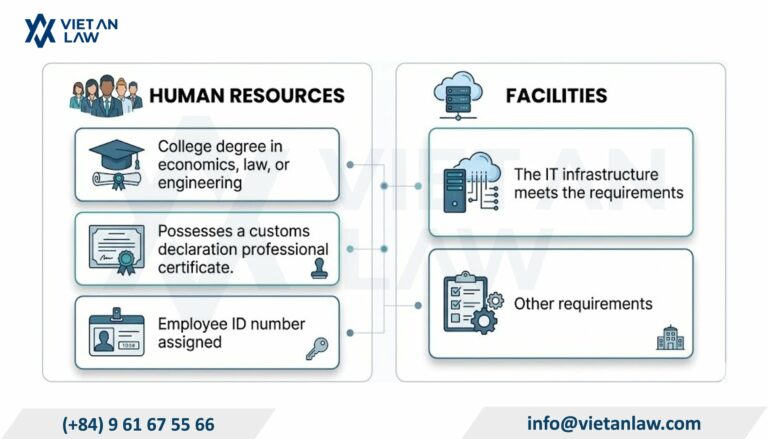
Requirements for establishing a customs brokerage agency
Procedures for registering a customs brokerage agency
Dossier for registering a customs brokerage agency
Based on Clause 4, Article 1 of Circular 22/2019/TT-BTC, the application dossier for recognition of eligibility to operate as a customs clearance agent includes:
- Application for recognition of eligibility to operate as a customs clearance agent, using Form No. 04 issued with Circular 22/2019/TT-BTC.
- The application file for a customs clearance agent employee code includes:
- Application for a customs clearance agent employee code (Form No. 07 issued with Circular 12/2015/TT-BTC).
- University or college diploma in law, economics, or engineering: 1 copy;
- Customs declaration professional certificate;
- 1 color photograph (2x3cm).
Procedures for public announcement of customs brokerage agencies
Based on Article 6 of Circular 12/2015/TT-BTC, amended by Circular 22/2019/TT-BTC, the procedure for announcing customs brokerage agents is as follows:
- Step 1: Enterprises meeting the eligibility requirements submit an application to the Customs Department requesting recognition of eligibility to operate as a customs brokerage agent.
- Step 2: Within 05 working days from the date of receiving the application, the Director of the Customs Department shall:
- Issue a decision recognizing the customs brokerage agent;
- Assign a customs brokerage agent employee code;
- Update the information on the Customs Department’s electronic portal.
- In case the enterprise does not meet the eligibility requirements, a written response will be sent to the enterprise.
Why is customs service a highly lucrative business sector?
Increased demand from import and export activities
In the context of globalization and international economic integration, trade between countries is developing rapidly. This has led to a significant increase in the volume of imported and exported goods. Domestic and foreign businesses need to complete customs procedures quickly and accurately to ensure business progress. However, not all enterprises have the resources to handle these procedures themselves, so the demand for customs services is increasing.
Customs procedures are complex and change frequently
Customs laws and regulations in Vietnam, and globally, are constantly being updated and changed to tighten control, combat trade fraud, and facilitate business operations. However, these changes create difficulties for enterprises that lack expertise. Therefore, traders often seek out specialized and experienced customs service companies for prompt assistance and to avoid unnecessary risks.
High profits can be achieved with expertise
Customs services do not require a large initial investment, but have the potential to generate stable profits if done well. With a professional team and a stable customer base, enterprises can create a steady stream of revenue. In addition, many companies combine related services such as logistics, transportation, and warehousing, helping to increase order value and expand business scale along the supply chain.
Less mass competition
Unlike many other service industries, customs services are not an easily accessible field for newcomers. This industry requires in-depth knowledge, legal understanding, document processing skills, and relationships with relevant authorities. Therefore, competition is not widespread, and those with established reputations and expertise tend to retain long-term clients.
Diverse opportunities for expansion and development
Customs services extend beyond simple customs declarations. Enterprises can expand into many other areas such as import/export consignment, tax consulting, comprehensive logistics services, international transportation, etc. This provides a solid foundation for developing into a comprehensive supply chain services company. Furthermore, the customer market for this industry is very broad, ranging from domestic enterprises to foreign-invested enterprises (FDI).
For clients requiring advice on setting up a customs service business in Vietnam, please contact Viet An Law for the best support!