


The petroleum business has long been regarded as the lifeblood of the economy, exerting a direct impact on production, transportation, and daily social activities. However, due to stringent requirements for fire safety, environmental protection, and market management, this sector is governed by a complex and rigorous specialized legal framework. Investors entering this market must thoroughly understand the specific conditions, technical standards, and compliance obligations to mitigate legal risks during operations. In this context, Viet An Law provides this comprehensive guide to clarify the legal basis, business conditions, and essential steps on how to start a petroleum company in Vietnam.
What is a petroleum business company?
According to Clause 2, Article 3 of Decree 83/2014/ND-CP, petroleum business includes the following activities:
- Export (petroleum products, domestically produced raw materials and petroleum products, raw materials of imported origin), import, temporary import for re-export, transshipment, processing for export of petroleum products and raw materials;
- Production and blending of petroleum products;
- Distribution of petroleum products in the domestic market;
- Services for leasing warehouses, ports, receiving, storing and transporting petroleum products.
Accordingly, a petroleum trading company is understood to be an enterprise established under Vietnamese law that carries out one or more of the aforementioned business activities.
When establishing a petroleum business, investors need to carry out the following legal procedures:
- Applying for an Investment Registration Certificate (for businesses with foreign investment);
- Applying for an Enterprise Registration Certificate;
- Applying for a Petroleum Business License.
Petroleum business lines under Vietnamese law
When registering a petroleum business, enterprises need to register the enterprise code according to Decision 36/2025/QD-TTg. Accordingly, enterprises can refer to the following business line codes:
- 3312 – Repair and maintenance of machinery and equipment
- 3315 – Repair and maintenance of transport vehicles (excluding automobiles, motorcycles, and other motor vehicles)
- 4653 – Wholesale of agricultural machinery, equipment and parts
- 4659 – Wholesale of other machinery, equipment and parts
- 4671 – Wholesale of solid, liquid and gaseous fuels and related products
- 4730 – Retail sale of motor fuels
- 47735 – Retail sale of kerosene, gas, and fuel coal for household use
- 9529 – Repair and maintenance of bicycles, watches, and other personal and household goods not elsewhere classified
- 9529 – Repair and maintenance of bicycles, watches, and other personal and household goods not elsewhere classified
- 9531 – Repair and maintenance of automobiles and other motor vehicles
- 9532 – Repair Repair and maintenance of motorcycles and scooters
- 9540 – Intermediary service activities for repair and maintenance of computers, personal and household goods, automobiles, motorcycles, scooters and other motor vehicles
- 9531 – Repair and maintenance of automobiles and other motor vehicles
- 9532 – Repair and maintenance of motorcycles and scooters
- 9540 – Intermediary service activities for repair and maintenance of computers, personal and household goods, automobiles, motorcycles, scooters and other motor vehicles
Procedures for establishing a petroleum business company in Vietnam
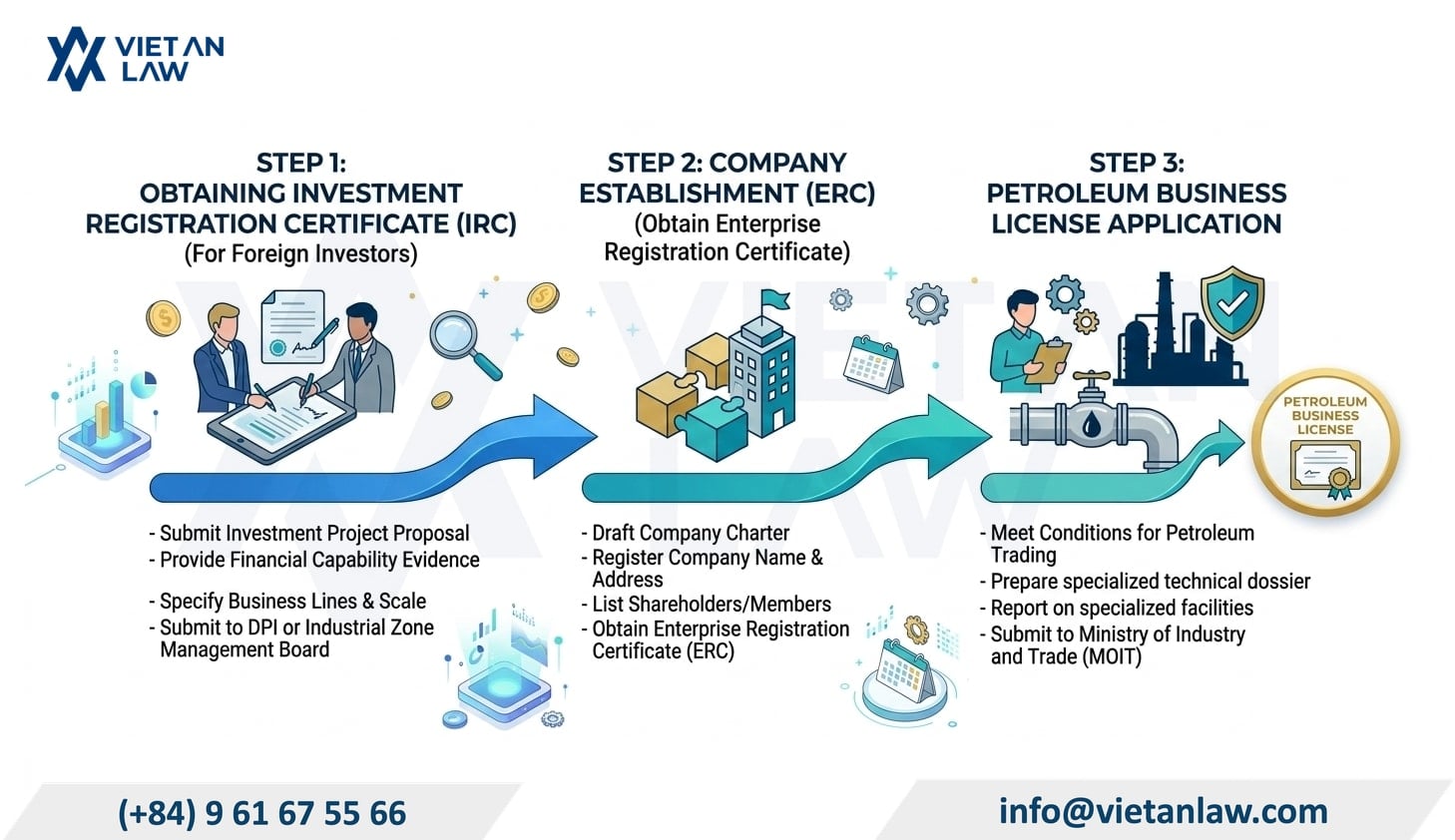
3 stages of establishing a petroleum trading company
Phase 1: Applying for an Investment Registration Certificate for foreign investors
A foreign-invested petroleum trading company is a company established in Vietnam by a foreign investor (FDI). Because it is a foreign-invested project, before proceeding with procedures similar to establishing a domestic enterprise, the company needs to apply for an Investment Registration Certificate as stipulated in the Investment Law 2020. Specifically, the procedures are as follows:
Dossier components:
According to Article 33 of the Investment Law 2020, as guided by Article 31 of Decree 31/2021/ND-CP, the application dossier for an investment registration certificate includes:
- A written request to implement the project and a commitment to take responsibility if the project is not approved.
- Documents proving the legal status of the investor.
- Documents proving financial capacity (such as financial statements, commitments to financial support or guarantees…).
- An investment project proposal, including key contents about the investor, objectives, scale, capital, location, progress, land and labor requirements, incentives, efficiency, and environmental impact assessment; a pre-feasibility study report may be substituted if required by law.
- A copy of the land use right certificate or documents identifying the right to use the site if not requesting the State to allocate/lease/change the land use purpose.
- Technological explanation if the project is subject to assessment and consultation on technology.
- BCC contract if the investment project is in the form of a BCC.
- Other documents as required by law regarding the investor’s qualifications and capabilities.
Phase 2: Enterprise registration
One of the requirements for operating a petroleum business is that the enterprise must be established in accordance with the law. Currently, the law does not specify the type of enterprise when establishing a petroleum business. Therefore, a petroleum business can be established in the form of a joint-stock company, limited liability company, partnership, or private enterprise. The procedure for registering the establishment of such an enterprise includes the following basic steps:
- Select the business lines for petroleum products as mentioned above.
- Prepare all necessary dossiers for enterprise establishment. This includes:
- Submitting the company establishment application to the Business Registration Authority under the Department of Finance where the business is headquartered;
- Receiving the Enterprise Registration Certificate from the Business Registration Authority within 3-5 working days;
- The Business Registration Authority publishing the business information as required.
- Businesses carry out the following procedures after company establishment:
- Engraving a company seal;
- Engraving and using a company seal;
- Displaying a signboard at the office;
- Registering for a digital signature and bank account;
- Registering for tax declaration and using electronic invoices.
Phase 3: Applying for a license to operate a petroleum business
After completing the company establishment procedures, it is necessary to apply for a specific petroleum business license according to business needs as stipulated in Decree 83/2014/ND-CP on petroleum business, amended and supplemented by Decree 08/2018/ND-CP, Decree 95/2021/ND-CP, Decree 80/2023/ND-CP, and Decree 146/2025/ND-CP. Specifically:
Cases requiring a Petroleum business license
As mentioned above, the petroleum business encompasses various activities such as production, distribution, and retail of petroleum products. Each activity has its own characteristics. Therefore, for each petroleum business activity, the law has separate regulations corresponding to each type of license. Specifically, as follows:
- Wholesale petroleum traders (including petroleum import and export activities) must possess a Certificate of eligibility to be a wholesale petroleum trader;
- Petroleum distributors must possess a Certificate of eligibility to be a petroleum distributor;
- General petroleum agents must possess a Certificate of eligibility to be a general petroleum agent;
- Retail petroleum agents must possess a Certificate of eligibility to be a retail petroleum agent;
- Retail petroleum outlets must possess a Certificate of eligibility to be a retail petroleum outlet.
Authorities competent to issue Petroleum business licenses
- The Department of Industry and Trade has the authority to issue the following types of licenses:
- Certificate of eligibility to act as a retail agent for petroleum products for enterprises with their head office in the area and a system of two (02) or more retail petroleum stores in one (01) province or centrally-administered city;
- Certificate of eligibility to act as a general agent for petroleum business for enterprises with their head office in the area and a petroleum distribution system in one (01) province or centrally-administered city.
- Certificate of eligibility for retail petroleum stores in the area.
- The Ministry of Industry and Trade has the authority to issue the following types of licenses:
- Certificate of eligibility to be a petroleum wholesale trader (old license name before 02/01/2022: Petroleum export and import business license)
- Certificate of eligibility to be a petroleum distributor;
- Certificate of eligibility to be a general agent for petroleum trading for traders with petroleum distribution systems in two (02) or more provinces and centrally-administered cities.
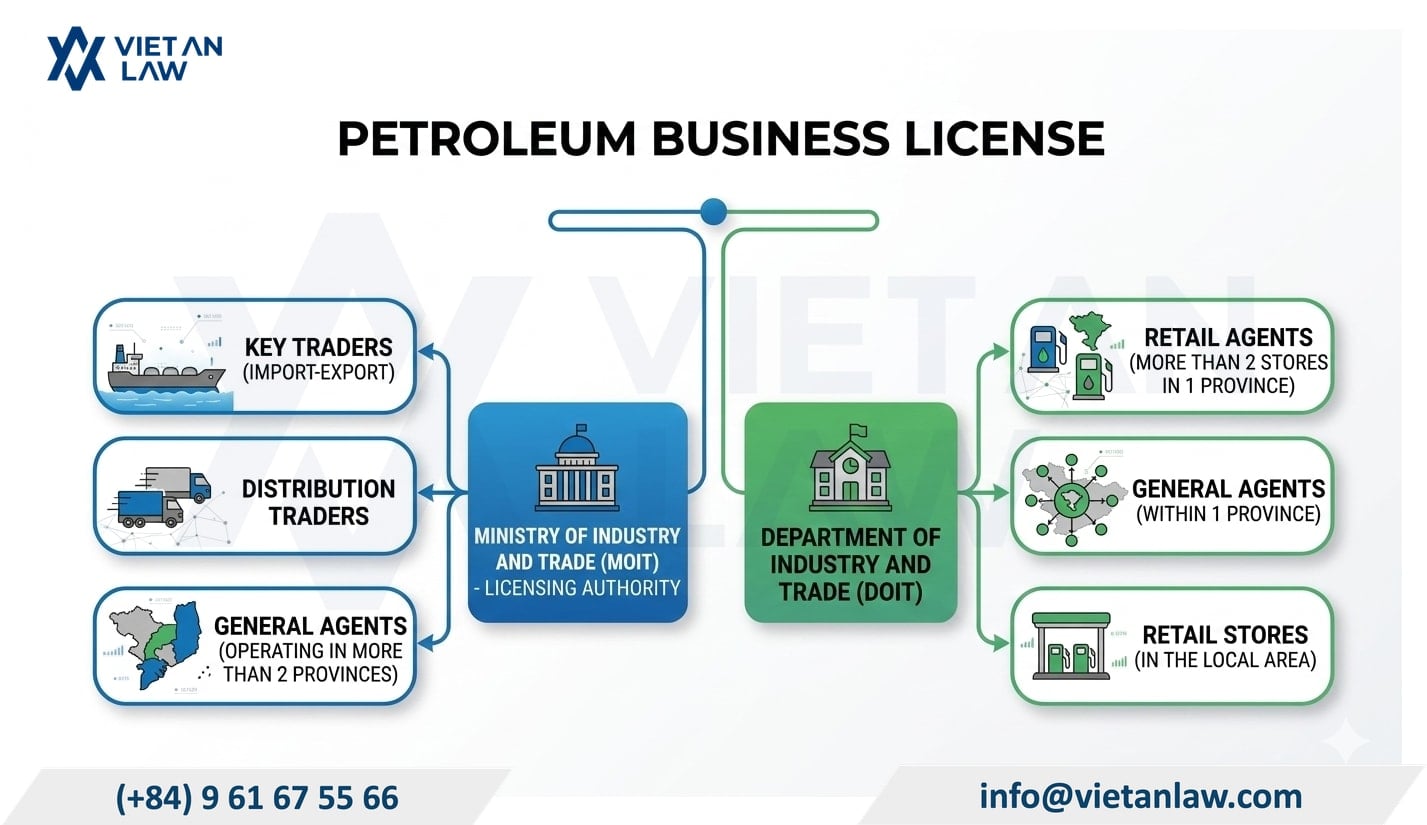
Petroleum business license
Prominent petroleum business companies in Vietnam
Vietnam national Petroleum group (Petrolimex)
Petrolimex is Vietnam’s largest petroleum distribution company, possessing a widespread distribution network and a modern system of retail outlets. As a key state-owned enterprise, Petrolimex ensures a stable supply and strictly adheres to all business regulations as stipulated by law.
Vietnam Oil Corporation (PVOIL)
PVOIL is a subsidiary of the Vietnam National Petroleum Group, operating in the fields of trading, processing, and distributing petroleum products. The company has a nationwide retail network and focuses on complying with safety, environmental, and technical requirements under relevant laws.
Saigon Petro Joint Stock Company (Saigon Petro)
Saigon Petro is a major petroleum trading company in the Southern region, with a stable retail network and a widely recognized brand. The company ensures compliance with all legal requirements regarding warehousing, transportation, and technical standards in its petroleum business operations.
Thanh Le Import-Export Trading Corporation (TLP Corporation)
TLP is a large-scale fuel distributor, owning storage infrastructure and a distribution network that fully meets the requirements for petroleum business. The company plays a crucial role in supplying fuel to the Southern region and complies with safety and environmental regulations.
Military Petrochemical Joint Stock Company (MIPEC)
MIPEC operates in the petrochemical and petroleum trading sectors with an ever-expanding network of warehouses and retail outlets. The company focuses on investing in infrastructure, ensuring compliance with fire safety, environmental protection, and technical standards as stipulated by relevant laws.
Are petroleum retailers required to own storage tanks, reservoirs, or specialized transport vehicles?
Based on Clause 18, Article 1 of Decree 95/2021/ND-CP amending and supplementing Article 24 of Decree 83/2014/ND-CP, current law does not require petroleum retailers to own their own storage facilities, tanks, or transportation vehicles. Instead, retailers are allowed to co-own or lease these assets from petroleum service enterprises, provided the lease contract has a term of 5 years or more.
What is the minimum capital required to open a petrol station? Does the law regulate legal capital?
According to Article 24 of Decree 83/2014/ND-CP, current specialized laws do not specify a concrete minimum capital requirement for retail gasoline and diesel fuel operations. The investment capital level depends entirely on the project scale and the actual financial capacity of the enterprise. However, the enterprise must ensure sufficient resources to meet stringent standards regarding planning, construction, and fire safety.
Establishing a petroleum business requires enterprises to have a thorough understanding of legal conditions, technical standards, and licensing procedures to ensure compliance with regulations. If you require advice or assistance with related procedures, Viet An Law is always ready to provide timely support and answers.