


Company branch establishment in Vietnam is a solution chosen by many enterprises when they want to expand their market, develop business operations, and increase customer reach in various provinces and cities. After completing the company establishment procedures, many enterprises continue to choose to open branches to expand their scale of operations and develop their business system in different localities.
According to the Law on Enterprises, a branch is a dependent unit of an enterprise, which can perform all or part of the business functions of the parent company, including authorized representation activities. Whether opening a branch in the same province or a different province, the business must register its operations with the business registration authority in accordance with regulations.
In the article below, Viet An Law will provide detailed guidance on company branch registration in Vietnam 2026: Latest procedures, documents and tax rules, helping enterprises choose the most suitable option and optimize operational efficiency.
What does it mean to establish a branch office in Vietnam?
Vietnam branch office registration means that an enterprise registers an additional operating location to perform part or all of its business functions outside of its head office. Branches can be opened within the same province or in a different province and are permitted to conduct business within the scope of authorization given by the parent company.
Conditions for company branch registration in Vietnam
To register a branch office, an enterprise must meet the following conditions as stipulated in the current Law on Enterprises:
- The parent company must be operating legally and not have its tax identification number blocked;
- The branch office must be permitted to perform all or part of the business functions of the parent company, including authorized representation. The enterprise must choose an appropriate independent or dependent accounting model;
- The branch office name must include the enterprise name followed by the phrase “Branch Office” and be displayed at the head office in accordance with legal regulations;
- The operating address must be clear and legal. The enterprise can open a branch office in the same province or a different province and is allowed to have multiple branches in one locality;
- The branch office’s business activities must be consistent with the registered business activities of the parent company;
- The head of the branch office must have full legal capacity and not be prohibited from managing a business according to legal regulations;
- There must be a decision to open the branch office with the correct authority according to the type of enterprise.
Documents for branch office establishment in Vietnam
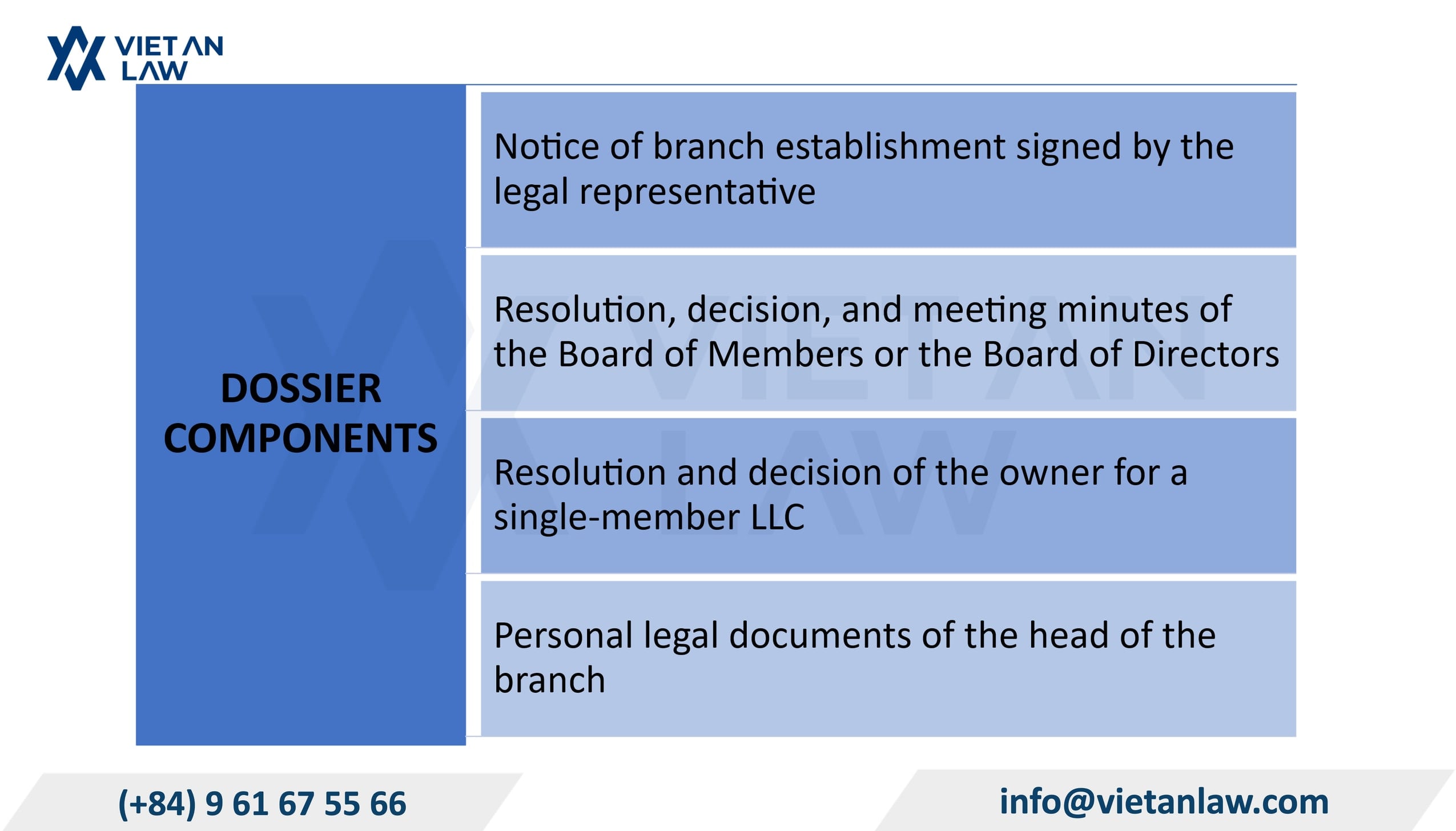
When establishing a branch office, enterprises need to prepare registration documents appropriate to each type of enterprise as stipulated in the current Law on Enterprises. Below are the required documents for opening a new company branch office in 2026:
| Type of business entity | Required Documents |
|---|---|
| Single-member LLC | Notice of branch establishment; Decision of the company owner; Decision on the appointment of the head of the branch. |
| Multi-member LLC | Notice of registration for branch operations; Decision and meeting minutes of the Board of Members regarding the establishment of the branch; Decision on the appointment of the head of the branch. |
| Joint stock company | Notice of branch establishment; Decision and meeting minutes of the Board of Directors; Decision on the appointment of the head of the branch. |
| In case of submitting documents via an authorized representative | Letter of authorization for the individual submitting the branch establishment documents as per regulations. |
In addition to the above documents, enterprises need to fully declare information about the branch name, branch address, business lines, information of the branch head, and whether the accounting system is dependent or independent.
According to the new regulations in Decree 168/2025/ND-CP, if an enterprise declares the personal identification number of the branch head on the national business registration system, the branch registration application may not require a copy of the branch head’s personal legal documents.
Procedures for branch office registration in Vietnam 2026
To legally open a branch office, enterprises need to prepare all necessary documents and follow the current business registration procedures. The branch registration process is governed by Article 45 of the Law on Enterprises 2020 and Decree 168/2025/ND-CP on business registration.
According to current regulations, when opening a branch office, businesses need to prepare information about the branch’s operations, draft registration documents, submit them to the Business Registration Authority, receive the Enterprise Registration Certificate, and continue with procedures related to taxes, invoices, and digital signatures. For branch offices located in different provinces, businesses should also be aware of regulations regarding tax declaration, accounting, and seal management based on the operating location.
The procedure for opening a company branch consists of 5 steps: preparing branch information, drafting the registration application, submitting the application to the Department of Finance, receiving the operating certificate, and carrying out post-registration tax procedures.
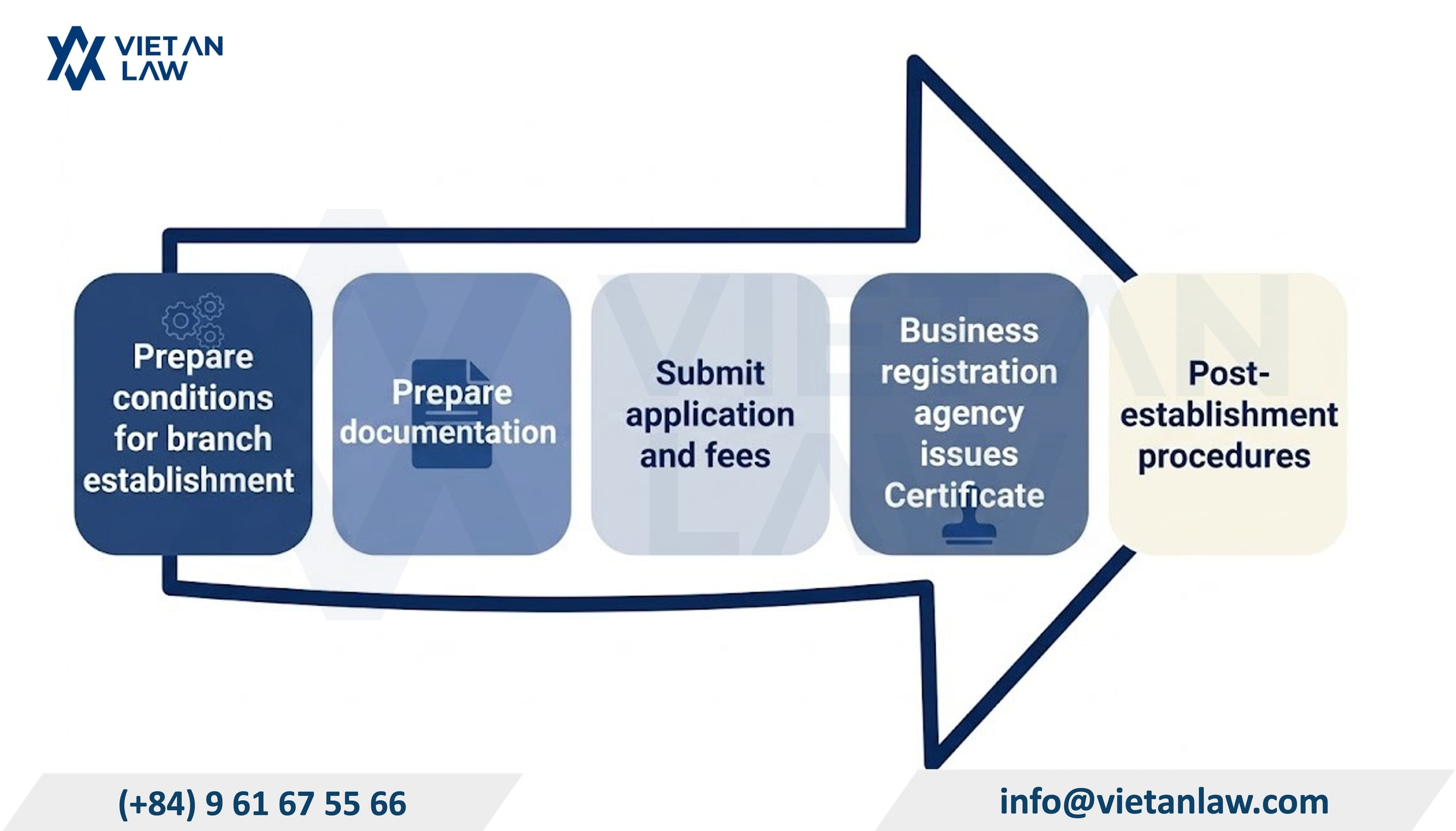
- Procedure steps:
- Step 1: Review and prepare the necessary conditions
- Step 2: Prepare the application documents
- Step 3: Submit the application and fees.
- Step 4: The business registration authority issues the Certificate.
- Step 5: Post-establishment procedures such as seal engraving, tax declaration and payment, signage making and display, purchasing an electronic signature, etc.
Common errors when registering a company branch
- Incorrect or missing business registration for the branch
- Invalid branch address according to legal regulations
- Branch head’s Citizen Identification Card/Citizen Identification Card not yet updated
- Branch head’s declared information is inaccurate
- Incorrect type of tax accounting for the branch
- Failure to declare the dependent tax code correctly
- Branch name not in accordance with enterprise regulations
- Branch registration dossier lacking signatures or attached documents
- Failure to carry out tax procedures after branch establishment
- Registering the branch address in an unauthorized location
- Incorrect parent company information on the branch registration dossier
- Failure to publish the branch registration details within the deadline
- Failure to display the branch signboard at the branch
- Failure to update branch information when changes occur
- Incorrect declaration of the branch’s tax management province/city.
Timeline and fees for company branch setup in Vietnam 2026
According to current regulations on branch registration, the processing time for a company branch registration application is usually around 3 working days from the date the Business Registration Authority receives a complete and valid application. If the branch registration application requires amendment or supplementation, the processing time may be extended depending on the specific circumstances.
Regarding the cost of opening a company branch, enterprises are currently exempt from registration fees, including the fee for publishing the branch registration details, as stipulated by current law. For opening a branch in a different province, enterprises should also be aware of the procedures related to taxes, declarations, and operational management in the locality where the branch is located.
How do dependent branch in Vietnam and independent accounting branch Vietnam differ?
When opening a company branch, enterpises need to choose between an independently accounting branch or a dependent accounting branch model that suits their management, accounting, and tax declaration needs. Each branch operating model will have different characteristics and tax obligations.
| Criteria | Independent accounting branch | Dependent accounting branch |
|---|---|---|
| Legal status | Does not have independent legal entity status | Does not have independent legal entity status |
| Business activities | Conducts business activities under the authorization of the company | Conducts business activities as assigned by the company |
| E-invoice Issuance | Can issue its own e-invoices | Can issue invoices as decentralized/authorized by the enterprise |
| Vat declaration | Self-declares and pays VAT | Declares through the parent company or according to tax management regulations. |
| Corporate income tax (cit) | Self-determines revenue, expenses, and taxable income | Revenue and expenses are consolidated at the parent company |
| Accounting | Has its own accounting book system and separate financial statements | Accounting data is a part of the company’s records |
| Accounting department | Considered a separate accounting unit under the Law on Accounting. | The accounting department belongs to the company’s accounting system. |
| Financial autonomy | More proactive in managing revenue and expenses | Dependent on the parent company for financial management |
| Suitability | Branches with large, independent business operations | Small-scale branches or those requiring centralized management |
Choosing the appropriate branch accounting method right from the branch registration stage will help enterprises manage their finances, file taxes, and operate their business effectively in the long term.
Branch office tax regulations in Vietnam
After completing the procedures for establishing a company branch, the enterprise needs to fulfill its obligations regarding taxes, electronic invoices, and tax declarations according to current regulations. Depending on whether the branch operates independently or as a dependent entity, the tax obligations of the company branch may vary.
| Tax type/ Financial obligation | Regulations for company branches |
|---|---|
| License Fees | Business license tax has currently been abolished for both enterprises and company branches |
| VAT | Independent accounting branches perform separate VAT declaration and payment. For dependent accounting branches, VAT declaration follows current tax management regulations. |
| CIT | Independent accounting branches self-declare their own CIT. For dependent branches, revenue and expenses are usually consolidated at the parent company |
| E-invoices | Branches involved in selling goods or providing services must register for e-invoice usage according to tax authority regulations |
| Initial tax declaration | Out-of-province branches usually must complete initial tax declaration procedures, register tax calculation methods, and work with the direct managing tax authority after establishment |
| Digital signature | Independent accounting branches or those with electronic tax filing requirements usually need to register a digital signature to perform online tax obligations |
| Bank account | Depending on operational needs, a company branch can open its own bank account for transactions and tax declarations |
Enterprises should choose the appropriate independent or dependent accounting branch model right from the branch registration stage to facilitate tax declaration, invoice management, and future business operations.
Note the procedures after establishment
Making and displaying company signs at the head office
Branch offices must display a branch office sign at the branch office with the following information: Name of the governing body (the agency that issued the Certificate of Business Registration, i.e., the Department of Finance), branch name, head office address, telephone number or email (if any).
Purchasing an electronic signature for electronic tax filing
- Branch offices must purchase an electronic signature to file taxes electronically for the branch.
- After the branch receives its Enterprise Registration Certificate, company employees must send the branch’s business registration information to the tax authority and submit the initial tax declaration if the branch is located in a different province or centrally-governed city.
Should you establish a branch, a representative office, or a business location?
| Model | Conduct business | Issue invoices | Tax declaration |
|---|---|---|---|
| Branch | Yes | Yes | Yes |
| Representative office | No | No | No |
| Business location | Yes | Dependent | Simpler |
What is the difference between a branch in the same province and a branch in a different province?
- If the branch is established in the same province/city as the company, the tax authority is the same as the company’s tax authority.
- If the branch is established in a different province/city from the company, the tax authority is the one in the province/city where the branch is located.
Advantages and disadvantages of Vietnam business branch registration
Advantages:
- Establishing a branch allows it to operate like the parent company, register its own seal, and sign economic contracts on behalf of the parent company.
- The branch can also file and pay taxes separately as an independent unit if registered as an independently accounting branch. This independent operation is convenient for customers, who can simply go to the nearest branch to conduct transactions instead of going directly to the company’s head office.
Disadvantages:
- Opening a branch will incur the procedure of filing independent tax returns for the branch.
- For independently accounting branches, at the end of the year, the branch needs to prepare financial statements for its operations. Currently, there are business locations that can generate business activity without the need for quarterly or annual tax filing. Therefore, if a company intends to establish an independently accounting branch, it can choose to establish a business location as an alternative.
Frequently asked questions about branch office licensing in Vietnam
How long does it take to open a company branch?
Typically, the processing time for branch registration is about 3 working days from the date of receipt of complete and valid documents.
Does opening a branch in a different province require separate tax declaration?
Branches in different provinces usually require initial tax declaration and work with the tax authority directly managing the location of the branch.
Can a company branch issue invoices?
A branch that conducts business and registers to use electronic invoices according to regulations is allowed to issue invoices.
Is it possible to open multiple branches in the same province?
Enterprises are allowed to open multiple branches in the same province or city according to the provisions of the Law on Enterprises.
What is the difference between a branch and a business location?
A branch is allowed to conduct business activities, sign contracts, and can have separate accounting; while a business location usually has a simpler scope of operation.
Does a company branch have legal personality?
A branch does not have independent legal personality but operates under the authorization of the parent company.
Is it mandatory to display a sign at the branch?
A branch must display a sign at its registered operating address in accordance with legal regulations.
What is the difference between independently accounting and dependent branches?
Independent branches declare and pay taxes separately, while dependent branches usually declare taxes together with the parent company.
What documents are required to open a company branch?
The documents usually include a notification of branch registration, a decision on establishment, meeting minutes, and documents of the branch head.
Can a branch be established in an apartment building?
It is not permitted to open a branch in a purely residential apartment building. Branches can only be located at addresses with business functions as stipulated by the law on housing and land.
Viet An Law’s company branch opening service
- With many years of experience in business consulting, Viet An Law assists clients in quickly and legally opening branches while optimizing costs. Our branch registration services include:
- Consulting on the conditions and legal regulations for opening a company branch;
- Consulting on choosing the appropriate independent or dependent accounting model;
- Drafting branch registration documents according to each type of business;
- Representing clients in submitting documents, monitoring and processing procedures at the Business Registration Authority;
- Providing advice on taxes, electronic invoices, digital signatures and post-registration procedures;
- Consulting on opening branches in other provinces, business locations and representative offices;
- Assisting with procedures for changing branch registration details during operation.
Registering a branch office with the advice of specialized lawyers will help businesses operate smoothly, manage taxes, and expand their market in the long term. If you need assistance with documents, procedures, or legal issues related to opening a company branch, please contact Viet An Law for prompt and accurate advice.