


As workplace dynamics evolve, ensuring legal compliance in human resources management is crucial to prevent conflicts. Under the Labor Code 2019, any enterprise employing 10 or more people must issue and register its internal labor regulations with the competent authorities.
Navigating this requirement often demands expert labor law consultancy to ensure that disciplinary rules, working hours, and liability clauses comply with current laws while suiting practical business needs. Poorly drafted rules not only complicate labor dispute resolution but can also expose employers to legal liabilities.
In this comprehensive guide, Viet An Law details the procedures for drafting internal labor regulations in Vietnam in 2026, covering mandatory content, registration steps, and key legal considerations.
Bases for drafting and reviewing internal labor regulations in Vietnam
Practical basis
Employers may base the drafting of company regulations on the production and business situation of their units in accordance with the provisions of labor laws.
Legal basis
- Enterprises with 10 or more employees: It is mandatory to register written internal labor regulations as stipulated in Clause 1, Article 118 of the Labor Code 2019.
- Enterprises with fewer than 10 employees: It is not mandatory to issue written regulations. However, contents regarding labor discipline and material responsibility must be specifically agreed upon in the labor contract (according to Clause 1, Article 69 of Decree 145/2020/ND-CP).
09 mandatory contents in internal labor regulations
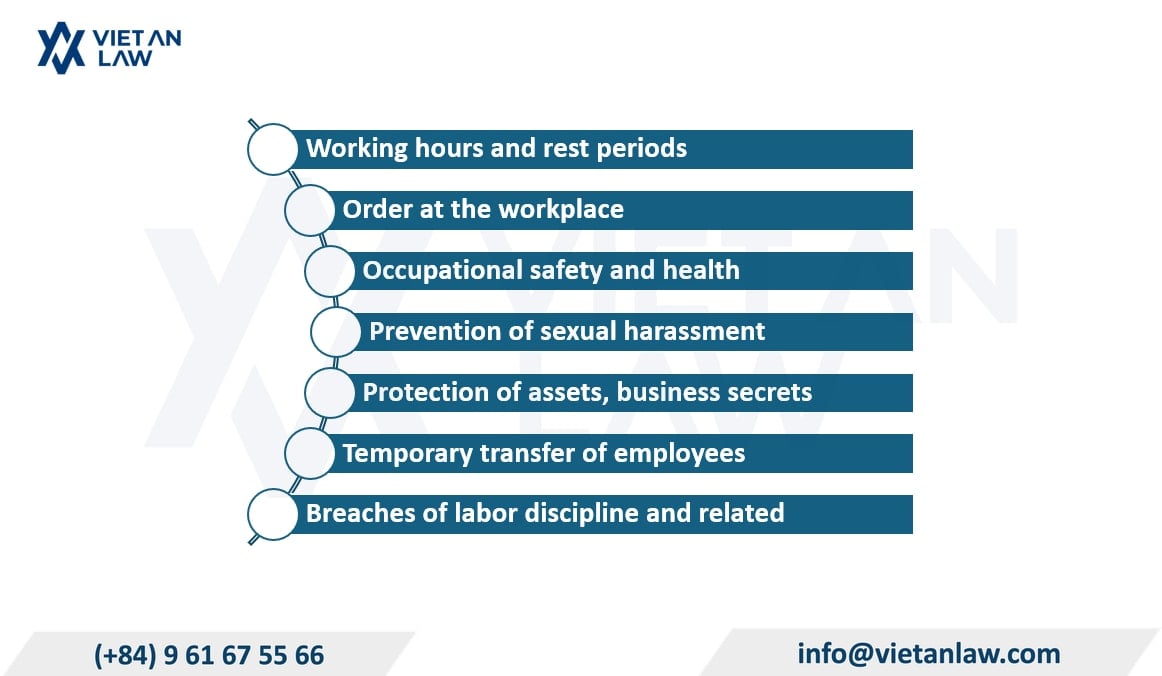
Pursuant to Clause 2, Article 118 of the Labor Code 2019 and Clause 2, Article 69 of Decree 145/2020/ND-CP, a standard set of internal labor regulations includes the following nine primary groups of content:
- Working hours and rest periods: Provisions on working shifts, starting and ending times, overtime, rest breaks, weekly days off, and annual leave.
- Order at the workplace: Working areas, movement during working hours, behavioral culture, dress code, and compliance with assignments and mobilizations.
- Occupational safety and health: Responsibilities for complying with safety procedures, fire prevention and fighting, and the use of labor protection equipment.
- Prevention of sexual harassment at the workplace: Provisions on prohibited behaviors, reporting mechanisms, internal handling procedures, and related labor discipline.
- Protection of assets, business secrets, and technological secrets: A list of assets and information requiring confidentiality; strictly prohibited acts; and responsibilities for damages.
- Temporary transfer of employees to perform work different from the labor contract: Circumstances, durations, and principles of application.
- Breaches of labor discipline and disciplinary measures: Clear identification of each violation and the corresponding form of disciplinary action.
- Material responsibility: Provisions on compensation for damages caused by damaging or losing assets.
- Authority to handle labor discipline: Clear identification of the person authorized to handle disciplinary actions.
Common errors when drafting and reviewing internal labor regulations
- Solely copying online templates without customizing them to company requirements;
- Lacking provisions on sexual harassmecompany’snt behaviors at work;
- Stipulating illegal monetary fines;
- Incorrectly designating the authority to handle discipline;
- Failing to register the company regulations;
- Failing to regulate overtime hours or regulating them incorrectly;
- Including contents that contravene labor law provisions.
Risks of invalid internal labor regulations
- Facing administrative fines upon inspection or audit;
- Inability to enforce disciplinary actions according to regulations;
- Unlawfully dismissing employees;
- Easily giving rise to labor disputes;
- Easily incurring liability to compensate employees;
- Promulgated disciplinary decisions being easily invalidated.
Procedures and process for drafting internal labor regulations in Vietnam
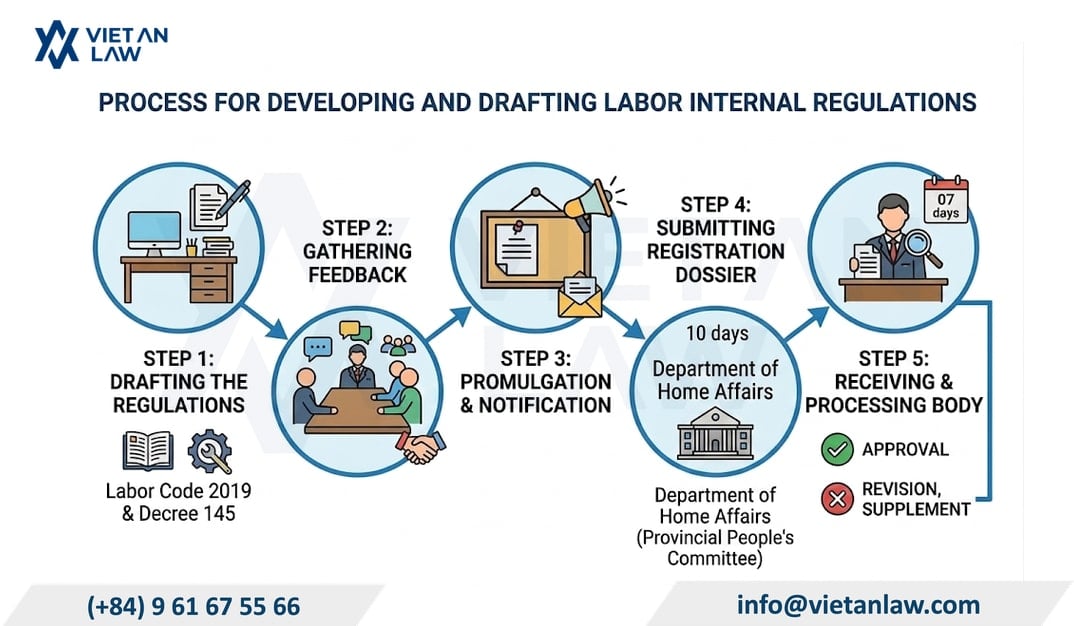
Step 1: Drafting the draft internal labor regulations
The content of the internal labor regulations must not contravene labor laws or relevant legal provisions and must include the main contents prescribed in Clause 2, Article 118 of the Labor Code 2019 and Clause 2, Article 69 of Decree 145/2020/ND-CP.
Step 2: Consulting the employee representative organization
Before issuing the internal labor regulations, the employer must consult the employee representative organization at the grassroots level, for workplaces where such an organization exists.
Step 3: Promulgating and publicly announcing the regulations
Once issued, the internal labor regulations must be sent to each employee representative organization at the grassroots level (if any) and notified to all employees. Additionally, the main contents must be posted in necessary areas at the workplace.
Step 4: Submitting the registration dossier
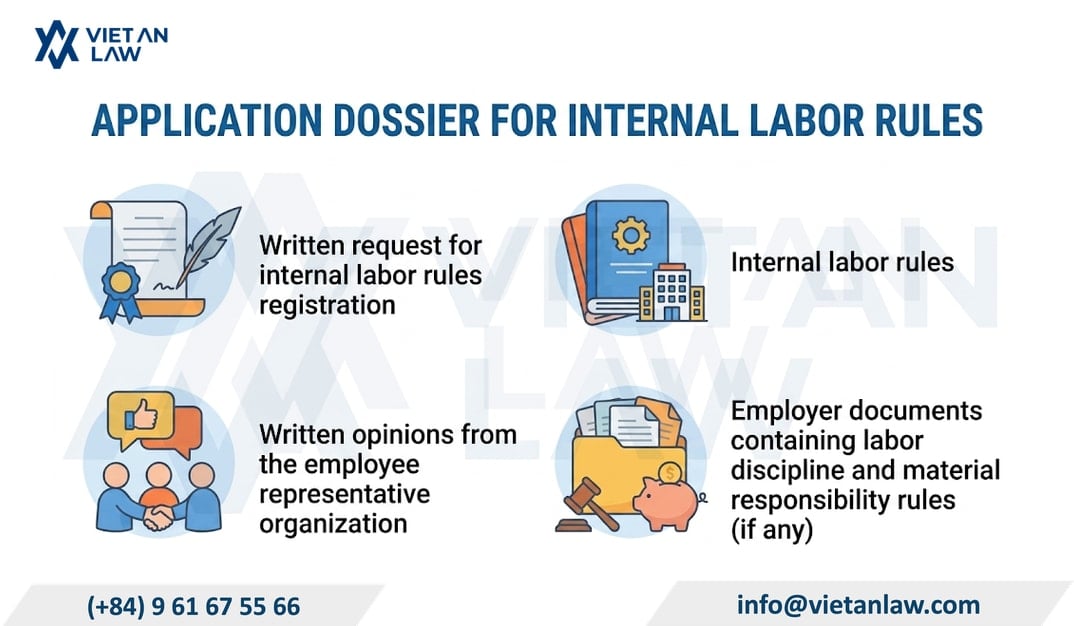
Within 10 days from the date of issuing the internal labor regulations, the employer must submit a registration dossier to the specialized labor agency (usually the Department of Home Affairs) under the provincial People’s Committee where the employer registers its business. The dossier includes:
- A written request for registration of the internal labor regulations;
- The internal labor regulations;
- A document containing feedback from the employee representative organization at the grassroots level, for workplaces where such an organization exists;
- Documents of the employer containing provisions related to labor discipline and material responsibility (if any).
Step 5: Processing by the competent authority
Within 07 working days from the date of receiving the registration dossier, if the specialized agency under the provincial People’s Committee or the communal People’s Committee (if authorized) discovers provisions contrary to the law, it will notify and guide the employer to amend, supplement, and re-register the internal labor regulations. The internal labor regulations take effect 15 days after the competent state agency receives the complete registration dossier.
| Stage | Timeframe |
| Drafting regulations | 1–3 days |
| Consulting the employee representative organization | 1–5 days |
| Submitting the registration dossier | Within 10 days |
| Agency response | 7 days |
| Regulations take effect | After 15 days |
Dossier of registration of internal labor regulations in Vietnam
Why are internal labor regulations essential for enterprises?
Internal labor regulation is not merely a formal document to satisfy legal requirements. This plays a central role in establishing labor discipline, preventing disputes, and protecting the legitimate rights and interests of both employers and employees. Specifically, internal labor regulations demonstrate the following important roles:
- Serving as an effective labor management tool within the enterprise. Through internal labor regulations, employers establish common standards on working hours, workplace order, occupational safety, and professional demeanor. This provides the basis for enterprises to uniformly organize and manage production and business activities, limiting arbitrary and undisciplined work behavior.
- Providing the mandatory legal basis for handling labor discipline. One of the prerequisites for an employer to impose disciplinary action is that the violation must be stipulated in the legally valid internal labor regulations. Therefore, these regulations serve as a vital legal foundation, helping enterprises protect their legitimate right to enforce discipline and minimizing the risk of rulings that declare disciplinary actions unlawful during a dispute.
- Contributing to the protection of employees’ legitimate rights and interests. Internal labor regulations help employees clearly understand their rights, obligations, and prohibited behaviors while working. When regulations are publicly and transparently announced, employees have grounds to protect themselves against incorrect or arbitrary disciplinary decisions.
- Acting as a foundation for preventing labor disputes and internal complaints. Clearly drafted regulations that conform to the law and closely match practical operations will help enterprises significantly reduce disputes arising from labor discipline, material responsibility, working and rest hours, and workplace behavior.
- Reflecting corporate culture and professional conduct standards. Beyond mandatory provisions, internal labor regulations reflect the core values, corporate culture, sense of responsibility, and work attitude that the employer wishes to cultivate. This is a crucial factor in building a professional, safe, and mutually respectful working environment.
- Functioning as a necessary condition for legal compliance and risk reduction. Issuing and registering internal labor regulations correctly helps enterprises avoid administrative penalties while creating a solid legal footing when dealing with state management agencies, trade unions, and during dispute resolution at the Court.
Common questions regarding internal labor regulations and labor regulations registration service in Vietnam
Is there a penalty for failing to register internal labor regulations?
According to Clause 1, Article 6 of Decree 12/2022/ND-CP, when an employer is required to register internal labor regulations but fails to do so with the competent authority as prescribed, they may face administrative fines ranging from 5,000,000 VND to 10,000,000 VND for individuals, and from 10,000,000 VND to 20,000,000 VND for violating organizations.
Do internal labor regulations require employee consultation?
Yes. When drafting the internal labor regulations, the employer must consult the employee representative organization at the grassroots level (if any) before issuance, in accordance with Clause 3, Article 118 of the Labor Code 2019. If an enterprise does not yet have an employee representative organization, the law does not strictly require consulting each employee; however, seeking employee feedback is still encouraged to ensure transparency, consensus, and minimize disputes during the application of the regulations.
When do internal labor regulations take effect?
The internal labor regulations take effect 15 days from the date the competent state agency receives the complete registration dossier.
Are sexual harassment provisions mandatory?
Yes. This is mandatory content according to Point c, Clause 2, Article 118 of the Labor Code 2019.
Do amended regulations require re-registration?
Yes. When amending or supplementing internal labor regulations, the employer must carry out procedures to re-register them with the competent state agency.
Do enterprises with fewer than 10 employees need internal labor regulations?
Enterprises with fewer than 10 employees are not required to issue written internal labor regulations. However, contents regarding labor discipline and material responsibility still need to be agreed upon within the labor contract.
Do internal labor regulations require a company seal?
Current laws do not mandate that internal labor regulations be stamped with the company seal. However, many enterprises still apply their seal to ensure consistency and facilitate internal management.
Do internal labor regulations need to be bilingual?
The law does not require internal labor regulations to be bilingual. However, foreign direct investment (FDI) enterprises or companies employing foreign workers should draft bilingual internal labor regulations to ensure uniform application and ease of management.
Can an employer dismiss an employee without registered regulations?
Generally, an enterprise that is required to register internal labor regulations but has not done so will face legal risks when enforcing dismissal discipline. In many cases, the disciplinary decision may be deemed invalid.
Do internal labor regulations require trade union approval?
Before issuing internal labor regulations, the enterprise must consult the employee representative organization at the grassroots level (if any). However, the law does not mandate that the trade union must “approve” the regulations before they can be promulgated.
Labor law consultancy services in Vietnam of Viet An Law
With extensive experience in providing labor law consultancy for numerous domestic and FDI enterprises, Viet An Law offers comprehensive services in drafting, reviewing, and addressing legal issues related to internal labor management in accordance with the latest provisions of the Labor Code 2019 and its guiding documents.
Viet An Law’s services include:
- Consulting on the framework and directly drafting internal labor regulations tailored to the enterprise’s operational model;
- Reviewing, amending, and updating internal labor regulations to reflect the latest legal requirements;
- Advising on and acting as a representative to execute registration procedures with competent state agencies;
- Consulting on handling labor discipline, material responsibility, and situations involving regulatory violations within the enterprise;
- Consulting on labor dispute resolution, internal company conflicts, and supporting interactions with labor management authorities;
- Consulting on drafting bilingual internal labor regulations for FDI enterprises and foreign-invested companies;
- Assisting in reviewing the legal validity of internal labor regulations to minimize the risk of administrative penalties and subsequent disputes.
Properly drafting and registering your company rules not only ensures compliance but also builds a foundation for professional, transparent, and efficient human resource management.
If your enterprise requires assistance with drafting internal labor regulations in Vietnam 2026, enforcing labor discipline, executing registrations, or resolving conflicts, please contact Viet An Law for prompt and effective support.