Professional Construction Contract Drafting Services in Vietnam
In the 2026 construction landscape, where standards for progress, quality, and especially material price fluctuations are being tightened, a rigorous contract serves as the ultimate “shield” protecting the interests of all parties. However, self-drafting based on generic online templates often leads to fatal legal loopholes, from missing price adjustment clauses to ambiguous inspection and acceptance procedures. A poorly drafted construction contract is more than just a signed paper; it is a “time bomb” that can jeopardize billions of VND and a company’s reputation at any moment. Utilizing professional construction contract drafting services in Vietnam not only helps you “digitalize” commitments but also ensures full compliance with the latest investment and construction management regulations in Vietnam. In the following article, Viet An Law will detail the key elements of this crucial matter.
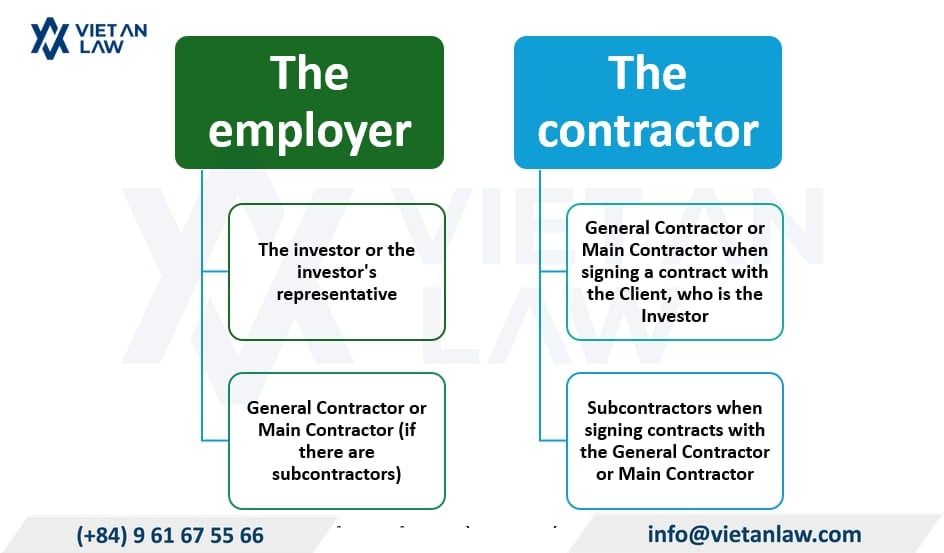
According to Article 80 of the Law on Construction 2025, which provides general regulations on construction contracts, a construction contract is a written agreement between the contracting party and the contractor regarding the establishment, modification, or termination of civil rights and obligations for the performance of work in construction activities. The law also stipulates the entities authorized to conclude construction contracts, generally comprising the following two groups:
The entity authorized to enter into construction contracts
The contracting party:
Is the investor or the investor’s representative. According to the Law on Construction 2025, the investor has the right and obligation to select the contractor and sign the construction contract.
Is the general contractor or the main contractor in case they subcontract a part of the work to a subcontractor.
Contractor:
Is the General Contractor or Main Contractor when signing a contract with the Client (the Investor).
Is a Subcontractor when signing a contract with the General Contractor or Main Contractor.
The Contractor may be a consortium of contractors. In this case, the members of the consortium must have a consortium agreement clearly specifying the leading member.
Note: The contractor may also be a foreign contractor (a foreign organization or individual engaged in construction activities in Vietnam).
Mitigating risks from construction material price fluctuations
In a volatile market, using rudimentary (“copy-paste”) contract templates often leads to disputes when material costs rise. Professional services will help enterprises apply the correct legal regulations to protect their rights.
Choosing the right contract pricing type: Instead of using a “lump-sum contract” or “fixed unit price” (where the contractor bears the price risk), experts advise using a “adjustable unit price contract”. This type of contract allows unit prices to change based on inflation as agreed upon in the contract.
Establish a strict price adjustment mechanism:
According to regulations, price adjustments must be specifically agreed upon in the contract regarding the adjustment method and data source.
Professional services will develop a specific price adjustment formula (such as the formula GTT=GHD×Pn stipulated in Decree 37/2015/ND-CP, amended and supplemented by Decree 50/2021/ND-CP), clearly defining the adjustment coefficients (Pn) corresponding to the basket of goods/materials.
Clearly define the input data for calculation (e.g., price index of a competent State agency such as the Ministry of Construction or the General Statistics Office). If the source of this index is not clearly defined from the outset, the parties will have no basis to trigger adjustments when the market fluctuates.
Regulations on adjustment thresholds and scope:
The contract must clearly specify the circumstances under which adjustments are permitted. For example, the Law on Construction 2025 allows adjustments in the event of changes in government policy or force majeure.
For work volume exceeding 20% of the original contract, the parties must agree on new unit prices. Professional drafting services will ensure these clauses are detailed to avoid applying the old unit prices to large additional work volumes, causing losses to the contractor.
Ensuring compliance with the legal framework in Vietnam
2026 is a crucial year as the construction legal system undergoes significant changes. Contracts need to be drafted by experts to ensure compliance with the Law on Construction 2025 (effective from January 1, 2026, and some provisions from July 1, 2026).
Avoiding the risk of invalid contracts:
According to the Law on Construction 2025, a construction contract is only legally valid when it meets all the conditions, including the signatories having full legal capacity, proper authority, and compliance with the principles of signing.
The contract content must comply with the latest mandatory regulations. The Law on Construction 2025 details the main contents of a contract in Article 82 (including legal basis, scope of work, price, advance payment, payment, warranty, etc.). An old contract found online may lack these mandatory contents, leading to legal risks.
Compliance with new regulations on operational capacity: The Law on Construction 2025 tightens regulations on the capacity of organizations and individuals participating in construction activities (Article 88). Professional services will help review the capacity documents of the parties (operational capacity certificates, professional licenses) to ensure that the contractor meets the requirements for signing the contract, avoiding cases where the contract is invalidated due to the contractor’s lack of capacity.
Handling transitional regulations: Enterprises need to pay attention to Article 95 of the Law on Construction 2025 regarding transitional regulations. Projects or contracts that are underway at the time the new law comes into effect need appropriate solutions to avoid interruption or violations of the new regulations.
Copy-pasting contracts often results in vague quality clauses (e.g., “guaranteeing good quality”). Professional contract drafting services will specify these requirements on a solid legal basis:
Legal basis for standardization: According to the Law on Construction 2025, construction activities are required to comply with national technical regulations and applicable standards (on a voluntary basis but subject to approval by the investment decision-maker).
Contractual obligations: Decree 37/2015/ND-CP, amended and supplemented by Decree 50/2021/ND-CP, clearly stipulates that the quality of products in construction contracts must meet the requirements of regulations and standards (Vietnamese standards or international standards such as Eurocodes, ASTM, etc., if agreed upon) as well as technical specifications applicable to the project.
Significance: Including these specific standard codes in the contract provides parties with an accurate benchmark for comparison when disputes arise regarding the quality of materials or construction methods, instead of relying on subjective judgment.
Furthermore, professional contracts not only specify the deadline but also break down risks through milestones and accompanying penalties:
Key Performance Indicators (KPIs): Decree 37/2015/ND-CP, amended and supplemented by Decree 50/2021/ND-CP, requires that contract implementation schedules clearly show completion and handover milestones for key works and products. For large contracts, construction schedules can be established for each phase. Professional services will set these milestones as prerequisites for disbursement or triggering penalty clauses.
Regulations regarding penalties for violations:
According to the Law on Construction 2025, contract bonuses/penalties must be specifically agreed upon by the parties.
For projects using public investment funds or non-public investment state funds, the penalty shall not exceed 12% of the value of the breached portion of the contract. Professional drafting services help businesses calculate the optimal penalty within this legal limit while still being sufficiently deterrent.
Compensation for damages: The breaching party must compensate the other party for actual damages caused by its fault. Although the source material does not detail the definition of “indirect damages”, the law stipulates the principle of compensation for “full actual damages”, including the costs of repair, inspection, and rectification of defects. A professional contract should clarify this scope to include consequential damages (if civil law permits and the parties agree).
Furthermore, professional contracts also address “quality disputes” during payment through a rigorous acceptance process, specifically:
Acceptance Conditions: The Law on Construction 2025 stipulates that construction items can only be accepted when they meet design requirements, technical regulations, and applicable standards. Parties are only allowed to accept products that meet quality requirements.
Right to Refuse: The contracting party has the right to refuse acceptance of products that do not meet the quality standards of the contract and to withhold payment for defective products.
Transparent Payment Documentation: To receive payment, the contract must clearly specify the required documentation, including a confirmation report of the quantity and quality of work completed. For lump-sum or fixed-price contracts, the completion report is the most important legal basis to avoid disputes over the amount payable.
Current types of construction contracts
By nature of work: Includes consulting contracts, construction contracts, equipment supply contracts, EPC (Engineering, Procurement, and Construction), and turnkey contracts, etc.
By pricing method: Includes lump-sum contracts, fixed unit prices, adjustable unit prices, combined contracts, etc.
Note: For complex projects, combining these types of arrangements requires in-depth understanding to avoid conflicts between scope of work terms and payment mechanisms.
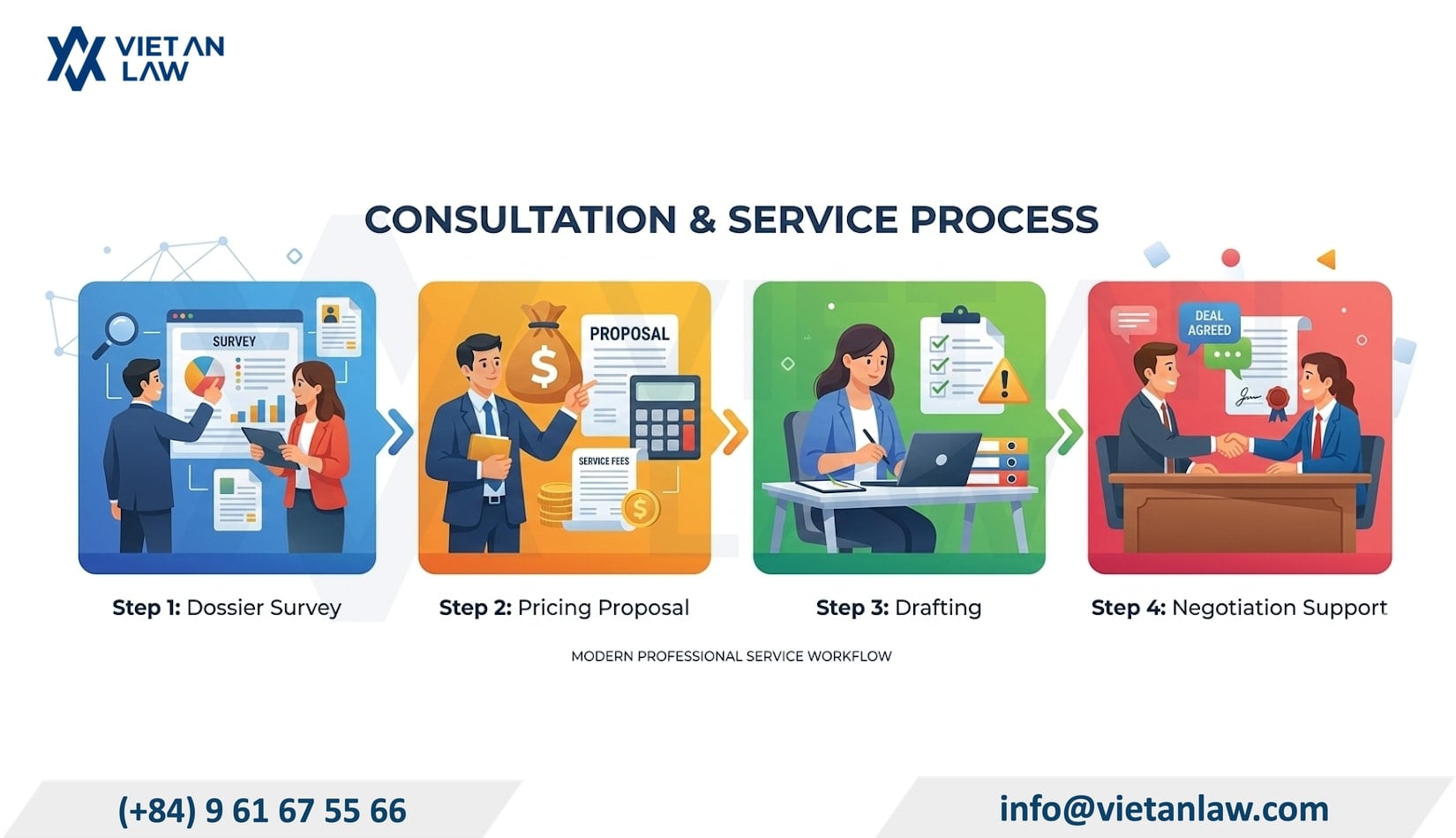
Service process for construction contract drafting at Viet An Law
Service process for construction contract drafting
Step 1: Dossier survey: Research the tender documents, feasibility reports, and requirements of all parties.
Step 2: Structural consultation: Propose contract pricing options (Lump sum, Adjustable unit price, or Cost plus fees).
Step 3: Drafting & review: Develop a detailed draft and explain potential risks to the client.
Step 4: Negotiation support: Accompany the client during meetings to finalize terms with partners.
Core components of construction contract drafting services at Viet An Law
Establish strict payment and advance payment terms: Clearly define the advance payment rate and disbursement conditions linked to acceptance documents and bank guarantees.
Manage changes and unforeseen expenses: Design a 4-step process to confirm unforeseen expenses (Request 🡪 Quotation 🡪 Approval 🡪 Implementation), helping to control items outside the budget and avoid cost overruns at the end of the project.
Detailed regulations on warranty and construction insurance: Determine the warranty period (usually 12-24 months) and the amount of warranty retention (3-5%). Mandatory construction and installation risk insurance (CAR).
Dispute resolution mechanism: Advise on the choice between commercial arbitration (VIAC) for information confidentiality or the Court for enforcement, depending on the client’s advantage.
Construction contracts are not just administrative procedures, but strategic documents that determine the success or failure of a project. With a team of experienced lawyers and construction economics experts, Viet An Law is committed to providing personalized, rigorous, and legally sound contracts for businesses. Please contact us for prompt assistance if you have any questions!
Fast & Reliable Legal Assistance
Fill out the form below and get connected with a lawyer quickly.
Navigating the legal framework for the Alcohol Distribution License in Vietnam (2026): Requirements, Procedures & Costs is a critical compliance step for businesses aiming to operate at the highest level…
Learn how to start a sporting goods business in Vietnam with our complete guide. Covers business registration, legal requirements, capital needs, and company formation procedures.
Discover high-growth industries for company incorporation in Singapore. Explore finance, IT, logistics, and consulting sectors with government incentives and market advantages.
Change Business Registration in Saigon Ward, HCMC guide. Complete procedures, required documents, timelines, and online submission process for enterprises in 2025.
Hai Phong City merger 2025 guide: Complete information on business registration, company formation procedures, and administrative updates after the merger with Hai Duong province.