


Acquiring shares or capital contributions in Vietnam is one of the most popular entry modes for foreign investors to join Vietnamese enterprises without having to directly establish a new FDI company. However, foreign investors must strictly comply with legal conditions and statutory regulations. Notably, current legislation clearly distinguishes between cases requiring the procedures for foreign investors to acquire shares and capital contributions in Vietnam (approval registration prior to updating company registration in Vietnam) and those that only require corporate changes of members or shareholders under enterprise law.
What is the concept of foreign investors to acquire shares and capital contributions in Vietnam?
Pursuant to Clause 2, Article 18 of the Law on Investment 2025, investment in the form of capital contribution, share acquisition, or capital contribution acquisition is a form of investment recognized under Vietnamese law. Investors have the right to contribute capital to, or acquire shares or capital contributions in, economic organizations established and operating in Vietnam.
In essence, foreign investors may participate in Vietnamese enterprises through two categories of transactions:
Capital contribution
- Purchasing shares issued for the first time or additional shares issued by a joint-stock company;
- Contributing capital to a limited liability company or a partnership;
- Contributing capital to other economic organizations does not fall under the aforementioned cases.
Acquisition of shares or capital contributions
- Purchasing shares of a joint-stock company from the company or its shareholders;
- Purchasing the capital contribution of a member of a limited liability company to become a member of that company;
- Purchasing the capital contribution of a capital-contributing partner in a partnership to become a capital-contributing partner of that partnership;
- Purchasing the capital contribution of a member of another economic organization not falling under the above cases.
Conditions for foreign investors to acquire shares and capital contributions in Vietnam
Article 21 of the Law on Investment 2025 stipulates that foreign investors purchasing shares or capital contributions in economic organizations must meet certain conditions.
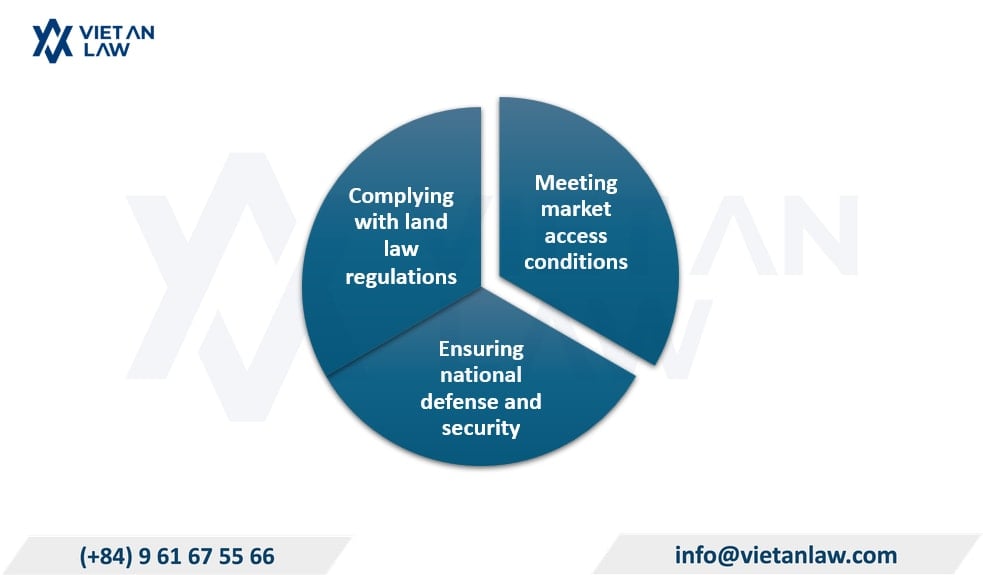
Meeting market access conditions for foreign investors in Vietnam
This is the first condition to be verified. Foreign investors are subject to the same market access conditions as domestic investors, except for:
- Sectors where market access is prohibited: Foreign investors are prohibited from investing in sectors where market access is not permitted, as specified in Section A of Appendix I attached to Decree No. 96/2026/NĐ-CP.
- Sectors subject to conditional market access: Foreign investors must satisfy the market access conditions published in accordance with Section B of Appendix I attached to Decree No. 96/2026/NĐ-CP.
Accordingly, it is necessary to review:
- The enterprise’s business lines;
- The sectors in which the foreign investor intends to participate;
- Market access conditions applicable to those sectors;
- Foreign investor capital ownership ratios, if stipulated by specialized laws or international commitments;
- Other conditions regarding the form of investment, scope of operations, or investor capacity, if applicable.
Ensuring national defense and security
Foreign investors acquiring shares or capital contributions must ensure compliance with national defense and security requirements under the Law on Investment and relevant laws.
Attention should be paid to this condition when the target enterprise holds land use rights in areas sensitive to national defense and security.
Complying with land law regulations
Pursuant to Point c, Clause 2, Article 21 of the Law on Investment 2025, foreign investors must comply with land law regulations regarding:
- Conditions for acquiring land use rights;
- Conditions for land use on islands;
- Communes, wards, and special zones in border areas;
- Coastal communes and wards;
- Other areas affecting national defense and security as prescribed by law.
Therefore, the land legal status of the target enterprise is a matter that should not be overlooked during the review process.
When must foreign investors register the acquisition of shares and capital contributions prior to transactions in Vietnam?
This is one of the most significant issues when foreign investors acquire shares or capital contributions in Vietnam. Pursuant to Article 21, Clause 3 of the Law on Investment 2025, foreign investors must carry out the registration procedure for capital contributions or the acquisition of shares or capital contributions prior to any change in members or shareholders if the transaction falls under any of the following cases:
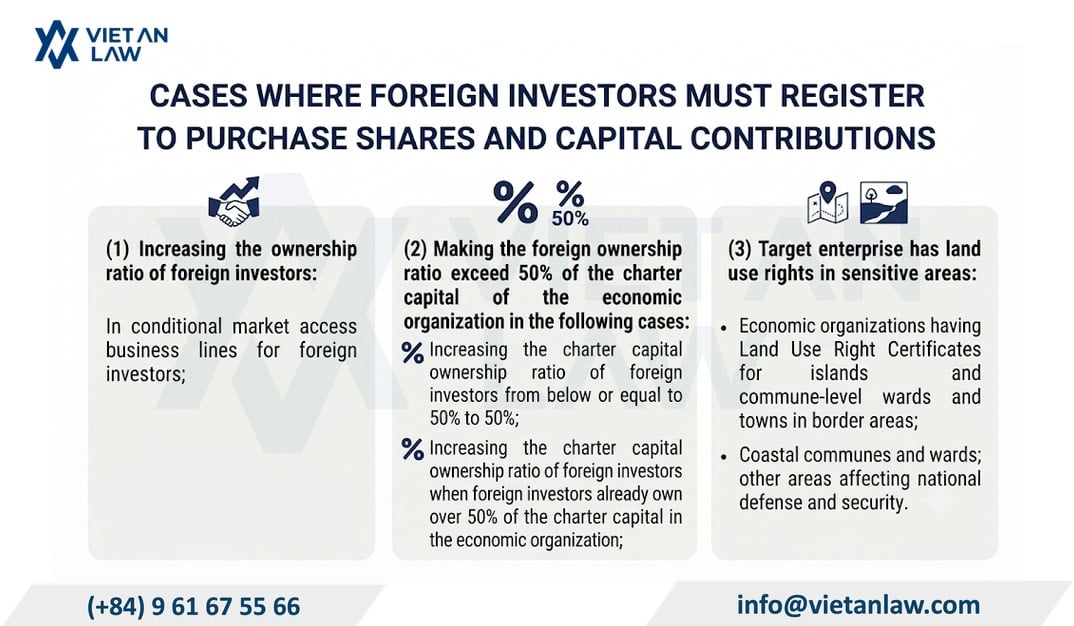
Case 1: Increasing the foreign ownership ratio in a business line subject to market access conditions
If a target enterprise operates in a business line subject to market access conditions for foreign investors, and a transaction would increase the foreign ownership ratio, a prior registration procedure must be carried out.
For example, consider a Vietnamese enterprise where a foreign investor currently holds 20% of the charter capital and intends to acquire an additional 10%. If the enterprise’s business sector falls under the category of conditional market access, it is necessary to verify the applicable conditions and complete the registration procedure in accordance with regulations.
Case 2: Increasing foreign ownership to over 50%
This is a very common scenario in practice regarding capital contributions and the acquisition of shares or capital contributions.
Investors are required to register transactions that result in a foreign investor or an economic organization – as defined in Clause 1, Article 20 of the Law on Investment 2025 – holding more than 50% of the charter capital of an economic organization in the following cases:
- Increasing the foreign investor’s charter capital ownership ratio from 50% or less to more than 50%;
- Increasing the foreign investor’s charter capital ownership ratio when the foreign investor already holds more than 50% of the charter capital in the economic organization;
It is noteworthy that the law focuses not only on transactions that cause ownership to exceed the 50% threshold but also mandates registration for transactions that increase the ownership ratio when the foreign investor already holds more than 50%.
Case 3: The target enterprise holds land use rights in a sensitive area
Foreign investors contributing capital or acquiring shares or capital contributions in economic organizations that hold Land Use Rights Certificates for land located in:
- Islands, communes, wards, or special zones in border areas;
- Coastal communes or wards;
- Other areas affecting national defense and security.
This is a crucial point to consider during the legal due diligence process prior to capital contribution or the acquisition of shares or capital contributions, as a transaction seemingly involving only shares or capital stakes may trigger requirements for the review of national defense, security, and land-related issues.
When is registration for the acquisition of shares and capital contributions not required in Vietnam?
Not all transactions involving the purchase of shares or capital contributions by foreign investors require prior approval or registration with the investment registration authority.
Pursuant to Article 76 of Decree 96/2026/ND-CP, in cases where registration of the purchase of shares or capital contributions is not required under Clause 3, Article 21 of the Law on Investment, an economic organization receiving investment from a foreign investor (via capital contribution or the purchase of shares or capital contributions) shall carry out procedures to register the change of members or shareholders with the business registration authority, in accordance with the law on enterprises and relevant regulations.
In practical terms, this can be understood as follows:
- Cases not requiring registration: Proceed with the transaction and the procedures for changing members/shareholders in accordance with the law on enterprises.
- Cases requiring registration: Registration procedures with the investment registration authority must be completed prior to changing members or shareholders.
This distinction helps enterprises avoid confusion between “registering the capital contribution or purchase of shares/capital contributions” and “registering the change of members or shareholders”.
Comparison table of cases for foreign investors acquiring shares and capital contributions in Vietnam
| Criteria | Registration not required | Registration required |
| Business lines | Not falling under cases subject to special market access conditions | Transactions that increase ownership percentage in conditional market access business lines |
| Foreign ownership ratio | Not falling under cases required by law to register | Increases ownership ratio from ≤50% to >50%, or continues to increase when already >50% |
| Land | Not located in areas affecting national defense and security as prescribed | Target enterprise holds land use rights in statutory regulated areas |
| Procedure prior to transaction | No requirement to perform prior investment registration procedures | Mandatory registration with the investment registration authority |
| Procedure after transaction | Proceed with registering changes of members/shareholders under statutory regulations | Proceed with registering changes of members/shareholders after receiving notice of meeting required conditions |
| Main legal basis | Clause 2, Article 76, Decree 96/2026/NĐ-CP | Clause 3, Article 24, Law on Investment & Article 76, Decree 96/2026/NĐ-CP |
Note: The breakdown of indicators for comparison purposes is intended to clarify the procedural differences associated with each; in practice, if even a single indicator requires registration, the enterprise must carry out the registration procedure.
Dossier for registration of acquisition of shares and capital contributions by foreign investors in Vietnam
Pursuant to Clause 3, Article 76 of Decree 96/2026/ND-CP, an economic organization with foreign investors subject to registration requirements must submit one set of documents regarding the registration of capital contribution, share acquisition, or capital contribution acquisition to the investment registration agency where the economic organization’s headquarters is located.
The dossier comprises the following principal documents:
Registration document for capital contribution, share purchase, or acquisition of capital contributions
The registration document must include the prescribed information, specifically:
- Business registration details of the economic organization;
- Business lines;
- List of owners, members, and founding shareholders;
- List of members and shareholders who are foreign investors, if any;
- Foreign investors’ ownership ratio of the charter capital before and after the transaction;
- Value of the proposed transaction;
- Information regarding the economic organization’s investment project, if any.
Documents regarding legal status
Includes documentation regarding the legal status of:
- Foreign investors;
- Economic organizations with foreign investor capital contributions, share purchases, or capital contribution purchases.
Agreement in principle on the transaction
The dossier must include a written agreement in principle among the parties regarding capital contribution, share acquisition, or the purchase of capital contributions, in accordance with regulations.
Land use rights documentation
In cases involving land-related conditions, the dossier must contain information regarding documents proving land use rights – enabling state agencies to verify details via databases – or a copy of the economic organization’s Certificate of Land Use Rights.
Procedures for foreign investors to acquire shares and capital contributions in Vietnam
Step 1: Check investment conditions
Investors need to determine:
- The target enterprise’s business lines;
- Market access conditions;
- Foreign ownership ratios;
- Land use rights status;
- National defense and security conditions;
- Specialized legal regulations.
This is the most critical step, as it determines whether the transaction requires prior registration.
Step 2: Prepare the dossier
If the case requires registration under Clause 3, Article 21 of the Law on Investment, the investor and the target enterprise shall prepare the dossier in accordance with Article 76 of Decree 96/2026/NĐ-CP.
Step 3: Submit the dossier to the investment registration authority
The dossier shall be submitted to the investment registration authority where the economic organization has its headquarters.
Step 4: Review of conditions by the investment registration authority
Pursuant to Clause 4, Article 76 of Decree 96/2026/NĐ-CP, within 10 working days from the date of receipt of a valid dossier, the investment registration authority shall review compliance with the conditions for capital contribution, share acquisition, or capital contribution acquisition and notify the investor, unless specific procedures regarding national defense and security apply.
Step 5: Execute the transaction and update members or shareholders
Upon satisfying the conditions and receiving the prescribed notification, the parties shall execute the transaction and carry out procedures to update members or shareholders with enterprise registration amendments in Vietnam in accordance with the law on enterprises.
Payment for the purchase of shares or capital contributions by foreign investors in Vietnam
Payments for the acquisition of shares or capital contributions by foreign investors must comply with regulations on both investment and foreign exchange management. Remitting funds to the wrong account or at the wrong time may affect the completion of the transaction and the subsequent repatriation of capital.
- Determining the investment form: First, it is necessary to determine whether the Vietnamese company is subject to the requirement of opening a direct investment capital account or if the transaction falls under the indirect investment mechanism. Under current regulations, enterprises subject to direct investment requirements include those with investment projects requiring an Investment Registration Certificate or those with foreign ownership exceeding 50%; investments in unlisted enterprises that do not require a direct investment capital account are conducted in accordance with regulations on indirect investment.
- Determining the payment account: For direct investment, transfer transactions between a non-resident investor and a resident transferor must be executed via a direct investment capital account. For indirect investment by a non-resident foreign investor, transactions are executed via an indirect investment account denominated in Vietnamese Dong opened at an authorized bank.
- Payment currency: In direct investment activities, transfer transactions between residents and non-residents must, in principle, be priced and settled in Vietnamese Dong; transactions between two non-residents may be conducted in foreign currency in accordance with foreign exchange management regulations.
- Timing of payment: If the transaction falls under the category requiring registration for the purchase of shares or capital contributions pursuant to Article 26 of the Law on Investment, the foreign investor must obtain written approval from the investment registration authority before proceeding with procedures to change members or shareholders. In practice, share or capital contribution purchase agreements should stipulate that payment—or the completion thereof – is contingent upon obtaining the necessary approval for the purchase registration and fully satisfying all transaction conditions precedent.
- Remittance documentation: Banks may require the share/capital contribution transfer agreement, the approval for the purchase registration (if applicable), corporate records, documents verifying the transaction value, tax obligation records, and other relevant paperwork to verify the purpose of the remittance.
- Outward remittance: Upon completion of the transaction and full settlement of financial obligations in Vietnam, foreign investors may remit proceeds from the capital sale, profits, and other lawful income abroad via the appropriate investment account and an authorized bank, in accordance with foreign exchange control regulations.
As the payment process depends on factors such as pre- and post-transaction foreign ownership ratios, the legal status of the target company and the transferor, and the specific structure of the share or capital contribution purchase, investors should clearly determine the appropriate account type and cash flow structure at the contract drafting stage to mitigate the risk of transaction rejection by the bank or difficulties in repatriating capital.
Tax obligations when foreign investors purchase shares or capital contributions
When a foreign investor acquires shares or capital contributions in a Vietnamese enterprise, tax obligations generally arise for the transferor regarding the income derived from the transaction. The applicable tax rate and calculation method depend on whether the transferor is an individual or an organization and the type of capital being transferred.
Where the transferor is an individual:
Under the Law on Personal Income Tax 2025, for income derived from the transfer of capital contributions, personal income tax is calculated by multiplying the taxable income by a tax rate of 20% for each transfer. Taxable income is determined as the transfer price minus the purchase price and related reasonable expenses. In cases where the purchase price and related expenses cannot be determined, the tax is calculated at 2% of the transfer price.
For the transfer of securities or shares classified as securities transfers, personal income tax is calculated at 0.1% of the transfer price for each transaction.
Where the transferor is an organization:
For Vietnamese enterprises transferring capital, taxable income is determined by deducting the acquisition cost of the transferred capital and valid transfer expenses from the transfer price. This income is included in the enterprise’s taxable income and is subject to the applicable corporate income tax (CIT) rate in accordance with CIT regulations; the current standard tax rate is 20%.
Where the transferor is a foreign enterprise without a permanent establishment in Vietnam, income arising in Vietnam from capital transfer is subject to CIT. Under Decree 320/2025/NĐ-CP, certain capital transfers by foreign enterprises are subject to tax at a rate of 2% of the taxable revenue from the transfer; the transferee or the Vietnamese enterprise where the investor holds capital may be responsible for declaring and paying the tax on their behalf, depending on the specific case.
Transfer price and tax declaration
The transfer price must be clearly specified in the contract and consistent with supporting documentation and payment records. In cases where the transaction price does not reflect the actual value or align with market rates, tax authorities may audit and redetermine the transfer price in accordance with regulations.
For transactions involving foreign elements, in addition to domestic tax regulations, it is necessary to consult the Double Taxation Avoidance Agreement between Vietnam and the country where the investor or transferor is a tax resident. Tax exemptions, reductions, or credits under such agreements apply only when all prescribed conditions and procedural requirements are met.
Therefore, prior to making payment for the purchase of shares or capital contributions, the parties should determine their respective tax obligations, the party responsible for declaration, and the timing of such declaration to avoid disrupting the completion of the transaction.
Legal advisory services for foreign investors acquiring shares and capital contributions by Viet An Law
Leveraging extensive experience in foreign investment consulting, corporate law, and M&A transactions in Vietnam, Viet An Law supports foreign investors and target companies throughout the entire process of capital contribution, share acquisition, and the purchase of capital contributions, including:
- Advising on market access conditions and foreign ownership limits applicable to the target company’s business sectors;
- Determining whether the transaction requires prior registration for capital contribution or the acquisition of shares/capital contributions before the change of members or shareholders;
- Conducting legal due diligence on the target company, covering corporate status, investment, licenses, land, labor, tax, contracts, and intellectual property;
- Advising on transaction structures, ownership ratios, and appropriate methods for acquiring shares or capital contributions;
- Drafting and reviewing NDAs, MOUs, LOIs, capital transfer agreements, Share Purchase Agreements (SPAs), Shareholders’ Agreements (SHAs), and related transaction documents;
- Preparing and representing clients in registration procedures for capital contributions and share/capital contribution acquisitions with investment registration authorities;
- Handling procedures for company registration in Vietnam and enterprise registration amendments in Vietnam;
- Advising on capital accounts, payment methods, and fund transfers for investment transactions;
- Advising on tax obligations arising from the transfer of shares or capital contributions;
- Advising on and executing post-transaction procedures related to business licenses, labor, tax, intellectual property, and corporate governance.
Viet An Law can assist from the preliminary review of the target company and transaction negotiation through to the completion of investment procedures, corporate registration, and post-transaction legal work, helping investors manage risks and ensure the transaction complies with Vietnamese law.
Some related questions
What should foreign investors consider when purchasing shares or capital contributions?
- Check business lines and market access conditions;
- Determine foreign ownership ratios before and after the transaction;
- Verify the land status of the target enterprise;
- Review specialized laws and required investment procedures.
Are foreign investors required to obtain an Investment Registration Certificate when purchasing shares?
Pursuant to Point c, Clause 2, Article 26 of the Law on Investment 2025, investments made through capital contributions, share purchases, or the acquisition of capital contributions in economic organizations are not subject to the procedure for issuing an IRC.
However, this does not mean that foreign investors are always free to purchase shares without undergoing any investment procedures.
If the transaction falls under one of the cases specified in Clause 3, Article 21, the investor must still complete the registration procedure for capital contribution, share purchase, or acquisition of capital contributions before the transaction.
Are foreign investors restricted when purchasing shares in an enterprise that holds land in Vietnam?
Foreign investors are not automatically restricted simply because an enterprise holds land. However, if the enterprise holds a Land Use Rights Certificate for land located on islands, in border or coastal areas, or in other areas affecting national defense and security, the transaction may be subject to registration requirements and must be evaluated against national defense, security, and land-related conditions under the Law on Investment and Decree 96/2026/ND-CP.
Can foreign investors own 100% of the capital of a Vietnamese company?
Yes. Foreign investors may own 100% of the charter capital of a company in Vietnam, provided that the business lines do not restrict foreign ownership ratios and the investor fully meets the conditions regarding market access, specialized laws, and relevant international treaties. Foreign ownership ratios may be restricted in certain business sectors.
Do foreign investors need to register if purchasing less than 50% of the capital?
Not all acquisitions of less than 50% require prior registration. However, investors must still register the capital contribution or the purchase of shares/capital contributions if the transaction increases foreign ownership in a sector subject to market access conditions, or in an enterprise holding land-use rights in areas designated for national defense and security purposes.
Through which account must share purchase funds be transferred?
The account used depends on the investment form and ratio. If the enterprise is required to open a direct investment capital account, transaction payments must comply with regulations governing such accounts. For indirect investments, foreign investors conduct transactions via a VND indirect investment account opened at an authorized bank. From 2025, the foreign ownership threshold determining the requirement for a direct investment capital account has been adjusted from 51% to “over 50%” of charter capital.
Are foreign investors liable for tax when purchasing shares?
Purchasing shares or capital contributions does not trigger income tax liability for the buyer solely due to the act of purchasing. Tax obligations primarily arise for the transferor regarding income derived from the transfer of capital or shares. In cases where the transferor is a foreign organization or individual, the buyer or the Vietnamese enterprise may be responsible for declaring, withholding, or paying tax on their behalf in accordance with regulations.
How does a foreign investor’s acquisition of a Vietnamese company differ from FDI company formation in Vietnam?
Acquiring shares or making capital contributions involves a foreign investor entering an existing enterprise and may inherit its personnel, assets, contracts, and licenses, as well as its legal obligations and risks. In contrast, establishing a new FDI company entails setting up a new economic entity and completing the requisite investment and business registration procedures. While acquiring a company often offers advantages in operational continuity, it requires legal due diligence on the target company before the transaction.
Author: Lawyer Trung Thi Lieu
Reviewer: Lawyer Dong Van Thuc
Hotline/ Zalo/ Whatsapp: (+84) 961 675 566
Email: info@vietanlaw.com
Hanoi Office: 3rd Floor, Hoang Ngan Plaza Building, No. 125 Hoang Ngan, Yen Hoa Ward, Hanoi
Ho Chi Minh City Office: Unit 04.68, 4th Floor, Lobby A, RiverGate Residence Building, 151-155 Ben Van Don, Khanh Hoi Ward, Ho Chi Minh City.
Article updated in September 2026.