

A data file containing credit card information of thousands of staying guests exploited through a vulnerability in hotel management software, or a tour itinerary list accompanied by passport images of a tourist group publicly leaked, does not merely destroy brand reputation – it also exposes businesses to administrative fines of up to 5% of total revenue or suspension of operations. Since January 1, 2026, when the Vietnamese Law on Personal Data Protection No. 91/2025/QH15 and Decree 356/2025/ND-CP officially took effect, personal data protection for tourism and hospitality businesses in Vietnam has become an urgent compliance priority that accommodation establishments and travel operators must address. Through this article, Viet An Law provides a detailed analysis of the prevailing legal framework and outlines comprehensive personal data protection legal advisory services in Vietnam to help enterprises minimize legal risks and ensure full regulatory compliance.
Identification and classification of tourist data at hotels and travel agencies in Vietnam
Under the provisions of Clause 1, Article 2 of the Law on Personal Data Protection in Vietnam, personal data is categorized into basic personal data and sensitive personal data. The tourism and hospitality industry is among the sectors with the most extensive collection and processing of diverse data types, requiring businesses to accurately identify each category of data in order to establish appropriate protection measures.
Basic personal data collected during the tour booking and accommodation process
Pursuant to Clause 2, Article 2 of the Law on Personal Data Protection and Article 3 of Decree 356/2025/NĐ-CP, the basic personal data of tourists is collected as early as the stage of receiving service booking information and accommodation registration, including:
- Identification and personal details: Full legal name, date of birth, gender, and nationality.
- Legal documentation for declaration purposes: Passport number, personal identification number, and driver’s license number (in the case of vehicle rental services).
- Contact and family information: Mobile phone number, email address, current place of residence, and details of an emergency contact person or family members accompanying the tourist.
- Personal images: Photographs of the tourist, used for check-in procedures, immigration processing, or the issuance of tourist visas.
Specific sensitive personal data: Traveler location, payment information, and health-related information
Pursuant to Clause 3, Article 2 of the Law on Personal Data Protection, and Articles 4 and 31 of Decree No. 356/2025/NĐ-CP, the category of sensitive personal data – which pertains to the privacy rights of customers in the tourism and hospitality sector – includes the following:
- Financial and payment information: Account holder name, credit or debit card number, card expiration date, security code, and the payment history for accommodation bills and services used.
- Geolocation data and travel itineraries: The specific location and actual travel routes of guests, collected via tour-guide applications, smart key-card systems, or tracking devices installed on transport vehicles.
- Health information, personal habits, and religious affiliation: Medical history, food allergies, requirements for special medical care, dietary restrictions based on religious beliefs, or information regarding disabilities.
- Private life details: Information concerning individuals sharing the same room, as well as notes on personal preferences, daily living habits, and the history of personal care services utilized.
Principles and conditions for the lawful collection and processing of tourist data in Vietnam
Pursuant to Article 3 of the Law on Personal Data Protection, personal data may only be processed for the specific purposes for which it was registered, and comprehensive technical and administrative measures must be implemented. Tourism and accommodation businesses are required to standardize the following operational processes.
Standards for establishing customer consent when booking accommodation or purchasing tours
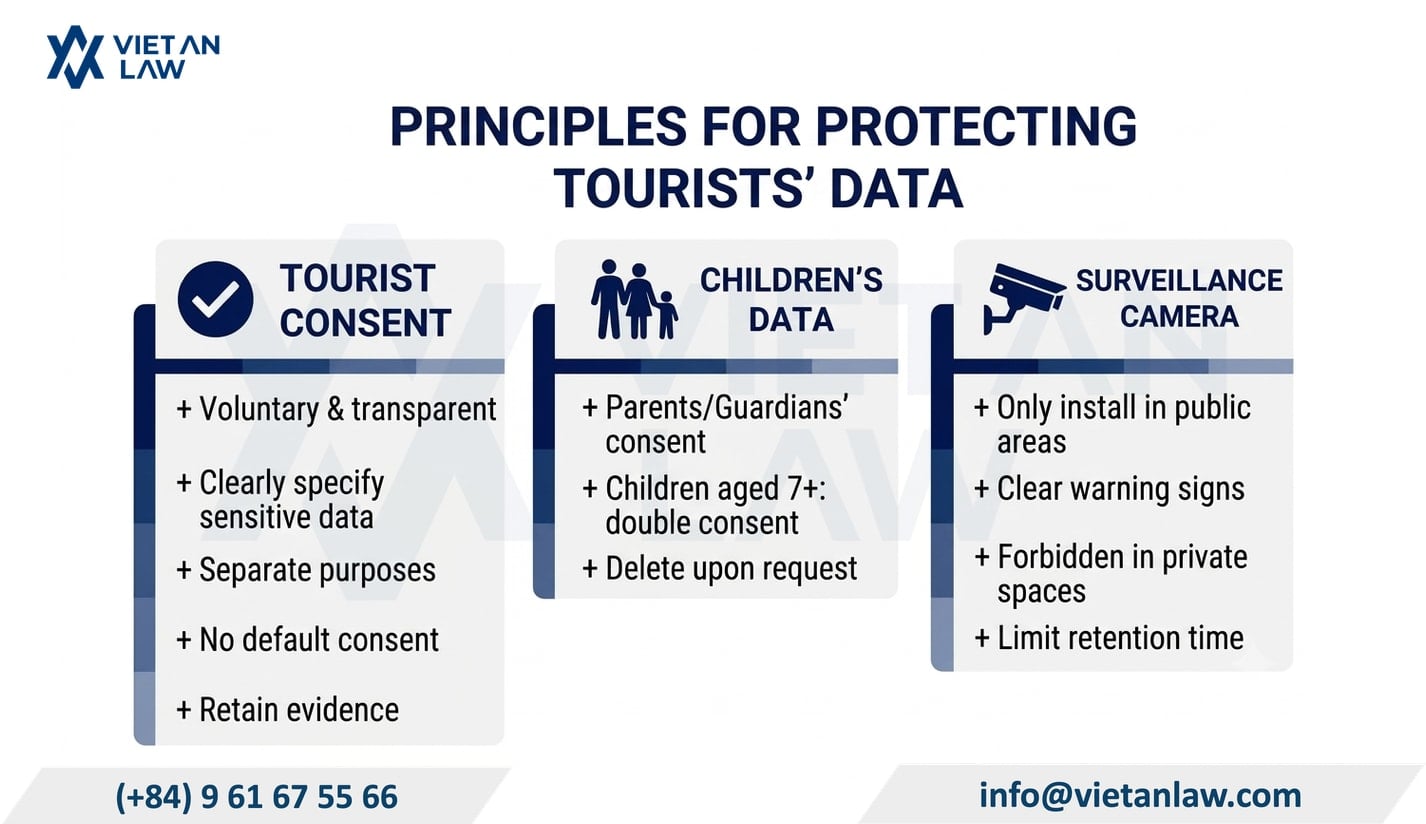
Pursuant to Articles 9 and 28 of the Law on Personal Data Protection and Article 6 of Decree 356/2025/NĐ-CP, obtaining customer consent is legally valid only when the following criteria are fully met:
- Voluntariness and transparency: Customers must be provided with comprehensive information – including the types of data collected, the purposes of processing, the identity of the data processor, and the customers’ own rights – before granting consent.
- Explicit notification for sensitive data: In cases involving the collection of payment card information, geolocation data, or health-related information, businesses are required to clearly notify the customer that such data is classified as sensitive.
- Separation of purposes: Consent for the provision of services (such as tour or room bookings) must be clearly distinguished from consent to receive marketing or promotional information.
- Prohibition of default consent: It is strictly prohibited to pre-select consent checkboxes on online booking interfaces; furthermore, a customer’s silence or failure to respond shall not be construed as consent.
- Retention of verifiable evidence: Businesses must maintain records – such as signed documents, call recordings, or time-stamped electronic logs – to substantiate that consent was obtained in the event of a dispute.
Processing of children’s personal data during family tours and school group trips
Pursuant to Article 24 of the Law on Personal Data Protection, the collection and processing of personal data of individuals under 16 years of age within the context of travel programs must adhere to the following principles:
- Consent from a representative: Parents or legal guardians must provide consent for the processing of personal data on behalf of the child.
- Dual consent for children aged 7 and older: If a business intends to publish or share images or personal information of a child aged 7 or older, consent must be obtained from both the child and their representative.
- Cessation of processing upon request: Businesses must immediately stop processing and proceed to delete the data if the representative withdraws their consent.
Regulations for the installation of security camera (CCTV) systems in hotels and resorts
Pursuant to Articles 7 and 32 of the Law on Personal Data Protection, the management and operation of surveillance camera systems at lodging establishments must comply with the following requirements:
- Installation in legitimate public areas: Recording is permitted at reception desks, lobbies, corridors, restaurants, and parking lots for the purpose of maintaining security, order, and protecting property, without requiring the consent of each individual.
- Obligation to provide clear notice: Establishments must display visible signage in easily observable locations to inform guests that the area is under surveillance.
- Prohibited areas for recording: Surveillance equipment must strictly not be installed in guest bedrooms, restrooms, changing rooms, or other private, personal spaces.
- Retention period limits: Visual data may only be stored for the duration necessary to fulfill security objectives and must be automatically deleted or destroyed once the specified retention period has expired.
Cross-border personal data transfers via OTA platforms and international accommodation systems in Vietnam
Cross-border data transfer is a core business activity, yet it carries the risk of severe penalties for tourism enterprises.
Typical cross-border data flows in the tourism industry
Pursuant to Clause 1, Article 20 of the Law on Personal Data Protection and Article 17 of Decree No. 356/2025/ND-CP, common instances of personal data transfers abroad within the tourism and hospitality sector include:
- Distribution connectivity via international OTAs (Online Travel Agencies): Accommodation providers in Vietnam receive and synchronize booking information through online platforms with servers located abroad.
- Integration with multinational hotel chain management systems: Franchised or affiliated hotels transfer guest profile data to the corporate group’s centralized reservation system located abroad.
- Organization of international tours: Travel agencies transfer lists of travelers – including passport and visa details – to local service providers, airlines, or foreign embassies/consulates abroad.
Conditions and Procedures for Preparing an Impact Assessment Dossier for Cross-Border Data Transfer
Pursuant to Clause 2, Article 20 of the Law on Personal Data Protection and Article 18 of Decree No. 356/2025/NĐ-CP, the procedure for transferring tourist data abroad shall be carried out as follows:
- Preparation of an impact assessment dossier, including:
- A written notification of data transfer;
- An impact assessment report, prepared in accordance with the prescribed template;
- A copy of the data transfer agreement, which establishes the responsibilities of both parties, along with internal privacy policies.
- Submission deadline and receiving authority: One complete set of the official dossier must be submitted to the specialized agency for personal data protection in Vietnam under the Ministry of Public Security within 60 days from the date the data transfer commences.
- Review and finalization period: The specialized agency shall conduct a review and provide a response within 15 days; if the dossier does not meet the requirements, the enterprise shall have 30 days to supplement and finalize it.
Comparison table of data protection responsibilities between independent hotels and international hotel chains in Vietnam
To assist our clients in accurately identifying the compliance obligations corresponding to their specific business models, Viet An Law has developed the following detailed comparison table:
| Legal criteria | Accommodation establishments & independent hotels | International hotel chains & online travel agencies (OTAS) |
| Primary legal role | Data controller or data controller and processor | Both a data controller and a cross-border data transferor |
| Scope of data flow | Primarily internal processing, local temporary residence registration, and connection with domestic payment gateways. | Regularly transmits international and Vietnamese customer data to servers located abroad. |
| Data protection impact assessment (DPIA) obligation | Prepare and submit the personal DPIA dossier within 60 days | Mandatory parallel preparation of both the data processing DPIA dossier and the cross-border data transfer impact assessment dossier |
| Appointment of data protection officer (DPO) | Mandatory appointment of internal personnel or engagement of a specialized external service provider | Mandatory establishment of a dedicated internal data protection department meeting high competency standards |
| Key sanction risks | Administrative fines of up to 3 billion VND for exposing card information or guest identities | Fines of up to 5% of the preceding year’s revenue for violations regarding cross-border data transfers |
Personal data processing impact assessment dossier and personnel qualification requirements in Vietnam
Defining the roles of data controller and data processor between travel agencies and hotels
Pursuant to Articles 2 and 37 of the Law on Personal Data Protection and Article 7 of Decree 356/2025/NĐ-CP, the delineation of authority and responsibilities among parties within the tourism service chain is as follows:
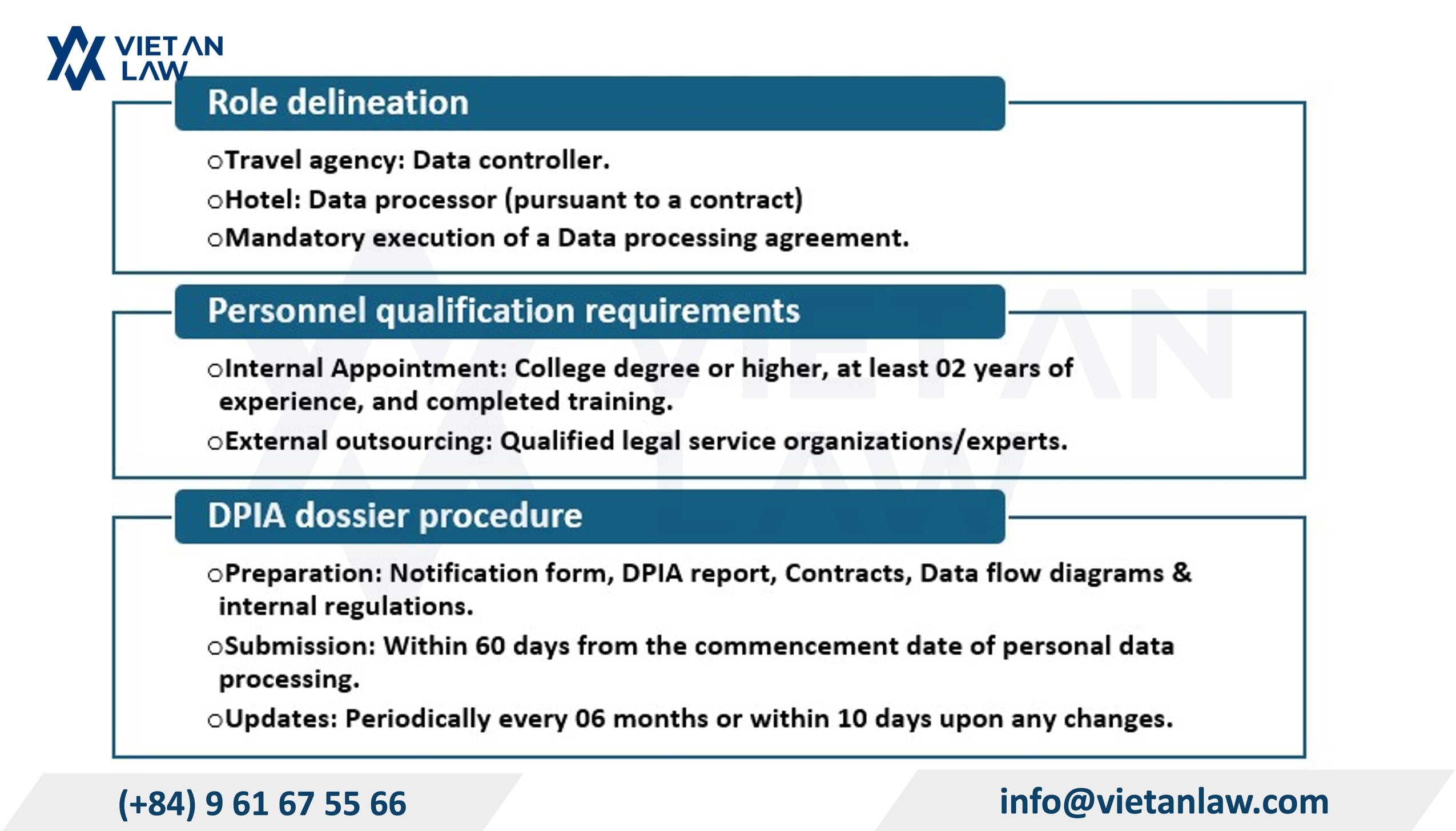
- Role of the travel agency: Acts as the data controller when directly collecting customer information, determining the purposes for its use, and transferring service lists to partners.
- Role of the accommodation provider: Acts as a data processor, permitted to use the customer list solely for room allocation and the provision of accommodation services in accordance with contractual agreements; they are prohibited from engaging in independent marketing activities.
- Mandatory data processing agreement: The parties must enter into a contract or data processing agreement that clearly stipulates confidentiality obligations, technical measures, and liability for compensation in the event of an incident.
Conditions for appointing data protection personnel or engaging personal data protection legal advisory services in Vietnam
Pursuant to Clause 2, Article 33 of the Law on Personal Data Protection and Articles 13, 15, and 16 of Decree 356/2025/NĐ-CP, tourism and hospitality enterprises must designate specialized personnel for data protection in accordance with one of the following options:
- Appointing internal data protection personnel: The designated individual must hold a college degree or higher, possess at least two years of experience in legal affairs, information security, or risk management, and have completed professional training in data protection.
- Engaging external experts or data protection service providers: Enterprises may enter into service contracts with professional legal entities that possess legal status and employ staff who hold relevant specialized certifications.
Procedure for Submitting a Data Protection Impact Assessment (DPIA) to the Ministry of Public Security
Pursuant to Articles 21 and 22 of the Law on Personal Data Protection, and Articles 19, 20, and 25 of Decree No. 356/2025/ND-CP, the preparation and submission of a Data Protection Impact Assessment (DPIA) shall be conducted as follows:
- Preparation of the dossier:
- Data processing notification form;
- Impact assessment report;
- Copies of contracts with partners;
- Data flow diagrams and internal policies.
- Submission within the prescribed timeframe: The dossier must be submitted to the Ministry of Public Security – either in person, online, or via postal service – within 60 days from the date data processing commences.
- Periodic updates: The dossier must be updated every six months, or whenever new purposes for processing or new partners are introduced. Additionally, it must be updated within 10 days should there be any changes to the organization’s structure or business activities.
Frequently asked questions on personal data protection in Vietnam for tourism and hospitality businesses
Are small hotels, homestays, or small-scale travel agencies exempt from preparing a Personal data processing impact assessment?
Although Clauses 2 and 3 of Article 38 of the Law on Personal Data Protection and Article 41 of Decree No. 356/2025/NĐ-CP outline a roadmap for small enterprises, micro-enterprises, and business households, these provisions exclude entities that directly process sensitive personal data. Since all hotels and homestays collect payment card information, and travel agencies often collect information regarding clients’ health status or dietary requirements, these entities are legally required to submit a Personal Data Processing Impact Assessment.
Is it a violation for a hotel to make a copy of an entire passport page or a national ID card of a foreign guest during the check-in process?
Hotels are permitted to collect passport information to fulfill their obligations regarding the declaration of temporary residence under the Law on Residence, pursuant to Point c, Clause 1, Article 19 of the Law on Personal Data Protection. However, the scanning and storage of identity document images within a computer system must be accompanied by encryption mechanisms, access controls, and secure deletion protocols once the retention period expires, in accordance with Articles 14 and 18 of the Law on Personal Data Protection. If a hotel allows such passport image files to be leaked onto the internet, it will be subject to penalties as prescribed by law.
Is it a violation for a travel company to use the phone numbers of customers who took a tour in a previous year to send SMS messages marketing new promotional offers?
This action is considered a violation of the law if the customers have not previously provided specific consent to receive advertising messages. Pursuant to Clause 3, Article 28 of the Law on Personal Data Protection, the processing of customer data for advertising purposes requires the customer’s separate consent, provided that the customer is fully informed of the frequency and format of such communications. Furthermore, the business must provide a mechanism for the customer to opt out of receiving such messages.
Is a hotel required to appoint a dedicated staff member for personal data protection, or can it engage an external lawyer?
Pursuant to Clause 2, Article 33 of the Law on Personal Data Protection and Clause 4, Article 16 of Decree 356/2025/ND-CP, a hotel has the following options:
- Appoint internal personnel (who must meet the criteria specified in Clause 2, Article 13 of Decree No. 356/2025/ND-CP).
- Contract with an external professional service provider specializing in personal data protection to assume the full scope of data protection functions.
If a travel agency develops a mobile application to sell tours and incorporates location tracking for tour group members, is any license or permit required?
Pursuant to Clauses 4 and 9 of Article 21, and Article 24 of Decree 356/2025/ND-CP, services involving the collection of personal data and the provision of personal location data fall under the category of conditional business activities. In accordance with Article 25 of Decree 356/2025/ND-CP, the business must apply to the Ministry of Public Security for a Certificate of Eligibility for Personal Data Processing Services before launching the application.
Compliance with personal data protection regulations within the travel and hospitality industry serves as a fundamental pillar for the sustainable development of tour operators and accommodation providers. Should you require in-depth legal consulting services regarding the processing of personal data, please contact Viet An Law for timely professional guidance.