


During recruitment, human resource management, and business operations, foreign-invested enterprises (FDI) routinely collect and process vast amounts of employee information – ranging from job applications, employment contracts, and payroll records to health data, system access credentials, and surveillance camera footage. Consequently, employee personal data protection in fdi enterprises in Vietnam is not merely an information security issue; it directly impacts employer legal liability, employee privacy rights, and cross-border corporate governance.
What information does employee personal data include in FDI enterprises in Vietnam?
Personal data refers to information in the form of symbols, text, digits, images, sounds, or other similar formats within an electronic environment that relates to a specific individual or enables the identification of a specific individual, in accordance with the law.
In foreign-invested enterprises, employees’ personal data may arise at almost every stage of the employment relationship – from recruitment, probation, contract signing, and human resources management to the termination of employment and the fulfillment of post-employment obligations.
Common categories of such data include:
- Identification information: Full name, date of birth, personal identification number, images, and details from identity documents.
- Contact information: Residential address, phone number, personal email address, and emergency contact details.
- Employment information: Job application documents, professional qualifications, work experience, employment contracts, job titles, and employment history.
- Salary and benefits information: Wages, bonuses, salary-receiving bank accounts, tax information, and social and health insurance details.
- Health data: Medical examination records, medical conditions, and other health-related information collected in circumstances permitted by law.
Data generated during the course of employment: Surveillance camera footage, entry/exit logs, timekeeping records, system access logs, and information regarding the use of company-managed equipment. Some of this information may fall under the category of “sensitive personal data” and requires protection in accordance with specific legal requirements.
Why must prioritize employee personal data protection in FDI enterprises in Vietnam?
Compared to businesses operating solely within Vietnam, FDI enterprises may be simultaneously subject to the internal governance systems of their foreign parent corporations, global security policies, audit requirements, and centralized human resources management processes.
For instance, a company in Vietnam might utilize human resource management (HRM) software deployed by its parent company; store personnel records on an international cloud platform; transmit payroll data to a regional finance department; or share employee information with an overseas benefits administration unit.
Such activities may give rise to legal requirements concerning the legal basis for data processing, the rights of employees, information security, contracts with service providers, and the cross-border transfer of personal data.
It is important to note that a parent company’s ownership of capital in – or its authority to manage – a subsidiary in Vietnam does not grant it unrestricted access to or the right to use all personnel data. Each processing activity must be evaluated based on its specific purpose, the roles of the parties involved, and the corresponding legal basis.
Types of employee personal data processed in FDI enterprises and employee data privacy in Vietnam
Data in the recruitment process
- Businesses typically collect job applications, resumes, contact information, academic qualifications, work experience, and interview results to evaluate candidates.
- Data collection must be tied to a specific recruitment purpose; businesses should avoid requesting unnecessary information or collecting data that exceeds the scope relevant to the position.
- Regarding candidates who are not hired, businesses must adhere to the provisions of Article 25 of the Vietnamese Law on Personal Data Protection concerning the deletion of candidates’ personal data, unless otherwise agreed upon or stipulated by law.
- If a business wishes to retain an application for future recruitment opportunities, it must establish an appropriate legal basis for processing, clearly communicate the purpose, and fulfill any requirements for obtaining consent as mandated by law.
Data during the period of employment
- Once an employee begins their work, an enterprise may process their data for purposes such as concluding and executing employment contracts, paying salaries, making social insurance contributions, organizing training, managing working hours, and ensuring workplace safety.
- However, the existence of an employment relationship does not grant an enterprise the right to use all employee data for any purpose. The enterprise must clearly define the purpose of processing, the scope of necessary information, and the corresponding legal basis.
- For instance, time-tracking data may be used to determine working hours and calculate salaries. If, however, an enterprise intends to integrate such data into a behavioral analysis system or share it with an affiliated company for the purpose of regional personnel evaluation, the legality and scope of such data usage must be assessed separately.
Sensitive data and workplace monitoring
- Some FDI enterprises operating in the manufacturing, industrial, or logistics sectors may utilize surveillance cameras, access control systems, activity-tracking equipment, or occupational health screening processes.
- Enterprises must distinguish between monitoring for the purposes of ensuring security and workplace safety, and the surveillance of employees beyond what is strictly necessary. Any data collection must be supported by an appropriate legal basis, limited to the necessary scope, and accompanied by corresponding protective measures.
- Regarding health data or other information classified as sensitive personal data, enterprises should restrict access to only those personnel whose duties require it; such data should not be broadly disclosed to direct supervisors or other departments without an appropriate legal or operational justification.
Data following the termination of an employment contract
- Upon an employee’s departure, a business must review which data must be retained to fulfill legal obligations and which data is no longer necessary for processing purposes.
- Pursuant to Article 25 of the Vietnam Personal Data Protection Law, an employee’s personal data must be handled in accordance with regulations regarding data deletion upon the termination of an employment contract, unless otherwise agreed upon or stipulated by law.
- Consequently, businesses should not adopt a policy of retaining entire personnel files indefinitely simply because the data is stored within a corporate system. Instead, files should be categorized, retention periods determined, and procedures established for the deletion, anonymization, or restriction of access to such data, in alignment with the applicable legal basis.
Responsibilities of FDI enterprises in employee personal data protection in Vietnam
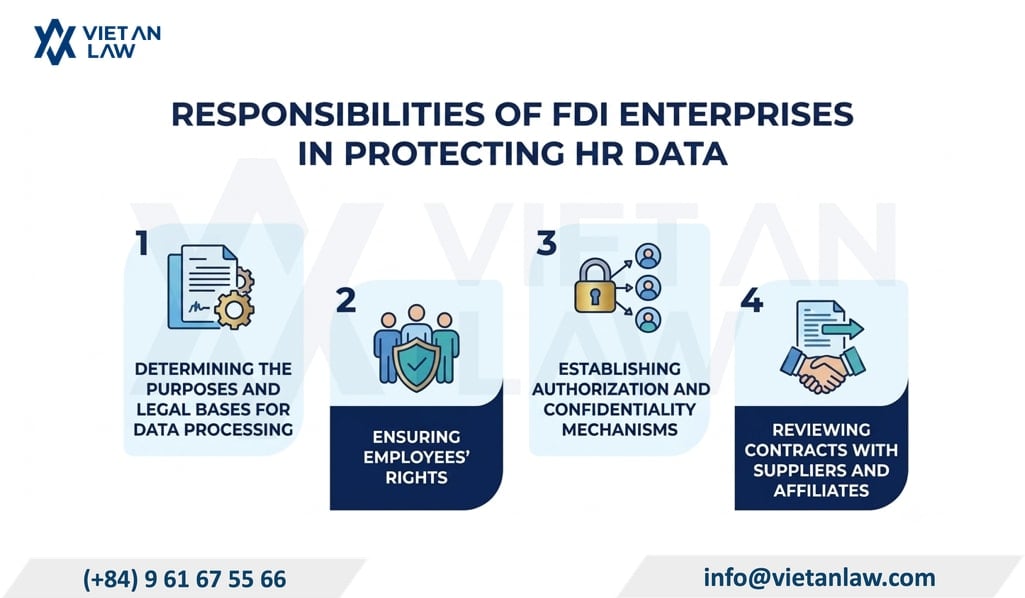
Determining the purpose and legal basis for data processing
- Before collecting or using employee data, a business must determine the purpose for which the data is being processed, whether such processing is necessary for the relevant activity, and the legal basis that authorizes it.
- For activities based on consent, the business must ensure that such consent meets the requirements set forth in Article 9 of the 2025 Personal Data Protection Law. The signing of an employment contract by an employee should not be construed as blanket consent for all data processing activities that may arise within the corporate group.
- In practice, businesses should develop a data processing notice specifically for employees, detailing the categories of data collected, the purposes of processing, the recipients of the data, retention periods, and the mechanisms through which data subjects may exercise their rights.
- In cases where the law permits data processing without consent, the business must accurately identify the applicable conditions and maintain documentation justifying the processing, rather than automatically extending such exceptions to all internal administrative activities.
Ensuring employees’ rights
- Employees, as data subjects, possess specific rights under the Law on Personal Data Protection 2025. These include the right to be informed, to provide or withdraw consent, and to request specific data processing actions or the protection of their legitimate rights and interests as stipulated by law.
- Enterprises must establish a designated point of contact to receive, verify, and address such requests. This includes setting internal processing timelines and coordinating with the human resources department, the IT department, and system providers to ensure requests are handled appropriately.
- For instance, if an employee requests a correction to their contact information or seeks action regarding data previously shared with a benefits provider, the enterprise must evaluate the request, clarify the roles of the involved parties, and take the necessary steps in accordance with the law.
- An employee’s withdrawal of consent does not automatically mandate the immediate deletion of all their data. Enterprises must assess whether the data must still be retained to fulfill legal obligations and determine the appropriate course of action.
Establishing access control and security mechanisms
Organizations must ensure that personnel data is accessible only to individuals with the appropriate roles and authorization. Not every senior manager, HR staff member, or IT employee requires full access to employee records.
Measures that can be implemented include:
- Assigning access rights based on job functions;
- Using multi-factor authentication for systems containing sensitive data;
- Encrypting data during transmission or storage, commensurate with the level of risk;
- Maintaining logs of data access, downloads, and modifications;
- Restricting the copying of data onto personal devices;
- Providing training to employees on personal data protection in Vietnam;
- Revoking accounts and access privileges when an employee changes roles or leaves the organization.
These technical measures should be complemented by management procedures, periodic audits, and protocols for addressing instances of unauthorized access.
Reviewing contracts with service providers and affiliated companies
FDI enterprises often outsource services such as payroll, insurance, benefits administration, record-keeping, or the operation of human resources software. In such cases, it is essential to determine whether the service provider is processing data strictly according to instructions or utilizing it for their own independent purposes.
When a partner acts as a data processor, Article 37 of the Law on Personal Data Protection must be consulted regarding the responsibilities of the parties involved and the requirements for a data processing agreement or contract. Such contracts should clearly define the scope of the data, the purpose of processing, access rights, security measures, the use of subcontractors, incident response mechanisms, and the obligations regarding the return or deletion of data upon the termination of the partnership.
Regarding a parent company or overseas affiliates, enterprises must assess the actual legal role of each entity. It should not be automatically assumed that every company within the same corporate group is authorized to receive personnel data.
Cross-border transfer of employee personal data in Vietnam to foreign parent companies
Common scenarios
Cross-border transfers of human resources data within FDI enterprises may occur when:
- A Vietnamese entity transmits payroll data to a regional finance department;
- HR records are stored on an HRM system hosted abroad;
- A parent company accesses data for HR management and performance evaluation purposes;
- Data is transferred to an international service provider;
- A corporate group conducts audits, restructuring, or transaction due diligence.
- Each scenario must be evaluated based on the method of data transfer, the purpose of processing, the role of the recipient, and the applicable legal requirements.
Determining legal obligations before data transfer
Businesses should map their data flows to identify what data is being transferred, its origin and destination, who has access to it, and the purposes for which it is used.
Subsequently, it is necessary to assess the obligations concerning the cross-border transfer of personal data under the Law on Personal Data Protection 2025 and Decree 356/2025/ND-CP. This includes requirements for conducting impact assessments – where applicable – as well as identifying any relevant exemptions.
It should not be assumed that all data stored on foreign-based servers are subject to the same legal obligations, nor that the use of software provided by a corporate group automatically grants an exemption from data transfer requirements. The determination of legal obligations must be based on actual business operations and the specific regulations in effect.
Aligning global policies with Vietnamese law
Many multinational corporations have implemented data protection policies based on the GDPR or their own internal security standards. While these can serve as a useful foundation for developing data governance procedures, they do not automatically satisfy obligations under Vietnamese law.
Businesses should assess the alignment between their global policies and local requirements – specifically regarding the legal bases for data processing, the rights of employees, data retention periods, the roles of parent companies, and obligations concerning cross-border data transfers.
Where necessary, companies may develop a data protection addendum specific to Vietnam or adjust internal procedures to ensure they remain consistent with the broader corporate group’s standards while also complying with local legal requirements.
Comparison table of data protection obligations across HR scenarios in Vietnam
| Criteria | Recruitment | During employment | Post-employment |
| Processing purpose | Evaluating and selecting candidates | Managing labor relations, payroll, employee benefits, and operations | Fulfilling legal obligations and resolving remaining rights and obligations |
| Common data types | CVs, degrees/qualifications, contact information, interview results | Employment contracts, salary, insurance, timekeeping, system data | Labor records, tax, insurance, and documents required to be retained by law |
| Key requirements | Collecting data relevant to recruitment purposes | Restricting access, ensuring security, and controlling data usage | Reviewing the legal basis for continued data retention and processing |
| Data retention & deletion | Considering deletion of unsuccessful candidates’ data pursuant to Article 25, unless otherwise prescribed by law | Retaining data in accordance with the purpose and applicable legal obligations | Deleting data when there is no longer a legal basis for retention, unless otherwise agreed or prescribed by law |
| Typical risks | Retaining CVs indefinitely or using them for other purposes | Over-sharing data beyond scope, inappropriate monitoring/surveillance | Retaining unnecessary data or leaving former accounts with active access |
Steps for FDI Enterprises to comply with personal data protection in vietnam
Businesses can proceed according to the following steps:
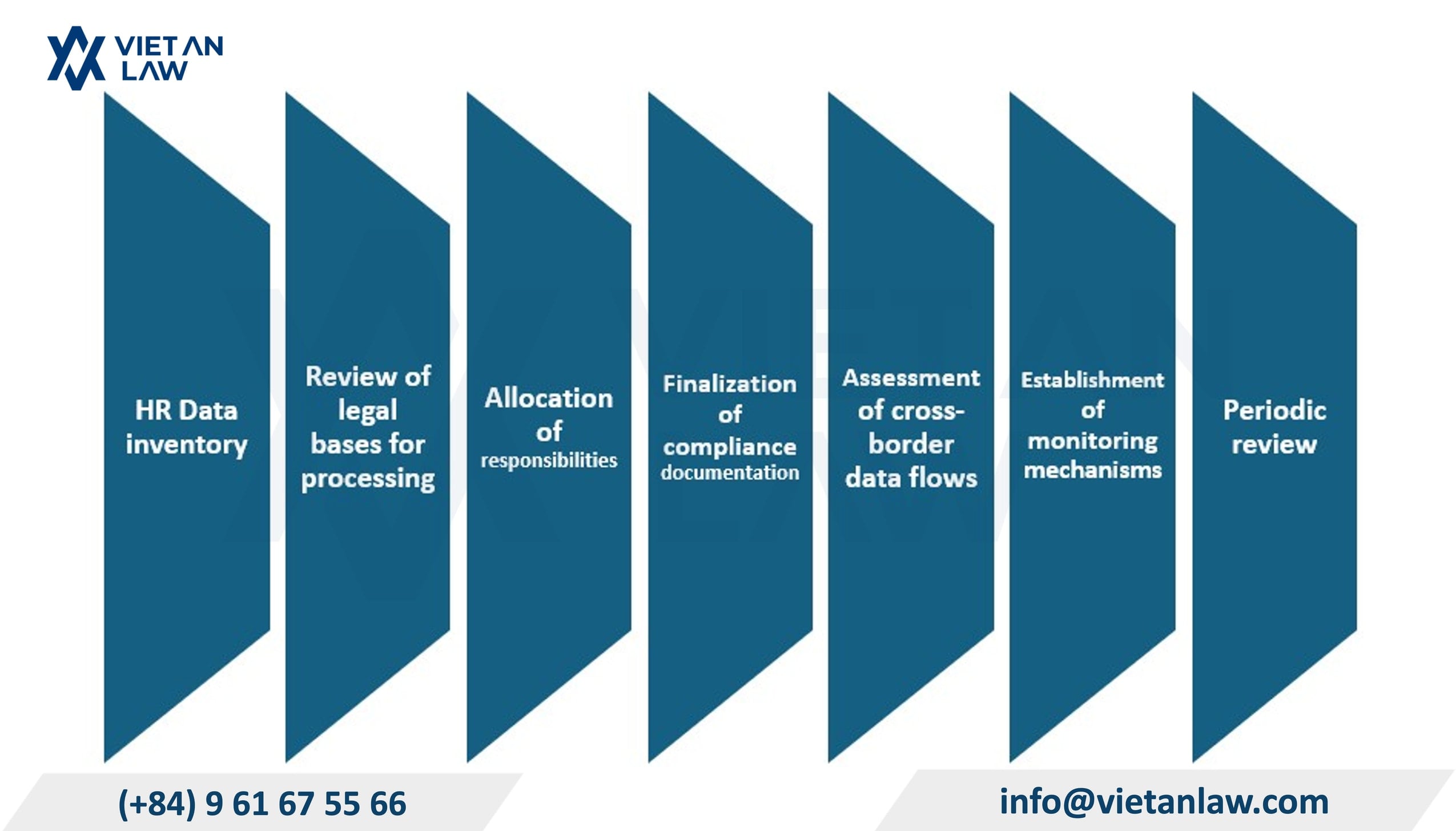
- Step 1: Conduct an inventory of HR data. Identify data types, collection sources, purposes, storage systems, and authorized parties with access.
- Step 2: Review the legal basis for processing. Determine the legal grounds for each processing activity, requirements for consent, and any applicable exceptions.
- Step 3: Define responsibilities. Clarify the roles of the Vietnamese entity, the parent company, affiliates, and service providers.
- Step 4: Finalize documentation. Review data processing notices, data protection policies, data processing agreements, and internal procedures.
- Step 5: Assess cross-border data flows. Identify instances where data is transferred abroad and the corresponding legal obligations.
- Step 6: Establish monitoring mechanisms. Manage access rights, conduct staff training, audit service providers, and prepare incident response plans.
- Step 7: Conduct periodic reviews. Update procedures whenever there are changes to technology systems, governance models, processing purposes, or legal regulations.
Businesses should clearly delineate responsibilities among the HR, legal, and IT departments, as well as senior management, to ensure that compliance measures are implemented consistently.
Personal data protection legal advisory services in Vietnam by Viet An Law
For FDI enterprises, compliance with personal data protection laws requires a comprehensive assessment of all data processing activities, rather than merely establishing a generic privacy policy.
Viet An Law provides personal data protection legal advisory services in Vietnam, assisting businesses in reviewing their obligations, assessing risks, and developing compliance solutions tailored to their operations in Vietnam.
Enterprises may refer to the following article: Personal Data Protection Legal Services in Vietnam for Foreign Companies to learn more about the scope of consulting, the necessary legal tasks, and strategies for managing personal data within business operations.
Consulting services may include:
- Reviewing the collection, storage, use, and sharing of personnel data;
- Assessing the legal basis for data processing and the rights of employees;
- Developing or reviewing personal data protection policies;
- Advising on data processing agreements with service providers and partners;
- Evaluating obligations related to the cross-border transfer of personal data;
- Assisting with the preparation of data protection impact assessments (DPIAs) where required by law;
- Establishing procedures for handling employee requests and managing data incidents;
- Assessing gaps between a corporate group’s global policies and Vietnamese law.
- Specific solutions are determined based on each enterprise’s operational model, data types, management systems, and applicable legal obligations.
Frequently asked questions on employee personal data protection in Vietnam for FDI enterprises
Can a business transfer personnel records to a parent company located abroad?
Such data transfers must be supported by an appropriate legal basis and comply with the conditions and obligations applicable to the cross-border transfer of personal data. Businesses must define the purpose of the transfer, the roles of the involved parties, and – where required – conduct an impact assessment.
Can a business retain the CVs of unsuccessful job applicants?
Businesses must comply with Article 25 of the Law on Personal Data Protection 2025, which mandates the deletion of personal data belonging to unsuccessful applicants, unless otherwise agreed upon or stipulated by law. If a business wishes to retain such data for future recruitment purposes, it must establish a valid legal basis for processing and fulfill all relevant requirements.
When an employee leaves the company, must the business delete all their personnel data?
Not necessarily in every case. Businesses should review which data must be retained – whether due to legal requirements or valid agreements – and identify data for which there is no longer a legal basis for retention. Any data processing must adhere to Article 25 of the Law on Personal Data Protection, as well as other relevant specialized regulations.
Do FDI enterprises that already comply with the GDPR still need to review Vietnamese law?
Yes. While the GDPR and global corporate policies can assist in establishing governance frameworks, they do not automatically supersede obligations under Vietnamese law. Businesses must review the requirements applicable to data processing activities within Vietnam, including the rights of employees, the responsibilities of the parties involved, and the rules governing cross-border data transfers.
Employee personal data protection in foreign-invested enterprises in Vietnam is a critical aspect of human resources management and legal compliance; Viet An Law stands ready to assist businesses in developing appropriate solutions.