


In the course of business operations, it has become increasingly common for enterprises to cooperate with partners in order to provide services, implement customer care programmes, carry out advertising and marketing activities, or operate information technology systems. To carry out these activities, an enterprise may need to transfer customer information to third parties. However, customer data is not merely a resource serving business purposes; it is also closely linked to the privacy and other lawful rights of each individual. Therefore, what conditions must the enterprise satisfy when sharing customer personal data with third parties in Vietnam, and what should it do to mitigate legal risks?
What information does customer data include?
Customer data is information collected, stored or processed by an enterprise in the course of receiving customers, providing products and services, and maintaining relationships with customers. Among such information, information associated with a specific individual or that helps identify an individual may fall within the scope of personal data as prescribed by law.
Common types of information include:
- Identification information: full name, date of birth, personal identification number, personal images;
- Contact information: telephone number, residential address, email address;
- Transaction information: purchase history, invoices, service usage history;
- Account information: login name, customer account information;
- Financial information, health information or other information falling within the category of sensitive personal data as prescribed by law.
Not all customer data constitutes personal data. For example, revenue statistics that have been aggregated and can no longer identify a specific individual may no longer be personal in nature. Conversely, information that has been encrypted but can still be linked to an individual by appropriate means does not automatically lose its nature as personal data.
What is meant by sharing customer data with partners?
Sharing customer data with partners refers to an enterprise providing, transferring, or enabling another organisation or individual to access and process customer data to serve a specific purpose.
This activity may take place in a variety of situations, for example:
- An enterprise provides a customer list to an advertising agency to implement a marketing campaign;
- An e-commerce platform transfers buyer information to a logistics provider for delivery;
- An enterprise uses a third-party technology platform to manage customer information;
- A financial institution cooperates with a partner to provide services within the scope of its permitted activities;
- An enterprise transfers customer data to an affiliated company within the same group to serve a customer care programme.
It should be noted that the transfer of data to a partner does not always have the same legal nature. In some cases, the partner only processes the data in accordance with the enterprise’s instructions; in other cases, the partner uses the data for its own purposes; and in yet other cases, the parties jointly determine the purposes and means of processing.
Legal requirements and governing legal framework in Vietnam
Vietnam Personal Data Protection Law 2025
Provisions that warrant particular attention include:
- Article 4: Provides for the rights and obligations of personal data subjects, including the right to be informed of data processing activities, the right to consent or not to consent, the right to request the withdrawal of consent, and the right to request the application of data protection measures.
- Article 9: Provides for the consent of personal data subjects. Consent must be given voluntarily and on the basis that the data subject clearly understands the type of data, the purpose of processing, the personal data controller or the personal data controller-processor, as well as the related rights and obligations.
- Article 19: Provides for the cases in which personal data may be processed without the consent of the data subject, subject to the conditions prescribed by law.
- Article 37: Provides for the responsibilities of the personal data controller, the personal data processor, and the personal data controller-processor.
These provisions demonstrate that an enterprise may not share customer data as a matter of course merely because the data is stored in its systems or because the sharing may bring business benefits.
Decree No. 356/2025/ND-CP
When developing data sharing procedures, enterprises should review this Decree in conjunction with the Personal Data Protection Law, particularly with respect to the requirements on the exercise of data subjects’ rights, the assurance of data security, and the responsibilities of the organisations involved in processing.
In addition, depending on the business sector and the type of data shared, enterprises may be required to comply with sector-specific regulations on information security, consumer protection, banking, insurance, e-commerce, cybersecurity, or record-keeping obligations under the relevant laws governing personal data protection in Vietnam.
Sharing customer personal data with third parties in Vietnam
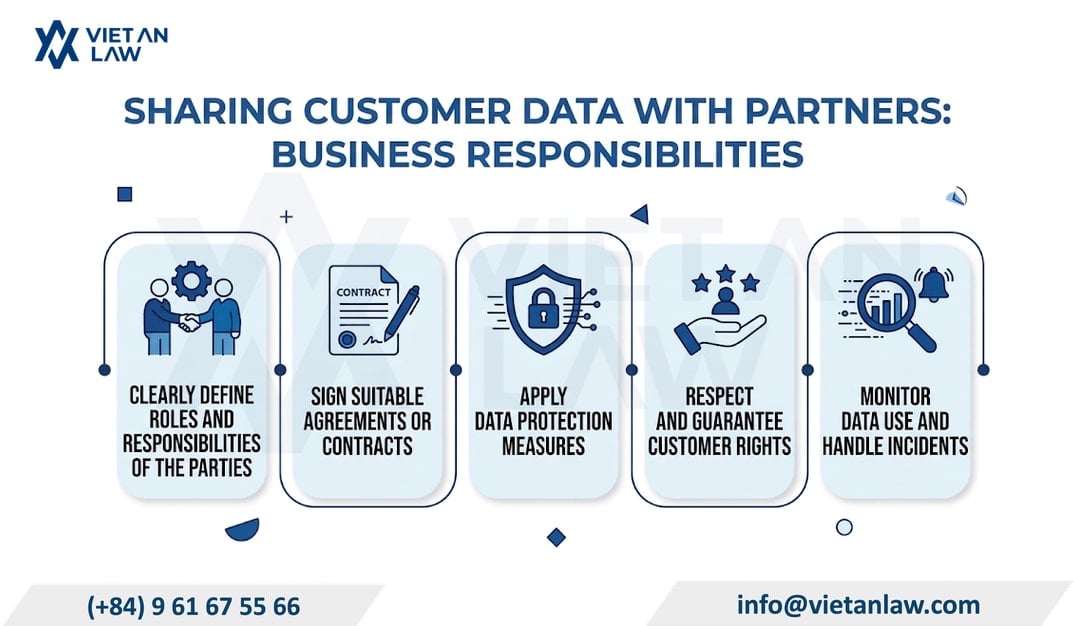
Clearly define the roles and responsibilities of the parties
- Article 37 of the Vietnam Personal Data Protection Law 2025 sets out the responsibilities of the personal data controller and the personal data processor. In particular, the data controller is responsible for determining the purposes and means of processing; selecting an appropriate processor; implementing managerial and technical measures to protect data; ensuring the rights of data subjects; and being liable for damage caused by the processing in accordance with the law. The data processor must receive and process data in accordance with the agreement or contract and implement the corresponding data protection measures.
- Accordingly, an enterprise needs to determine what role it plays in the processing activity and what role its partner plays. Such classification should not be based solely on the designation used in the contract, but rather on the actual functions and activities of each party.
- If the partner only processes data in accordance with the enterprise’s instructions, the parties should clearly specify the scope of processing, purposes, duration, security measures and obligations upon termination of the contract.
- If the partner uses the data to determine its own purposes, the enterprise should reassess the legal basis for providing the data and the responsibilities of each party. A partner should not automatically be regarded as a data processor merely because the two parties have entered into a commercial contract.
Enter into an Appropriate Agreement or Contract
The contract with the partner should clearly set out the rights, obligations and responsibilities relating to the processing of personal data, including the partner’s third-party data protection obligations. Under Article 37, a personal data processor may only receive data after having entered into a data processing agreement (DPA) or contract with the personal data controller or the personal data controller-processor.
Depending on the cooperation model, the contract or the appendix on data processing should contain the following provisions:
- Scope of data: The types of data provided, the data subjects concerned and access limitations.
- Purpose of processing: The tasks the partner is permitted to perform and the prohibited acts.
- Processing period: The commencement date, the retention period and the conditions for terminating processing.
- Data security: Technical measures, account management, access authorisation and access logging.
- Third parties and subcontractors: Conditions for engaging subcontractors or onward transfer of data.
- Incident handling: Responsibility for cooperation, preservation of evidence and notification in the event of a breach.
- Exercise of customers’ rights: Coordination mechanisms when customers request access to, rectification, erasure or restriction of processing of their data.
- Termination of cooperation: Return, erasure or destruction of data in accordance with the agreement and applicable law.
- Liability for breach: Mechanisms for remedy, compensation and allocation of liability in accordance with the law.
These provisions should be consistent with the actual role of each party. A general clause merely requiring the partner to “keep information confidential” may not be sufficient to control the entire data processing activity.
Apply data protection measures
Enterprises need to apply appropriate managerial and technical measures throughout the entire data sharing process, not only at the time of transfer.
- In terms of management, enterprises should issue a data sharing approval procedure, designate a responsible point of contact, limit the number of personnel granted access, and organise training on personal data protection.
- In terms of technology, depending on the nature of the data and the level of risk, enterprises may use encryption in transit and at rest, multi-factor authentication, access authorisation, activity logging, backups and monitoring of data downloads.
- When sending data files via email or online platforms, enterprises should verify the recipients, limit access rights, set expiry periods for links and avoid sending sensitive data through uncontrolled channels.
- Encryption does not mean that the data has been removed from the scope of legal protection. Pursuant to Article 12 of the Vietnam Personal Data Protection Law 2025, personal data that has been encrypted remains personal data. Therefore, enterprises should not regard encryption as a basis for freely sharing data without assessing the legal conditions.
Respect and ensure the rights of customers
- Under Article 4 of the Vietnam Personal Data Protection Law 2025, data subjects have rights relating to being informed, giving consent, withdrawing consent, requesting the provision or erasure of data, restricting processing and requesting data protection in accordance with the law.
- Enterprises should establish a mechanism for receiving and handling such requests, while also specifying how to coordinate with partners that hold or process the data. When a customer requests the withdrawal of consent or the restriction of processing, the enterprise should assess the scope of the request and the related legal obligations, and then notify and coordinate with its partners to implement appropriate measures.
- For example, if a customer withdraws consent for marketing purposes, the enterprise should consider ceasing the transfer of data to its advertising partners and handling the data already provided in accordance with legal requirements. However, the withdrawal of consent does not automatically invalidate processing activities carried out prior to such withdrawal, nor does it exclude cases where continued processing is permitted by law.
Monitor data use and handle incidents
- After transferring data to partner, an enterprise still needs to monitor the use of data within the scope of its responsibilities. Signing a contract does not mean that the enterprise may disregard the risk of the partner using the data for unauthorised purposes, disclosing the data or transferring the data onward without authorisation.
- Enterprise should conduct periodic inspections, review access rights, request partners to provide necessary information on their data protection measures, and keep records evidencing such monitoring.
- Upon detecting or suspecting unauthorised access to, disclosure or use of data, an enterprise should promptly contain the risk, revoke access rights where necessary, preserve logs and evidence, assess the scope of impact, coordinate with the partner and fulfil its notification obligations in accordance with applicable law.
Distinguishing between sharing data with a data processor and with a partner using data independently in Vietnam
| Criteria | Partner processing data under instructions | Partner using data for its own purposes |
| Purpose of processing | Performing tasks determined by the enterprise | The partner determines, or participates in determining, its own purposes |
| Examples | Data storage providers, customer relationship management system providers | A partner receiving data to market its own products |
| Legal basis and agreement | A data processing agreement (DPA) or contract under Article 37 and an appropriate legal basis for processing are required | The legal basis for each party’s provision and use of the data must be assessed, typically documented in a data sharing agreement (DSA) |
| Right to use data | Limited to the instructions, scope and purposes agreed upon | Data may not be used freely; a lawful basis is required for the partner’s own purposes |
| Protection responsibilities | The processor performs its obligations under the law and the contract; the controller remains correspondingly responsible | Each party must identify and perform its obligations according to its actual role |
| Risks to be controlled | Processing beyond the agreed scope, weak security, unauthorised use of subcontractors | Use for unauthorised purposes, onward sharing, or marketing without an appropriate legal basis |
Recommended procedure for enterprises for customer data sharing in Vietnam
To ensure that data sharing is carried out in a controlled manner, enterprises may establish an internal procedure comprising the following steps:
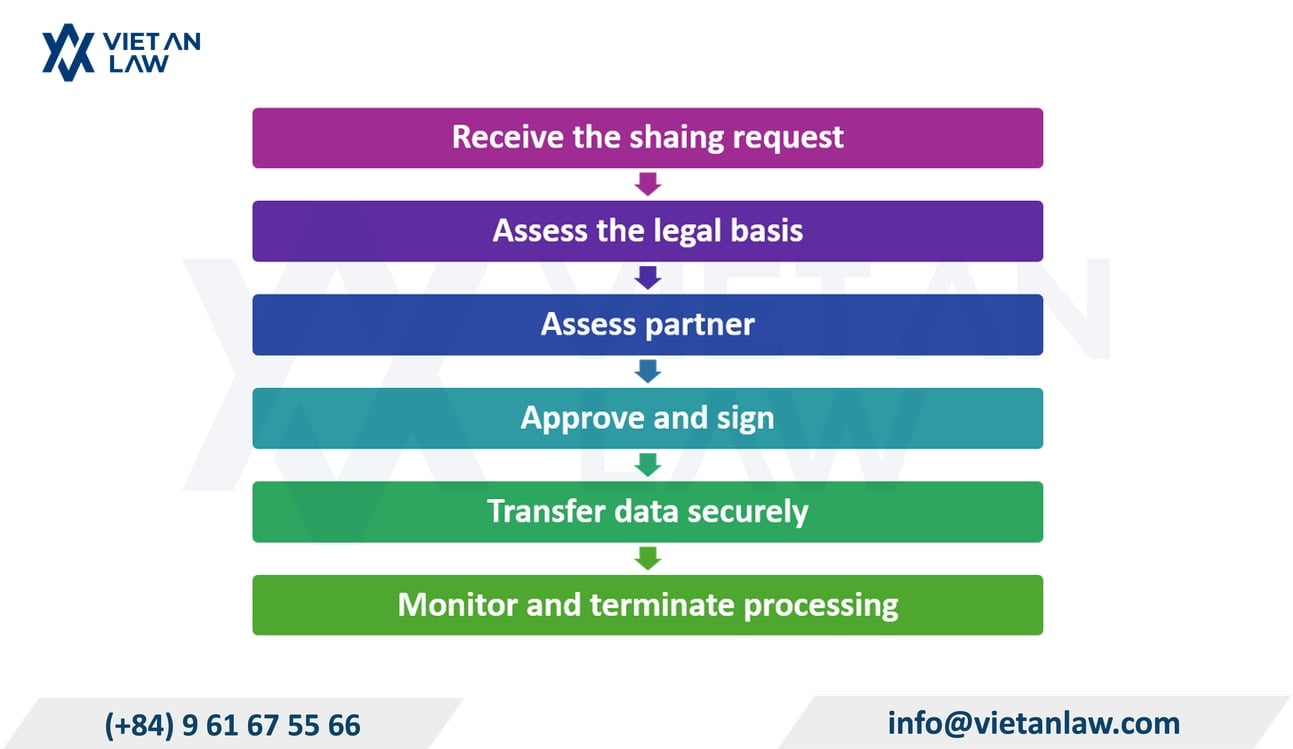
- Step 1: Receive the sharing request. The business unit or requesting department should clearly specify the partner, purpose, type of data, scope and period of use.
- Step 2: Assess the legal basis. The legal or data protection department determines the legal basis for processing, consent requirements, sector-specific regulations and other related obligations.
- Step 3: Assess partner. Verify the partner’s capabilities, security measures, incident response procedures and ability to fulfil its contractual obligations.
- Step 4: Approve and sign. Share data only after approval has been obtained in accordance with the internal procedure and the necessary agreements have been concluded.
- Step 5: Transfer data securely. Limit data to what is necessary, use appropriate transmission channels and record the transfer.
- Step 6: Monitor and terminate processing. Check compliance, handle customer requests, revoke access rights and request the return or erasure of data upon termination of the cooperation in accordance with regulations.
This procedure should be adapted to the size, business sector, type of data and cooperation model of each enterprise. For sensitive data or high-risk processing activities, enterprises should conduct an in-depth assessment prior to implementation and may consider engaging personal data protection legal advisory services in Vietnam.
FAQs on sharing customer data with third parties in Vietnam
May an enterprise share customer data with partners at its own discretion?
Enterprises should not share customer data at their own discretion. An enterprise must identify a lawful basis for processing, the purpose of sharing and the roles of the parties, and satisfy consent requirements where required by law. Articles 9 and 19 of the Vietnam Personal Data Protection Law 2025 are important provisions to be reviewed.
Is Customer Consent for Data Sharing required each time an enterprise shares data?
It cannot be concluded that consent must be obtained again for every instance of sharing. Enterprises should consider the scope and purposes previously notified, the content of the prior consent and the applicable legal basis for processing. If the purpose or the recipient changes significantly, the enterprise should reassess the lawfulness of the sharing.
Is an enterprise required to sign a contract with the partner receiving the data?
If the partner is a personal data processor, Clause 2, Article 37 of the Vietnam Personal Data Protection Law 2025 provides that the processor may only receive data after having entered into a data processing agreement (DPA) or contract with the personal data controller or the personal data controller-processor. For other models, the enterprise needs to correctly identify the roles and legal requirements in order to select the appropriate type of agreement.
If a partner discloses customer data, is the enterprise liable?
The specific liability depends on the roles of the parties, the cause of the incident, the obligations under the law, and the terms of the agreement. Under Article 37, the data controller bears its own responsibilities for processing activities, while the data processor must also comply with its data protection obligations and bear liability in accordance with the law. Enterprises should not assume that transferring data to a partner will exempt them from their own liability.
Upon termination of the cooperation, what should an enterprise do with the shared data?
The enterprise should review the contract and the applicable legal basis to determine the return, erasure or destruction of data, the revocation of access rights, and the handling of backup copies. Where the law requires certain data to be retained, the enterprise should clearly define the corresponding scope, retention period and protection measures, rather than automatically requiring complete erasure or continuing to retain the data indefinitely.
Sharing customer personal data with third parties in Vietnam is a matter that warrants careful attention in the course of business cooperation. Viet An Law is always ready to assist enterprises in reviewing their practices and ensuring customer data privacy compliance with the relevant legal regulations.