


Even a minor lapse in managing electronic medical records, mistakenly sending laboratory test results to the wrong recipient, or sharing patient lists with insurance or pharmaceutical partners without written consent can expose medical examination and treatment facilities to administrative fines of up to billions of Vietnamese dong or suspension of operations starting in 2026. As Vietnamese Law on Personal Data Protection No. 91/2025/QH15 and Decree No. 356/2025/ND-CP officially take effect on January 1, 2026, patient personal data protection in clinics and healthcare facilities in Vietnam has become a mandatory legal obligation subject to stringent control standards under the framework of personal data protection in Vietnam. Through the article below, Viet An Law provides a comprehensive analysis of the applicable regulations and offers in-depth personal data protection legal advisory services in Vietnam to help clients establish the safest and most effective compliance procedures.
Identifying and classifying patient data in clinics and healthcare facilities in Vietnam
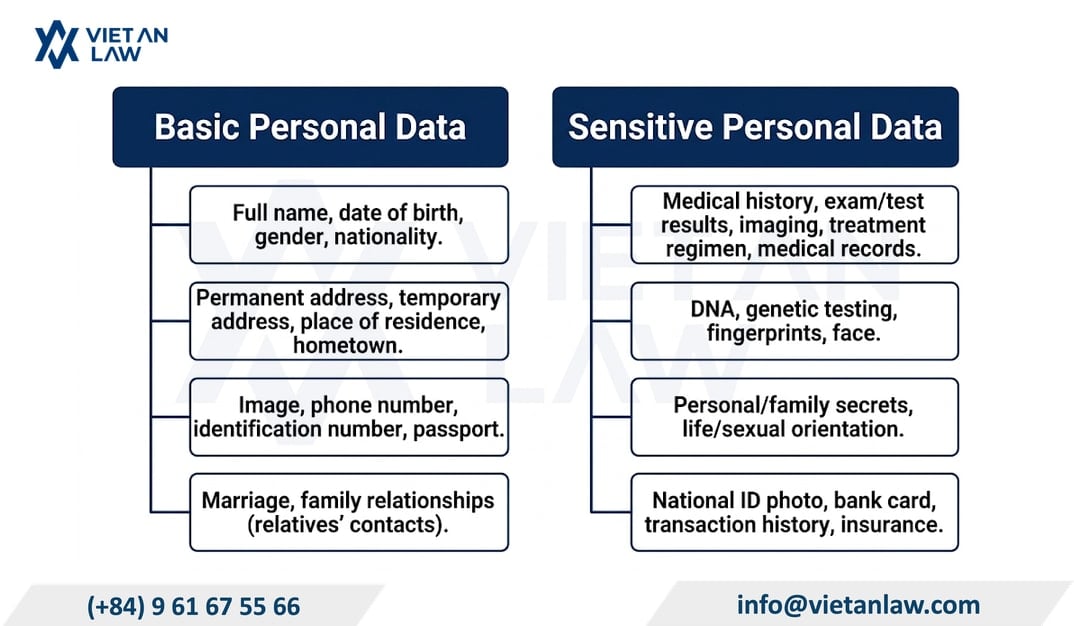
In medical examination and treatment activities, clinics and hospitals typically act as a personal data controller or a personal data controller and processor under Article 2 of the Law on Personal Data Protection with respect to two groups of data:
- Basic personal data: Full name, date of birth, and gender; permanent residence, temporary residence, current place of residence, hometown, contact address, and nationality; personal images, telephone number, personal identification number, passport number, marital status, and information on family relationships (parents, children, spouse) for contacting family members.
- Sensitive personal data: Most specialized medical information falls into this group, including:
- Health status: Medical history, clinical and paraclinical examination results, laboratory test results, diagnostic imaging, treatment regimens, and medical records.
- Biometric data and genetic characteristics: DNA samples, genetic test results, fingerprints, and facial data used for patient identification.
- Private life, sexual, and financial information: Personal and family secrets; sexual life and sexual orientation serving specialized medical examinations; images of citizen identity cards and old identity cards; bank card information, financial transaction history, and insurance information.
When processing sensitive personal data, healthcare facilities must establish access-restriction authorization rules, processing procedures, and strict security measures pursuant to Clause 2, Article 4 of Decree No. 356/2025/ND-CP.
Legal regulations on personal data protection in Vietnam for clinics and healthcare facilities
To ensure the principle of collecting and processing data strictly within the proper scope and for specific purposes pursuant to Clause 2, Article 3 of the Law on Personal Data Protection, healthcare facilities must strictly comply with the following regulations:
Rules for obtaining the consent of personal data subjects during medical examination and treatment
Pursuant to Point a, Clause 1, Article 26 and Clause 1, Article 11 of the Law on Personal Data Protection, healthcare facilities must obtain the patient’s consent before and during the collection and processing of health information, except in cases prescribed by law:
- Conditions for validity: Consent must be given voluntarily, and the patient must be clearly informed of the types of data to be processed (with explicit notice that the data constitutes sensitive personal data), the specific processing purposes, the personal data controller and processor, and their own rights and obligations.
- Methods of establishment and storage: Consent must be expressed through a clear and verifiable method (in writing, recorded telephone calls, text messages, or technical settings on websites or healthcare applications). Clinics must retain records of consent and bear the burden of proof in the event of a dispute.
- Prohibition of default consent settings: Silence or non-response is not regarded as consent; clinics must not set default consent options or compel patients to consent to purposes other than medical examination and treatment.
Cases of data processing without consent and regulations for pediatric patients
- Emergency and urgent cases: Consent is not required, but the healthcare facility must prove the urgent circumstances and establish an internal monitoring mechanism.
- Pediatric patients and persons who have lost or have restricted civil act capacity: The legal representative exercises the rights of the personal data subject on their behalf; if disclosing or publishing information on the private life or personal secrets of a child aged full 7 years or older, the consent of both the child and the legal representative must be obtained.
Controlling the sharing and transfer of health information to insurance enterprises and third parties
- Prohibition on unauthorized disclosure to third parties: Healthcare facilities must not provide patient data to other healthcare organizations or to health insurance or life insurance enterprises, unless there is a written request from the patient or the case falls under Clause 1, Article 19 of the Law on Personal Data Protection.
- Transfer agreements and physical security: When transferring data, the parties must execute an agreement clearly stating the purpose, types of data, processing duration, deletion and destruction requirements, and protection responsibilities. When transferring sensitive personal data, physical security measures for storage and transmission devices, as well as data encryption and anonymization, are mandatory.
- Controlling internal sharing among departments and divisions: Facilities must establish procedures to control internal data sharing for treatment purposes and implement measures to prevent internal personnel from unlawfully sharing data with third parties.
Security in audio and video recording and the application of healthcare technology and cloud computing
- Audio and video recording in public areas (reception lobbies, hallways): Such recording may be conducted to ensure order and safety and to protect lawful rights and interests without the patient’s consent, provided that patients are notified and the recordings are stored only for the necessary duration.
- Application of healthcare technology, AI, and cloud computing: Organizations developing healthcare applications must fully comply with personal data protection regulations. When storing electronic medical records in the cloud or applying AI and big data, healthcare facilities must encrypt data at rest and in transit, implement multi-factor authentication, enforce strict access authorization, and sign contracts binding the responsibilities of service providers.
Comparison of protection mechanisms for basic personal data and sensitive personal data of patients in Vietnam
To help clients easily cross-check requirements when implementing patient data protection in clinics and healthcare facilities, Viet An Law has compiled a comparison table of the legal requirements for the two data groups as follows:
| Comparison criteria | Basic personal data of patients | Sensitive personal data of patients |
| Typical types of information at healthcare facilities | Full name, date of birth, gender, place of residence, telephone number, personal identification number, personal images, and family relationship information. | Health status, medical records, laboratory test results, biometric data, genetic characteristics, sexual life, images of citizen identity cards, and bank card or insurance information. |
| Requirements when obtaining patient consent | Clearly notify the patient of the types of data, processing purposes, data controller and processor, and the patient’s rights. | In addition to general information, the facility must explicitly notify the patient that the data to be processed is sensitive personal data. |
| Security requirements during processing and transfer | Implement administrative and technical data protection measures and establish a data transfer agreement. | Must establish access-restriction authorization; upon transfer, must apply physical security for storage and transmission devices, encryption, and data anonymization. |
| Exemption rules for small enterprises, micro-enterprises, and household businesses | Exempt from, or entitled to opt out of, preparing an impact assessment dossier and designating data protection personnel if processing data of fewer than 100,000 data subjects. | Not exempt. All healthcare facilities directly processing sensitive personal data must prepare an impact assessment dossier and assign a data protection department or personnel. |
Procedures for preparing a personal data processing impact assessment dossier and obtaining a certificate of eligibility
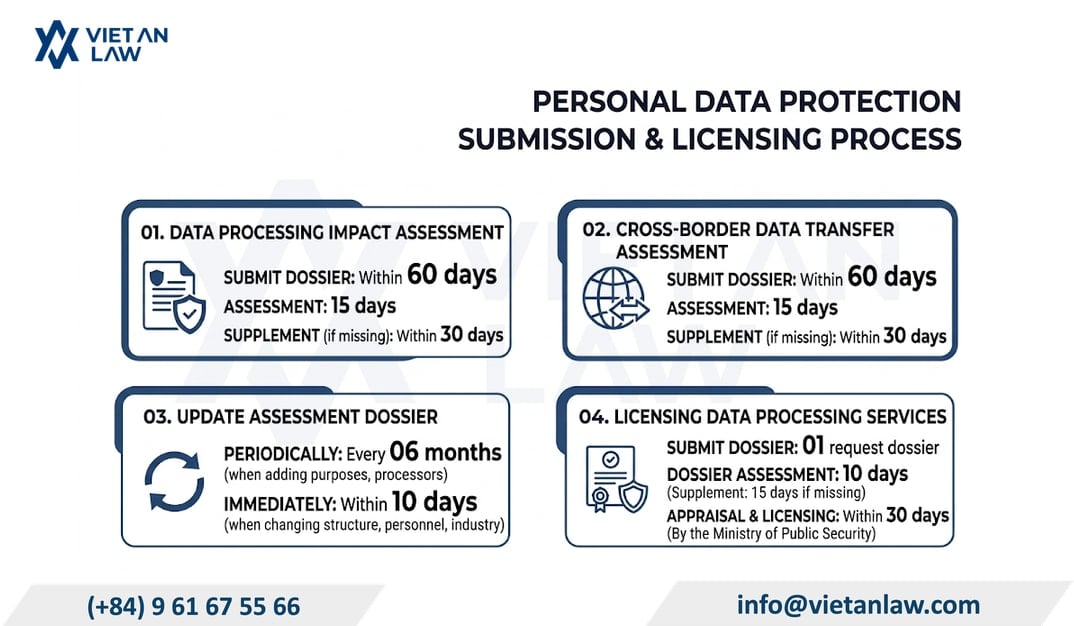
Preparing and submitting a personal data processing impact assessment dossier
Under Article 21 of the Law on Personal Data Protection and Article 19 of Decree No. 356/2025/ND-CP, the procedure is carried out as follows:
- Dossier preparation:
- Notification of personal data processing.
- Impact assessment report.
- Copies of data processing contracts or agreements, together with internal policies, procedures, and forms.
- Dossier submission: Within 60 days from the first day of conducting personal data processing, the healthcare facility must submit 01 original dossier to the Specialized Agency for Personal Data Protection under the Ministry of Public Security.
- Assessment and results: The specialized agency will evaluate the dossier and return the results within 15 days; if the dossier is incomplete, the facility must complete it within 30 days.
Preparing and submitting a cross-border personal data transfer impact assessment dossier (if applicable)
Pursuant to Article 20 of the Law on Personal Data Protection and Articles 17 and 18 of Decree No. 356/2025/ND-CP, where a clinic or healthcare facility stores patient data on servers or cloud computing services located abroad, or transfers medical records to organizations or individuals abroad (except in emergencies to protect an individual’s life or health under Point c, Clause 3, Article 17 of Decree No. 356/2025/ND-CP), the procedure is carried out as follows:
- Dossier preparation:
- Notification of submission of the cross-border personal data transfer impact assessment dossier.
- Cross-border personal data transfer impact assessment report.
- Copies of contracts or personal data transfer documents demonstrating the binding obligations and responsibilities between the organizations or individuals transferring and receiving personal data across borders.
- Policies, procedures, regulations, forms, and other relevant documents regarding personal data protection of the healthcare facility conducting cross-border personal data transfers.
- Dossier submission: Within 60 days from the date of conducting the cross-border personal data transfer, the healthcare facility must submit 01 complete original dossier online, in person, or via postal service to the Specialized Agency for Personal Data Protection under the Ministry of Public Security.
- Assessment and results: The specialized agency will evaluate the dossier and return the results within 15 days; if the dossier is incomplete or not in accordance with regulations, the healthcare facility must complete it within 30 days.
Updating the impact assessment dossier periodically or immediately upon changes
Pursuant to Article 22 of the Law on Personal Data Protection and Article 20 of Decree No. 356/2025/ND-CP, the procedure for updating the personal data processing impact assessment dossier and the cross-border personal data transfer impact assessment dossier is carried out as follows:
- Dossier preparation:
- Notification of changes to the contents of the personal data processing impact assessment dossier or the cross-border personal data transfer impact assessment dossier.
- The updated and supplemented impact assessment dossier reflecting the changes, accompanied by supporting documents proving the corresponding changes.
- Dossier submission: The healthcare facility submits the updated dossier online (via the National Portal on Personal Data Protection), in person, or via postal service to the Specialized Agency for Personal Data Protection under the Ministry of Public Security according to the following timelines:
- Periodic updates every 06 months from the initial submission when new processing purposes or personal data transfer purposes arise, or when there is an addition or change of the personal data controller, personal data controller and processor, personal data processor, or third party.
- Immediate updates within 10 days when the healthcare facility undergoes reorganization, termination of operations, dissolution, or bankruptcy; when there is a change in information regarding the organization or individual providing personal data protection services; or when there is an addition or change in business lines or services related to personal data processing registered in the dossier.
Applying for a certificate of eligibility for provision of personal data processing services
Pursuant to Articles 26 and 33 of the Law on Personal Data Protection and Articles 21, 22, 24, and 25 of Decree No. 356/2025/ND-CP, where a clinic or healthcare facility conducts business in providing services for collecting and processing personal data through websites, applications, or software for healthcare, health monitoring, or medical services, the entity must satisfy the conditions regarding legal status, personnel, infrastructure, and technology, and obtain a satisfactory evaluation result for its personal data processing impact assessment dossier and cross-border personal data transfer impact assessment dossier (if applicable) under Article 22 of Decree No. 356/2025/ND-CP. At the same time, the application procedure for the certificate is carried out as follows:
- Dossier preparation:
- Application for the Certificate of Eligibility for Provision of Personal Data Processing Services.
- Copy of the Enterprise Registration Certificate (not required if the state authority can retrieve the information from the database).
- Document designating the personal data protection department or a contract for using personal data protection services in accordance with regulations.
- Scheme requesting the issuance of the Certificate of Eligibility for Provision of Personal Data Processing Services.
- Degrees and other supporting documents proving the personal data protection qualifications and capacity of at least 03 eligible personnel.
- Dossier submission: The healthcare facility submits 01 set of application dossiers for the Certificate of Eligibility for Provision of Personal Data Processing Services online, in person, or via postal service to the Specialized Agency for Personal Data Protection under the Ministry of Public Security.
- Evaluation, appraisal, and issuance of results:
- The specialized agency will evaluate whether the dossier meets or fails to meet requirements within 10 days; if the dossier is incomplete or non-compliant, the healthcare facility must supplement and complete it within 15 days.
- Within 30 days from the date of receiving a complete and valid dossier, the specialized agency will appraise, review, and decide on the issuance of the Certificate of Eligibility for Provision of Personal Data Processing Services; in case of refusal, it will issue a written notification clearly stating the reasons.
FAQs on protecting patient data in clinics and healthcare facilities in Vietnam
Are private clinics operating as household businesses or micro-enterprises exempt from preparing a personal data processing impact assessment dossier?
Under Clause 3, Article 38 of the Law on Personal Data Protection and Clause 2, Article 41 of Decree No. 356/2025/ND-CP, household businesses and micro-enterprises are not exempt from the obligation to prepare a personal data processing impact assessment dossier and designate data protection personnel if they directly process sensitive personal data. Because information regarding a patient’s health status is sensitive personal data, all clinics are required to prepare and submit a personal data processing impact assessment dossier within 60 days from the date they commence data processing.
Are healthcare facilities permitted to provide patient medical records to health insurance or life insurance enterprises without a written request from the patient?
Pursuant to Clause 2, Article 26 of the Law on Personal Data Protection, agencies, organizations, and individuals operating in the healthcare sector are not permitted to provide patients’ personal data to third parties that are healthcare service providers or health insurance and life insurance enterprises, except where there is a written request from the personal data subject or where the case falls under Clause 1, Article 19 of the Law on Personal Data Protection.
Is it lawful for a clinic to use former patients’ information to send promotional text messages or make marketing calls for new services without their consent for advertising purposes?
Under Articles 9 and 28 of the Law on Personal Data Protection, the consent of the data subject must be expressed for each specific purpose, and the processing of customers’ personal data for advertising service business activities requires the customer’s consent based on the customer being clearly informed of the content, method, form, and frequency of product introductions, while also providing a method for the customer to opt out of receiving advertising information.
Must healthcare facilities that submitted a personal data processing impact assessment dossier under Decree No. 13/2023/ND-CP before January 1, 2026 prepare a new dossier?
Under Clause 2, Article 39 of the Law on Personal Data Protection, personal data processing impact assessment dossiers and outbound personal data transfer impact assessment dossiers that were received by the specialized agency before January 1, 2026 may continue to be used without having to prepare a new dossier under the regulations on personal data protection in Vietnam outlined in this Law.
In which cases must enterprises operating in the healthcare sector apply for a certificate of eligibility for provision of personal data processing services?
Under Articles 21 and 25 of Decree No. 356/2025/ND-CP, organizations and enterprises conducting business in collecting and processing personal data via websites, applications, or software for healthcare, health monitoring, and medical services, or providing and operating automated software systems to process personal data on behalf of healthcare facilities, must carry out the procedure to request the Ministry of Public Security to issue a Certificate of Eligibility for Provision of Personal Data Processing Services.
The above is Viet An Law’s analysis of the regulations on patient personal data protection in clinics and healthcare facilities in Vietnam. If clients need licensing advice or require personal data protection legal advisory services in Vietnam, please contact Viet An Law immediately for timely support.