


Personal data protection in FDI manufacturing companies in Vietnam: legal requirements and compliance is an important legal issue for businesses that manage a large workforce and use biometric timekeeping systems, surveillance cameras and cross-border HR management software. From January 1, 2026, the Vietnamese Law on Personal Data Protection 2025 (No. 91/2025/QH15) and Decree 356/2025/ND-CP establish a new legal framework for employee personal data protection in FDI enterprises in Vietnam, which these businesses need to review to ensure compliance. In the article below, Viet An Law Firm helps clients better understand this issue.
What types of personal data must FDI manufacturers in Vietnam protect?
In manufacturing, personal data arises not only from HR records but is also collected through factory management, access control, occupational safety systems and technology platforms.
Common data groups include:
| Data group | Examples in manufacturing | Risks to note |
| HR data | Full name, citizen ID, address, phone number, labour contract | Disclosure of identification data, identity fraud |
| Payroll data | Salary, bank account, personal income tax information | Disclosure of income, payment fraud |
| Timekeeping data | Fingerprints, facial images, factory entry and exit history | Excessive collection, unauthorised access |
| Health data | Health check records, occupational health status | Disclosure of sensitive information |
| Client and supplier data | Contact details of representatives and persons in charge of transactions | Misuse, inappropriate sharing |
| Surveillance data | Camera images, audio recordings linked to individuals | Monitoring beyond what is necessary, data leakage |
Businesses should classify data by legal nature, processing purpose and level of risk. In particular, biometric data and much health-related information belong to groups that must be strictly protected under the applicable regulations.
Legal framework for personal data protection in Vietnam applicable to FDI enterprises
Applicable legal documents
As of 2026, foreign-invested manufacturing enterprises should pay attention to the following key documents:
- Law on Personal Data Protection 2025 (No. 91/2025/QH15): effective from January 1, 2026, it regulates the rights of data subjects, the principles of data processing and the responsibilities of the parties involved.
- Decree 356/2025/ND-CP: effective from January 1, 2026, it details and guides the implementation of the Law on Personal Data Protection, including requirements on impact assessment dossiers and cross-border data transfers.
- Law on Data 2024 (No. 60/2024/QH15): effective from July 1, 2025, it should be considered where the enterprise’s activities fall within its scope, especially in data governance and processing.
In addition, businesses should cross-check the regulations on labour, information security, cybersecurity and other relevant sector-specific rules on personal data protection in Vietnam.
Are foreign-invested enterprises within the scope of application?
Yes. The Law on Personal Data Protection applies to foreign organisations and individuals in Vietnam and to foreign entities within the statutory scope involved in processing the personal data of protected persons. Therefore, FDI enterprises are not exempt from their obligations merely because the parent company is located abroad.
In practice, businesses need to clearly identify the legal role of each party in the data processing chain, including:
- The company in Vietnam that collects and manages employee data.
- The parent company abroad that receives data for HR management or consolidated reporting.
- Providers of timekeeping software, cloud storage or payroll services.
- Security service providers operating camera systems and access control.
Distinguishing between the data controller, the data processor and the controller-processor is the basis for determining the corresponding legal obligations.
Obligations for employee personal data protection in FDI enterprises in Vietnam
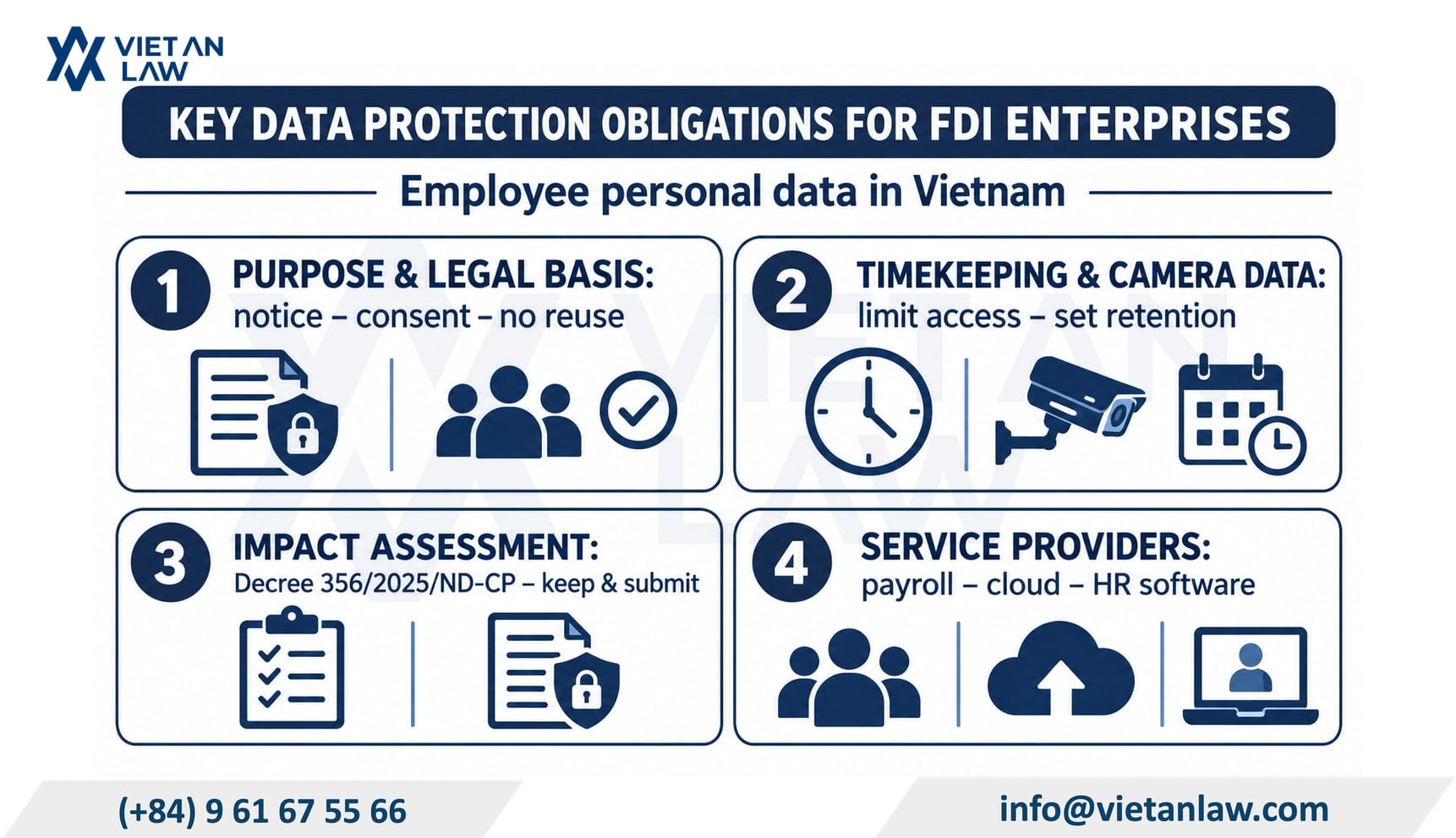
Determining the purpose and legal basis for data processing
- Businesses need to clearly determine what the data is collected for, who has access to it, how long it is stored and whether it needs to be shared with third parties.
- For example, bank account data may be used for payroll, and access data for factory security. However, businesses may not arbitrarily use the collected data for other purposes.
- Businesses must provide notices and obtain consent where required by law, and correctly identify the cases in which processing does not require consent. An employee’s signing of a labour contract does not mean that he or she automatically consents to all personal data processing activities.
Controlling timekeeping and camera data
Manufacturers often use cameras, fingerprint scanners and facial recognition systems to manage staff and control access. These activities may generate personal data, including sensitive data.
Businesses need to:
- Determine the purpose and scope of data collection.
- Provide transparent notice of processing activities as prescribed.
- Limit access rights according to job functions.
- Control the copying, extraction and sharing of data.
- Set a retention period appropriate to the purpose and the law.
Personal data processing impact assessment
Businesses need to determine their obligations to prepare, keep and submit a personal data processing impact assessment dossier under the Law on Personal Data Protection and Decree 356/2025/ND-CP.
The assessment should cover the collection of HR records, biometric timekeeping, outsourced payroll services and data sharing within the group. The dossier should accurately reflect the types of data, processing purposes, parties involved, risks and protective measures.
Businesses should check the conditions, deadlines and exceptions that apply to them, instead of assuming that all activities carry the same obligations.
Controlling service providers
- When outsourcing payroll services, HR management software or cloud storage, businesses need to review the contracts and the responsibilities of each party.
- Key contents include the scope of data processing, access rights, security measures, incident notification responsibilities, the use of subcontractors and the mechanism for returning or deleting data upon termination of the contract.
- Businesses should proactively review their personal data, focusing on key legal tasks such as checking internal documents, reviewing cross-border data flows and establishing compliance governance. Clients may refer to the article on Personal Data Protection Legal Advisory Services in Vietnam: https://vietanlaw.com/protection-of-personal-data-in-vietnam/
Transferring personal data from Vietnam to the parent company abroad
This is a particularly important issue for FDI enterprises. For example, a business in Vietnam may use an HR system located in Singapore, Japan or South Korea to manage employee records and compile group-wide reports.
Under Article 20 of the Law on Personal Data Protection, cross-border transfer of personal data includes transferring data stored in Vietnam to systems abroad, transferring data to organisations or individuals abroad, and using platforms abroad to process data collected in Vietnam.
Businesses need to review:
- Where the data is stored and which software systems are in use.
- The parent company, affiliates and providers with access rights.
- The purpose of the transfer and the scope of data transferred.
- Obligations to prepare, submit and update the impact assessment dossier.
- Security, access control and data-sharing control measures.
The law sets a deadline of 60 days from the first data transfer for submitting the cross-border personal data transfer impact assessment dossier, unless exempted as prescribed. Notably, the law provides an exception for organisations storing the personal data of their own employees on cloud computing services. Businesses should check the applicable conditions and guidance in Decree 356/2025/ND-CP before concluding on their obligations.
Data transfers within the same group are not automatically exempt from all personal data protection obligations.
Compliance checklist for FDI manufacturers in Vietnam
Businesses may use the following checklist for internal review:
- Make an inventory of personal data collected at the factory.
- Classify basic personal data and sensitive personal data.
- Review processing purposes, legal bases, and retention periods.
- Check data protection notices and the consent mechanism where needed.
- Review camera, timekeeping and biometric recognition systems.
- Check contracts with software, payroll and cloud storage providers.
- Identify data flows to the parent company or recipients abroad.
- Assess obligations to prepare, submit and update dossiers as prescribed.
- Assign access rights and establish a data incident response procedure.
- Train staff in charge of HR, IT and legal affairs.
This checklist supports an initial review and does not replace a full assessment of employee personal data protection in FDI Enterprises in Vietnam: https://vietanlaw.com/employee-personal-data-protection-in-fdi-enterprises-in-vietnam/
Frequently asked questions
Do FDI enterprises have to comply with Vietnamese law on personal data?
Yes. Enterprises within the scope of Vietnamese law must perform the corresponding obligations, even if the parent company is located abroad.
May a factory use fingerprints or facial recognition for timekeeping?
Yes, but it must meet the conditions for lawful data processing, be transparent about the purpose and apply appropriate protective measures.
May a business send employee data to its parent company abroad?
Yes, but it must determine its obligations relating to cross-border data transfer and complete the applicable procedures, unless exempted as prescribed.
Does outsourcing payroll services release a business from responsibility?
No. The business must still determine its role and responsibilities and control data processing as prescribed.
When should a business hire a personal data protection consultant?
A review is advisable when deploying an HR management system, biometric timekeeping, outsourced payroll services or data transfers to the parent company, in order to identify obligations promptly and limit risks.
Personal data protection legal advisory services in Vietnam at Viet An Law Firm
Viet An Law Firm supports businesses in:
- Reviewing the collection, storage, use and sharing of personal data;
- Assessing legal obligations based on the website’s operating model;
- Reviewing data protection policies, data processing notices and the consent mechanism;
- Checking contracts with website operators, advertising platforms and technology providers;
- Assessing issues related to cross-border transfer of personal data;
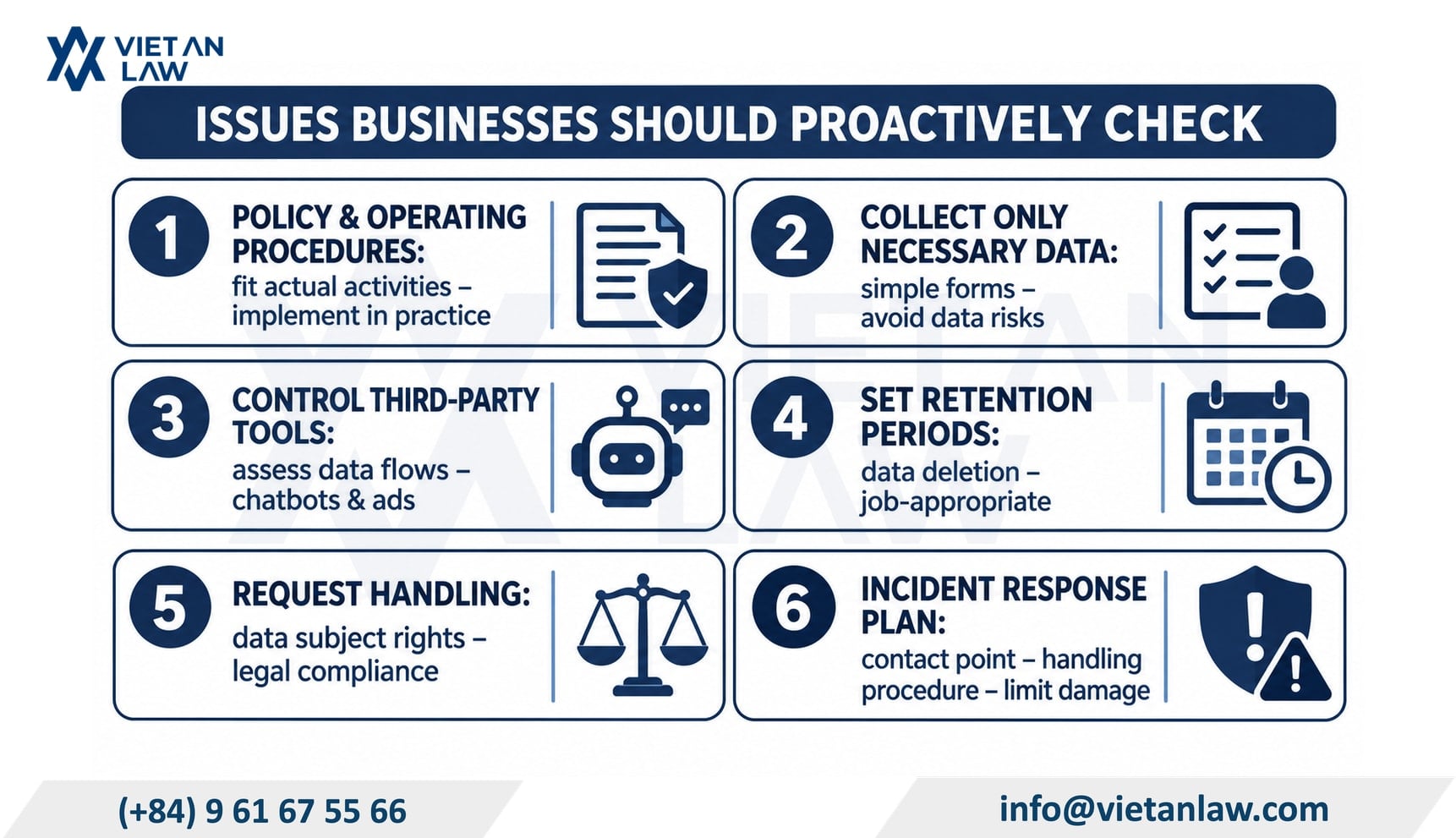
- Advising on procedures for handling data subjects’ requests and responding to incidents.
For more detailed advice on personal data protection in FDI manufacturing companies in Vietnam: legal requirements and compliance, please contact Viet An Law Firm for the best support!