(+84) 9 61 67 55 66
info@vietanlaw.vn

Partnership Company for Startups in Vietnam

In the current vibrant startup context, selecting the right type of enterprise from the outset is a key factor affecting the long-term development of a startup. Besides the popular types, a partnership company – although not too popular – is still a choice worth considering, especially in some specific business models. Thus, when should a partnership company be established, and is this form suitable for startups – young, dynamic, and risky businesses – or not? The following article by Viet An Law will help you answer the question: Partnership company for startups in Vietnam. Is it suitable for startups?

Table of contents

Hide

    Partnerships definition in Vietnam

    Pursuant to Article 177 of the Law on Enterprise 2020, regulations on partnerships are as follows:

    • There are at least 02 partners that are joint owners of the company and do business under the same name (hereinafter referred to as “general partner”). There can be limited partners in addition to general partners.
    •  A general partner shall be an individual whose liability for the company’s obligations is equal to all of his/her assets;
    • A limited partner can be an organization or an individual whose liability for the company’s debts is equal to the promised capital contribution.

    In addition, a partnership also has the following characteristics:

    • A partnership has the status of a juridical person from the day on which the Enterprise Registration Certificate is issued.
    • A partnership must not issue any kind of securities.
    • In a partnership, a general partner is a person with expertise and professional reputation who jointly manages and conducts business on behalf of the company and is jointly and severally liable for the company’s obligations.
    • Capital contributors only participate with capital, do not manage or represent the company, and are entitled to share profits according to the Charter.
    • Thanks to the personal reputation of the general partners, this model easily creates trust with partners, while the small scale and mutual trust help make operations simple and flexible.

    When should a partnership be established?

    According to the enterprise choice

    Depending on the needs, purposes, and conditions of the enterprise, the type of partnership will be suitable and effective. Some advantages of the partnership type will be brought when the enterprise chooses such as:

    • A partnership has legal status, so there is a distinction between the assets of the Enterprise and the assets of the company members. However, this distinction only applies to capital contributing members, while the general partners are still subject to unlimited liability for the company’s debts.
    • This form of enterprise is not limited in the number of members, so it is possible to raise capital by adding more company members.

    According to the regulations

    According to the regulations for partnerships, the law does not specifically stipulate which industries are allowed and which are not allowed to establish this type of company. Enterprises have the right to choose; however, based on the legal regulations on the working regulations of partnerships, we often encounter partnerships consisting of partners who are people with specialized knowledge in specific industries and capital contributors who are simply investors in opening the company and enjoying profits.

    However, the law also regulates this type for some specific business lines as follows:

    Popular business lines for the form of a partnership company

    Popular business lines for the form of a partnership company

    Law firm

    Pursuant to Article 34 of the Law on Lawyers 2006, amended and supplemented in 2012, Law firms include law partnerships and limited liability law firms. Law firms’ members must be lawyers. Accordingly, a law firm must be organized in the form of a partnership or a limited liability company. A law partnership is established by at least two lawyers. A law partnership does not have capital contributing members.

    Notary offices

    Pursuant to Article 23 of the 2024 Law on Notarization, a Notary Office is organized and operates under the provisions of this Law and other relevant legal provisions for partnerships and private enterprises. There must be at least two notaries in partnership, and there must be no capital contributors in this type.

    Bailiff offices

    Under Clause 1, Article 17 of Decree 08/2020/ND-CP on the organization and operation of Bailiffs’ offices, a bailiff office established by a bailiff shall be organized as a sole proprietorship. A bailiff office established by at least 2 bailiffs shall be organized as a partnership company.

    Asset management enterprises

    Clause 1, Article 13 of the Law on Bankruptcy 2014 stipulates that enterprises in the form of partnerships and private enterprises are allowed to practice asset management and liquidation during the bankruptcy settlement process.

    Accounting firms

    Pursuant to Clause 1, Article 59 of the Law on Accounting 2015, an accounting firm may be established in the form of: A multi-member limited liability company, a partnership, or a private enterprise. Thus, accounting firms can be organized under the partnership model..

    Credit rating agencies

    Clause 1, Article 9 of Decree 88/2014/ND-CP stipulates that the types of enterprises: Limited liability companies, Joint stock companies, Partnership companies are allowed to conduct credit rating services after being granted a business eligibility certificate.

    Thus, the above fields all require high responsibility from the members of the service providing company, operating based on personal reputation and expertise – characteristics suitable for the Partnership model. Although not as popular as other types of companies, the partnership is still an effective choice in specific industries such as law, accounting, and notary, where personal trust and transparency play a key role in business operations.
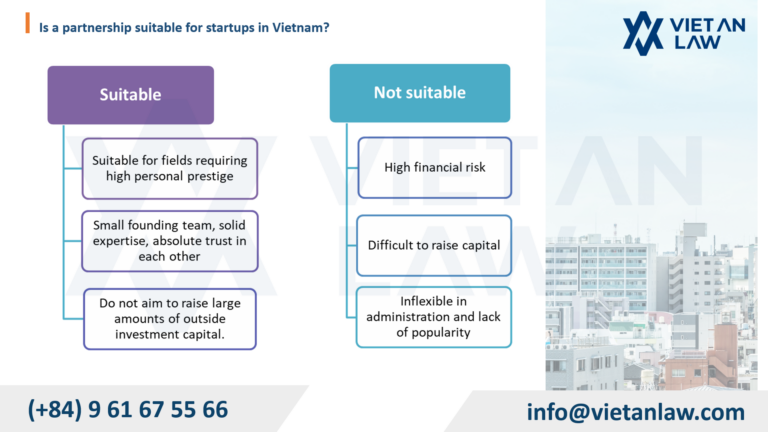
    Is a partnership suitable for startups?

    The suitability of the partnership form for startups

    As mentioned above, a partnership has different advantages and disadvantages. Therefore, when taking advantage of it, this model will become a very good business model for young enterprises. Each enterprise will have its answer to the problem: Partnership company for startups in Vietnam ”

    Suitable when:

    • Startups operate in fields that require a high personal reputation, such as law, accounting, and professional consulting, where customers trust the person, not just the brand.
    • The founding team is small, has solid expertise, trusts each other completely, and is willing to take unlimited responsibility.
    • Do not aim to raise large amounts of capital from outside investors.

    Not suitable when:

    • High financial risk: General partners have unlimited liability with their assets, which is especially dangerous for startups, which have a high failure rate.
    • Difficulty in raising capital: The model does not allow capital contribution without participation in management (no “silent investors”), thus limiting the ability to expand and attract investment.
    • Inflexible in management: All partners have management rights, which can easily lead to conflicts when expanding the scale.
    • Lack of popularity: Most startups today choose LLCs or joint stock companies because these models are more flexible, protect personal assets better, and are easier to attract investors.

    Dossiers for establishing a partnership company according to the new regulations from July 1, 2025

    Pursuant to Point a, Clause 11, Article 1 of the Law on Enterprises 2025, amending and supplementing Article 25 of the Law on Enterprises 2020, stipulating the list of members/partners of a limited liability company/partnership, list of founding shareholders and shareholders that are foreign investors of a joint stock company, and list of beneficial owners.

    Pursuant to Article 24 of Decree 168/2025/ND-CP regulating the registration dossiers of private enterprises, partnerships, limited liability companies, and joint stock companies

    Under Circular 68/2025/TT-BTC, regulating forms are used in business registration and household business registration.

    The dossier for establishing a partnership company according to the new regulations includes:

    • The application for enterprise registration of a partnership is Form No. 5, Appendix I, issued with Circular 68/2025/TT-BTC.
    • The company charter.
    • List of members of the partnership (Form No. 9), Appendix I, issued with Circular 68/2025/TT-BTC.
    • List of ultimate beneficial owners of the enterprise (Form No. 10), Appendix I, issued with Circular 68/2025/TT-BTC.
    • A copy of the legal documents of the individual for the member.
    • Copy of Investment Registration Certificate for foreign investors as prescribed by the Investment Law 2020 (According to Article 20 of the Enterprise Law 2020, amended by Clause 7, Article 1 of Law No. 76/2025/QH15)

    Note: In case the member is an individual, the authorized representative of the member is an organization that declares the personal identification number (when declaring personal information in the business registration procedure), the enterprise registration dossier does not include copies of legal documents of these individuals (according to Clause 2, Article 24, Decree 168/2025/ND-CP).

    Above is the advice of Viet An Law about partnership company for startups in Vietnam. If you have any related questions or need legal advice regarding the enterprise, please contact Viet An Law for the best support.

    Fast & Reliable Legal Assistance
    Fill out the form below and get connected with a lawyer quickly.

      Related Acticle

      Decree 340/2025/ND-CP: New Penalties for Foreign Loan Violations in Vietnam

      Decree 340/2025/ND-CP: New Penalties for Foreign Loan Violations in Vietnam

      Vietnam foreign loan penalties updated under Decree 340/2025/ND-CP. Discover new fines, compliance rules, and foreign debt repayment violations effective February 2026.
      How to register dependent deduction via VneID: A complete online guide

      How to register dependent deduction via VneID: A complete online guide

      Learn how to register dependent deduction via VNeID in minutes. Step-by-step online guide covering documents, common errors, and 2026 PIT deduction rules. Start now!
      Tax Incentive Eligibility 2026: Checklist under Decree 20/2026/ND-CP

      Tax Incentive Eligibility 2026: Checklist under Decree 20/2026/ND-CP

      On January 15, 2026, the Government issued Decree 20/2026/ND-CP detailing and guiding the implementation of a number of articles of Resolution 198/2025/QH15 on some special mechanisms and policies for private…
      Declaration of Food Applicable Standards in Vietnam: 2026 Regulations

      Declaration of Food Applicable Standards in Vietnam: 2026 Regulations

      Declaration of food applicable standards in Vietnam explained for 2026. Learn required documents, procedures, and key regulations to ensure full compliance before market entry.
      Specialized Court Law: A Turning Point for Vietnam International Financial Center (IFC)

      Specialized Court Law: A Turning Point for Vietnam International Financial Center (IFC)

      Vietnam's Specialized Court Law marks a turning point for the International Financial Center (IFC). Learn how this landmark legislation transforms dispute resolution with dedicated jurisdiction, fast procedures, and international standards…

      CONTACT VIET AN LAW

      In Hanoi: (+84) 9 61 67 55 66
      (Zalo, Viber, Whatsapp, Wechat)

      WhatsApp Chat

      whatsapp-1

      In Hochiminh: (+84) 9 61 67 55 66
      (Zalo, Viber, Whatsapp, Wechat)

      WhatsApp Chat

      whatsapp-1

      ASSOCIATE MEMBERSHIP