


Respond to a trademark opposition in Vietnam is not merely about submitting an explanatory document to the Vietnam National Office of Intellectual Property (NOIP) to fulfil a formal procedure. This is an intensive process of analysing and contrasting each opposition ground against legal regulations, specific citations, evidentiary documents, and the protection scope of the filed trademark application, which is a critical turning point during trademark prosecution in Vietnam.
For the application to proceed through examination and potentially be granted a protection title, the applicant or the industrial property (IP) representative organisation must build precise legal arguments, respond comprehensively to every opposed point, and provide appropriate evidence. Through this, the applicant must prove that their right to register is lawful, the trademark meets the conditions for protection, and the grounds presented by the opposing party lack sufficient basis to refuse the application.
What is the response to a trademark opposition in Vietnam?
Responding to a trademark opposition in Vietnam is the act where the applicant submits a document to the Vietnam NOIP to answer the grounds, arguments, and evidence presented by a third party aimed at opposing the issuance of a trademark registration certificate.
The law typically uses the term “feedback opinion of the applicant”. However, in consulting practice, this procedure is commonly referred to as an opposition response or the process of responding to a trademark opposition in Vietnam.
The objective of the response document is to prove one or more of the following contents:
- The opposition opinion does not meet procedural conditions;
- The legal basis of the opposing party is inappropriate;
- The opposition evidence is incomplete or unreliable;
- The trademark is not identical or confusingly similar;
- The applicant has a lawful right to register;
- The application was not filed in bad faith;
- The trademark still satisfies the protection conditions.
Note: The response document must be sent to the Vietnam NOIP, not just sent directly to the opposing party.
Legal basis for the response to a trademark opposition in Vietnam
- Article 112a of the Vietnam Intellectual Property Law regarding opposition to industrial property registration applications;
- Article 82 of the Consolidated Document No. 06/VBHN-BKHCN in 2026 regarding the handling of opposition opinions against trademark registration applications; Article 83 of this document regarding the amendment and supplementation of trademark registration applications;
- Articles 73, 74, 87, 90, and 117 of the Vietnam Intellectual Property Law, depending on the specific opposition grounds.
According to the provisions of the Intellectual Property Law amended in 2025, an opposition to a trademark application must be filed within a time limit of 03 months from the date the application is published. When the opposition opinion meets the conditions for reception, the Vietnam NOIP notifies the applicant and, in cases where it is necessary to obtain an opinion, sets a time limit for the applicant to respond in writing.
When does the applicant need to defend a trademark application in Vietnam?
The applicant needs to prepare a response document when receiving a notification from the Vietnam NOIP stating that a third party has opposed the trademark registration application.
To prepare a well-founded and persuasive response document concerning the contents of the party attempting to defend a trademark application, the responding party must note and clarify the following information:
- Information about the opposed application;
- Information or documents of the opposing party;
- The raised grounds for opposition;
- The time limit within which the applicant must answer;
- The requests requiring explanation or the provision of documents.
Before responding, it is necessary to determine which category the opposition falls into: conflict with a prior trademark, lack of right to register, bad faith, conflict with a trade name, copyright, or another intellectual property right.
A generic response template should not be used for every case, because each opposition ground entails different legal conditions and burdens of proof when seeking to defend a trademark application in Vietnam.
Time limit to respond to a trademark opposition in Vietnam
According to Article 82 of the current regulations, the Vietnam NOIP sets a time limit of 01 month from the date of issuing the notification for the applicant to respond in writing.
A point requiring special attention is that the time limit is calculated from the date of issuing the notification, not automatically from the date the applicant actually receives the notification. Therefore, immediately upon receiving the document, the applicant must check the signing date, the issuing date, and the expiration date for the answer.
The time for the applicant to answer the opposition and the time for the opposing party to provide feedback in return are not counted into the time limit for the substantive examination of the trademark registration application.
Checking the validity of the attempt to oppose a trademark application in Vietnam
Before answering the content, the applicant should check the procedural conditions of the opposition, including:
- Whether the opposition was filed within the 03-month time limit;
- Whether the opposition document accurately identifies the application number and the opposed trademark;
- Whether the opposing party has paid the charges in accordance with regulations;
- Whether the opposition grounds are presented specifically;
- Whether the opposition is accompanied by documents or cites information sources for proof;
- Whether the evidence directly relates to the cited right or subject matter;
- Whether the date of establishment or use of the opposing party’s right precedes the filing date.
The opposition opinion must be established in Vietnamese, accompanied by documents or information sources for proof. Documents in another language must be translated into Vietnamese upon request.
If the opposition is filed late, lacks evidence, or cites a right formed after the filing date, the applicant needs to clearly state this deficiency right from the beginning of the response document as a foundational requirement for a trademark opposition in Vietnam.
Required contents in the response for trademark registration in Vietnam
Information about the trademark application
It is necessary to clearly identify:
- Application number;
- Filing date and priority date;
- Name of the applicant;
- Trademark specimen;
- List of goods and services;
- Number and date of the notification from the Vietnam NOIP.
Summary of the opposition contents
This section should neutrally and concisely present each ground raised by the opposing party. One should not misinterpret or skip unfavourable arguments.
For example: The opposing party claims that the trademark in the application is confusingly similar to the cited trademark according to point e, clause 2, Article 74, and claims that the applicant carried out the registration with bad faith according to point b, clause 1, Article 117.
Viewpoint of the applicant
The applicant must clearly state:
- Disagreement with the entirety or a part of the opposition opinion;
- Which grounds are accepted or rejected;
- The scope of goods and services under dispute;
- The request for the Vietnam NOIP to continue processing and grant a protection title for the entire or a part of the application.
Analysis of each opposition ground
Each ground must be answered separately according to the structure:
Argument of the opposing party → applicable legal regulation → factual events → evidence → conclusion.
Merely declaring that “the opposition opinion has no basis” without analysing each legal condition is usually not persuasive enough, and the application is prone to being refused a certificate for trademark registration in Vietnam.
Responding to a trademark opposition based on confusingly similar trademarks
When the opposing party cites point e, clause 2, Article 74, the applicant needs to separately analyse two issues:
- The degree of similarity between the signs;
- The degree of relation between the goods and services.
Regarding the sign, one should compare:
- Structure and number of components;
- Pronunciation;
- Meaning;
- Form of presentation;
- Prominent and distinctive components;
- Overall impression on consumers.
Regarding goods and services, it is necessary to consider:
- Nature and function;
- Target consumers;
- Distribution channels;
- Method of provision;
- The capability of being produced or provided by the same subject.
For example: The opposing party cites the trademark “SUN RIVER” for drinking water to oppose “SUNRIVA” for cosmetics. The applicant can argue that although both signs contain “SUN”, the overall structure, pronunciation, and meaning are different; simultaneously, drinking water and cosmetics differ in nature, purpose of use, and distribution channels. However, the argument must be adjusted if the actual list contains more closely related products.
Responding to a trademark opposition in Vietnam based on well-known or widely used trademarks
If the opposing party cites a well-known trademark or a trademark that is widely used and recognised, the applicant needs to check:
- Whether the use takes place in Vietnam;
- Whether the time of use is before the filing date;
- The scope and continuity of the use;
- Sales revenue, market share, and distribution system;
- The awareness level of the relevant public;
- The relationship between the goods and services of both parties.
Registration certificates in foreign countries or general advertising posts on the Internet do not automatically prove that the trademark is well-known or widely recognised in Vietnam.
The response document must evaluate each document, pointing out exactly which documents do not reflect the Vietnamese market, fail to determine the time, or fail to prove the awareness level of consumers.
Responding to a trademark opposition in Vietnam based on trade names or copyrights
For a trade name, it is necessary to check whether the opposing party has proven lawful and actual use before the filing date. An enterprise registration certificate alone does not fully reflect the scope of trade name use, the business territory, and the customer group.
For copyright, it is necessary to clarify:
- The subject matter claimed as a work;
- The author and the rights owner;
- The time of creation or publication;
- The document transferring the rights;
- The possibility that the applicant has accessed the work;
- The degree of similarity in the protected creative elements.
For example: If the opposing party claims that the logo in the application is a copy of their work but only provides a copyright registration certificate issued after the filing date, the applicant should not merely rely on the issuance date. It is necessary to further check the creation date, the process of forming the work, and documents proving actual ownership rights.
Responding to a trademark opposition in Vietnam concerning the right to register a trademark
When an opposition relates to the right to register, the focus is usually on the relationship between the applicant and the opposing party, such as:
- Manufacturer and distributor;
- Brand owner and agent;
- Outsourcing party and processing unit;
- Employer and former employee;
- Joint venture or franchise partners.
The applicant needs to provide contracts, power of attorney letters, distribution agreements, transaction vouchers, or documents proving they possess an independent right to register and defend a trademark application in Vietnam.
According to the current process, disputes regarding the registration right can be transferred for settlement at the Court. The Vietnam NOIP may request the opposing party to file a lawsuit and send a copy of the acceptance notice within a 02-month time limit. If not performed on time, the opposition is considered withdrawn, and the application continues to be processed, except for cases resolved directly during the examination process as prescribed.
Responding to allegations of registration with bad faith
Regarding an allegation of bad faith, the applicant needs to refute the chain of circumstances that the opposing party uses to prove that the applicant knew about the prior trademark and had the intention to misappropriate or obstruct.
The evidence that can be used includes:
- Documents proving the independent trademark creation process;
- Naming and design records;
- Product development plans;
- Manufacturing, advertising, or distribution contracts;
- Documents on trademark use prior to the dispute arising;
- Permission documents or agreements between the parties;
- Evidence of actual business operations.
For example: If the opposing party alleges that a distributor registers the manufacturer’s trademark in bad faith, the applicant can provide an agreement permitting the registration or prove they independently created the sign. Conversely, if the contract clearly defines that the trademark belongs to the manufacturer, a general denial will be difficult to persuade.
Documents and evidence accompanying the response to a trademark opposition in Vietnam
Depending on the case, the dossier may include:
- Response document;
- Power of attorney for the industrial property representative;
- Relevant protection titles or registration applications;
- Design, transfer, or distribution contracts;
- Sales invoices and vouchers;
- Catalogues, packaging, and advertising materials;
- Website and social media data;
- Documents proving the trademark creation process;
- Trademark comparison table;
- Goods and services correlation table;
- Vietnamese translations of foreign documents;
- Application amendment and narrowing documents, if any.
Each piece of evidence should be numbered, with a description of the proof purpose, and directly referenced in the argumentation section. One should not submit a large volume of documents without explaining the legal value of each document.
Can the application be amended to handle the opposition in Vietnam?
Before the Vietnam NOIP issues a decision to grant or refuse to grant a protection title, the applicant can amend and supplement the application. However, the amendment must not expand the disclosed scope of protection and must not alter the essence of the registration subject matter.
In practice, as a tactic for the settlement of trademark opposition in Vietnam, the applicant may consider:
- Narrowing the list of goods and services;
- Removing directly conflicting goods and services;
- Clarifying the content of separate protection exclusions;
- Adjusting application information to match legal records;
- Negotiating with the opposing party regarding coexistence scope.
Amending the trademark specimen must be evaluated cautiously because significantly altering the components, structure, or overall impression can be deemed as altering the essence of the trademark.
Processing procedure after the applicant’s response in Vietnam
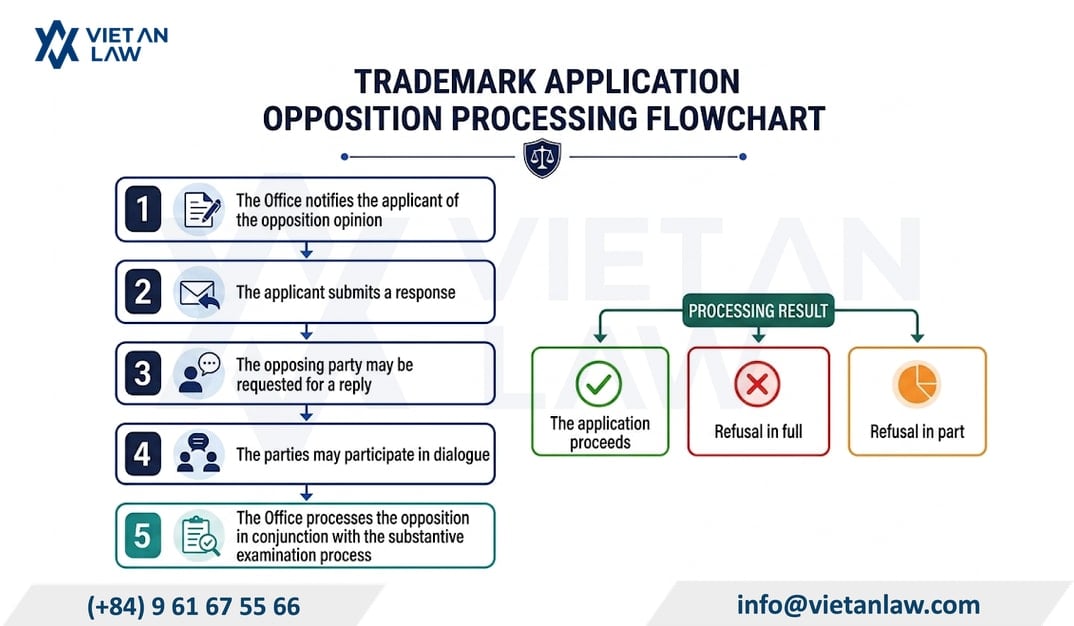
After receiving the response document, if deemed necessary, the Vietnam NOIP may send the feedback opinion of the applicant to the opposing party and set a period of 01 month for the opposing party to answer.
The Vietnam NOIP can also organise a dialogue if deemed necessary or when both parties mutually request it. The settlement of a trademark opposition in Vietnam is determined based on the application dossier, evidence, the parties’ arguments, and any dialogue results.
Possible outcomes after responding to a trademark opposition in Vietnam
After reviewing the dossier, the Vietnam NOIP may:
- Not accept the opposition opinion and continue processing the application;
- Accept a part of the opposition and refuse a part of the list;
- Accept the entire opposition and refuse to grant the protection title;
- Accept the application amendment or narrowing plan;
- Suspend the processing of the application to await the dispute resolution results at the Court;
- Suspend the processing of the opposition if the application for trademark registration in Vietnam is withdrawn.
The opposition results are considered alongside the substantive examination results of the application. In case the application is withdrawn, the Office issues a notice to suspend the processing of the opposition.
Common mistakes during trademark prosecution in Vietnam when responding to an opposition
Common mistakes to avoid when attempting to respond to a trademark opposition in Vietnam include:
- Submitting the document past the time limit;
- Merely issuing a general denial without answering each ground;
- Failing to distinguish between a prior right and prior use;
- Failing to separately analyse the signs and the goods or services;
- Failing to accurately determine the right formation date;
- Submitting evidence without explaining the purpose of proof;
- Relying primarily on documents created after the filing date;
- Presenting arguments that contradict the registration dossier;
- Amending the trademark beyond the permitted scope;
- Failing to foresee the possibility of a dispute having to be resolved at the Court.
An effective document needs to focus on the strongest ground and directly answer each element that the opposing party is obligated to prove.
Services for responding to a trademark opposition in Vietnam by Viet An Law Firm
- Reviewing the opposition notification and dossier;
- Evaluating the protection capacity of the application;
- Identifying weaknesses in the arguments and evidence of the opposing party;
- Searching for the trademark and cited rights;
- Building a response strategy;
- Drafting documents and systematising evidence;
- Representing to work with the Vietnam NOIP;
- Participating in dialogues and negotiations with the opposing party;
- Consulting on amending or narrowing the list;
- Monitoring the processing procedure and consulting on complaints if the application is refused.
With a team of highly experienced lawyers and intellectual property specialists, Viet An Law supports clients to defend a trademark application in Vietnam suitable for each case, ensuring strict arguments, comprehensive evidence, and minimising the risk of the trademark registration application being refused.
In case you receive an opposition notice regarding a trademark application before figuring out how to respond to a trademark opposition and settlement of trademark opposition in Vietnam, please contact Viet An Law for consultation, dossier review, and support in carrying out the procedures promptly.