


Setting up a company in the UK is an important decision and brings many benefits to the business. However, the establishment of a company also requires thoroughness and mastery of legal regulations. To ensure a smooth and efficient company formation process, there are a few important considerations to consider. Viet An Law would like to guide customers to some notes through the article below.
Notes on the registered office address when setting up a company in the UK
The Registrar’s Office address is the company’s official address, where it receives correspondence and notices from Companies House and other government agencies.
Role of the Registered Office Address
- Official Contact Address: The Registered Office address is the only publicly available address of the company. Anyone can search for this address on the Companies House website.
- Receive correspondence and notifications: All important correspondence and notices from Companies House, HMRC (UK Taxation and Customs Authority) and other government agencies will be sent to this address.
- Archiving of company records: Some important legal records of the company must be stored at the Registrar’s Office address, so that they can be checked when necessary.
Requirements for Registered Office Address
- Physical address in the United Kingdom: The Registered Office address must be a physical address in the United Kingdom (England, Scotland, Wales or Northern Ireland).
- Manned: This address must have someone to receive mail during office hours.
- Must not be a PO Box mailbox: The Registered Office address must not be a PO Box address.
- Can be your home address: You can use your home address as your Registered Office Address, but you’ll need to make sure to comply with security and privacy regulations.
Notes on naming when setting up a company in the UK
Choosing a company name is an important step in the process of setting up a business in the UK, as it is not only a legal name but also the face of your brand. Therefore, it is extremely necessary to choose a name that is suitable, unique and compliant with the law.
The naming of the requirements for compliance with the law is as follows
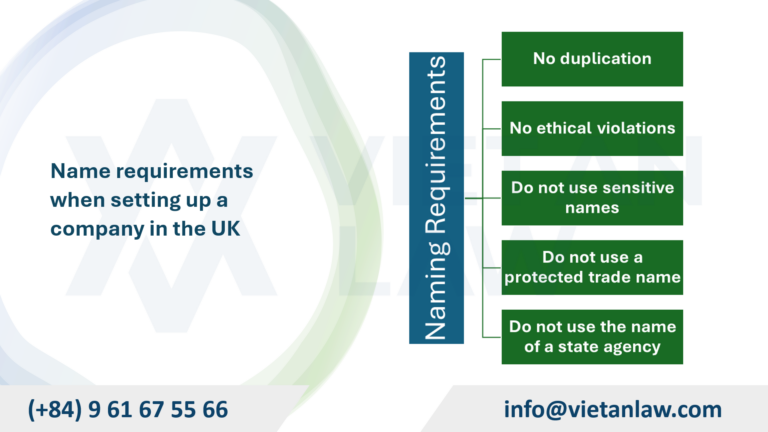
- No duplication: The company name must not be identical or too similar to the name of the companies registered with Companies House.
- No ethical violations: The company name must not contain vulgar, offensive, misleading, or vulgar words.
- Do not use sensitive names: Company names must not use words related to politics, religion, or other sensitive issues.
- Do not use a protected trade name: A company name must not use a trade name, trademark or geographical indication that has been protected by another organization or individual, unless approved by the owner.
- Do not use the name of a state agency: The name of the company must not use the name of a state agency or socio-political organization, unless there is approval.
Once the company name is available, customers need to register the company name
- Register at Companies House: After choosing the right name, you need to register your company name at Companies House. The dossier includes the following list of documents:
- Company name application: This form can be downloaded from the Companies House website.
- Documents proving the applicant’s identity: A copy of the applicant’s passport or photo ID.
- Power of attorney (if applicable): If the applicant is not the legal representative of the company, a valid power of attorney is required.
Notes on providing information about business activities when setting up a company in the UK
After registering the name, customers proceed to provide information about business activities to Companies House.
SIC code (Standard Industrial Classification code)
- What is SIC Code? The SIC code (Standard Industrial Classification Code) is a numerical code system used to classify the economic activities of businesses. Each code corresponds to a specific type of business activity.
- Why do I need a SIC code? Providing the SIC code to Companies House is mandatory. The SIC code helps this agency and related parties better understand the company’s business activities, thereby serving the purpose of statistics, management and data analysis.
How to choose a SIC code
- Identify your company’s core business: You need to clearly define what your company’s core business is.
- Search for the right SIC code: Visit the Companies House website or use online search tools to find the right SIC code for your business.
Notes on shareholders when setting up a company in the UK
To complete the registration procedure, some important information about shareholders needs to be provided fully and accurately. According to UK law, the minimum age to become a shareholder is 16 years old.
A company can be formed with only one shareholder, however, it is also quite common to have multiple shareholders.
When registering a company, some of the following information about shareholders will be required:
- Full name
- Birthday
- Nationality
- Permanent Address
- Contact
- Number of shares owned
- Nature and control ratio of each shareholder
Notes on appointing a person with significant control when setting up a company in the UK
During the process of registering a company in the United Kingdom, identifying and providing information about a Person in Substantial Control (PSC) is a mandatory requirement by law. PSCs are individuals or legal entities that have significant control over the company, even if they are not shareholders or directors.
If the PSCs are not concurrently shareholders or directors, you need to provide the following information about each person:
- Full name: It is necessary to provide the correct first and last name according to the identity document.
- Date of birth: Provide the date, month, and year of birth.
- Nationality: Specify the current nationality.
- Contact Address: This is the address used to receive official correspondence and communications from Companies House and state agencies.
- Permanent address: The address where the person resides regularly.
- Rate and Nature of Control: The percentage of control that person holds in the company should be clearly stated, as well as the nature of that control (e.g., stock ownership, voting rights, the right to appoint/remove directors, or other agreements).
Notes on minimum charter capital when setting up a company in the UK
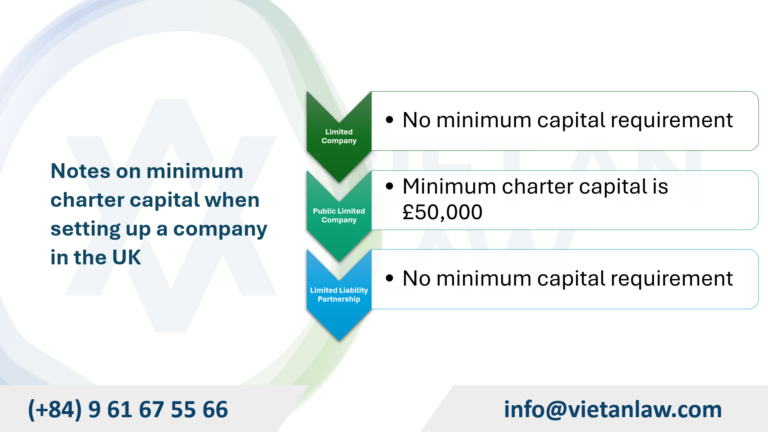
When starting the process of setting up a company in the UK, identifying and providing information about the capital is an important step. The amount of capital required to start a business will depend on the structure and type of company you choose. There are many different types of companies in the United Kingdom, each with different capital requirements. Example:
- Limited Company (Ltd): This is the most common type, usually with no minimum capital requirement. However, you need to prove the financial ability to run the company effectively.
- Public Limited Company (PLC): This type requires a minimum charter capital of £50,000, of which at least 25% must be paid before the company commences.
- Limited Liability Partnership (LLP): This type does not have a minimum capital requirement, but the members need to agree on the capital contribution ratio and related responsibilities.
In addition, there are other types of companies such as Limited by Guarantee or Unlimited Company, each with its own regulations on capital and legal obligations. Determining the right amount of capital is not only a legal requirement but also an important factor to ensure the stability and development of the business in the future. You need to carefully consider factors such as the size of your operation, projected costs, business plan, and ability to raise capital to make the optimal decision.