


When investors wish to restructure their investments, transfer ownership to other investors or withdraw capital from an enterprise, they need a clear understanding of capital transfer and foreign investor divestment in Vietnam: procedures, tax and payment requirements. In 2026, enterprises need to pay special attention to new regulations on investment, tax and foreign exchange management, including the Law on Investment 2025, Decree 96/2026/ND-CP and Circular 38/2026/TT-NHNN. In the article below, Viet An Law Firm will help clients better understand capital transfer in Vietnam.
What are capital transfer and divestment by foreign investors in Vietnam?
- Capital transfer is the transfer by an investor of part or all of its shares or capital contribution to another individual or organization under an agreement and in accordance with the law.
- Meanwhile, divestment is understood more broadly as the withdrawal by an investor of part or all of its investment from an enterprise. In practice, divestment is usually carried out through the transfer of shares or capital contributions.
- The transferee may be a Vietnamese investor or a foreign investor. The transfer of all capital to Vietnamese investors may also convert the enterprise from a foreign-invested enterprise into a 100% Vietnamese-owned enterprise.
Conditions for the transfer of capital to foreign investors in Vietnam
Under current investment regulations, when a foreign investor acquires capital in a Vietnamese enterprise, the following issues should mainly be examined:
- Market access conditions for foreign investors;
- Foreign ownership ratio in the relevant business lines;
- National defense and security conditions;
- Land conditions if the enterprise holds land use rights in sensitive areas;
- Specialized regulations on foreign ownership ratios;
- Regulations on foreign exchange management and payment;
- Tax obligations arising from the transaction.
The Law on Investment 2025 and Decree 96/2026/ND-CP are the legal bases that should be given priority when assessing investment conditions today. Decree 96/2026/ND-CP also sets out the principle of market access for foreign investors, under which, where Vietnamese law does not impose restrictions, foreign investors enjoy the same market access as domestic investors.
When must a capital transfer in Vietnam be registered?
Not every transaction transferring capital to foreign investors requires prior registration with the investment registration authority.
Enterprises need to check whether the transaction falls under the cases requiring registration of capital contribution, share purchase or capital contribution purchase. Under regulations on foreign investment, the cases requiring special attention include:
- Transactions that increase the ownership ratio of foreign investors in an enterprise engaged in business lines subject to conditional market access for foreign investors;
- Transactions resulting in foreign investors holding more than 50% of the charter capital in cases prescribed by law;
- Foreign investors acquiring capital in an economic organization holding land use rights on islands, in border or coastal areas, or in other areas affecting national defense and security.
Procedures for the transfer of capital to foreign investors in Vietnam
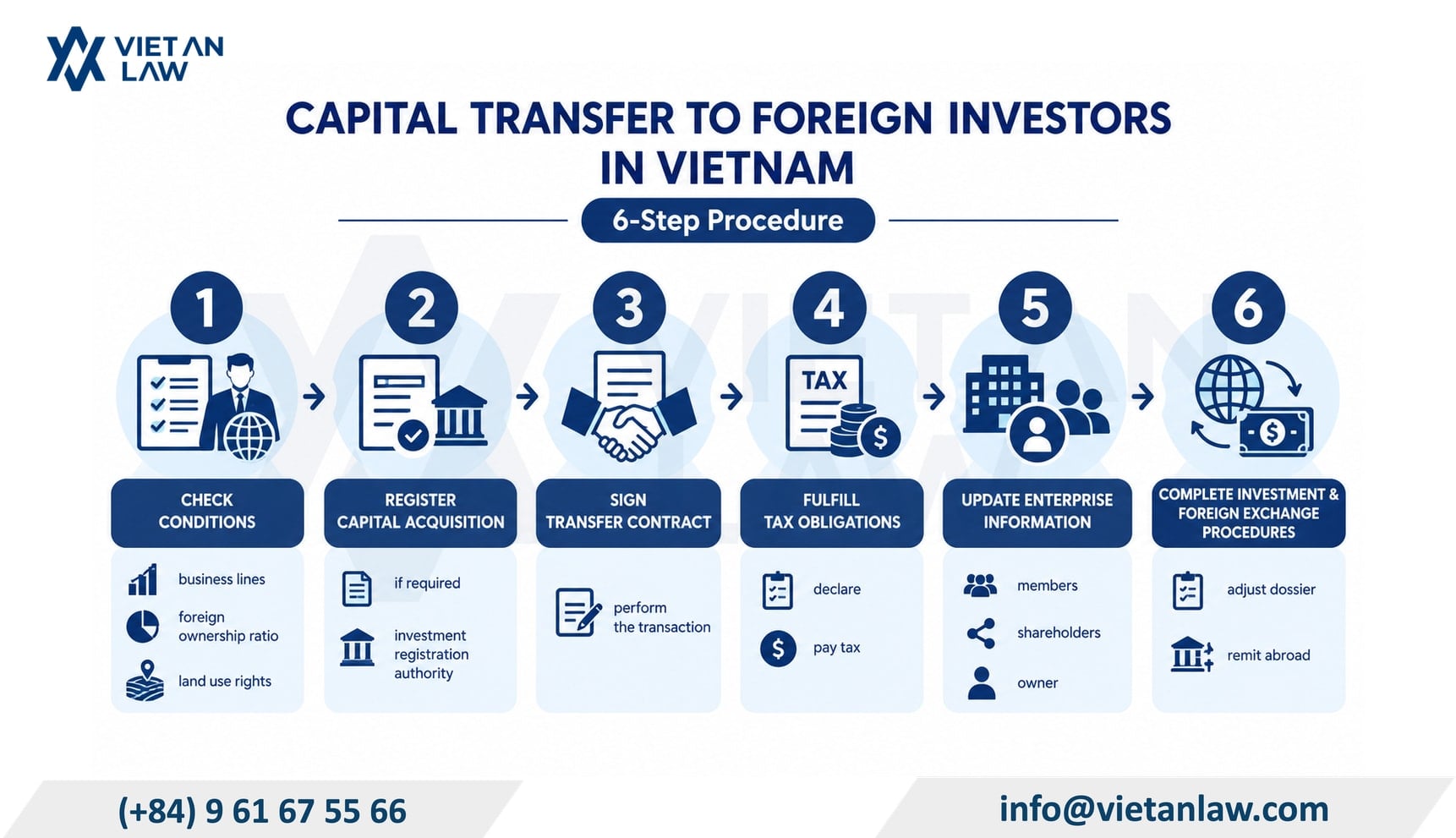
Step 1: Check the transfer conditions
Determine the business lines, foreign ownership ratio, legal status of the enterprise, land use rights and specialized conditions.
Step 2: Register the capital acquisition if required
The foreign investor prepares a dossier for registration of capital contribution, share purchase or capital contribution purchase and submits it to the competent investment registration authority.
The dossier usually includes:
- A written registration of capital contribution, share purchase or capital contribution purchase;
- Legal documents of the investor;
- Legal documents of the economic organization;
- An agreement in principle on the capital contribution, share purchase or capital contribution purchase;
- Documents on land use rights, if subject to review;
- A power of attorney and other relevant documents.
Step 3: Sign and perform the transfer contract
After satisfying the conditions or receiving a written approval in cases requiring registration, the parties carry out the transaction under the contract.
Step 4: Fulfill tax obligations
The transferor declares and pays the taxes arising according to the transferor’s status and the nature of the transaction.
Step 5: Change enterprise information
The enterprise carries out procedures to change its members, shareholders, owner or other relevant information.
Step 6: Complete investment and foreign exchange procedures
Where the transaction changes information in the investment dossier, the corresponding adjustment procedures must be carried out. Payment and remittance of money abroad must comply with regulations on foreign exchange management.
Capital transfer tax in Vietnam for foreign investors
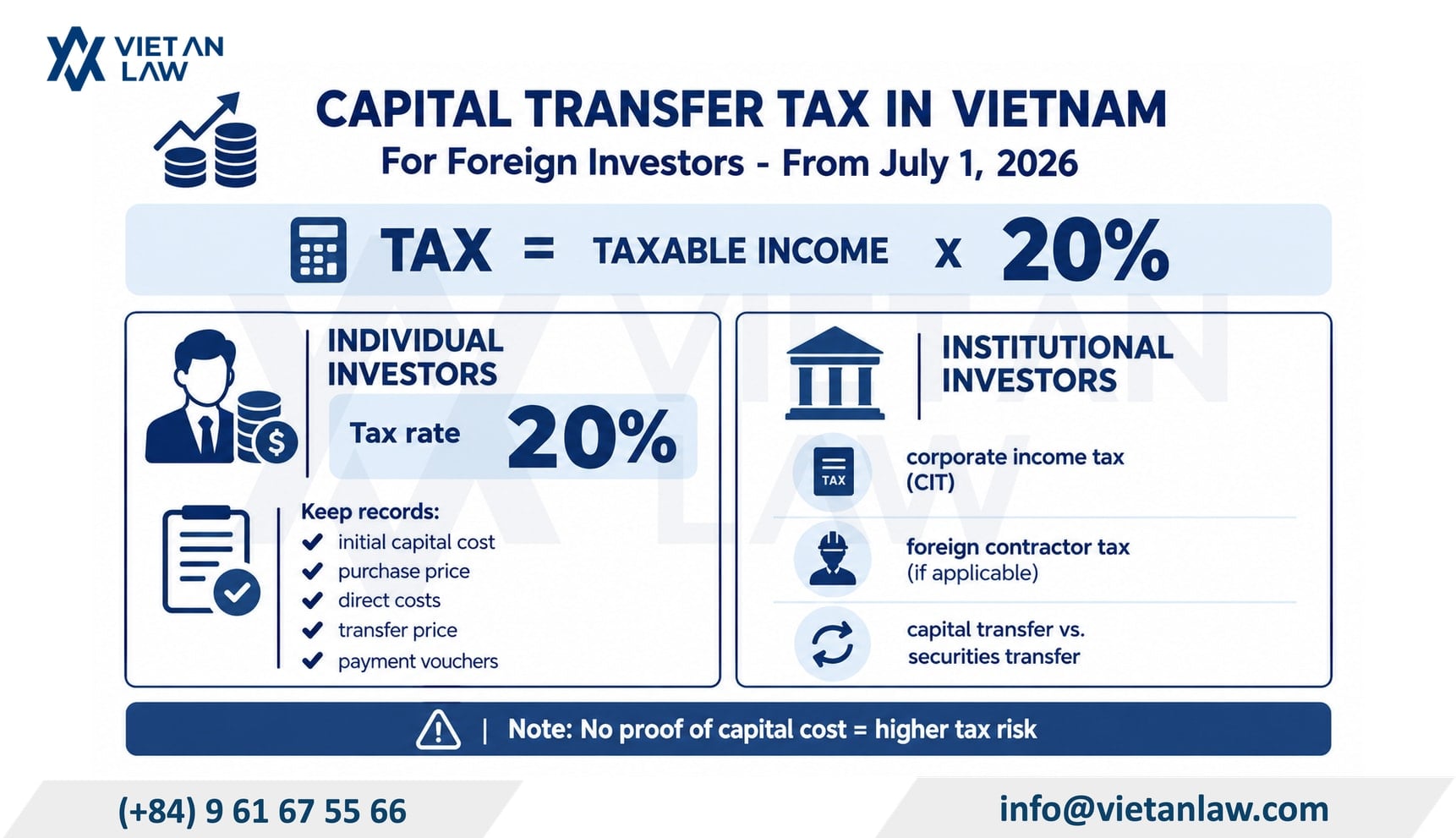
From July 1, 2026, the new personal income tax policy takes effect. For income from capital transfer, the capital transfer tax in Vietnam is determined on the basis of taxable income at a tax rate of 20%; where the purchase price and related costs cannot be determined, the calculation method based on a percentage of the transfer price applies under the new regulations.
For individual investors
- Initial capital cost;
- Purchase price of the capital;
- Direct costs related to the transfer;
- Transfer price;
- Payment vouchers.
Failure to prove the cost of capital may significantly change the amount of tax payable.
For institutional investors
- Income from capital transfer by foreign organizations must be determined and declared under the law on corporate income tax, while also considering foreign contractor tax regulations where applicable.
- Capital transfer should be distinguished from securities transfer, as the method of determining tax may differ.
- In addition, the preferential CIT rate for enterprises with small revenue should not be applied by default to income from capital transfer; the nature of the income and the taxpayer must be correctly determined.
New rules on payment and remittance upon foreign investor divestment in Vietnam
Payment is the final pillar of capital transfer and foreign investor divestment in Vietnam: procedures, tax and payment requirements. A very notable point in 2026 is Circular 38/2026/TT-NHNN, effective from August 18, 2026, which replaces Circular 06/2019/TT-NHNN on foreign exchange management for foreign investment activities in Vietnam.
Under the new regulations, the concept of “foreign investment capital account in Vietnam” is used to manage cash flows related to foreign investment activities.
This foreign direct investment capital account may be used for transactions related to:
- Capital contribution, purchase of shares or capital contributions;
- Receipt of capital transfer proceeds;
- Payment of the transfer value;
- Receipt of profits;
- Remittance of capital and lawful income abroad when the investor divests.
Therefore, investors should not agree on cash payment or transfer money through an inappropriate account. Authorized banks are responsible for checking the documents, vouchers and purpose of the transaction before execution.
Can foreign investors remit divested capital from Vietnam back home?
Yes. After completing the capital transfer and related obligations, foreign investors may remit the proceeds abroad in accordance with regulations on foreign exchange management.
However, it is necessary to distinguish between:
- Initial investment capital;
- Difference/gain from the transfer;
- Undistributed profits;
- Other lawful income.
Each amount may have different legal bases and tax obligations.
Under Circular 38/2026/TT-NHNN, the remittance of capital and lawful income abroad in cases of capital transfer, capital reduction, termination or cessation of investment activities is carried out through the foreign direct investment capital account and documents proving the transaction.
Differences between capital transfer and foreign investor divestment in Vietnam
| Criteria | Capital transfer | Divestment |
| Nature | Transfer of capital ownership | Withdrawal of part/all of the investment |
| Scope | Part or all | Part or all |
| After the transaction | May still hold capital | No longer holds capital if fully divested |
| Common form | Sale of shares/capital contribution | Usually through capital transfer |
| Tax | Arises according to the transaction | Corresponding tax obligations must be determined |
| Remittance abroad | Under foreign exchange regulations | Under regulations on investment capital accounts |
Frequently asked questions
Can a foreign investor transfer all of its capital to another foreign investor?
Yes, if the conditions on investment, ownership ratio, business lines, land and related regulations are met. In some cases, the capital acquisition must be registered before the transaction is completed.
Does a capital transfer between two foreign investors require registration?
Not in all cases. It is necessary to check whether the transfer increases the foreign ownership ratio, exceeds the ownership threshold prescribed by law or falls under conditional business lines/areas.
Can a divesting foreign investor remit money back home?
Yes. Upon divestment, after completing the transaction, tax obligations and related procedures, the investor may remit capital and lawful income abroad in accordance with regulations on foreign exchange management.
From 2026, what should be noted about capital transfer payments?
Special attention should be paid to Circular 38/2026/TT-NHNN, effective from August 18, 2026, on foreign investment capital accounts and receipt and payment transactions related to investment activities.
If an investor transfers all of its capital, must the company be dissolved?
No. If, after the transaction, the enterprise still satisfies the operating conditions and has a lawful owner, members or shareholders, the company may continue to operate.
For more detailed advice, please contact Viet An Law Firm, which supports clients in every aspect of capital transfer and foreign investor divestment in Vietnam: procedures, tax and payment requirements!