


After obtaining an Enterprise Registration Certificate, foreign-invested enterprises (FDI) in Vietnam cannot simply proceed with standard operational procedures like domestic companies. Instead, they must meet specialized regulatory obligations related to foreign investment, foreign exchange management, and investment project tracking. Notably, businesses must ensure the opening of a Direct Investment Capital Account (DICA), inject capital strictly according to the committed schedule, track project progress, complete annual financial audits, and secure specialized sub-licenses, such as a Business License or Retail Establishment License. Below, Viet An Law provides an in-depth legal analysis of post-incorporation procedures for FDI companies in Vietnam to help foreign investors maintain full compliance and operational efficiency.
Overview of FDI companies and post-incorporation procedures in Vietnam
An FDI company can be established through various investment methods, such as a foreign investor setting up an economic organization, contributing capital, purchasing shares or capital contributions, or implementing an investment project in accordance with the Vietnamese Law on Investment.
Under Article 18 of the Vietnamese Law on Investment 2025, foreign investors may establish an economic organization to implement an investment project before obtaining an IRC, provided they meet the market access conditions applicable to foreign investors. The Law also stipulates that investment projects by foreign investors fall under the category requiring the issuance of an IRC.
Upon establishment, an FDI enterprise needs to categorize its required tasks as follows:
- General corporate procedures: tax, e-invoices, digital signatures, payment accounts, labor, social insurance, signage, accounting, etc.;
- Procedures specific to direct investment: DICA, capital contribution, project progress, investment activity reporting, and the remittance of profits and capital abroad;
- Procedures related to business lines: Business Licenses, licenses for establishing retail outlets, and other specialized licenses;
- Specific financial and accounting obligations: annual financial statement audits, tax finalization, and documentation for profit remittance abroad.
In addition to the specific tasks mentioned above, regarding general post-establishment procedures for enterprises in Vietnam, businesses may refer to the article by Viet An Law on post-incorporation procedures (latest update) at: Legal Checklist After Company Formation in Vietnam – Viet An Law.
Post-incorporation procedures for FDI companies in Vietnam
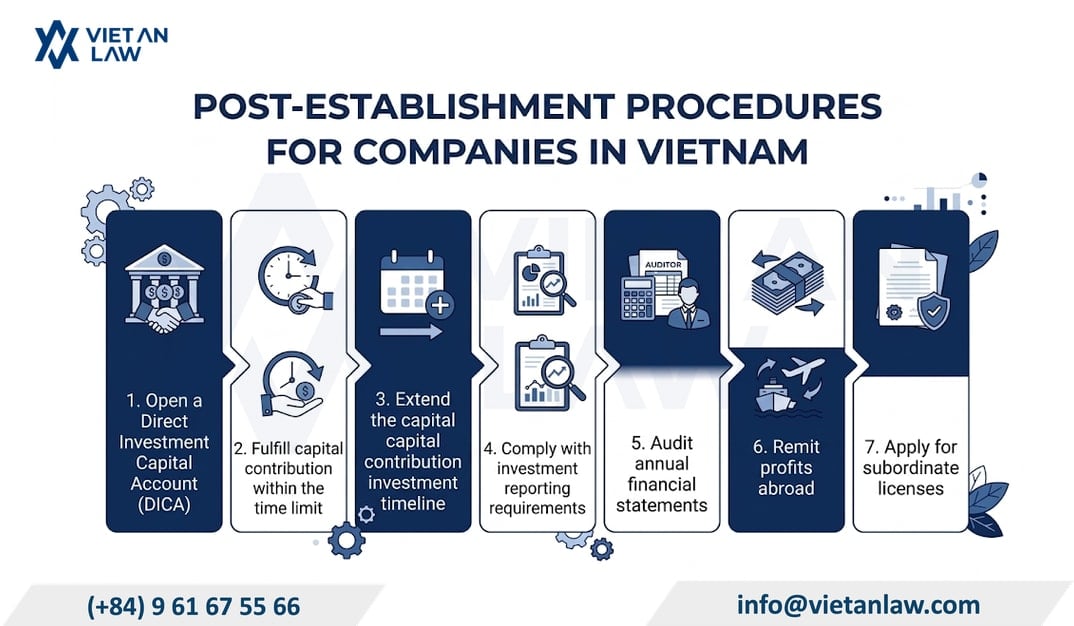
Open a Direct Investment Capital Account (DICA)
One of the first specific tasks an FDI company must undertake is to open a DICA at an authorized bank.
Pursuant to Article 6 of Circular 38/2016/TT-NHNN, foreign-invested enterprises are required to open and use a direct investment capital account to conduct transactions related to direct investment activities. This account may be opened in foreign currency and, where necessary, in Vietnamese Dong at an authorized bank.
Specifically, regarding a foreign-currency DICA, an enterprise may open only one account in the specific foreign currency used for the capital contribution at an authorized bank. In cases of investment in Vietnamese Dong, the enterprise may open a DICA in Vietnamese Dong at the same bank where the foreign-currency DICA was opened.
A DICA is not merely an ordinary corporate bank account. For FDI companies, this account serves as a crucial channel for executing transactions related to investment capital, including:
- Receiving investment capital contributions;
- Receiving payments for the transfer value of capital or projects in cases prescribed by law;
- Executing transactions related to increases or decreases in investment capital;
- Profit repatriation from Vietnam for foreign investors and other lawful income of foreign investors abroad;
- Remitting investment capital abroad in the event of capital reduction, project termination, or liquidation;
- Executing certain transactions related to foreign loans in accordance with foreign exchange control regulations.
Capital contribution timeframe after establishing an FDI company
Once the company is established, investors must fulfill their capital contribution obligations in accordance with the registration dossier and the investment project’s schedule.
Regarding the enterprise’s charter capital, it is also necessary to observe the Law on Enterprise regulations concerning contribution deadlines based on the business entity type. For instance, in a limited liability company, members must fully contribute the committed assets within 90 days of the ERC’s issuance; in a joint-stock company, shareholders must fully pay for their registered shares within the statutory timeframe.
However, for FDI enterprises, one must not focus solely on the 90-day charter capital deadline; it is equally important to monitor the progress of investment capital contributions and project implementation as outlined in the investment dossier.
This constitutes a key distinction between FDI companies and ordinary Vietnamese enterprises.
Extension of the capital contribution schedule for an FDI enterprise
If investors anticipate an inability to contribute the full capital according to the registered schedule, the enterprise should consider adjusting the capital contribution timeline before the original deadline expires.
Under Article 33 of the Vietnamese Law on Investment 2025, the project implementation schedule is a detail subject to adjustment during the project’s execution. The enterprise must prepare a dossier explaining the reasons for the adjustment and the new schedule, along with other relevant documents as required by current regulations.
Important note: Enterprises should not wait until the capital contribution deadline has passed to initiate adjustment procedures. In practice, the schedule adjustment should be carried out prior to any violation to minimize the risk of penalties and adverse effects on the project’s legal status.
Therefore, if a delay in capital contribution is anticipated, FDI enterprises should review their documentation and proceed with the adjustment formalities promptly.
Implementation of investment reporting for FDI companies in Vietnam
Following establishment and the commencement of operations, Investment reporting for FDI companies in Vietnam has been complied with as stipulated by investment laws.
Pursuant to Point a, Clause 2, Article 47 of the Law on Investment 2025, investors and economic organizations implementing investment projects are required to submit quarterly and annual reports to the investment registration authority and the local investment database regarding the project’s implementation status. These reports must cover the following:
- Realized investment capital;
- Business and investment performance results;
- Information concerning labor, state budget contributions, investment in research and development, and environmental treatment and protection;
- Key sector-specific performance indicators;
Consequently, enterprises should assign specific responsibility for tracking investment reporting tasks to their legal, accounting, or investment departments to ensure that project reporting obligations are not overlooked in favor of tax-related duties alone.
Annual financial statement audit for FDI companies
This is a particularly important point for FDI companies to note.
According to Article 37, Clause 1 of the Vietnamese Law on Independent Audit (2011, amended in 2024), FDI enterprises fall into the category of businesses whose annual financial statements must be audited by an auditing firm or a branch of a foreign auditing firm operating in Vietnam.
Therefore, newly established FDI companies need to proactively prepare for the audit process starting from their very first financial year.
Enterprises should:
- Select a qualified auditing firm;
- Prepare the system of supporting documents and accounting records;
- Reconcile capital contribution figures with bank records;
- Reconcile revenue, expenses, and tax obligations;
- Conduct the year-end financial statement audit;
- Use the audit report for relevant procedures as prescribed by law.
Notably, audited financial statements are also crucial when investors distribute and repatriate profits abroad.
Profit repatriation from Vietnam for foreign investors after an FDI company becomes profitable
A key concern for foreign investors is when and how they can repatriate profits once their FDI company becomes profitable.
In principle, the repatriation of profits by foreign investors must comply with regulations on taxation and foreign exchange management.
Clause 1, Article 12 of Circular 38/2016/TT-NHNN stipulates that the transfer of profits and other lawful income derived from direct investment activities abroad must be conducted via a direct investment capital account.
Article 4 of Circular 186/2010/TT-BTC prescribes the timing for profit repatriation as follows:
- Annual profit repatriation: Foreign investors are permitted to repatriate profits distributed or derived from direct investment activities in Vietnam on an annual basis following the end of the fiscal year, provided that the FDI enterprise has fulfilled its financial obligations to the State of Vietnam in accordance with the law and has submitted its audited financial statements and corporate income tax finalization declaration for the fiscal year to the direct tax authority.
- Profit repatriation upon termination of direct investment activities in Vietnam: Foreign investors are permitted to repatriate profits upon the termination of direct investment activities in Vietnam, provided that the investee enterprise has fulfilled its financial obligations to the State of Vietnam in accordance with the law, has submitted its audited financial statements and corporate income tax finalization declaration to the direct tax authority, and has fully complied with the obligations prescribed by the Law on Tax Administration.
Obtaining sub-licenses for an FDI company
Not every FDI company can commence full business operations solely with an Enterprise Registration Certificate and an Investment Registration Certificate.
Following establishment, the enterprise must review its business lines and project objectives to determine which specialized licenses are required.
Common scenarios include:
Trading License for distribution and retail activities
Foreign-invested economic organizations engaging in the trading of goods or activities directly related to the trading of goods may be required to obtain a Trading License pursuant to Article 5 of Decree 09/2018/ND-CP (as amended and supplemented by Decree 248/2026/ND-CP).
Notably, foreign-invested economic organizations exercising retail distribution rights fall under the category of entities required to obtain a Trading License in accordance with regulations.
License for establishing a retail outlet
If an FDI company wishes to open a store, supermarket, or retail outlet falling under the scope of Article 5 of Decree 09/2018/ND-CP (as amended and supplemented by Decree 248/2026/ND-CP), it must complete the procedures to obtain a license for establishing a retail outlet.
For retail outlets beyond the first one, an Economic Needs Test (ENT) may also be required in certain cases, in accordance with regulations.
Other specialized licenses
Depending on the business sector, an FDI company may also need to obtain:
- Service business license;
- Certificate of eligibility for business operations;
- Specialized operational license;
- Environmental license/permit;
- Fire prevention and fighting license/permit;
- Construction permit;
- Transport and logistics license/permit;
- License in the education sector;
- License in the healthcare sector;
- Licenses related to e-commerce;
- Other specialized licenses, certificates, or conditions.
Enterprises need to distinguish between market access conditions applicable to foreign investors and business conditions applicable after the enterprise commences operations. These are two distinct sets of conditions that may apply concurrently.
Key differences in post-incorporation procedures for direct and indirect foreign investments in Vietnam
It is necessary to distinguish between direct investment and indirect investment, as these two forms involve different cash flow management mechanisms.
Direct investment
For FDI enterprises subject to direct investment regulations, the enterprise and the investor utilize a DICA in accordance with Circular 06/2019/TT-NHNN.
The DICA is used for transactions such as capital contributions, capital transfers, profit remittances, and the transfer of lawful proceeds related to direct investment activities.
Indirect investment
Foreign indirect investment involves a specific account mechanism.
Pursuant to Clause 2, Article 3 of Circular 03/2025/TT-NHNN (as amended and supplemented by Circular 38/2026/TT-NHNN), foreign investors engaging in indirect investment activities in Vietnam must use an VND indirect investment account opened at an authorized bank. Generally, a foreign investor is permitted to open only one indirect investment account, except in specific cases as prescribed by regulation.
The indirect investment account is used for transactions related to activities such as:
- Buying and selling securities;
- Making capital contributions or purchasing shares or capital portions in cases falling within the scope of indirect investment;
- Receiving dividends or distributed profits;
- Transferring capital or securities;
- Other lawful transactions related to indirect investment activities.
Comparison table of accounts for direct and indirect investment
| Criteria | Foreign direct investment | Foreign indirect investment |
| Account type | Direct Investment Capital Account (DICA) | Indirect Investment Account in VND |
| Applicable entities | Foreign-invested enterprises with direct investment capital and investors under statutory cases | Foreign investors conducting indirect investment |
| Capital contribution | Executed via DICA in accordance with regulations | Executed via indirect investment account within the scope of indirect transactions |
| Profit remittance | DICA serves as the essential channel for remitting profits and lawful revenues | Executed via indirect investment account in accordance with regulations |
| Capital repatriation | Executed under foreign exchange management mechanisms for direct investment | Executed under foreign exchange management mechanisms for indirect investment |
FDI companies: Checklist after company formation in Vietnam
For practical convenience, FDI companies may use the following checklist:
| Stage | Required tasks |
| Immediately after incorporation | Complete corporate dossier, digital signature, tax registration, and e-invoices |
| Post-incorporation | Open payment accounts and DICA |
| Capital contribution phase | Investors transfer capital into the correct account, in the correct currency, and on schedule |
| Before capital contribution deadline | Review the ability to fully contribute capital; prepare schedule adjustment if necessary |
| During operation | Monitor investment project progress and submit investment reports |
| Prior to operating conditional business lines | Verify requirements and apply for the corresponding sub-licenses |
| Retail operations | Review Business License and Retail Establishment License requirements |
| End of financial year | Prepare and audit financial statements |
| Upon generating profit | Issue profit distribution decision and fulfill tax obligations |
| Profit remittance | Submit regulatory notifications and remit profits through appropriate account channels |
| When ownership ratio changes | Re-evaluate foreign exchange control compliance and DICA / indirect investment account status |
| When project details change | Review procedures for amending Investment Registration Certificate or investment dossiers |
Key considerations for FDI enterprises following company registration in Vietnam
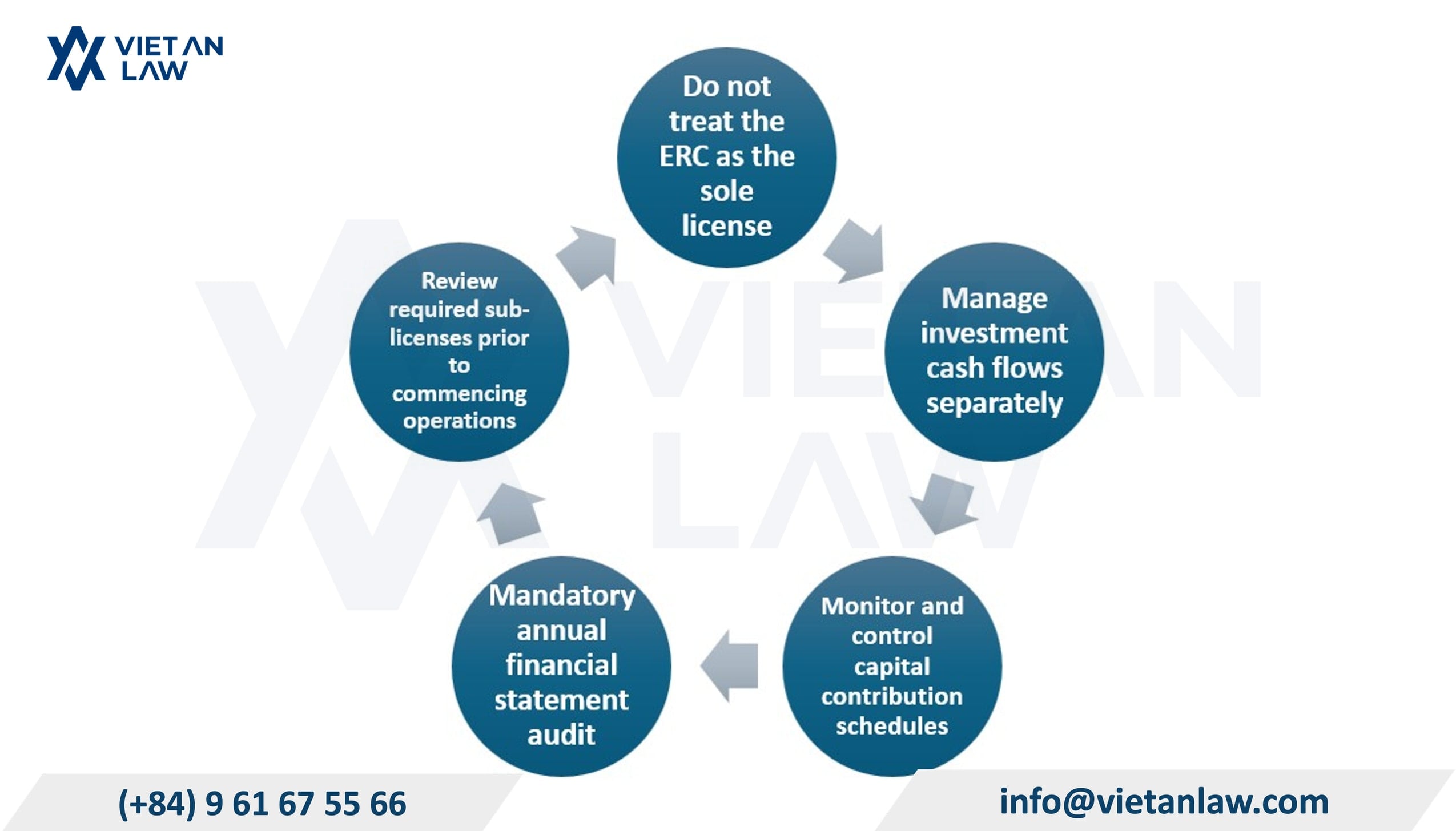
Do not treat the ERC as the sole license
FDI enterprises need to simultaneously review their Investment Registration Certificate, project objectives, business lines, and market access conditions.
Manage investment cash flows separately
Capital contribution, capital transfer, and profit remittance are subject to specific foreign exchange management requirements. DICA is a matter that enterprises need to address right from the outset.
Monitor and control capital contribution schedules
Do not wait until the deadline is imminent to verify the actual contributed capital. If there is a risk of falling behind schedule, the enterprise should proactively handle the procedures for adjustment.
FDI enterprises are required to have their annual financial statements audited
This is a significant and specific obligation, regardless of whether the enterprise is large or small.
“Sub-licenses” must be reviewed before launching business activities
The fact that a business line is recorded on the Enterprise Registration Certificate or in the investment dossier does not mean the enterprise has met all the conditions required to conduct that specialized business activity.
Frequently asked questions about post-incorporation procedures when establishing an FDI company in Vietnam
Is an FDI company required to open a DICA after establishment?
Enterprises with foreign direct investment are required to open and use a direct investment capital account in accordance with foreign exchange management regulations. The DICA is used for transactions related to direct investment activities, including capital contributions, profit repatriation, and the outward transfer of investment capital as prescribed.
Can an FDI company repatriate profits immediately upon generating them?
Investors cannot immediately repatriate profits simply because accounting profits have been generated. Profit repatriation is subject to conditions regarding the fulfillment of financial obligations, the determination of distributable profits, and compliance with notification procedures. A notification regarding profit repatriation must be submitted at least seven working days in advance, in accordance with current regulations.
Does an FDI company engaged in retail business need to obtain a separate license?
Foreign-invested economic organizations exercising retail distribution rights are required to obtain a Trading License; if establishing a retail outlet, they must also consider the requirement for a Retail Outlet Establishment License and determine whether an Economic Needs Test (ENT) is required, pursuant to Decree 09/2018/ND-CP (as amended and supplemented by Decree 248/2026/ND-CP).
Can a newly established FDI company commence business operations before fully contributing its capital?
In principle, an FDI company may carry out business activities within the scope of its registered business lines and investment objectives; however, it must simultaneously ensure compliance with capital contribution obligations under enterprise laws and adhere to the capital contribution schedule registered in its investment dossier.
If an investor is unable to contribute the full capital according to the registered schedule, the enterprise must proactively review the situation and carry out procedures to adjust the capital contribution schedule and project implementation timeline in accordance with regulations before the registered deadline expires. Continuing operations without fulfilling capital commitments may lead to legal risks and impact the implementation of the investment project.
Author: Trainee Lawyer Do Quynh Trang
Reviewer: Lawyer Trung Thi Lieu
Hotline/ Zalo/ Whatsapp: (+84) 961 675 566
Email: info@vietanlaw.com
Hanoi Office: 3rd Floor, Hoang Ngan Plaza Building, No. 125 Hoang Ngan, Yen Hoa Ward, Hanoi
Ho Chi Minh City Office: Unit 04.68, 4th Floor, Lobby A, RiverGate Residence Building, 151-155 Ben Van Don, Khanh Hoi Ward, Ho Chi Minh City.
Article updated in September 2026.