(+84) 9 61 67 55 66
info@vietanlaw.vn

Notes when setting up a company in Thailand

Thailand is increasingly asserting its position as an attractive investment destination in Southeast Asia, attracting the attention of many foreign businesses looking to expand their business activities. There are many key factors contributing to this attraction such as the stable development of the Thai economy along with the diversity in sectors such as manufacturing, tourism, agriculture and services, creating a potential business environment. In addition, Thailand’s strategic geographical location – located in the center of Southeast Asia serves as an important gateway to connect to major markets in the region, including ASEAN countries and larger economies in Asia, facilitating access to regional markets and supply chains. However, there are some notes when investing in establishing a company in Thailand, Viet An Law will mention some issues to pay attention to through the article below.

Table of contents
Hide

    Notes on the number of founders and shareholders when setting up a company in Thailand

    Notes on the number of founders and shareholders when setting up a company in Thailand

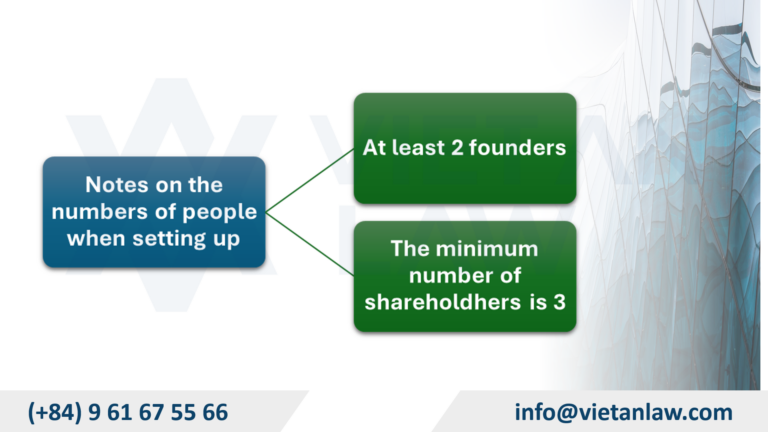
    When setting up a Private Limited Company in Thailand, one of the important factors to consider is the structure of the number of founders and shareholders. According to Thai law, the process of establishing a limited liability company needs to have some of the following notes:

    • Minimum Quantity: At least 2 founders are required to proceed with the registration process for the establishment of a private limited liability company in Thailand.
    • Role: Founders are the initiators and responsible for the initial legal procedures for the establishment of the company. They play an important role in the preparation of documents, business registration, and other activities related to the establishment of the company.

    After the company is officially established, the minimum number of shareholders is required to be three, including the following regulations to be noted:

    • The number of shares, usually 51% or more, must be owned by a Thai citizen or a Thai legal entity. This means that, in the shareholder structure, it is mandatory to have at least one Thai shareholder holding the dominant shareholding. This regulation is set to protect national interests and control business activities of foreigners in Thai territory.
    • However, there are also some industries that are allowed by the Thai government to be 100% owned by foreigners. The relationship between founders and shareholders is usually very close, because founders will often also become shareholders of the company. In summary, to set up a private limited liability company in Thailand, you need at least two founders, and the company must have at least three shareholders, of which at least one shareholder is a Thai who holds the majority of the shares, except for some other special industries.

    Notes on reporting obligations when setting up a company in Thailand

    The reporting requirements for a limited company in Thailand are quite specific and need to be strictly followed.

    Financial Statements

    • Frequency: A limited company in Thailand is required to prepare monthly financial statements. This is different from many countries that only require quarterly or annual reporting.
    • Audit: Annual financial statements must be audited.
    • Approval: The financial statements must be approved by the annual shareholders’ meeting within 4 months of the end of the company’s fiscal year.
    • Report Submission: Once approved, the financial statements must be submitted to the Business Development Department (DBD) within 1 month from the date of approval.

    List of Shareholders: The Director of the company is responsible for making and submitting to DBD the following two lists within 14 days from the date of the Annual General Meeting of Shareholders:

    • List of all shareholders holding shares at the time of the meeting.
    • A list of people who have ceased to be shareholders since the last shareholder meeting.

    Shareholders’ Meeting:

    • First Annual Meeting: Must be held within 6 months from the date of registration of the company.
    • Follow-up meetings: Must be held at least once every 12 months.

    Related Questions When Setting Up a Company in Thailand

    – When establishing a company, which type should I choose?

    A limited liability company is the most common form for foreign investors in Thailand. It limits the responsibilities of shareholders to the scope of contributed capital and has a relatively simple management structure. Other types may be suitable for more specific business purposes.

    – Is there a minimum charter capital requirement? What is the value per share?

    Usually, there is no minimum charter capital requirement for a limited liability company. However, the value per share should not be lower than 5 Baht. At least 25% of the value of the shares must be paid in full.

    – What are the regulations on naming a company?

    The company name must end with the word “Limited” (or the abbreviation “Co., Ltd.”). The name must not be identical to the name of the registered companies and must not violate the regulations on fine customs and customs. Customers should prepare 3 company names in order of priority in case the first name is identical.
    Related Acticle

    Key Changes in Vietnam’s Amended Law on Prices (Applied from 2026)

    Key Changes in Vietnam’s Amended Law on Prices (Applied from 2026)

    Vietnam's Amended Law on Prices 2025 takes effect January 1, 2026. Discover key changes including price stabilization transfers, state pricing updates, and new business requirements.
    Decree 03/2026/ND-CP: Stricter Management of Charity & Social Funds in Vietnam

    Decree 03/2026/ND-CP: Stricter Management of Charity & Social Funds in Vietnam

    Decree 03/2026/ND-CP introduces stricter management of charity & social funds in Vietnam from March 2026. Learn new disclosure rules, establishment conditions & penalties.
    Vietnam’s AI & Semiconductor Strategy: The Impact of Decree 353/2025

    Vietnam’s AI & Semiconductor Strategy: The Impact of Decree 353/2025

    Vietnam's AI & Semiconductor strategy under Decree 353/2025 explained. Comprehensive guide to tax incentives, investment support, and preferential policies for digital technology industry.
    Decree 356/2025 vs. Decree 13/2023: Updates on Personal Data Protection in Vietnam

    Decree 356/2025 vs. Decree 13/2023: Updates on Personal Data Protection in Vietnam

    Decree 356/2025 vs Decree 13/2023: Complete guide to Vietnam's Personal Data Protection updates. Learn new DPO requirements, cross-border transfer rules, and compliance deadlines for 2026.
    Electronic Labor Contracts in Vietnam: New Standards under Decree 337/2025

    Electronic Labor Contracts in Vietnam: New Standards under Decree 337/2025

    Electronic Labor Contracts in Vietnam explained under Decree 337/2025. Learn new standards, legal validity, eContract requirements, and digital signing procedures effective 2026.

    CONTACT VIET AN LAW

    In Hanoi: (+84) 9 61 67 55 66
    (Zalo, Viber, Whatsapp, Wechat)

    WhatsApp Chat

    whatsapp-1

    In Hochiminh: (+84) 9 61 67 55 66
    (Zalo, Viber, Whatsapp, Wechat)

    WhatsApp Chat

    whatsapp-1

    ASSOCIATE MEMBERSHIP