Ninh Binh Company Formation Support for SMEs in Vietnam
Ninh Binh currently presents numerous favorable conditions for business, investment, and innovative entrepreneurship activities. Particularly following its consolidation with the remaining portions of Ha Nam and Nam Dinh provinces, the region offers significant potential and opportunities for investors. Accordingly, for those wishing to establish SMEs in Ninh Binh post-merger, it is essential to consider a number of legal and procedural matters. Viet An Law is pleased to provide Ninh Binh company formation support for SMEs in Vietnam.
Table of contents
Hide
Post-consolidation overview of Ninh Binh Province
As per recent governmental updates, the administrative map of Vietnam will be restructured into 34 provincial-level units, comprising 28 provinces and 6 centrally-governed cities. Under this framework, the current provinces of Ha Nam, Nam Dinh, and Ninh Binh shall be consolidated into a single province, to be named Ninh Binh. The political and administrative center of this new province will be located in Hoa Lu City (presently in Ninh Binh).
Following the merger, the new Ninh Binh province will span an area of approximately 3,900 km² and have a population exceeding 4.4 million, becoming one of the most populous and expansive administrative units in the Red River Delta. In 2024, the combined economic scale of Ha Nam, Nam Dinh, and Ninh Binh is projected to exceed VND 310 trillion in GDP, VND 55 trillion in state budget revenue, and USD 17.56 billion in export turnover.
The new province holds a geographically strategic position as the southern gateway to the Capital, situated along the North Central – Red River Delta economic corridor. It also encompasses a multitude of cultural heritages, natural resources, and renowned landscapes.
The consolidation of the three provinces is anticipated to streamline administrative operations, enhance economic scale, improve the efficiency of state management, and unlock development potential in key sectors including the marine economy, tourism, industry, and logistics.
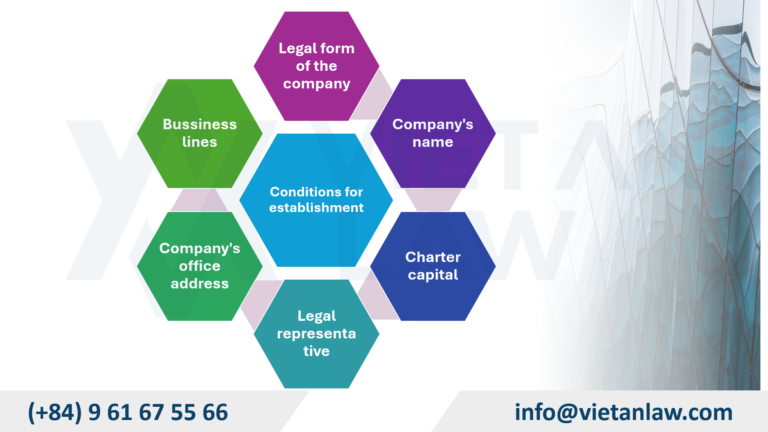
Similar to other types of enterprises, small businesses are required to satisfy specific legal conditions for registration and operation. Key considerations include:
Legal form of the company
Enterprises must select an appropriate legal structure in accordance with their capital resources and the number of participants. Each legal form has its own distinct characteristics suitable for different types of investors. For small-scale business ventures, it is advisable to consider simple structures such as private enterprises, single-member limited liability companies, or limited liability companies with two members.
Naming the SME
When naming a company, the enterprise must ensure that its name is not identical to or confusingly similar to the name of an existing registered enterprise. The company name must include both the type of enterprise and a distinctive proper name. It is strictly prohibited to use the names of state authorities or people’s armed forces units as the distinctive part of the enterprise name.
It is prohibited to use words or symbols that violate historical traditions, cultural values, ethical standards, or the fine customs and practices of the nation.
The enterprise name must follow the correct structure, comprising the enterprise type (e.g., “Limited Liability Company”, “Joint Stock Company”) and a distinctive element.
Enterprises are advised to conduct a name availability search before registration to ensure compliance with legal regulations and avoid infringement of naming rights.
The distinctive part of the enterprise name may be abbreviated or expressed in English, provided that it does not coincide with any previously registered business name.
Charter capital upon company establishment
A company must adequately prepare its capital upon establishment, as the process of setting up an enterprise involves various costs.
For business lines that do not require legal capital, enterprises may declare their charter capital at their discretion, based on their capabilities, without being subject to any specific conditions.
However, it is advisable not to register excessively low charter capital, as this may negatively impact the company’s credibility with customers and partners.
If the enterprise registers a business line that requires legal capital, the declared charter capital must be equal to or greater than the prescribed legal capital.
Company’s legal representative
The legal representative holds a crucial role within the company. Therefore, the enterprise should select an individual with sufficient competence, capacity, experience, and trustworthiness.
This position of legal representative may be assumed by the enterprise owner, director, general director, chairperson, or manager.
An enterprise may have one or multiple legal representatives depending on the company type, and the legal representative(s) may be changed after the company’s establishment.
Company’s registered office address
When selecting a registered office address, small and medium-sized enterprises must ensure that the address is located within the territory of Vietnam, has a specific and clear address, including house number, district, ward, city, etc.
It is prohibited to use fictitious addresses or to register residential apartments or collective living quarters as the company’s address.
Enterprises may use a private residential address or lease office space for the company’s registered office.
Business lines
Select business lines that are appropriate for the enterprise’s business needs.
Utilize the industry codes according to the Vietnam Standard Industrial Classification System (issued with Decision No. 27/2018/QD-TTg).
Certain business lines require specific conditions (such as tourism, education, healthcare, etc.) and necessitate sub-licenses.
Ninh Binh Company Formation Support for SMEs in Vietnam
Receiving and processing authority
The authority responsible for receiving and issuing Enterprise Registration Certificates in Ninh Binh is the Department of Enterprise – Ninh Binh Provincial Department of Finance (formerly the Business Registration Office – Ninh Binh Department of Planning and Investment).
Submission methods
Directly or via postal service: The enterprise founder or authorized person undertaking enterprise registration procedures shall submit the enterprise registration dossier and pay the enterprise registration fee at the Department of Enterprise – Ninh Binh Provincial Department of Finance.
Online: The legal representative shall declare information, upload electronic documents, and digitally sign the electronic registration dossier according to the procedures on the National Business Registration Portal (https://dangkykinhdoanh.gov.vn) using a public digital signature or a Business Registration Account.
Resolution timeframe
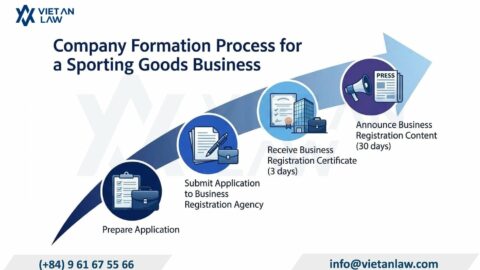
Upon receiving the enterprise registration dossier, the Department of Enterprise shall issue an acknowledgment receipt to the applicant.
The Department of Enterprise shall issue the Enterprise Registration Certificate within 03 working days from the date of receiving a valid dossier.
After being issued the Enterprise Registration Certificate, the enterprise must publicly announce its establishment on the National Business Registration Portal within 30 days from the date of public announcement.
Conditions for issuance of Enterprise Registration Certificate
An enterprise shall be issued an Enterprise Registration Certificate upon satisfying all of the following conditions:
The registered business line is not prohibited from investment and business.
The enterprise’s name is established in accordance with regulations.
There is a valid enterprise registration dossier.
All enterprise registration fees have been paid in accordance with legal provisions on state fees.
Criteria for determining SMEs
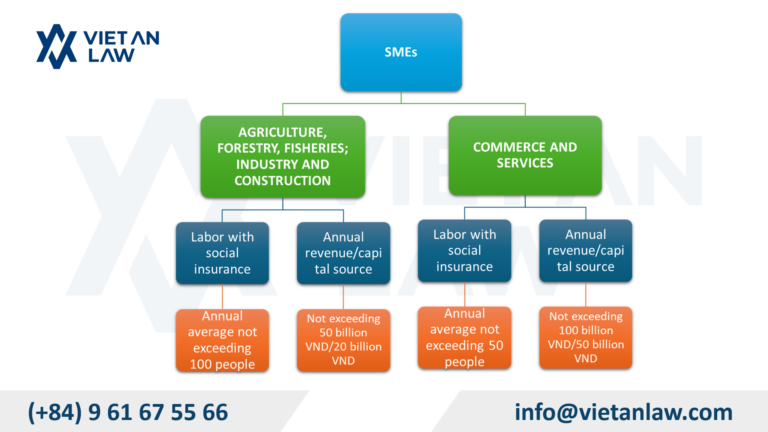
According to Clause 2, Article 5 of Decree No. 80/2021/ND-CP, the criteria for determining small enterprises are as follows:
SMEs in the fields of agriculture, forestry, fisheries; industry and construction:
Average annual number of employees participating in social insurance shall not exceed 100 individuals;
Annual total revenue shall not exceed 50 billion VND or annual total capital shall not exceed 20 billion VND;
However, not classified as a micro-enterprise.
SMEs in the fields of commerce and services:
Average annual number of employees participating in social insurance shall not exceed 50 individuals;
Annual total revenue shall not exceed 100 billion VND or annual total capital shall not exceed 50 billion VND;
However, not classified as a micro-enterprise.
Accordingly:
The number of employees participating in social insurance refers to all employees managed, utilized, and paid by the enterprise, who participate in social insurance in accordance with the law on social insurance. The average annual number of employees participating in social insurance is calculated by dividing the total number of employees participating in social insurance for all months in the immediately preceding year by 12 months.
Annual total revenue refers to the total revenue from the sale of goods and provision of services by the enterprise, as determined in the financial statements of the immediately preceding year submitted by the enterprise to the tax authorities.
Enterprise support policies for SMEs in Ninh Binh
SMEs are among the subjects eligible for preferential policies and support under Chapter II of the Law on Support for Small and Medium-sized Enterprises 2017, which include:
Support for access to credit.
Tax and accounting support: Small enterprises are permitted to apply a lower corporate income tax rate for a limited period than the ordinary tax rate applicable to enterprises, as stipulated by the law on corporate income tax.
Support for production premises: The Provincial People’s Committee shall submit to the People’s Council of the same level for decision the allocation of land funds to form and develop industrial clusters; concentrated processing zones for agricultural, forestry, aquatic, and marine products for small and medium-sized enterprises, consistent with approved land use planning.
Market expansion support: Enterprises and organizations investing in and operating product distribution chains where at least 80% of participating small enterprises supply products manufactured in Vietnam shall receive the following support: Exemption or reduction of land rent, land use fees, non-agricultural land use tax; Exemption or reduction of corporate income tax for a limited period as stipulated by the law on corporate income tax.
Information, consulting, and legal support.
Human resource development support: Eligible for exemption or reduction of costs for participating in state-budget-funded training courses on business startup and enterprise management, and vocational training for employees working in small enterprises.
Additionally, recent policies on private economic development have introduced several mechanisms and solutions to support small enterprises, such as those outlined in Decree 20/2026/ND-CP guides Resolution 68/NQ-TW on private economic development, National Assembly’s Resolution 198/2025/QH15 on special mechanisms and policies for private economic development, Resolution 139/NQ-CP of 2025 on the implementation plan for Resolution 198/2025/QH15, etc.
Viet An Law provides Ninh Binh Company Formation Support for SMEs in Vietnam, from preparation for establishment to the process of establishment and company operation. Should clients have any related inquiries or require consultation on company establishment procedures, please contact Viet An Law for optimal support!
Fast & Reliable Legal Assistance
Fill out the form below and get connected with a lawyer quickly.
Navigating the legal framework for the Alcohol Distribution License in Vietnam (2026): Requirements, Procedures & Costs is a critical compliance step for businesses aiming to operate at the highest level…
Learn how to start a sporting goods business in Vietnam with our complete guide. Covers business registration, legal requirements, capital needs, and company formation procedures.
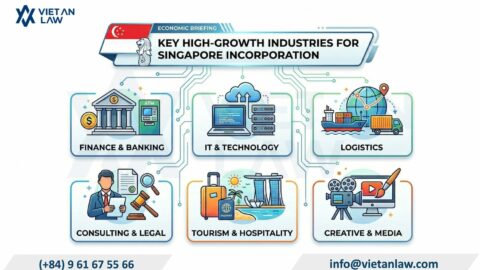
Discover high-growth industries for company incorporation in Singapore. Explore finance, IT, logistics, and consulting sectors with government incentives and market advantages.
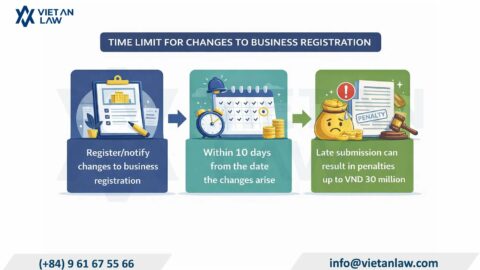
Change Business Registration in Saigon Ward, HCMC guide. Complete procedures, required documents, timelines, and online submission process for enterprises in 2025.
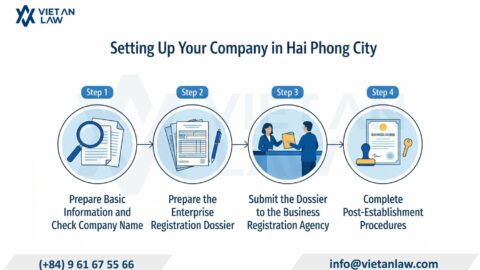
Hai Phong City merger 2025 guide: Complete information on business registration, company formation procedures, and administrative updates after the merger with Hai Duong province.