Launch a Company Business in Merged Quang Ngai Province, Vietnam
Establishing a company is the first crucial step on the journey of doing business. However, legal procedures may vary across different localities. Through the following article, Viet An Law provides a profound analysis of the conditions, procedures, and important legal considerations to launch a company business in Merged Quang Ngai Province, Vietnam, assisting investors in understanding the regulations and preparing effectively.
Table of contents
Hide
Overview of the Merged Quang Ngai Province
Pursuant to Resolution 60-NQ/TW in 2025, the provinces of Kon Tum and Quang Ngai have been consolidated under the name Quang Ngai Province, with the political-administrative center located in the current Quang Ngai Province.
The total area of the province is 14,832.55 km² (ranking 5th nationwide in terms of geographical scale); the population as of the time of consolidation reached 2,161,755 people, comprising 96 commune-level administrative units (including 86 communes, 09 wards, and 01 special administrative-economic zone).
Post-consolidation, Quang Ngai holds a particularly important strategic position:
To the West: The province houses the Indochina junction, bordering three countries (Vietnam – Laos – Cambodia), with the Bo Y International Border Gate playing a key role in trade within the Development Triangle Area.
To the East: The province continues to be a key coastal economic zone with numerous advantages in the marine economy. The Ly Son Special Zone—the nation’s outpost island—not only holds strategic significance for national defense and security but also serves as a prominent cultural and tourism destination in the ocean. The Dung Quat deep-water seaport system, Dung Quat Economic Zone, and large industrial parks/clusters, including VSIP Quang Ngai Industrial Park, continue to act as the locomotive for industrial development and investment attraction.
Conditions to Launch a Company Business in Merged Quang Ngai Province, Vietnam
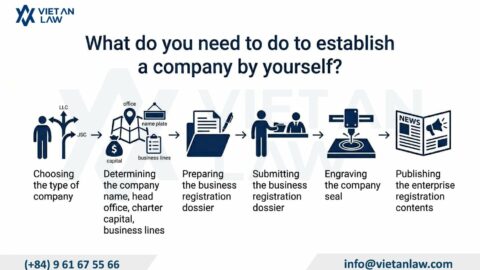
Types of Enterprises
Currently, there are five (05) types of enterprises, including:
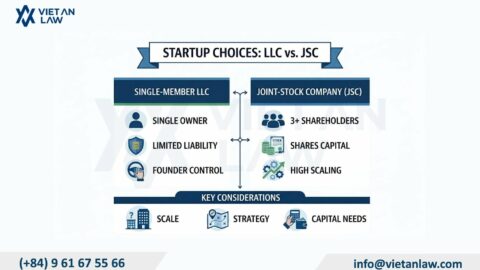
Single-member Limited Liability Company (LLC);
Multi-member Limited Liability Company (LLC with two or more members);
Joint Stock Company (JSC);
Partnership;
Private Enterprise.
Note: Business Households are also a popular business model suitable for small-scale operations such as cafes, eateries, and grocery stores.
Company Name
The company name must be written in Vietnamese, may include numerals and symbols, must be pronounceable, and contain at least two components: “Type of enterprise + Proper name”.
It must not duplicate or cause confusion with previously registered company names.
The company name may use foreign languages or abbreviations.
It must not use symbols or words that violate historical, cultural, ethical, and traditional customs of the nation.
It must not use the names of state agencies, political organizations, socio-political organizations, or people’s armed forces units as part of the proper name or the entire enterprise name, unless there is justifiable approval from the relevant agency, unit, or organization.
Headquarters
The enterprise headquarters must satisfy the following conditions:
Must be located within the territory of Vietnam.
Must have a defined address, including house number, street name (alley)/commune, ward, town, district, city under provincial jurisdiction, province, or centrally-run city.
If the location of the headquarters does not have a house number or street name, the business registration dossier must be accompanied by a confirmation from the locality stating that the address has not yet been assigned a house number or street name.
The main headquarters must not be located in a condominium or collective housing unit (apartment building).
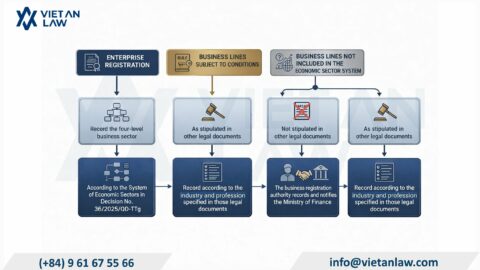
Business Lines
Enterprises have the right to conduct business in any industry not prohibited by law. However, enterprises must meet all conditions for conditional business lines.
Example: For the tourism and travel business, after obtaining the Enterprise Registration Certificate, the enterprise must subsequently apply for a Travel Service Business License (domestic or international) which requires a deposit. The enterprise must ensure the maintenance of these conditions throughout its operation.
Charter Capital
For business lines that do not require legal capital, the law does not stipulate a minimum capital level; it depends on the actual scale of the enterprise.
For business lines requiring legal capital, the enterprise must declare a minimum charter capital equal to the level prescribed for that specific business line.
Procedures to launch a company business in Merged Quang Ngai Province, Vietnam
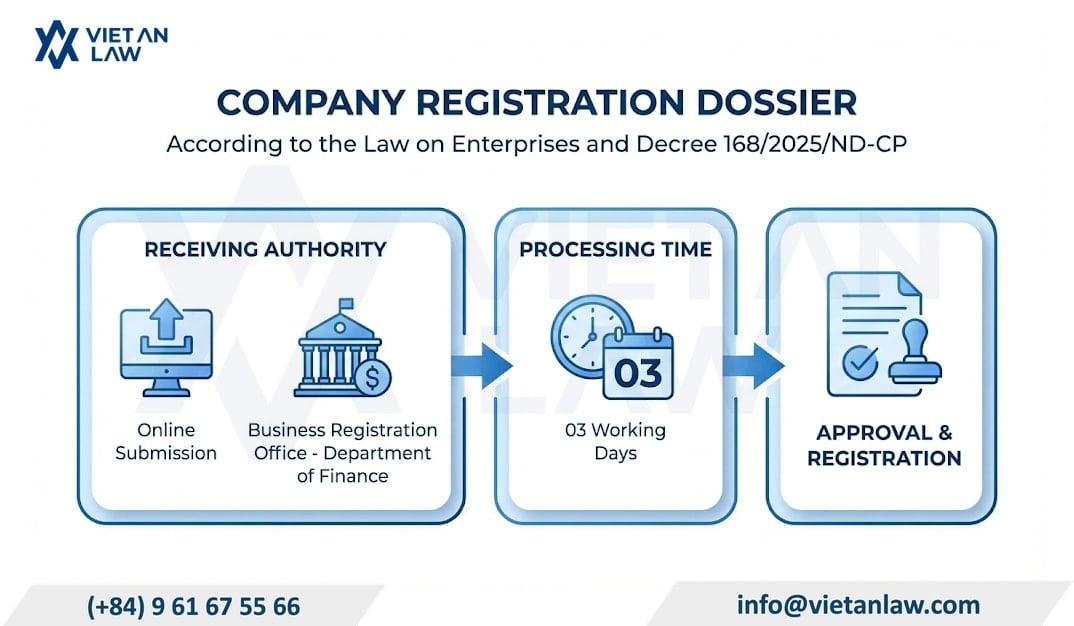
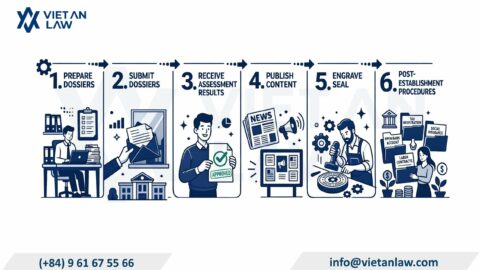
Application Dossier for Company Establishment
According to the regulations of the Law on Enterprises 2020 (as amended and supplemented in 2025) and Decree 168/2025/ND-CP, depending on the type of enterprise, the dossier for company registration shall include the following documents:
Application for Enterprise Registration;
Company Charter;
List of members/shareholders;
List of beneficial owners of the enterprise (if any);
Legal documents of individuals/organizations;
Power of Attorney for the performance of procedures.
Receiving Authority
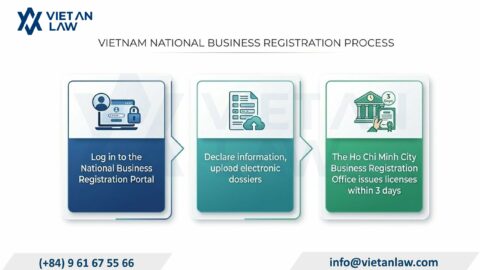
The company founder or the authorized person shall perform the enterprise registration procedure via the following methods:
Online registration via the National Business Registration Portal.
Registration through the Public Administration Center of the province where the headquarters is located.
Processing Time Limit
The time limit for processing the enterprise registration dossier is 03 working days from the date of receipt of a valid dossier. Upon approval by the competent state authority, the enterprise will be issued an Enterprise Registration Certificate (ERC).
Publication of Enterprise Registration Contents
After being issued the Enterprise Registration Certificate, the enterprise must publicly announce the registration on the National Business Registration Portal and pay the fees as prescribed by law. The published content includes the information on the Enterprise Registration Certificate and the following:
Business lines;
List of founding shareholders; list of shareholders being foreign investors (for Joint Stock Companies, if any).
Important Notes When Establishing an Enterprise in Quang Ngai
Pursuant to Articles 7, 8, 9, 10, 12, and 13 of Resolution 198/2025/QH15, specific incentives are provided for enterprises, particularly small and medium-sized enterprises (SMEs), innovative startups, and experts/scientists working at R&D centers, as follows:
Tax and Fee Incentives:
Exemption for 3 years from the date of the first issuance of the Enterprise Registration Certificate.
Exemption on income from the transfer of shares, capital contributions, rights to contribute capital, rights to purchase shares, and rights to purchase capital contributions in innovative startup enterprises.
Termination of the collection and payment of the business license tax (license fees) from January 1, 2026.
Support for Access to Land and Production Premises:
Support for a minimum reduction of 30% on land sublease fees.
Applicable for the first 05 years from the date of signing the land lease contract with the infrastructure developer of industrial parks, industrial clusters, or technology incubators.
Support for Renting Public Property (Housing/Land):
The State provides support for renting housing and land that are public assets currently unused or underutilized in the locality.
Financial and Credit Incentives:
For loans to implement green projects, circular economy projects, and projects applying Environmental, Social, and Governance (ESG) standards: The State supports an interest rate of 2%/year.
Support for Enhancing Corporate Governance and Human Resource Quality:
Allocation of the state budget to implement a Training Program for 10,000 CEOs by 2030.
Provision of free legal consulting services and training on corporate governance, accounting, taxation, and human resources for small enterprises, micro-enterprises, business households, and individual businesses.
Prominent Enterprises in Quang Ngai Province
An Khang Transport One Member Co., Ltd.
Tax Code: 4300909379
Address: Hamlet 3, An Phu Commune, Quang Ngai Province, Vietnam
Main Business Line: Freight transport by road.
Thuan Kieu Trading Co., Ltd.
Tax Code: 4300909139
Address: National Highway 1A, Tri Binh Hamlet, Binh Nguyen Commune (Expired), Quang Ngai Province, Vietnam
Main Business Line: Wholesale of beverages.
Moc Duong Construction and Trading Co., Ltd.
Tax Code: 4300908569
Address: Son Tinh Residential Area, Truong Quang Trong Ward, Quang Ngai Province, Vietnam
Main Business Line: Construction of residential buildings.
Hung An Iron and Steel Service Trading Co., Ltd.
Tax Code: 4300907477
Address: Tu Son 2 Hamlet, Lan Phong Commune, Quang Ngai Province, Vietnam
Main Business Line: Wholesale of metals and metal ores.
Viet An Law Service for launch a Company Business in Merged Quang Ngai Province, Vietnam
In-depth and comprehensive consultation before establishment
Viet An Law provides professional services to assist clients who wish to launch a Company Business in Merged Quang Ngai Province, Vietnam. If you require assistance or legal advice to launch a Company Business in Merged Quang Ngai Province, Vietnam, please contact Viet An Law for the fastest and most effective support.
Fast & Reliable Legal Assistance
Fill out the form below and get connected with a lawyer quickly.
Enterprise Formation & Registration Services in Binh Duong, HCMC. Expert guidance on company setup, legal compliance, tax incentives, and FDI procedures. Contact us today!
Identifying and assigning business codes is a mandatory step when registering a new company, notifying changes to business lines, or applying for a revised Enterprise Registration Certificate. This coding process…
According to enterprise registration data from the Hanoi Statistics Office, in the first five months of 2025, Hanoi granted certificates to 11,600 newly established enterprises with a total registered capital…
LLC vs JSC: Which business structure is best for startups? Compare single-member LLC and joint-stock company advantages, capital raising, costs, and tax obligations to choose wisely.
Complete step-by-step guide on how to incorporate your own company. Learn business registration procedures, enterprise types, legal requirements, and post-establishment obligations.