


Establishing an FDI trading company in Vietnam is an investment form chosen by many foreign investors to conduct import, export, wholesale, and retail trading of goods. Accordingly, foreign investors may set up a 100% foreign-owned trading company in Vietnam if they satisfy the market access conditions under Vietnam’s WTO commitments, free trade agreements (FTAs) to which both Vietnam and the investor’s country of nationality are parties, and Vietnamese law. However, export rights, import rights, and distribution rights carry different legal scopes. Therefore, identifying business lines, CPC codes, the list of goods, and required licences are matters that must be carefully reviewed and prepared to obtain investment licensing.
Effective from October 18, 2026, Decree No. 342/2026/ND-CP replaces Decree No. 09/2018/ND-CP and regulates the purchase and sale of goods and activities directly related to the purchase and sale of goods by foreign investors and foreign-invested economic organizations, directly shaping foreign investment in Vietnam’s trading sector. Based on current regulations, Viet An Law provides guidance on the conditions for FDI trading company formation in Vietnam, the determination of distribution service CPC codes, the scope of business rights, and key legal notes regarding FDI company formation in Vietnam, company registration in Vietnam, and wholesale and retail trading activities.
Legal basis
- Law on Investment No. 143/2025/QH15 and its implementing guidelines;
- Law on Enterprises No. 59/2020/QH14 and its amending and supplementing documents;
- Law on Commerce No. 36/2005/QH11;
- Law on Foreign Trade Management No. 05/2017/QH14;
- Decree No. 342/2026/ND-CP dated September 3, 2026 of the Government, effective from October 18, 2026;
- Vietnam’s Schedule of Specific Commitments in Services upon WTO accession and relevant international treaties.
What activities may an FDI trading company perform?
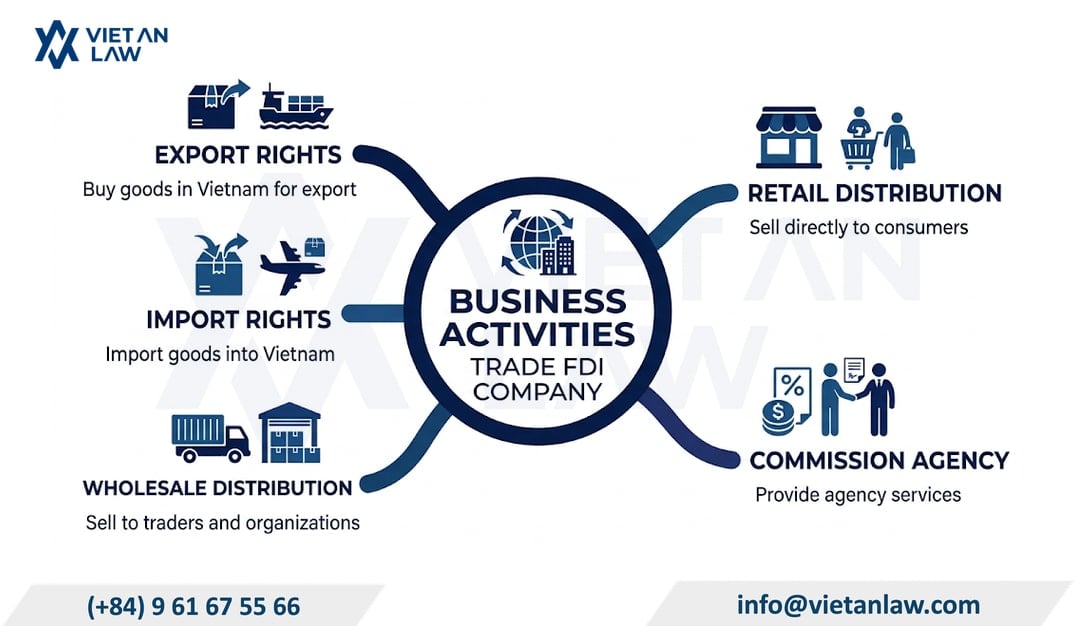
An FDI trading company is a foreign-invested economic organization established in Vietnam to carry out import, export, and the purchase and sale of goods within its registered scope and in accordance with conditions prescribed by law.
Under commercial law and foreign trade management regulations, investors must distinguish among the following activities:
| Activity | Scope of business |
| Export rights | Purchasing goods in Vietnam for export within the scope permitted by law |
| Import rights | Importing goods from abroad into Vietnam in accordance with the granted rights |
| Wholesale distribution | Selling goods to traders, business organizations, and other entities consistent with wholesale trading |
| Retail distribution | Selling goods directly to consumers within the permitted scope |
| Commission agency | Providing agency services within the applicable scope of activities and market access commitments |
These business activities carry distinct legal scopes. An enterprise holding import rights does not automatically hold wholesale or retail distribution rights for those goods in Vietnam.
For example, a foreign investor seeking to establish a foreign-owned trading company in Vietnam to import cosmetics and sell them to distribution enterprises in Vietnam must register a scope of activities covering both import rights and wholesale distribution. Where the enterprise directly sells cosmetics to consumers or opens a retail store, it must consider adding retail distribution rights or establishing a retail outlet together with the corresponding licensing conditions.
CPC codes for FDI trading and distribution companies in Vietnam
The CPC (Central Product Classification) code is a product and service classification system used in international commitments on trade in services. For foreign investors, CPC codes serve as one of the bases for identifying service sub-sectors and cross-checking market access conditions.
CPC codes for distribution services
Under Vietnam’s Schedule of Specific Commitments in Services in the WTO, the distribution services group includes the following CPC codes:
| Service sector | CPC code |
| Commission agents’ services | 621, 61111, 6113, 6121 |
| Wholesale trade services | 622, 61111, 6113, 6121 |
| Retailing services | 631, 632, 61112, 6113, 6121 |
| Franchising services | 8929 |
The CPC (Central Product Classification) code is the United Nations classification system for products and services, used in economic statistics and for cross-checking market opening commitments applicable to foreign investors in Vietnam.
Note: Identifying the CPC codes listed above does not mean that foreign investors are permitted to distribute all goods falling under the corresponding service groups.
For goods that Vietnam has not committed to opening to the market or that belong to conditional sectors, investors must further cross-check Vietnamese legal regulations and applicable international treaties.
Do export rights and import rights have CPC codes?
Export rights and import rights for goods are not identical to the CPC codes of wholesale or retail services.
When registering a trading project, investors must separately determine:
- Goods export rights;
- Goods import rights;
- Wholesale distribution services under the corresponding CPC codes;
- Retail distribution services under the corresponding CPC codes if planned.
Determining CPC codes must be based on the substantive nature of the activities and applicable international commitments, not merely on the business line names the enterprise intends to register.
In addition to CPC codes, enterprises must also identify the appropriate Vietnamese economic sector codes when carrying out business registration in Vietnam. CPC codes, Vietnamese economic sector codes, and HS codes for goods serve different purposes and cannot replace one another.
Conditions for FDI trading company formation in Vietnam
Market access conditions for foreign investors
Foreign investors may set up a trading company in Vietnam when they satisfy the market access conditions applicable to the intended business lines and activities, reflecting the regulatory framework governing foreign investment in Vietnam’s trading sector.
Factors to review include:
- The nationality and legal status of the investor;
- The intended foreign ownership ratio;
- Vietnam’s market opening commitments under relevant international treaties;
- The types of goods and scope of trading rights;
- Business investment conditions under specialized laws.
For many ordinary goods distribution activities, investors may set up a 100% foreign-owned trading company in Vietnam. However, this conclusion does not apply to all types of goods and business models.
Conditions for traded goods
The list of goods is a critical factor to review before defining the scope of activities of an FDI trading company.
Investors must determine whether the intended goods fall under prohibited business lines, import or export bans, market access restrictions, or specialized regulatory conditions.
Certain groups of goods requiring particular attention include:
| Group of goods | Matters to review |
| Cosmetics | Product notification, product labeling, and conditions for import and circulation |
| Food | Food safety, and product declaration or registration as applicable |
| Medical devices | Classification, circulation, import, and corresponding business conditions |
| Chemicals | Chemical classification, regulated lists, and specialized business conditions |
| Alcohol and tobacco | Business conditions and market access limitations for foreign investors |
| Books, newspapers, and magazines | Market opening commitments and specialized regulations on publishing and distribution |
The table above only identifies groups of issues requiring review and does not represent a list of goods automatically permitted for trading.
Conditions on investment capital
The law does not prescribe a uniform minimum statutory capital for all cases of foreign-owned trading company incorporation in trading and distribution.
The projected capital must align with the scale and implementation plan of the project, covering premises leasing costs, goods procurement, warehousing, transportation, personnel, and distribution network development.
For goods or activities belonging to conditional business lines, investors must further check specific capital requirements if prescribed by specialized laws.
Note: Under Plan No. 400/KH-UBND dated October 29, 2026 of Bac Ninh Province, local targets for attracting new FDI projects mention a total investment capital threshold of USD 500,000, of which contributed capital must account for at least 20% of total investment capital. However, this is an investment attraction target within a local plan, not a general minimum statutory capital requirement applicable to all FDI trading projects.
Conditions on head office and business location
The project implementation location must be suitable for the registered activities and comply with relevant legal regulations.
Investors must distinguish the company’s head office address from warehouses, showrooms, and retail outlets. For a store-opening model, investors must verify the usability of the premises under land, construction, fire prevention and fighting, and other relevant regulations before signing a long-term lease agreement.
Does an FDI trading company need a business licence for FDI companies?
Under Articles 5, 6, and 7 of Decree No. 342/2026/ND-CP, whether an enterprise must apply for a business licence depends on the specific activities and goods involved.
Not every FDI company exercising export rights, import rights, or operating as a foreign-invested wholesale company in Vietnam is required to apply for a separate business licence.
For retail distribution activities and other activities or groups of goods subject to licensing, the enterprise must satisfy the prescribed conditions and obtain a business licence before commencing operations.
Where the enterprise opens a retail outlet, it must also consider the procedure for obtaining a retail outlet establishment licence, including the Economic Needs Test (ENT) where applicable.
Decree No. 342/2026/ND-CP also provides a mechanism for concurrently processing procedures for granting a business licence and a retail outlet establishment licence when the prescribed conditions are met.
Investors may refer to detailed conditions, dossiers, and procedures in the articles on the business licence for FDI companies and the retail outlet establishment licence for FDI companies published by Viet An Law.
Procedures for FDI company formation in Vietnam in the trading sector
The basic procedures for FDI trading company registration in Vietnam include: reviewing market access conditions and the scope of business rights; carrying out procedures for an Investment Registration Certificate (IRC) where required; completing enterprise registration (ERC) as part of business registration in Vietnam; and fulfilling post-establishment obligations.
Specifically for trading and distribution activities, enterprises must clearly define export, import, wholesale, and retail rights and carry out procedures for obtaining a business licence, a retail outlet establishment licence, or specialized licences when required by law.
For detailed dossiers, sequences, and processing timelines, investors may refer to the guides on FDI company formation in Vietnam and company registration in Vietnam published by Viet An Law.
Key notes on company registration in Vietnam for FDI trading and distribution
Determining the proper business rights from initial project registration
Investors should not merely register general trading activities without specifying the scope of export, import, wholesale, or retail operations when they set up a trading company in Vietnam.
Where an enterprise intends to simultaneously import and distribute goods in Vietnam, the project objectives must be structured to match the actual operational scope. If additional business activities arise after establishment, the enterprise must review its obligations to amend the relevant dossiers and licences.
Distinguishing CPC codes from HS codes for goods
CPC codes serve to identify service sub-sectors under international commitments, whereas HS codes are used to classify imported and exported goods.
Registering wholesale or retail service CPC codes does not replace the requirement to verify regulatory conditions for each specific type of good.
Therefore, enterprises importing and distributing multiple product groups should compile a projected list of goods for review before implementing the project.
Distinguishing online sales from e-commerce platform provision
An FDI enterprise directly selling its own goods on its website and an enterprise providing an e-commerce platform for third parties represent business models with different operational natures.
Decree No. 342/2026/ND-CP contains provisions regulating the management and operation of intermediary e-commerce platforms, social networks conducting e-commerce activities, and integrated e-commerce platforms.
Accordingly, investors must clearly determine whether the enterprise only trades its own goods or also provides transaction-connecting services for other traders in order to apply the appropriate legal conditions.
Checking conditions before obtaining a retail outlet establishment licence
Where an enterprise intends to open a store, a showroom conducting retail sales, or a retail store chain in Vietnam, it must review the conditions governing retail distribution rights and licensing requirements for the intended location.
Opening additional retail outlets may trigger licensing procedures and Economic Needs Test requirements under applicable regulations.
Enterprises should not rely solely on the Enterprise Registration Certificate to sign premises lease agreements or commence retail operations.
Notes on transitional provisions effective from October 18, 2026
Under the transitional provisions of Decree No. 342/2026/ND-CP, foreign-invested economic organizations already granted a business licence or a retail outlet establishment licence before the decree takes effect may continue operating in accordance with the licensed contents.
When an enterprise needs to adjust or change its operations, it must cross-check the transitional provisions and corresponding procedures under Decree No. 342/2026/ND-CP.
FAQs on business registration in Vietnam for FDI trading companies
Can foreign investors set up a 100% foreign-owned trading company in Vietnam?
Yes, it is possible. However, the ability to hold 100% foreign ownership depends on market access conditions, the investor’s nationality, the service sector, and the intended goods. No single uniform condition applies to all trading activities.
Does a foreign-invested wholesale company in Vietnam need a business licence for FDI companies?
Not all wholesale distribution activities require a business licence. Enterprises must cross-check the types of goods, scope of activities, and licensing cases prescribed under Decree No. 342/2026/ND-CP.
Can an FDI company with import rights engage in retail distribution?
Not automatically. Import rights and retail distribution rights are separate business rights. The enterprise must satisfy the conditions for retail distribution rights and obtain relevant licences if required by law.
Is an FDI trading company required to register a CPC code?
Determining a CPC code must be based on the intended service activities and applicable international commitments. For distribution services, CPC codes are an important basis for cross-checking market access conditions; however, not every trading activity is defined by a CPC code.
Is an FDI company required to lease a warehouse upon establishment?
There is no general mandatory requirement during foreign-owned trading company incorporation that every FDI trading company must have its own warehouse immediately upon establishment. Warehouse usage depends on the business plan, types of goods, and relevant specialized regulatory conditions.
Can an FDI company conduct both wholesale and retail distribution?
Yes, provided that the enterprise satisfies market access conditions, registers the appropriate business scope, and completes the corresponding licensing procedures for each activity.
Viet An Law’s services for FDI trading company registration in Vietnam
Viet An Law provides legal advisory services to establish a foreign-owned trading company in Vietnam in the fields of trading, import, export, and goods distribution, including:
- Advising on market access conditions for foreign investors;
- Advising on foreign ownership ratios and selecting investment structures;
- Reviewing the projected list of goods intended for trading;
- Advising on determining export rights, import rights, wholesale distribution, and retail distribution;
- Identifying distribution service CPC codes and appropriate Vietnamese economic sector codes;
- Advising on investment capital, business location, and operational plans;
- Drafting investment registration and enterprise establishment dossiers;
- Advising on and executing procedures for obtaining a business licence and a retail outlet establishment licence where applicable;
- Advising on specialized licences and legal obligations arising during operations.
Clients seeking advice on establishing an FDI trading company in Vietnam, as well as import, export, and distribution operations, please contact Viet An Law for guidance on investment conditions, business scope, and appropriate legal procedures.
Author: Trainee Lawyer Do Quynh Trang
Supervising and Reviewing Lawyer: Lawyer Trung Thi Lieu
Hotline/ Zalo/ WhatsApp: (+84) 961 571 818
Email: info@vietanlaw.com
Hanoi Office: 3rd Floor, Hoang Ngan Plaza Building, No. 125 Hoang Ngan Street, Yen Hoa Ward, Hanoi
Ho Chi Minh City Office: Rooms 2.26 – 2.27, Charmington La Pointe Building, 181 Cao Thang Street, Hoa Hung Ward, Ho Chi Minh City.