On January 25, 2025, the Government issued Decree 340/2025/ND-CP, marking an important change in the penalty mechanism for violations in banking, monetary fields, and foreign borrowing and repayment activities. This decree takes effect on February 09, 2026, and replaces Decree 88/2019/ND-CP along with its amending and supplementing documents. To understand the Decree 340/2025/ND-CP: New penalties for foreign loan violations in Vietnam, it is important to note that it tightens financial discipline, enhances compliance and transparency in credit transactions, and more clearly adjusts the fines for late debt repayment and acts of failing to properly perform the obligations of reporting and registering foreign loans. Under this new framework, Vietnam foreign loan penalties are significantly updated.
Table of contents
Penalties for violations regarding foreign loans
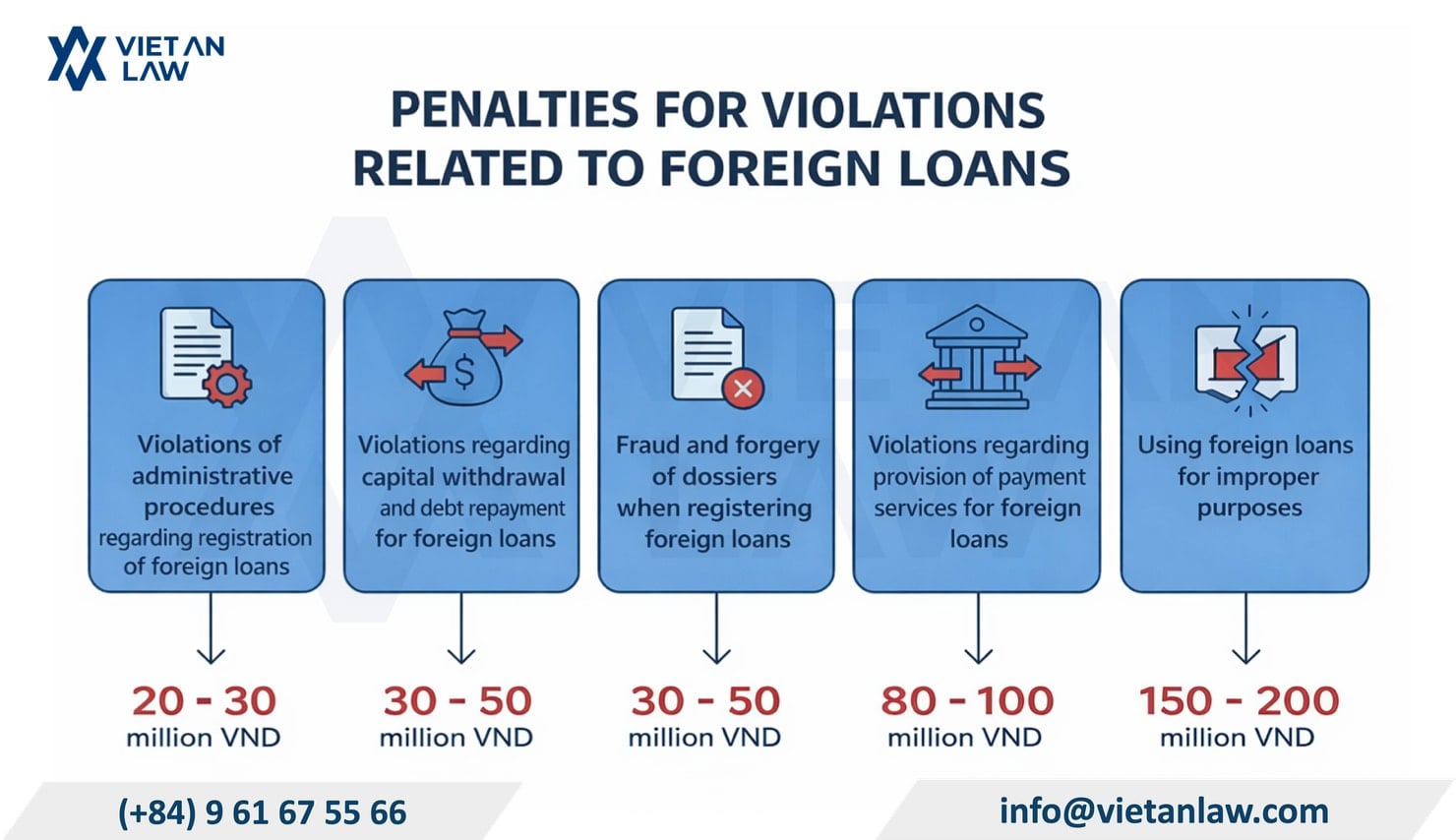
Previously, Point g, Clause 3, Article 23 of Decree 88/2019/ND-CP also stipulated that the fine for violations regarding the registration and registration for changes of foreign loans was from 20 million VND to 30 million VND.
Inheriting this regulation, Point g, Clause 3, Article 27 of Decree 340/2025/ND-CP stipulates as follows:
“Article 27. Violations of regulations on foreign exchange activities …3. A fine ranging from 20,000,000 VND to 30,000,000 VND shall be imposed for one of the following violations: … g) Failing to properly comply with legal regulations on administrative procedures for: the registration and registration for changes of foreign loans, international bond issuance; registration and registration for changes of offshore loans, guarantee debt recovery for non-residents; registration and registration for changes of foreign exchange transactions related to offshore investment activities; registration of proprietary trading limits; registration of temporary proprietary trading limits; registration of trust receipt limits; registration of temporary trust receipt limits and other administrative procedures related to other capital transactions;…”
Currently, according to Article 11 of Circular 12/2022/TT-NHNN (amended and supplemented by Clause 2, Article 3 of Circular 19/2024/TT-NHNN, Article 4 of Circular 80/2025/TT-NHNN), the following self-borrowed and self-repaid foreign loans must be registered:
Accordingly, for self-borrowed and self-repaid foreign loans that the law requires to be registered, if the borrower delays the registration of the foreign loan, it is considered an act of failing to properly comply with legal regulations on administrative procedures for the registration and registration for changes of foreign loans. The fine for this act is from 20 million VND to 30 million VND. These are notable administrative fines Vietnam 2026 updates.
According to Point g, Clause 4, Article 27 of the decree, carrying out capital withdrawal and debt repayment for foreign loans incorrectly according to legal regulations will be fined from 30,000,000 VND to 50,000,000 VND. This is one of the critical foreign debt repayment violations to watch out for.
Currently, the capital withdrawal and debt repayment for foreign loans are stipulated in Circular 12/2022/TT-NHNN guiding foreign exchange management for enterprises’ foreign borrowing and debt repayment, amended and supplemented by Circular 08/2023/TT-NHNN, Circular 21/2023/TT-NHNN, Circular 19/2024/TT-NHNN, and Circular 80/2025/TT-NHNN.
One of the notable additions is the regulation penalizing the act of committing fraud and forging foreign loan registration dossiers.
According to Point o, Clause 4, Article 27, the act of fraud and forgery of dossiers and documents carrying out administrative procedures for registration and registration for changes of foreign loans, which has not reached the level of penal liability examination, will be fined from 30,000,000 VND to 50,000,000 VND. These Vietnam foreign loan penalties are necessary for market integrity.
The addition of this act is reasonable and suitable for the trend of tightening control over international capital flows. However, if the act involves appropriation elements or serious document forgery, it may be transferred to criminal handling.
According to Point b, Clause 5, Article 27, the act of providing payment and money transfer services for transactions related to foreign loans and given loans incorrectly according to legal regulations will be fined from 80,000,000 VND to 100,000,000 VND. This strict approach addresses significant compliance risks Vietnam faces in cross-border transactions.
According to Point a, Clause 7, Article 27, a fine ranging from 150,000,000 VND to 200,000,000 VND shall be imposed for the act of using foreign loans for improper purposes according to regulations on foreign borrowing conditions for enterprises not guaranteed by the Government. This is a newly supplemented regulation compared to the previous Decree 88/2019/ND-CP.
Currently, the conditions for foreign borrowing of enterprises not guaranteed by the Government are stipulated in Circular 08/2023/TT-NHNN, amended and supplemented by Circular 19/2024/TT-NHNN, Circular 80/2025/TT-NHNN.
Penalties for violations regarding foreign debt repayment
Point d, Clause 4, Article 27 stipulates:
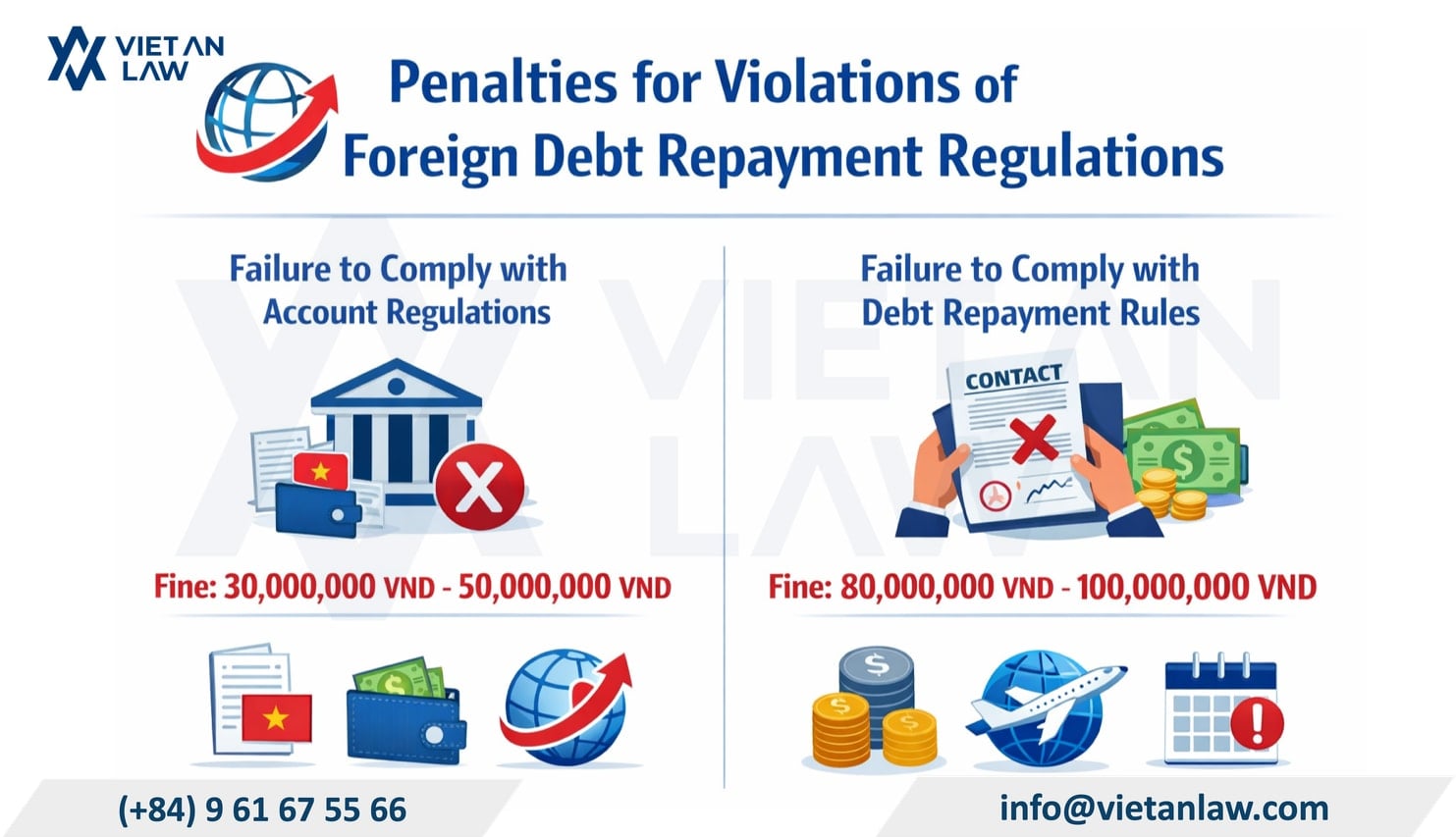
“Article 27. Violations of regulations on foreign exchange activities 4. A fine ranging from 30,000,000 VND to 50,000,000 VND shall be imposed for one of the following violations: … d) Failing to properly comply with legal regulations on the opening, closing, and use of accounts in Vietnam to carry out one of the following activities: Foreign investment into Vietnam; Vietnam’s offshore investment; foreign borrowing and debt repayment; offshore lending and debt recovery, offshore securities issuance by residents being organizations; securities issuance in Vietnam by non-residents being organizations and other capital transactions;”
Thus, failing to properly comply with regulations on opening, closing, and using accounts in Vietnam for foreign debt repayment can be fined from 30,000,000 VND to 50,000,000 VND. This contributes to the list of serious foreign debt repayment violations.
“Article 27. Violations of regulations on foreign exchange activities Point c, Clause 6, Article 27 stipulates: 6. A fine ranging from 80,000,000 VND to 100,000,000 VND shall be imposed for one of the following violations: c) Failing to comply with regulations on foreign borrowing and debt repayment, except for the cases specified at Point g Clause 3, Points d and g Clause 4, Point b Clause 5, Point a Clause 7 of this Article.”
Thus, failing to comply with regulations on foreign debt repayment can be fined from 80,000,000 VND to 100,000,000 VND.
The fine levels stipulated above are the fine levels applied to individuals.
The fine level applied to an organization with the same administrative violation is equal to 02 times the fine level applied to an individual. This rule governs how administrative fines Vietnam 2026 are assessed.
Adding violation acts and raising fines for acts such as using capital for wrong purposes, providing payment services contrary to regulations, or forging dossiers shows that management agencies are shifting from the mindset of “handling isolated administrative violations” to “systemic risk control”.
Higher fines force enterprises to proactively register loans, properly perform capital withdrawal and debt repayment processes, and comply with reporting regimes, rather than treating violations as acceptable risks. Managing compliance risks Vietnam will require active adaptation.
Penalty regulations related to the use of foreign loans for improper purposes and opening and using accounts contrary to regulations help strengthen the management of national capital inflows and outflows.
The positive impact is helping management agencies accurately monitor foreign debt obligations, limit non-transparent capital transfers, and reduce the risk of foreign exchange imbalances.
The new decree targets not only the borrower but also places clear responsibilities on organizations providing payment and money transfer services.
This forces banks to enhance the process of inspecting dossiers and verifying foreign loan transactions before making payments, thereby forming a two-tier control mechanism: enterprise – bank.
In the short term, enterprises will have to invest more in legal departments, risk management, and reporting systems. However, in the long term, standardizing foreign borrowing and debt repayment activities helps improve transparency and increase prestige with international investors and partners.
Therefore, the overall impact is market discipline orientation, contributing to building a more stable and sustainable financial environment.
Above is the update on Decree 340/2025/ND-CP: New penalties for foreign loan violations in Vietnam. If any client requires in-depth legal advice, please contact Viet An Law Firm for the best support!