In the food production and business sector, ensuring product quality and safety is a mandatory legal requirement. One of the most critical procedures an enterprise must perform before bringing a product to market is the declaration of food applicable standards in Vietnam. Understanding these regulations helps businesses mitigate legal risks and ensures that commercial operations proceed smoothly under the new Vietnam 2026 regulatory framework.
Table of contents
The legal landscape for food safety in Vietnam is undergoing a transition. Businesses should note the following key instruments from the year 2026:
On January 27, 2026, the Government issued Resolution No. 66.13/2026/NQ-CP providing detailed regulations on the declaration of food applicable standards and the registration of food product declarations. The scope of this Resolution covers most common food groups circulating in the market.
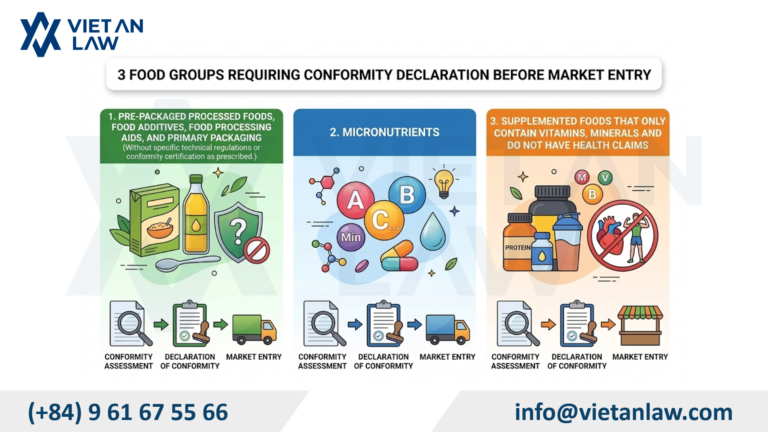
Pursuant to Clause 1, Article 5 of Resolution No. 66.13/2026/NQ-CP, products requiring declaration include:
The Resolution also clearly lists cases exempt from declaration procedures, such as raw materials used solely for export production, materials not consumed domestically, and imported products for aid, scientific research, or testing purposes.
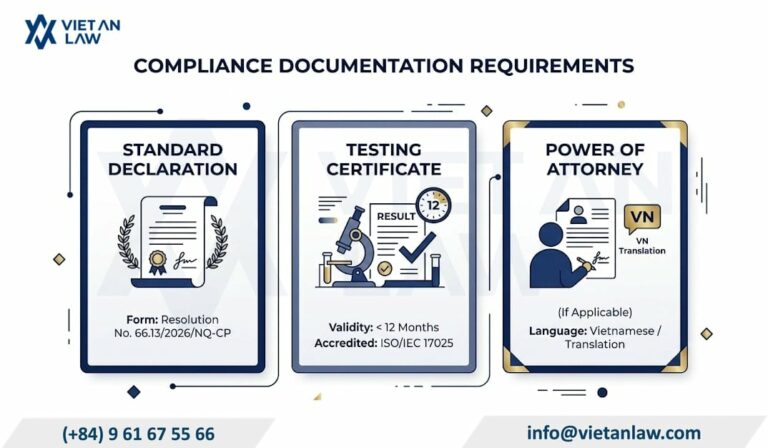
According to Clause 1, Article 6 of Resolution No. 66.13/2026/NQ-CP, the dossier for the declaration of food applicable standards must include:
Entities shall submit the declaration dossier through the following methods:
According to Point b, Clause 2, Article 6 of Resolution No. 66.13/2026/NQ-CP, the processing timeframe for the declaration of food applicable standards is 15 working days from the date of receipt.
If no written feedback is provided by the authority within this period, the competent state agency shall upload the declaration dossier to their website or online public service system.
Organizations and individuals are permitted to disclose declaration information on labels, packaging, accompanying documents, and mass media or their own websites. They are entitled to produce and trade the product only after the dossier is officially published on the receiving authority’s electronic portal.
Entities bear full legal responsibility for the accuracy of the dossier and the quality and safety of the declared products. Furthermore, they must disclose the declaration dossier when trading products on e-commerce platforms in Vietnam. This serves as a vital legal basis for post-market inspection and protects consumers from false or exaggerated advertising.
While Resolution No. 66.13/2026/NQ-CP was initially set to take effect from its signing date (January 27, 2026), the Government subsequently issued Resolution No. 09/2026/NQ-CP on February 4, 2026, to suspend its implementation.
Consequently, the application of Resolution No. 66.13/2026/NQ-CP is suspended until the end of April 15, 2026.
During this period, Decree No. 15/2018/ND-CP remains in effect. The new regulations on the declaration of food applicable standards under Resolution 66.13 will officially take effect on April 16, 2026.
To ensure food safety compliance in Vietnam, businesses should proactively review their production processes and update their quality management systems.
Enterprises must check their entire product portfolio to determine which items fall under the mandatory declaration category, focusing on the food type, ingredients (vitamins, minerals), and the status of applicable national technical regulations.
Gather all mandatory documents, including the self-established basic standards, product specifications, ingredient information, and draft labels to facilitate explanations to authorities if required.
Ensure products are tested at organizations accredited to ISO/IEC 17025. Testing must cover all safety and quality indicators, and the certificate must be valid within the 12-month window.
Businesses should ensure they have active accounts on the National Public Service Portal and valid digital signatures to perform electronic administrative procedures efficiently.
Once the declaration of food applicable standards is complete, businesses must ensure transparency by reflecting the declaration info on physical labels and digital storefronts to build consumer trust and comply with the law.
Entities must retain all records related to product quality for at least 03 years from the date the goods are circulated (or longer if the shelf life exceeds 3 years). If there are changes to the product name, origin, or ingredients (excluding excipients), a new declaration must be filed. For other minor changes, a written notice to the competent authority is sufficient to continue business.
The information provided above outlines the current requirements for the declaration of food applicable standards in Vietnam. For specific legal advice or support in navigating these 2026 updates, please contact Viet An Law for the most dedicated assistance.