Corporate Reorganization, Dissolution and Bankruptcy under Vietnam Enterprise Law 2020
In the context of market fluctuations and the significant changes introduced by the Law amending and supplementing a number of articles of the Law on Enterprises 2025 (effective from July 1, 2025), decisions regarding corporate reorganization, implementation of dissolution procedures, or filing for bankruptcy declaration require the utmost level of caution. The new regulations impose stricter responsibilities on legal representatives and introduce enhanced requirements for transparency of beneficial ownership. These changes compel enterprises to strictly comply with legal provisions in order to avoid potential legal risks. Through this article, Viet An Law aims to provide clients with a comprehensive and systematic overview of this issue.
Overview of corporate reorganization, dissolution and bankruptcy under Vietnam Enterprise Law 2020
Corporate reorganization
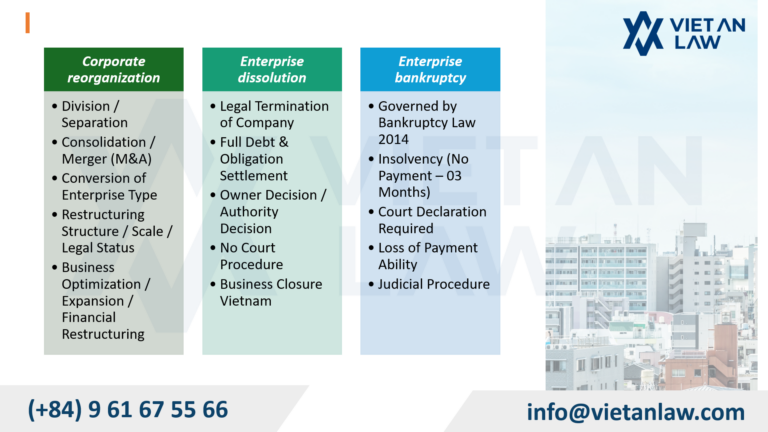
Pursuant to Clause 31, Article 4 of the Law on Enterprises 2020, corporate reorganization refers to the division, separation, consolidation, merger, or conversion of enterprise types.
In a more straightforward manner, corporate reorganization can be understood as the process of restructuring the organizational form, operational scale, or legal status of one or more existing enterprises. This process is typically carried out to optimize business efficiency, expand market presence, address financial difficulties, or serve other business purposes as determined by the enterprise owner.
Enterprise dissolution
Enterprise dissolution is a legal process and procedural mechanism aimed at terminating the existence of an enterprise as a legal entity, after the enterprise has fully fulfilled all obligations relating to assets and settled all debts and commitments toward relevant stakeholders.
Dissolution may be carried out either based on the decision of the enterprise owner or pursuant to a decision issued by a competent state authority.
Enterprise bankruptcy
In contrast to corporate reorganization and dissolution, enterprise bankruptcy is governed by the Law on Bankruptcy 2014 and its guiding legal instruments.
According to Clause 2, Article 4 of the Law on Bankruptcy 2014, the concept of “enterprise bankruptcy” is defined as follows:
“Bankruptcy is the status of an enterprise that has lost its ability to make payments and is declared bankrupt by a People’s Court.”
To further clarify this concept, Clause 1, Article 4 of the same Law provides that an enterprise or cooperative is considered insolvent when it fails to perform its obligation to pay debts within 03 months from the due date of payment.
Corporate reorganization, dissolution and bankruptcy under Vietnam Enterprise Law 2020
Types of corporate reorganization
Division and separation of enterprises
Division and separation are two forms of corporate reorganization that share a fundamental similarity: both result in the establishment of at least one new enterprise with a smaller operational scale.
This similarity often leads to confusion in legal application, thereby creating practical difficulties for enterprises during implementation.
According to Articles 198 and 199 of the Law on Enterprises 2020, the key legal characteristics of these two forms are as follows:
With the division of enterprises
Definition: Division of an enterprise refers to the process whereby a company (referred to as the “divided company”) transfers all of its assets, rights, obligations, and members/shareholders to establish two or more new companies.
Legal consequences:
Newly formed companies are granted Enterprise Registration Certificates
The divided company ceases to exist
Applicable entities:
Joint-stock companies
Limited liability companies
Legal consequences:
Newly formed companies are granted Enterprise Registration Certificates
The divided company ceases to exist
All rights and obligations of the original company are fully transferred to the newly established companies in accordance with the division plan
Separation of enterprises
Definition: Separation of an enterprise refers to the process whereby a company (referred to as the “separating company”) transfers a portion of its assets, rights, obligations, and members/shareholders to establish one or more new companies (referred to as the “separated companies”).
Applicable entities:
Joint-stock companies
Limited liability companies
Legal consequences:
The separating company continues to exist alongside the newly established companies
The separating company must register changes to its charter capital and membership structure corresponding to the transferred portion
Consolidation and Merger of enterprises (M&A)
In contrast to division and separation, consolidation and merger lead to the formation of enterprises with a larger operational scale. These forms are typically carried out to expand business operations, enhance competitiveness, increase market share, or restructure internal governance for profit optimization.
According to Articles 200 and 201 of the Law on Enterprises 2020:
Enterprise Consolidation
Definition: Consolidation is the process whereby two or more companies (referred to as “consolidating companies”) combine to form a new company (referred to as the “consolidated company”), and simultaneously, the consolidating companies cease to exist.
Formula: A + B → C
Legal consequences:
All consolidating companies terminate their existence
A completely new legal entity is established, inheriting all rights and obligations
Enterprise Merger
Definition: Merger is the process whereby one or more companies (referred to as “merged companies”) are merged into another company (referred to as the “receiving company”) through the transfer of all assets, rights, obligations, and lawful interests.
Formula: A + B → B
Legal consequences:
The merged company ceases to exist
The receiving company continues to operate with an expanded scale
Conversion of enterprise type refers to the process of changing the legal form of an enterprise to better align with its business scale, development strategy, or ownership structure. According to Articles 202, 203, and 204 of the Law on Enterprises 2020, there are three main forms:
Conversion from a limited liability company into a joint-stock company
Conversion from a joint-stock company into a single-member limited liability company
Conversion from a joint-stock company into a multi-member limited liability company
Enterprise Dissolution
As previously mentioned, dissolution is the legal termination of an enterprise’s existence based on either the decision of its owner or a competent authority.
Cases of enterprise dissolution
According to Clause 1 of the Law on Enterprises 2020, an enterprise shall be dissolved in the following cases:
The expiry of the operating term as stated in the company charter without extension
Dissolution pursuant to a resolution or decision of the enterprise owner
Failure to maintain the minimum number of members or shareholders for a continuous period of 06 months without carrying out procedures for conversion of enterprise type
Revocation of the Enterprise Registration Certificate, except where otherwise provided by tax laws
Conditions for dissolution
Pursuant to Clause 2, Article 207 of the Law on Enterprises 2020, an enterprise may only be dissolved when the following conditions are satisfied:
All debts and other property obligations have been fully settled
The enterprise is not involved in any dispute being resolved at a Court or Arbitration
In cases of compulsory dissolution, the enterprise and its relevant managers shall be jointly liable for outstanding debts
This regulation aims to prevent enterprises from abusing dissolution procedures to evade obligations and infringe upon the legitimate rights of other stakeholders.
Procedures for enterprise dissolution
Although there are differences between voluntary and compulsory dissolution, the process generally consists of four fundamental stages:
Step 1: Adoption of decision and initiation of process
For voluntary dissolution: the enterprise holds a meeting and adopts a resolution specifying reasons, timeline, debt settlement plan, and employee arrangements
For compulsory dissolution: the business registration authority updates the status upon receiving a valid decision
Step 2: Notification and public disclosure
Within 07 days: submit documents to business registration authority, tax authority, and employees
Publicly post at headquarters
Provide debt settlement plan to creditors
Step 3: Asset liquidation and debt settlement
Debts are settled in the following priority order:
Employee wages, severance allowances, social insurance, health insurance, unemployment insurance, and other benefits
Tax obligations
Other debts
Step 4: Submission of dossier and legal status update
Within 05 working days after full settlement of debts, submit dissolution dossier
Legal status is updated to “dissolved”
Enterprise bankruptcy
Indicators of insolvency
An enterprise is considered insolvent when it fails to fulfill its debt payment obligations within 03 months from the due date.
However, it should be emphasized that insolvency does not automatically equate to bankruptcy. Bankruptcy only arises when there is an official declaration issued by a competent People’s Court.
Notably, insolvency is determined based on the enterprise’s failure to perform payment obligations, rather than its actual asset capacity. This provision is designed to better protect creditors’ rights.
Persons having the right and obligation to file for bankruptcy
Persons entitled to file
Unsecured creditors or partially secured creditors
Employees or trade unions
Shareholders meeting ownership thresholds
Persons obligated to file
Legal representative
Private enterprise owner
Chairman of Board of Directors
Chairman of Members’ Council
Company owner
General partners
Failure to fulfill this obligation may result in legal liability.
Order of asset distribution in bankruptcy
According to Article 54 of the Law on Bankruptcy 2014, the order of asset distribution in bankruptcy is as followed:
Bankruptcy expenses
Employee-related debts and benefits
Debts incurred after commencement of bankruptcy proceedings
Financial obligations to the State and other debts
Comparison between dissolution and bankruptcy
Dissolution
Bankruptcy
Legal consequences
Both lead to termination of the enterprise’s existence
Procedure
An administrative procedure
A judicial procedure handled by the Court
Reason
Based on decision or legal grounds
Based on insolvency and court declaration
Should a loss-making enterprise choose dissolution or bankruptcy?
In cases where an enterprise incurs losses and intends to terminate operations, the owner may consider either dissolution or filing for bankruptcy.
The final decision depends on the actual financial condition and business objectives of the enterprise.
Advantages and disadvantages of enterprise dissolution and enterprise bankruptcy in Vietnam
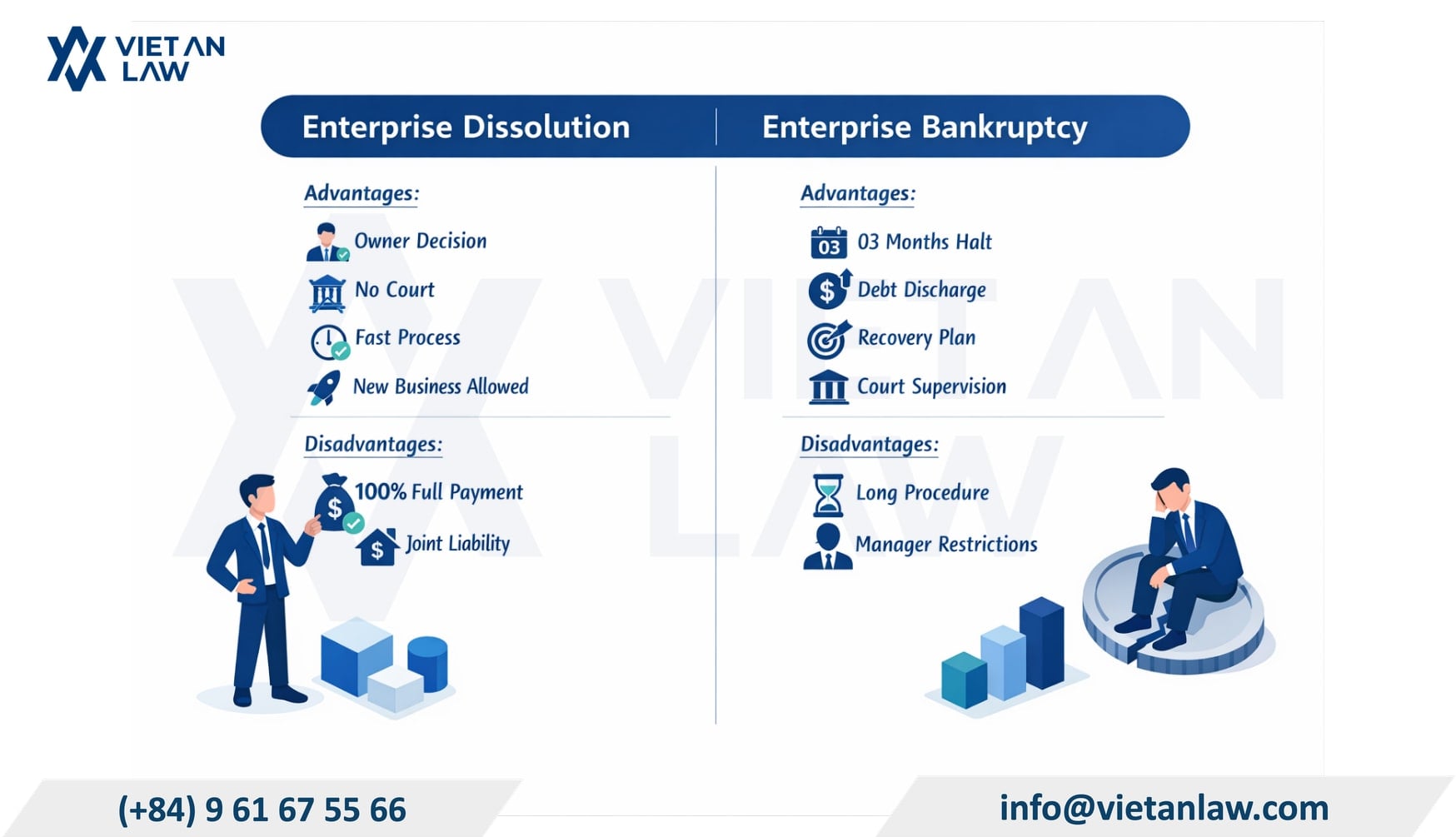
Advantages and disadvantages of enterprise dissolution and enterprise bankruptcy in Vietnam
With enterprise dissolution in Vietnam
Advantages:
The implementation process is primarily based on the will of the enterprise owner and coordination with the tax authority and Business Registration Authority, without having to undergo court litigation procedures
Optimized in terms of time for completing legal procedures
The enterprise fully fulfills its financial obligations prior to termination, thereby enabling managers to maintain a strong reputation in their business and legal records
After dissolution, enterprise managers are not restricted from establishing or managing new enterprises in the future
Disadvantages:
A prerequisite condition is the full payment of 100% of debts and property obligations. In cases where the enterprise suffers heavy losses and no longer has sufficient assets to repay debts, it is difficult to carry out dissolution procedures.
After dissolution, if any unpaid debts are later discovered, the managers and owners shall bear joint liability using their personal assets.
With enterprise bankruptcy in Vietnam
Advantages
From the time the Court issues a decision to commence bankruptcy proceedings, all enforcement actions, default interest accrual, and individual asset liquidation activities shall be temporarily suspended
The enterprise owner is only required to repay debts within the remaining asset value. Debts that cannot be settled after asset distribution shall be legally discharged.
The Law on Bankruptcy allows enterprises to develop a business recovery plan. If approved by creditors, the enterprise has an opportunity to restructure and overcome financial crisis.
Assets are distributed according to the statutory priority order, ensuring fairness and transparency among creditors
Disadvantages:
Bankruptcy procedures involve multiple stages and are generally more time-consuming than company dissolution procedures.
All business operations and asset transactions of the enterprise are subject to strict supervision and approval by the Judge.
Managers of a bankrupt enterprise may be restricted from holding managerial positions in state-owned enterprises or other economic organizations depending on the severity of violations
Can a director of a bankrupt company establish a new business?
Pursuant to Clause 3, Article 130 of the Law on Bankruptcy 2014, persons holding managerial positions in an enterprise who commit the following violations may be prohibited from establishing enterprises or acting as managers of enterprises or cooperatives for a period of 03 years from the date the People’s Court issues a bankruptcy declaration decision. Specifically:
Failure to comply with requests of the Judge, the insolvency practitioner, or the civil judgment enforcement authority.
Failure to fulfill legal obligations and compensate for damages in cases where a bankruptcy petition is not filed despite insolvency.
Engaging in prohibited acts after the decision to commence bankruptcy proceedings, including
Concealing, dispersing, or donating enterprise assets
Repaying unsecured debts, except for wages and debts arising after the commencement of proceedings
Voluntarily waiving the right to claim debts from related parts
Converting unsecured debts into secured debts using enterprise assets
The above constitute the core legal aspects relating to corporate reorganization, company dissolution in Vietnam, and bankruptcy procedures under the Law on Enterprises 2020 and Bankruptcy Law 2014. Choosing between dissolution vs bankruptcy in Vietnam depends on the enterprise’s financial condition, debt repayment capacity, and long-term business strategy. Should you encounter any legal difficulties or require further assistance regarding corporate reorganization, dissolution and bankruptcy under Vietnam Enterprise Law 2020, please contact Viet An Law for timely and professional support.
Fast & Reliable Legal Assistance
Fill out the form below and get connected with a lawyer quickly.
LLC vs JSC: Which business structure is best for startups? Compare single-member LLC and joint-stock company advantages, capital raising, costs, and tax obligations to choose wisely.
Complete step-by-step guide on how to incorporate your own company. Learn business registration procedures, enterprise types, legal requirements, and post-establishment obligations.
Corporate Setup & Registration in Phu My Ward, HCMC guide. Complete procedures, required dossiers, tax incentives, and legal compliance for establishing your enterprise in 2025.
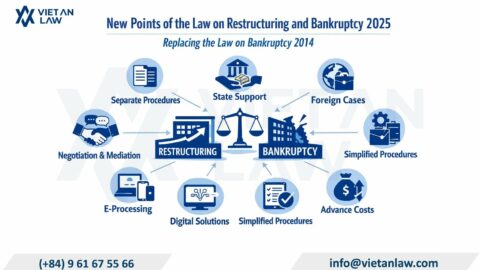
Effective from March 1, 2026, the Law on Restructuring and Bankruptcy 2025 will officially come into force, replacing the Law on Bankruptcy 2014. This law marks a significant development in…
In an era of deep globalization and economic integration, Foreign Direct Investment (FDI) plays an increasingly vital role in the economic growth of many nations. One of the core factors…