

A book may encompass written content, illustrations, photographs, cover designs, translations, and various materials derived from different sources. Therefore, prior to registering a book copyright, it is essential to clearly identify the direct creator, the copyright owner, and the legal basis for using each component of the work.
Registering book copyright officially records information regarding the work, author, and owner while establishing a crucial legal foundation in cases of manuscript copying, book piracy, or disputes between authors, ghostwriters, translators, illustrators, and publishing investors. Below, Viet An Law provides guidance on book copyright registration in Vietnam: required documents and procedures in 2026, along with specific legal considerations.
Which aspects of a book can be covered by copyright registration in Vietnam?
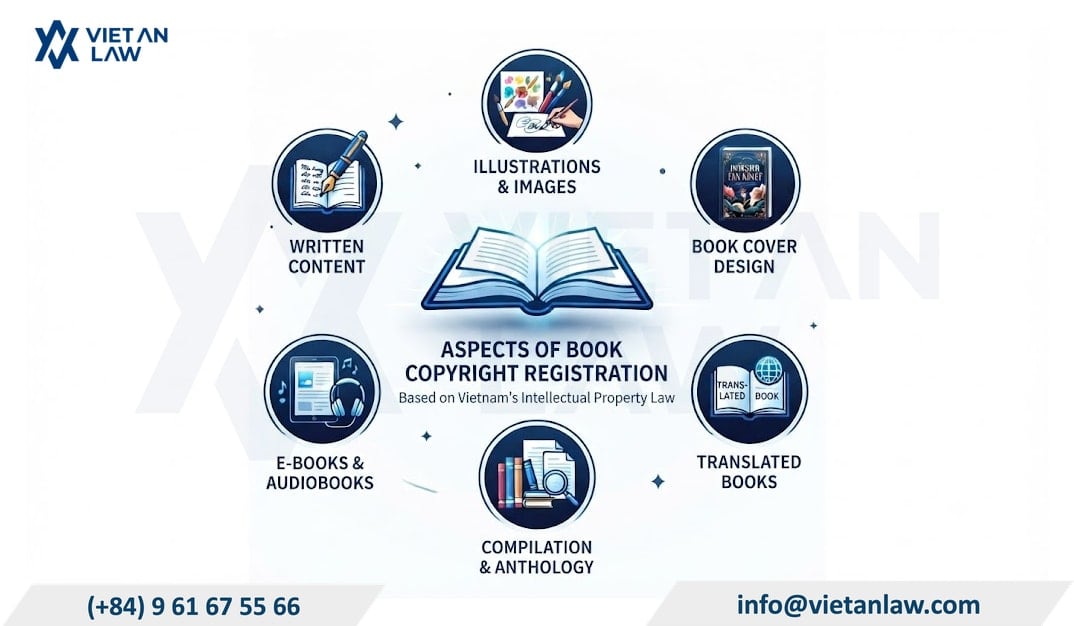
The difference between registering a book copyright and registering a simple written work lies in the fact that a complete book can contain many independent creative elements.
Written content
Written content is the main part of a book and may include:
- Novels, short stories, and literary works;
- Research books and monographs;
- Skill and professional books;
- Guidebooks;
- Professional manuals;
- Scientific documents;
- Textbooks and curricula;
Other works expressed in written form or characters.
When registering copyright for a book, the content must be presented as a complete manuscript with a title, author’s name, page numbers, and content consistent with the information declared in the application.
Illustrations and images
Photographs, drawings, maps, charts, diagrams, and illustrations can be protected as independent works.
The author’s rights to written content do not mean the author is free to use any image found on the Internet in the book. Before registration and publication, it is necessary to clearly identify the images:
- Created by the author;
- Created by the unit’s staff as part of their duties;
- Created by a hired artist or photographer;
- Purchased or licensed for use;
- Belonging to a permitted source of material;
- Or falling under cases where permission is not required according to legal regulations.
If the images are provided by a third party, the contract or document granting permission for use must clearly specify the scope of printing, publication, reproduction, advertising, and use in the digital environment.
Book cover design
Cover design can include drawings, graphics, image combinations, layout, and other creative elements.
If the book cover is created by an artist or design company, the contract should be reviewed to determine:
- Whether the designer has transferred ownership rights;
- The scope of use of the design by the client;
- Whether the design can be modified, reused, or used for other versions;
- Whether the right to use can be transferred to the publisher or distributor.
Depending on the independence and creativity of the design, the owner may consider registering the cover separately under the appropriate work category instead of assuming that the book content registration includes all rights to the cover.
Translated books
A translation is a form of derivative work. A translator may be recognized as the author of the translation they directly created, but the translation and exploitation of the translation must be based on the legal right to use the original work.
When registering copyright for a translated book, the applicant needs to clarify:
- Whether the original work is still under protection;
- Who is the author and owner of the original work;
- Who is the translator;
- Who invested in and owns the translation;
- Whether there is a contract or document authorizing the translation;
- Whether the scope of permission includes publication, reprinting, electronic distribution, and audiobook production.
A certificate of copyright registration for a translation does not replace a document authorizing the translation and exploitation of the original work.
Compilation and anthology
For books created by selecting, arranging, or systematizing multiple materials, copyright may arise for the creative contribution expressed in the selection and arrangement of the content.
However, the compiler does not automatically own the rights to each article, image, table, or document included in the book. The applicant must individually verify the source and basis for use of each component.
E-books and audiobooks
Copyright registration for e-books is still carried out for the content of the work already formatted in Word, PDF, EPUB, or other suitable electronic formats.
For audiobooks, in addition to copyright for the content, other rights may arise related to:
- The voice actor;
- The performance;
- The recording;
- Background music;
- Sound effects;
- The design and editing of the recording.
Therefore, copyright registration for the book content does not automatically establish rights to the entire audiobook product or any related rights (if any).
What risks are mitigated by book copyright registration in Vietnam?
Instead of being merely a formality, registering copyright for a book can help authors and owners address three common groups of risks.
The manuscript was used before the book was published
During the process of searching for a publisher, investor, or distribution partner, an author may have to submit their manuscript to multiple individuals and organizations. Without documentation clearly identifying the time the work was created, proving ownership when the manuscript is copied or used illegally can be difficult.
Registering a completed manuscript creates a source of evidence regarding the work’s title, content, author, and owner at the time of submission.
The book is being illegally printed or uploaded online
Common forms of infringement include:
- Printing and selling books without permission;
- Scanning entire books into PDF files;
- Uploading books to websites or sharing groups;
- Copying individual chapters for use in other documents;
- Converting book content into courses or videos;
- Creating audiobooks without the owner’s consent.
When dealing with infringement, the Certificate may be used along with the original, contract, creative data, and evidence of the infringement to request cessation of the infringement, removal of content, or the implementation of necessary legal measures.
Disputes between people involved in book production
A book may have an author, editor, proofreader, translator, illustrator, cover designer, and funding entity.
Without defining rights through a contract or assignment document, disputes may arise regarding:
- Who is credited as the author;
- The owner of the intellectual property rights;
- The right to publish the work;
- The right to reprint and modify;
- The right to release e-books;
- The right to translate or adapt;
- The revenue sharing ratio.
The process of preparing a book copyright registration application helps the parties review and agree on these issues before the work is commercially exploited.
Does book copyright registration replace publishing license and ISBN in Vietnam?
No. Copyright registration, publishing activities, and ISBN assignment are legal matters with different purposes.
Copyright registration for books aims to record information about the work, the author, and the copyright owner.
Meanwhile, the organization of publishing, co-publishing, printing, distribution of publications, and ISBN assignment are carried out according to publishing laws.
Therefore:
- An author holding a copyright registration certificate does not automatically mean they can independently organize the printing and distribution of books to the market;
- A publisher agreeing to publish a book does not automatically become the sole owner of the copyright;
- The assignment of an ISBN does not replace the determination of copyright and ownership rights over the manuscript;
- The rights of the publisher, author, and co-publisher must be determined according to the contract and relevant legal basis.
Who is the author and copyright owner of a book in Vietnam?
The author and copyright owner can be the same person or two different entities.
The author is the individual who directly creates the work. Organizations or businesses cannot be recognized as authors but can be copyright owners.
The copyright owner is the individual or organization that holds the right to publish and part or all of the property rights to the work according to law, contract, assignment decision, inheritance, or transfer of rights.
| Case of book formation | Author | Potential owner |
|---|---|---|
| An individual writes and self-funds the book independently | The individual who directly writes the book | The actual author |
| Multiple people write the book together | Co-authors | Co-authors or entities as agreed upon in contract |
| An employee writes the book under assigned duties | The employee who directly creates the work | The enterprise assigning the task, depending on grounds and agreements |
| A company hires someone to write the book | The person who directly writes the book | The hiring party or the writer, according to the contract |
| The owner receives ownership through transfer | The original author | The transferee |
| Rights inherited upon death or succession | The person who created the work | The legal heir of property rights |
| A book translated from another work | Translator | The translator or entity holding rights per agreement |
| A book jointly funded by multiple parties | Individuals who directly create the work | Parties as agreed upon in ownership terms |
Cases where an enterprise assigns an employee to write a book
For example, Company A assigns employee B to create a professional handbook within the scope of their work. Since B is the direct creator, they are identified as the author. Company A can be the copyright owner if there is documentation assigning the task, confirming the work, and no other agreement.
The file should include:
- Decision or assignment document;
- Job description;
- Documentation confirming the progress of the work;
- Manuscript handover record;
- Agreement on ownership and exploitation of the work.
The case of hiring a book writer
The payment of writing fees does not automatically settle all copyright issues. The creative contract needs to clearly specify:
- Which party owns the right to publish;
- Which party has the right to copy and reproduce;
- Whether the content can be modified or supplemented;
- Whether it can be translated, adapted, or made into an audiobook;
- Whether the rights can be transferred to the publisher;
- Whether the author can continue to use the content for other projects.
The publisher does not automatically become the copyright owner simply because they have edited, printed, and distributed the book. The publisher’s rights must be determined by the contract with the author or copyright owner.
Dossier for copyright registration for books in Vietnam
Vietnam book copyright registration dossier includes the following basic groups of documents:
| document group | content to prepare |
|---|---|
| Documents regarding the work | Copyright registration declaration, 02 copies of the work, and an electronic copy as required |
| Documents regarding the subject entities | Legal documents of the author and copyright owner |
| Documents proving ownership rights | Decision on task assignment, creation contract, assignment contract, inheritance documents, or handover minutes |
| Documents for arising/derived rights | Written consent of co-authors or co-owners; documents proving translation rights, rights to use images or third-party works |
For literary, scientific, and other works expressed in written form, applicants must use the corresponding registration form as prescribed by current regulations. Textbooks and teaching materials are classified and declared using a separate form.
The book submitted for registration must be consistent in terms of title, author’s name, owner, number of chapters, number of pages, completion date, and publication status.
Additional documentation is required on a case-by-case basis
| Case | Key documents to note |
|---|---|
| An individual writes the book independently | Commitment of self-creation and personal identification documents of the author |
| Books with co-authors | Written consent and rights agreement among co-authors |
| Enterprise assigns an employee to write | Task assignment decision and work handover minutes |
| Enterprise hires a writer | Creation contract and clauses defining ownership rights |
| Translated books | Documents proving translation rights and rights to exploit the original work |
| Books containing illustrations or photographs | Contracts, licenses, or written authorization for use |
| Compiled or selected books | List of sources and legal grounds for using each component content |
| Multi-volume book series | Complete manuscript and specific information for each volume if each volume is an independent work |
For general document requirements and specific document specifications, please refer to the article “Documents for Copyright Registration” by Viet An Law Firm.
Procedure for verifying rights to a book prior to dossier submission in Vietnam
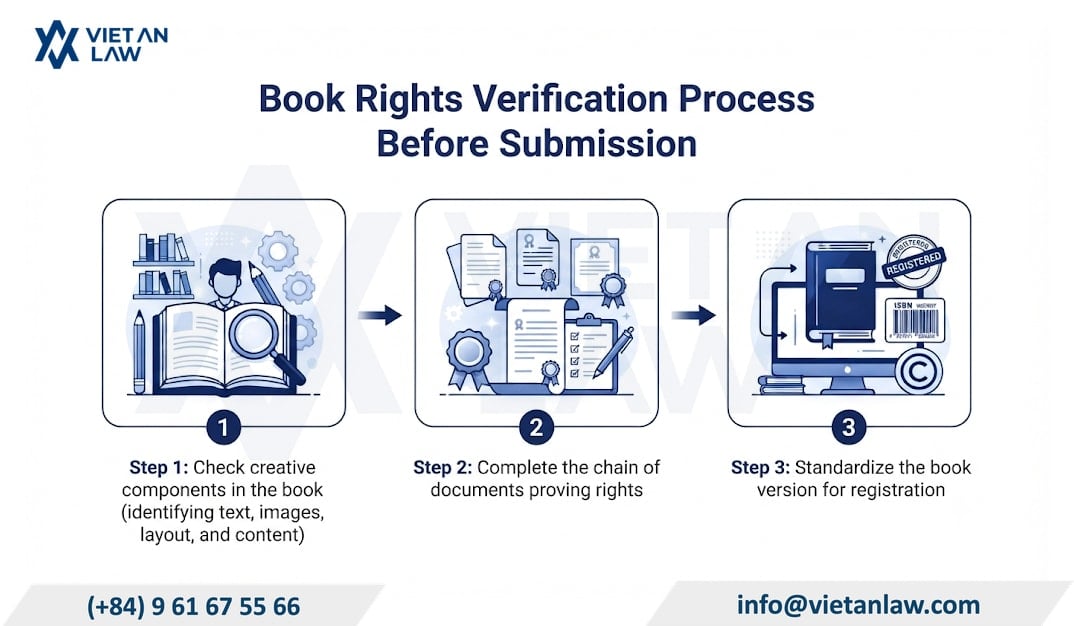
Before registering copyright for a book, the author and owner should complete the following three verification steps:
Step 1: Check creative components in the book
Identify what content the book contains besides the written text, such as:
- Illustrations and photographs;
- Cover design;
- Translations;
- Charts, maps, or diagrams;
- Third-party articles and materials;
- AI-powered content;
- Selections or compilations.
Each component must have supporting evidence demonstrating creative rights, ownership, or legal right of use.
Step 2: Complete the chain of documents proving rights
It is necessary to accurately identify the author, owner, and basis for the formation of rights to the work.
For books written by employees commissioned by a business or created by hired individuals, the file should include the assignment decision, contract, and handover record. For translated books, documentation proving the right to translate and exploit the original work is required.
Step 3: Standardize the book version for registration
The work must be finalized before submission and agreed upon with the declaration form regarding:
- Book title;
- Author’s name;
- Owner;
- Number of pages;
- Completion date;
- Publication status.
After completing the above information, the application is submitted directly, via postal service, or online to the competent authority. The process of receiving, evaluating, and issuing the Certificate follows the general copyright registration procedure.
Timeframe, fees, and validity of book copyright registration in Vietnam
| Content | Basic information |
|---|---|
| Implementing agency | Copyright Office of Vietnam |
| Submission method | In person, by post, or online |
| Validity review | 01 month from the date of receiving the dossier |
| Certificate issuance | 15 working days after the dossier is determined to be valid |
| Certificate issuance fee | 100,000 VND for written works according to current fee schedule |
| Result | Copyright Registration Certificate |
The actual processing time may be extended if the application lacks supporting documents, the author and owner information is inconsistent, or the book requires revisions or additions.
The copyright registration certificate is valid in Vietnam and does not require periodic renewal like trademark registration.
For book works with clearly stated author information, the right to publish and other common property rights are protected throughout the author’s lifetime and for 50 years after the author’s death. In the case of co-authors, the term is calculated until the end of 50 years after the death of the last remaining co-author.
Detailed regulations on the protection period and validity of the certificate are presented in the article “Copyright Registration in Vietnam” by Viet An Law Firm.
Common mistakes when trying to protect a book copyright in Vietnam
No clear agreement with the ghostwriter
Paying for writing a book does not automatically mean the client owns all copyrights. The contract needs to clearly specify the rights to publish, copy, reproduce, modify, translate, adapt, and license to third parties.
Failure to prove rights to the translated book
The contract with the translator only defines rights to the translated portion. The applicant still needs to prove the right to translate and exploit the original work if the work is still under protection.
Use of images and illustrations of unknown origin
Images or illustrations found on the Internet cannot automatically be freely used in a book. The owner needs to retain the contract, license, or documents proving the legal scope of use.
Assuming the publisher is the default owner
A publisher does not automatically become the copyright owner simply because they have edited, printed, and distributed the book. The publisher’s rights must be defined in the contract with the author or owner.
Do not separate rights to the book cover and content
The book content and cover design may be created by different people. If the cover is done by an artist or design company, the rights of use and ownership must be clearly defined in the contract.
Registration when the manuscript undergoes significant changes
If, after registration, the work is supplemented with many chapters or undergoes significant changes in structure and content, the published version may differ from the submitted version. The author should finalize the main manuscript before registration.
Do not check rights for audiobooks
The certificate for book content does not automatically include rights to the voice, performance, recording, background music, and sound effects in the audiobook version.
Frequently asked questions about registering copyright for books
Should you register a manuscript or a published book?
The work does not need to be published before registration. Authors can register an unpublished manuscript if the content is complete and presented in a defined form. The appropriate time is usually after finalizing the main manuscript but before sending the work to many partners or launching a distribution.
Can published books be registered for copyright?
Yes. Published works can still be registered. The applicant needs to accurately declare the date, place, and form of publication.
Does content modification after registration require re-registration?
If the book’s title, structure, chapters are added, or a version with new creative content is created, the owner should consider registering the new version.
Should a multi-volume book series be registered with one or multiple applications?
Registration depends on the independence of each volume. If each volume has its own title, content, author, or completion date, registering each volume individually often helps to define the scope of rights more clearly.
Do book covers and book content need to be registered separately?
If the cover design is independently creative or owned by another entity, separate registration may be considered. In the case of joint registration, the application must still prove the legal right to use the cover and image.
Can e-books be copyrighted?
Yes. Book content in electronic file format can still be registered under the appropriate written work category. The version of the file used for registration must be clearly identified.
Can books with AI-assisted content be copyrighted?
The use of AI does not automatically invalidate the possibility of protection. However, the applicant needs to identify and describe the human-created elements, the scope of AI assistance, and the process of selecting, editing, and controlling the final result.
Viet An Law Firm’s book copyright registration service in Vietnam
Viet An Law Firm assists authors, businesses, training institutions, and publishers in establishing and completing copyright documentation for books, including:
- Checking the rights chain for manuscripts;
- Accurately identifying the author and owner;
- Classifying works and selecting appropriate forms;
- Reviewing contracts with writers, translators, and illustrators;
- Reviewing rights for photographs, illustrations, and cover designs;
- Providing advice on translated books, compiled books, and anthologies;
- Advising on registering individual volumes or components;
- Standardizing the work before submission;
- Drafting declarations, power of attorney, and supporting documents;
- Representing clients in submitting and monitoring applications;
- Handling requests for amendments and additions;
- Receiving and delivering the Certificate;
- Advising on publishing contracts, transfers, and licensing of works.
For clients who need to register copyright for books, translated books, e-books, or review rights for manuscripts before publication, please contact Viet An Law Firm for advice and support.
Lawyer in charge of and moderating articles: Lawyer: Do Thi Hong Hanh – IP Representative.
Hotline/ Zalo/ Whatsapp: (+84) 961 571 818
Email: info@vietanlaw.com
Hanoi Office: 3rd Floor, Hoang Ngan Plaza Building, 125 Hoang Ngan Street, Yen Hoa Ward, Hanoi City
Ho Chi Minh City Office: Room 04.68, 4th Floor, Lobby A, RiverGate Residence Building, 151-155 Ben Van Don Street, Khanh Hoi Ward, Ho Chi Minh City.