


Copyright registration is the procedure to record ownership over a work through the issuance of a Copyright registration certificate. An application file for copyright registration consists of a declaration form, copies of the work, and relevant documents. The processing time is around 15 working days, and the fee ranges from 100,000 to 600,000 VND depending on the type of work.
| Content | Information |
|---|---|
| Receiving agency | Copyright Office of Vietnam |
| Time | 15 working days |
| Fee | 100,000 – 600,000 VND |
| Submission format | In-person, postal mail, online |
| Validity | According to the copyright protection term |
Currently, the situation of illegal copying and exploitation of works on the internet environment is becoming increasingly common, raising the risk of copyright disputes. In the event of a dispute, the Copyright registration certificate is crucial legal evidence that helps authors and work owners prove their rights without spending much time and cost to collect evidence.
Therefore, registering copyright not only helps protect the legitimate rights and interests of authors and owners but also creates a favorable basis for commercial exploitation, transfer, and licensing of works in the digital economy. The article below will fully update the latest regulations on copyright registration in Vietnam: procedures, required documents, fees and protection duration 2026.
Legal basis for copyright registration in Vietnam
- Law amending and supplementing a number of articles of the Law on Intellectual Property No. 131/2025/QH15, passed by the National Assembly and officially effective from April 01, 2026;
- Decree 134/2026/ND-CP amending Decree 17/2023/ND-CP guiding the Law on Intellectual Property regarding copyright and related rights, which is an important document providing detailed regulations on protected subjects, application files, and procedures for registering copyright and related rights;
- Circular 211/2016/TT-BTC regulating the collection rates, collection, payment, management, and use regimes of fees for registering copyright and related rights issued by the Minister of the Ministry of Finance.
These regulations serve as the legal basis to determine protection conditions, registration procedures, the issuance of Copyright registration certificates, and the handling of copyright infringement acts.
What is copyright registration in Vietnam?
Copyright registration is an administrative procedure performed by a competent state agency to record information about authors, owners, and works through the issuance of a Copyright registration certificate. Registration provides authors and owners with a favorable legal basis to prove their rights when disputes or copyright infringement acts occur.
According to the provisions of the Law on Intellectual Property, copyright is the right of organizations and individuals to works they directly create or legally own. Unlike trademarks, inventions, or industrial designs, copyright is established automatically from the moment the work is created and expressed in a certain material form, independent of whether it has been published or registered.
Pursuant to Clause 1, Article 6 of the Law on Intellectual Property 2005 (amended and supplemented in 2009, 2019, and 2022), copyright arises as soon as the work is fixed in any form, medium, or language. However, the Vietnam copyright registration is still encouraged to create clear legal evidence of ownership and the timing of right generation, especially in the context of copyright disputes and content copying on the digital environment becoming increasingly common.
Conditions for a work to be protected by copyright in Vietnam
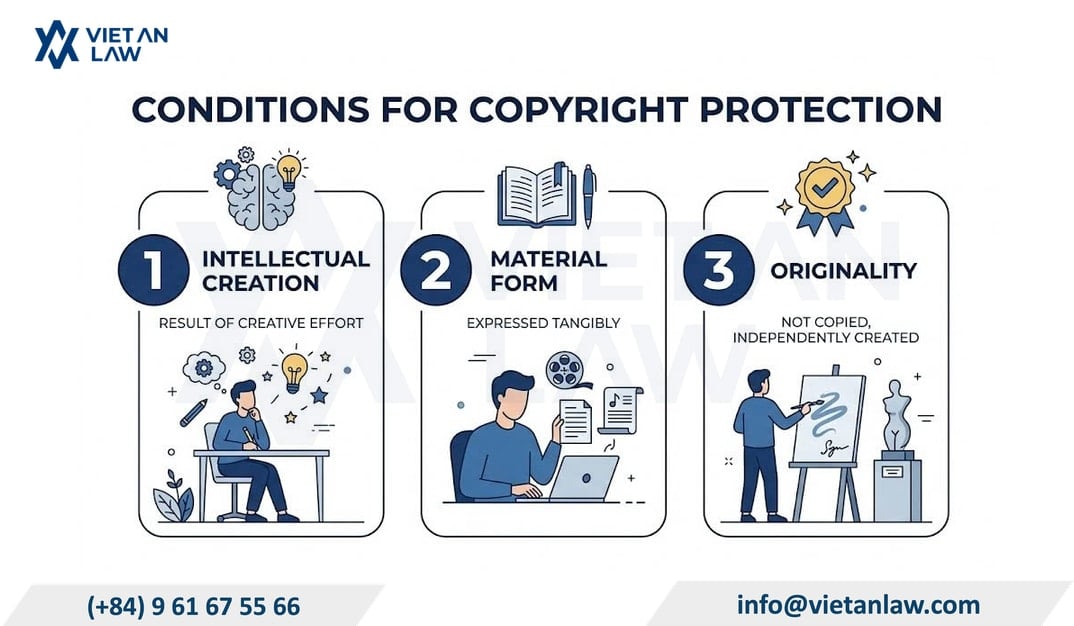
Conditions for a work to be protected by copyright
A work is protected by copyright when it meets the following conditions:
- It is the result of the author’s intellectual creative activity;
- It is expressed in a certain material form and is recognizable;
- It is original and not copied from another person’s work.
Is copyright registration mandatory in Vietnam?
No. According to the provisions of the Law on Intellectual Property of Vietnam, copyright is established automatically from the moment the work is created and expressed in a certain material form, independent of whether it has been published or subjected to copyright registration procedures.
However, although the law does not require copyright registration, performing this procedure brings many important benefits to authors and work owners. The Copyright registration certificate is an effective legal basis to prove legal ownership of the work, confirm the timing of right generation, and facilitate the protection of interests when disputes occur or against copyright infringement acts.
Particularly, in the context of the strong development of digital content and AI technology, the risk of illegal copying, editing, or use of works is increasing. Registering copyright helps authors, businesses, and work owners minimize legal risks, while facilitating transfer, licensing exploitation, and commercialization of intellectual property assets.
Why should you register copyright in Vietnam?
Although the law does not compel copyright registration, registration brings many important benefits to authors and work owners. The Copyright registration certificate is not only a legal basis proving ownership but also helps protect the work against risks of unauthorized copying or use and facilitates future commercial exploitation.
Benefits of Vietnam copyright registration
| Benefit | Meaning |
| Protecting legitimate rights and interests | Confirms ownership of the work, limiting risks of unauthorized copying or use. |
| Creating a solid legal basis | The Copyright registration certificate is vital evidence when disputes or copyright infringement acts occur. |
| Easily proving ownership | Reduces time and costs for collecting evidence when requesting competent authorities to protect interests. |
| Enhancing the commercial value of the work | Facilitates the transfer, licensing, exploitation, and commercialization of copyright. |
| Ensuring exclusive use rights | Owners have the right to decide on the exploitation and use of the work and enjoy economic benefits from it. |
| Supporting investment and business activities | Copyright can be valued, contributed as capital, transferred, or used in mergers and acquisitions transactions. |
| Strengthening the ability to fight copyright infringement | Handling unauthorized copying and use acts will be more favorable once copyright is registered. |
| Encouraging creative activities | Motivates individuals and organizations to continue investing in creativity and developing new intellectual products. |
In the context of the strong development of digital technology and artificial intelligence (AI), the illegal copying, editing, or exploitation of content is becoming more widespread. Therefore, copyright registration is an effective solution helping authors and owners protect their legitimate interests, enhance the value of intellectual property assets, and minimize legal risks during work exploitation.
What types of works can be registered for copyright in Vietnam?
According to Article 14 of the Law on Intellectual Property, most works that are creative, expressed in a certain material form, and original can be registered for copyright. Registering copyright helps authors and work owners have a legal basis to prove ownership, facilitating the process of exploiting and protecting their legitimate interests.
| Type of work | Eligible for copyright registration |
| Books, textbooks, materials, articles | Yes |
| Lectures, speeches | Yes |
| Journalistic works | Yes |
| Musical works | Yes |
| Stage works | Yes |
| Films, videos, cinematographic works | Yes |
| Artworks | Yes |
| Applied art logos | Yes |
| Photographic works | Yes |
| Architectural drawings | Yes |
| Maps, diagrams, sketches, technical drawings | Yes |
| Websites (interface, creative content) | Yes |
| Computer software | Yes |
| Databases, data collections | Yes |
| Folk literary and artistic works | Yes |
Subjects not protected and ineligible for copyright registration
Not all content is protected by copyright. According to Decree 17/2023/ND-CP as amended and supplemented by Decree 134/2026, the following subjects do not fall within the scope of protection and cannot undergo copyright registration procedures:
| Subject | Eligible for copyright registration |
|---|---|
| Pure news of the day | No |
| Legal normative documents | No |
| Administrative documents of state agencies | No |
| Work processes | No |
| Operational systems and methods | No |
| Concepts, principles, ideas | No |
| Mere numbers and data | No |
Note that copyright only protects the form of expression of the work and does not protect the ideas, methods, processes, or principles behind that work. Therefore, when registering copyright, authors need to ensure that the work possesses creativity, originality, and is expressed in a specific, recognizable form.
What does the application for copyright registration in Vietnam include?
According to the Law on Intellectual Property and Decree 17/2023/ND-CP, amended by Decree 134/2026/ND-CP, a copyright registration dossier usually includes the following documents:
| Dossier component | Requirement |
|---|---|
| Copyright registration declaration form | According to the form issued by the competent authority |
| Copies of the registered work | 02 copies of the work (accompanied by an electronic version if any) |
| Power of attorney | In case of filing through an authorized organization or individual |
| Documents proving ownership | Applicable when the owner is assigned tasks, receives transfers, inherits, or under a contract |
| Written consent of co-authors | If the work has two or more authors |
| Written consent of co-owners | If the copyright is under joint ownership |
| ID card/Passport of authors, owners | Certified copy |
| Business registration certificate | In case the owner is an organization or enterprise |
Dossier for some popular types of works
| Type of work | Documents to submit |
|---|---|
| Books, articles, textbooks | 02 printed copies on A4 paper with numbered pages |
| Computer software | Printed source code, interface, and electronic version stored on CD/DVD or storage device |
| Applied art works, logos | 02 color prints fully displaying the work |
| Musical works | Sheet music and lyrics or audio recording (if any) |
| Architectural works | Design drawings, relevant architectural drawings |
Note: All documents in the copyright registration file must be made in Vietnamese. In case documents are in a foreign language, they must be translated into Vietnamese and certified according to regulations. Preparing a complete copyright registration dossier right from the start will help shorten processing times and limit requests for amendments or supplements from the competent authority.
The copyright registration procedure in Vietnam 2026
The copyright registration procedure is carried out according to 4 basic steps below. Preparing a complete file right from the beginning will help shorten the processing time and allow the early issuance of the Copyright registration certificate.
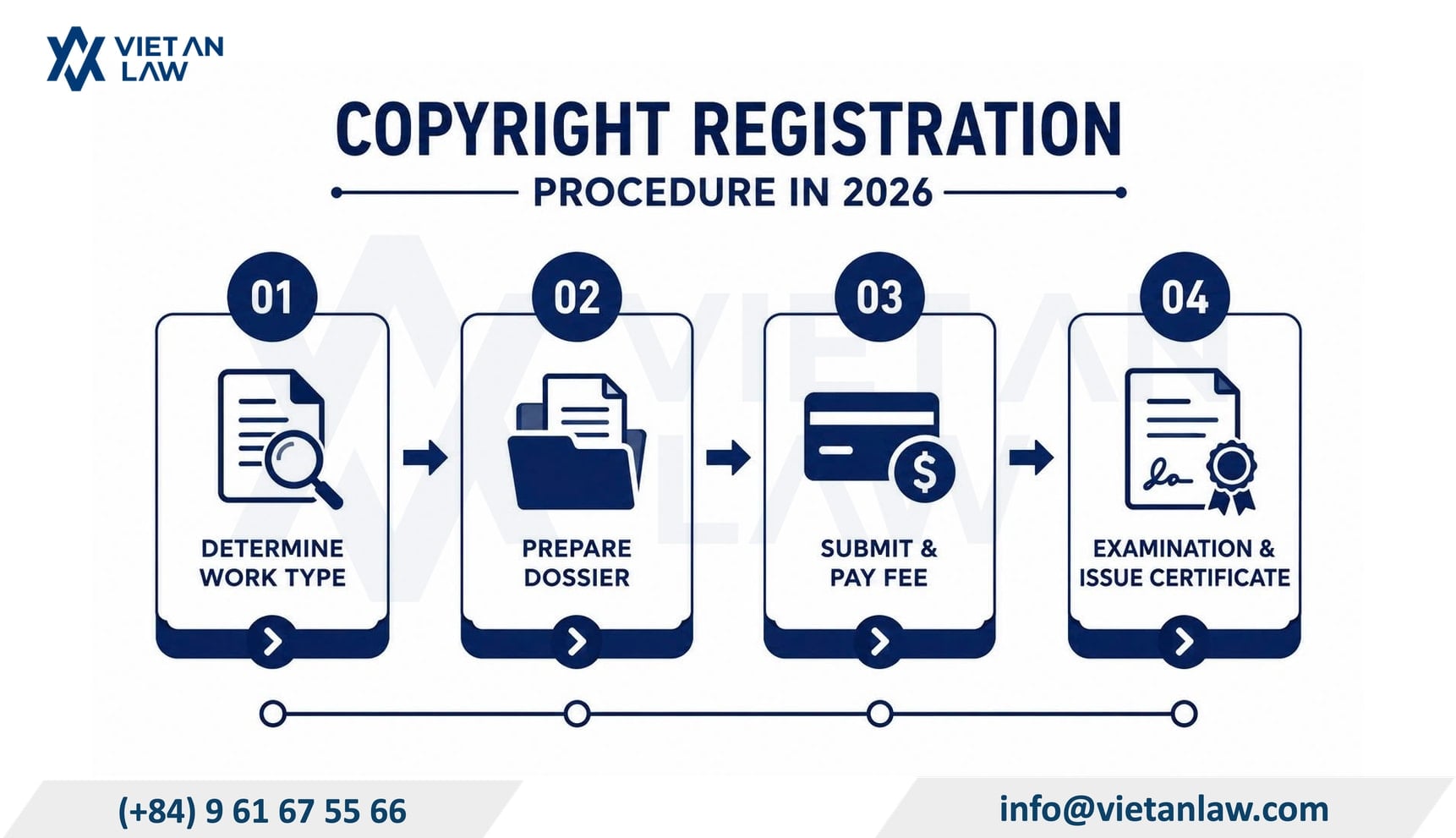
The copyright registration procedure in 2026
Processing time for the copyright registration process
| Stage | Time |
|---|---|
| Examination of file validity | 01 day |
| Amending, supplementing the dossier (if any) | 01 day |
| Issuance of Copyright registration certificate | 15 working days from the date of receiving a valid dossier |
Note: Authors or owners can directly perform the procedure or authorize a representative organization such as Viet An Law Firm to handle the preparation of the dossier, file the application, and monitor the entire registration process until the certificate is received.
Notes to avoid rejection of the copyright registration certificate in Vietnam
To be granted a Copyright registration certificate, authors and owners must ensure they fully meet the conditions regarding subjects, works, and registration dossiers. In case these conditions are not met, the application may be requested for amendment, supplement, or rejected for protection title issuance.
Conditions for authors, copyright owners
- The author must be the person who directly creates the work. In case two or more people jointly create a work with the intention that their contributions be combined into a complete whole, those people are co-authors.
- A person who supports, gives opinions, or provides materials for another person to create a work is not an author or co-author.
- Organizations and individuals with works protected by copyright include the person who directly creates the work and the copyright owner specified in Articles 37 to 42 of the Law on Intellectual Property.
Conditions for works registered for copyright
Works, performances, audio/video recordings, and broadcasting programs must belong to the types and subjects specified in Article 14 of the Law on Intellectual Property as analyzed and must not fall outside the scope of copyright protection:
- Pure news of the day.
- Legal normative documents, administrative documents, other documents in the judicial field, and official translations of those documents.
- Processes, systems, operational methods, concepts, principles, data.
Conditions for copyright registration dossiers
- Dossiers must have full components as prescribed by law;
- Information about authors, owners, and works must be accurate and consistent;
- Documents in foreign languages must be translated into Vietnamese and certified according to regulations;
- Upon receiving a notice requesting amendments or supplements to the dossier, the applicant needs to perform them within the statutory time limit to avoid dossier rejection.
Common errors causing copyright dossier rejection in Vietnam
| Common error | Consequence |
|---|---|
| Inability to prove ownership of the work | Rejection of certificate issuance |
| The work does not belong to the protected subject matter | Dossier not accepted |
| Missing documents or inconsistent information | Requested for amendment, supplement |
| Failure to respond to supplement requests on time | Dossier returned |
| Choosing the wrong registration declaration form | Dossier returned |
| Incorrectly identifying the author or owner | Prolonging the dossier processing time |
Reviewing protection conditions carefully and preparing a complete dossier right from the beginning will help the copyright registration process take place quickly, limiting the risk of being refused a Copyright registration certificate.
State fees for the copyright registration procedure in Vietnam 2026
The fee for registering copyright is a state fee that the author or work owner must pay when performing copyright registration procedures at the Copyright Office of Vietnam. According to current regulations, the fee level is determined based on each type of work as follows:
| Type of work registered for copyright | State fee |
|---|---|
| Literary works, books, textbooks, lectures, speeches, journalism, music, photography | 100,000 VND/dossier |
| Architectural works, maps, diagrams, sketches, scientific drawings | 300,000 VND/dossier |
| Plastic art works, applied arts, logos | 400,000 VND/dossier |
| Cinematographic works, stage works fixed on tapes, discs | 500,000 VND/dossier |
| Computer programs, software, databases | 600,000 VND/dossier |
What expenses does the copyright registration cost include?
In addition to the state fees mentioned above, the applicant may incur some other costs such as:
- Costs for preparing the copyright registration dossier;
- Costs for notarizing, certifying documents, translation costs (if documents are in a foreign language);
- Service fees for a copyright registration representative (if using a consulting unit).
Note: The fee rates above are only state fees payable to competent authorities. The total actual copyright registration cost may vary depending on the type of work, number of registered works, and whether a representative service is used.
How long is the copyright certificate in Vietnam valid?
The Copyright registration certificate is valid throughout the territory of Vietnam and serves as an important legal basis to prove copyright and ownership over a work. Unlike trademarks or inventions, a Copyright registration certificate does not need to be renewed periodically; its validity is attached to the copyright protection duration under the provisions of the Law on Intellectual Property.
According to the framework of copyright registration in Vietnam: procedures, required documents, fees and protection duration 2026, validity is as follows:
Copyright protection duration
| Subject protected by copyright | Protection term |
|---|---|
| Moral rights specified in Clauses 1, 2, and 4, Article 19 of the Law on Intellectual Property (naming the work, bearing the author’s name, protecting the integrity of the work) | Protected indefinitely |
| The right to publish the work and economic rights for cinematographic, photographic, applied art works, and anonymous works | 75 years from when the work is first published |
| Cinematographic, photographic, applied art works not published within 25 years from their fixation | 100 years from when the work is fixed |
| Anonymous works when information about the author appears | The protection term is calculated according to the regulations applied to works with identified authors |
| Other types of works (books, articles, computer software, music, architecture, lectures…) | Throughout the author’s life and 50 consecutive years after the year of the author’s death |
| Works with co-authors | Throughout the life of the last surviving co-author and 50 consecutive years after the year of the last surviving co-author’s death |
| Timing of termination of copyright protection term | 24:00 on December 31 of the year the protection term expires |
Notes on copyright protection duration
According to the provisions of the Law on Intellectual Property, the copyright protection duration is determined differently depending on each type of right and type of work. For moral rights (except the right to publish the work), authors are protected indefinitely. Meanwhile, the right to publish the work and economic rights are only protected for a certain period of time according to law.
Example: Author A passed away in 2020. For a book composed by A, economic rights will be protected until the end of 24:00 on December 31, 2070, after which the work will belong to the public domain according to law.
Example of copyright granted a copyright registration certificate
Copyright registration certificate No. 1467/2022/QTG dated March 11, 2022, issued by the Copyright Office of Vietnam:
- Granted to owner: Nguyen Hue Notary Office, No. 165 Giang Vo – Cat Linh – Dong Da – Hanoi, Business Registration No.: 4370/QD-UBND dated October 3, 2012
- Author: Ha Si Manh, Vietnamese nationality
- Work: Tính phi công chúng (Non-public nature)
- Type: Computer program (Excluding data).
Frequently asked questions about copyright registration in Vietnam
Does the copyright certificate in Vietnam need to be renewed?
No. Once issued, the Copyright registration certificate is valid for proving ownership over the work throughout the entire time the work is protected by law. The owner does not have to perform renewal procedures like trademarks or industrial designs.
Is it mandatory to register copyright?
No. According to the provisions of Vietnamese law, copyright arises from the moment the work is created and expressed in a certain material form, independent of whether it is registered or not. However, registering copyright helps the owner have a more favorable legal basis when proving rights and handling acts of copyright infringement.
How long is the protection term for copyright?
The copyright protection duration depends on each type of right and type of work. Moral rights (except the right to publish the work) are protected indefinitely. For economic rights and the right to publish the work, the protection term can be 75 years, 100 years, or throughout the author’s life and 50 consecutive years after the year of the author’s death according to the Law on Intellectual Property.
How long does the copyright registration process take?
Normally, the time to issue a Copyright registration certificate is about 15 working days from the date the competent authority receives a valid dossier. In case the dossier needs to be amended, supplemented, or requires explanation, the processing time may be extended.
Can I register copyright online?
Yes. Organizations and individuals can submit copyright registration dossiers through the online public service portal of the competent authority if they meet the conditions for electronic dossiers as prescribed. In addition, dossiers can also be submitted in person or sent via postal services.
Where to register copyright?
Copyright registration dossiers can be submitted directly at the headquarters of the Copyright Office of Vietnam or its representative offices (Hanoi, Ho Chi Minh City, Da Nang) or online via the Online Public Service Portal. Applicants can perform the procedure themselves or authorize a representative organization or a law firm to perform the copyright registration.
How much does copyright registration services cost?
The cost of registering copyright usually includes state fees and service fees (if using a representative unit to perform the procedure). The specific cost level depends on the type of work, number of registered works, and the scope of service chosen by the owner.
Can a work be protected without copyright registration?
Yes. Copyright is still protected by law even when the work has not been registered. However, when disputes or copyright infringement acts occur, having a Copyright registration certificate will help the owner easily prove their rights and protect their interests more effectively.
Copyright registration is an important solution that helps authors and work owners protect their legitimate rights and interests, while creating a favorable legal basis for the exploitation, transfer, and licensing of works. In case of requiring support with copyright registration dossiers, copyright registration procedures, related rights registration, or legal issues arising during the process of establishing and protecting copyright, Viet An Law Firm is ready to advise and provide full-package copyright registration services for domestic and foreign individuals and organizations. If clients have any questions or need prompt, effective intellectual property law consulting, please contact Viet An Law Firm for advice on copyright registration in Vietnam: procedures, required documents, fees and protection duration 2026 to receive the best support!