


Solutions for domestic and international investors
Legal investment consulting services in Vietnam include establishing FDI companies, M&A, capital transfer, dissolution, tax, and outward investment.
Navigating a new jurisdiction requires more than just understanding the law; it demands strategic foresight to optimise market entry and ensure strict compliance amid evolving regulations. As the country integrates into the global economy, securing investment legal consulting in Vietnam has become the decisive factor for corporate success. Whether you are aiming to set up a foreign-invested company, engage in M&A in Vietnam, or manage complex tax structures, this article outlines the legal pathways for executing cross-border transactions and maintaining regulatory compliance.
Summary of investment legal consulting services in Vietnam
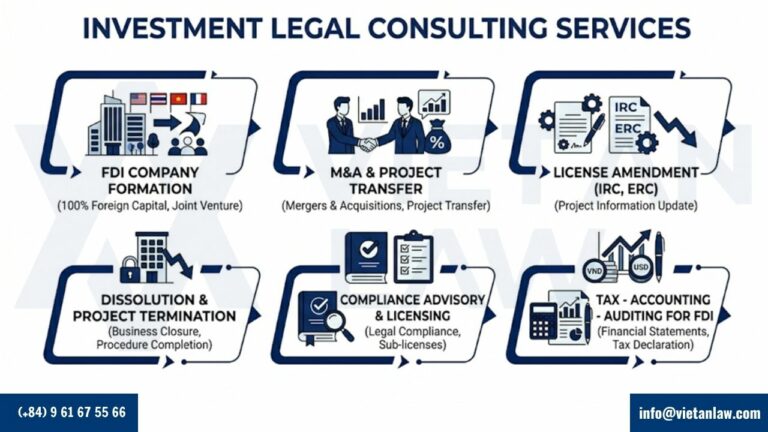
- Setting up a foreign-invested company (100% foreign-owned or joint venture)
- M&A – Buying, selling, and transferring investment projects
- Adjusting investment licenses (IRC, ERC)
- Corporate dissolution and project termination
- License and compliance consulting in Vietnam
- Tax, accounting, and auditing services for FDI enterprises
Implementation time: 15 – 30 days (depending on the dossier and business line)
Target clients: Vietnamese and international investors (FDI)
Overview of investment legal consulting in Vietnam
In the context of profound international economic integration, Vietnam has become an attractive destination for Foreign Direct Investment (FDI) inflows, while simultaneously serving as a potential market for Vietnamese enterprises expanding their outward investment.
Viet An Law accompanies and supports clients to understand:
- The legal framework in Vietnam
- Investment incentive policies in Vietnam
- Regulations of international law
When investors grasp these elements or secure the companionship of a local legal consulting unit, they gain a crucial competitive advantage that helps optimise business efficiency and limit legal risks.
Investment legal consulting services at Viet An Law
With over 19 years of experience consulting on foreign investment into Vietnam and outward investment from Vietnam, Viet An Law provides comprehensive one-stop services for domestic and international investors.
Investment consulting areas
Setting up a foreign-invested enterprise (FDI)
- Setting up a 100% foreign-owned enterprise
- Setting up a joint venture enterprise
- Applying for the Investment Registration Certificate (IRC)
- Applying for the Enterprise Registration Certificate (ERC)
- Providing optimal solutions for new investors entering the Vietnamese market
Capital contribution and share purchase
- Foreign investors contributing capital to Vietnamese enterprises
- Purchasing shares or capital contributions
- Applying for investment approval (if required)
- Utilising fast, flexible, and time-saving investment forms
Mergers and Acquisitions (M&A)
- Conducting legal due diligence
- Drafting M&A contracts (SPA, SHA)
- Consulting on transaction structuring
- Executing post-transaction legal procedures
- Delivering effective solutions to penetrate the Vietnamese market through M&A in Vietnam
Investment via PPP and BCC Contracts
- Consulting on investments in the form of Public-Private Partnerships (PPP)
- Consulting on Business Cooperation Contracts (BCC)
- Providing suitability for infrastructure projects, energy sectors, and specialised business cooperation
Applying for foreign contractor licenses
- Securing construction contractor licenses
- Obtaining operating licenses in Vietnam
Visas, temporary residence cards, and work permits
- Applying for investment visas (DT visas)
- Processing Temporary Residence Cards in Vietnam (TRC)
- Securing work permits in Vietnam
Ensuring legal conditions are met for foreigners working in Vietnam
Adjusting investment and enterprise licenses
- Changing investor information
- Adjusting charter capital and business lines
- Changing investment project locations
Capital and investment project transfer
- Transferring capital contributions
- Transferring investment projects
- Consulting on associated tax obligations
Commonly applying these procedures in real estate, FDI operations, and M&A
Dissolution and suspension of operations
- Dissolving FDI enterprises
- Terminating investment projects
- Ensuring legal compliance and avoiding post-clearance inspection risks
Tax consulting for foreign investors
- Consulting on tax obligations (CIT, VAT, PIT)
- Processing tax refunds
- Optimising corporate tax structures
Offshore investment consulting
- Applying for offshore investment policy approval
- Executing offshore investment procedures and applying for licenses
- Providing international legal consulting
Supporting Vietnamese enterprises in global expansion
Tax, payroll, accounting, and auditing services for FDI enterprises
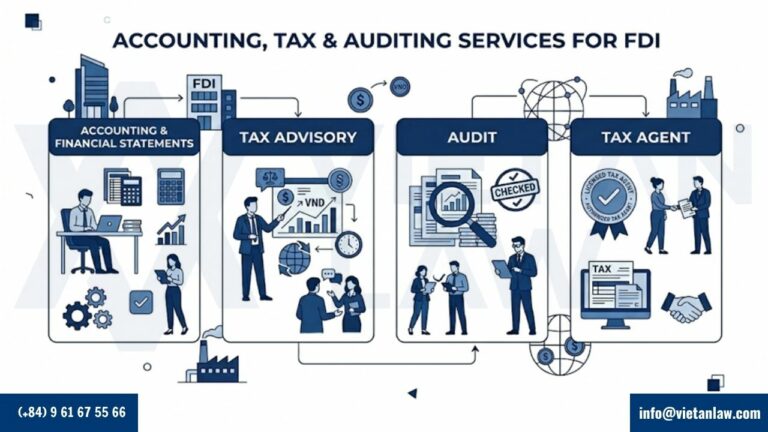
Accounting and financial reporting
- Preparing financial statements
- Executing periodic tax declarations
- Providing payroll and social insurance calculation services
- Handling tax finalisation
In-depth tax consulting
- Optimising Corporate Income Tax (CIT)
- Consulting on transfer pricing
- Managing M&A taxation
Corporate auditing
- Auditing financial statements
- Conducting internal audits
Tax agency services
- Representing enterprises in working with tax authorities
- Providing explanations during tax inspections
- Helping FDI enterprises operate in compliance with the law while optimising costs
Why choose Viet An Law
A legal partner for global investors in Vietnam.
- Over 19 years of experience in investment consulting, supporting FDI enterprises in Vietnam, and assisting with outward investments.
- A service ecosystem encompassing legal, tax, and accounting solutions to ensure synchronised operations and compliance.
- Experience working with international investors from South Korea, Japan, the United States, China, Singapore, the EU, the Middle East, and other major markets.
- Providing a one-stop service approach that saves time, optimises costs, and minimises legal risks. When selecting a firm for Investment Legal Consulting in Vietnam: FDI, M&A & Tax Services, Viet An Law delivers unparalleled local expertise.
FAQ – Frequently Asked Questions
What forms can foreign investors use to invest in Vietnam?
Setting up a company, capital contribution, M&A, PPP, and BCC.
Can investment projects be transferred?
Yes, provided that the legal conditions are met.
Are FDI enterprises required to perform accounting?
Yes, it is mandatory according to Vietnamese legal regulations.
Can Vietnamese investors invest abroad?
Yes, but they must apply for the appropriate licenses according to regulations.
Get a free consultation within 24 hours.
09 61 37 18 18 (Zalo/ WhatsApp)