(+84) 9 61 67 55 66
info@vietanlaw.vn

CIT Law Implementation in Vietnam: Key Insights into Decree 320/2025

On December 15, 2025, the Government issued Decree No. 320/2025/ND-CP detailing several provisions and measures for organizing and guiding the implementation of the Corporate Income Tax Law 2025. This Decree takes effect from December 15, 2025, replacing Decree No. 218/2013/ND-CP, which was amended and supplemented by Decree 91/2014/ND-CP, Decree 12/2015/ND-CP, and Decree 57/2021/ND-CP. Accordingly, many new regulations will officially be applied from the 2025 tax year. Below, Viet An Law Firm will update CIT Law Implementation in Vietnam: Key Insights into Decree 320/2025 (Corporate Income Tax Law) for 2025.

Table of contents

Hide

    Adding certain types of income that are exempt from corporate income tax (CIT)

    Article 4 of Decree 320/2025/ND-CP provides detailed guidance on tax-exempt income as stipulated in Article 4 of the 2025 Corporate Income Tax Law. Compared to the previous regulations in Article 4 of Decree No. 218/2013/ND-CP (which has been amended and supplemented), the new regulations have added several income items that are exempt from corporate income tax, including:
    • Income from digital transformation and innovation: Compared to the old regulations, which were limited to scientific research and technological development, Decree 320/2025/ND-CP has expanded the scope of tax exemption to include: Income from the implementation of innovation and digital transformation contracts; Income from digital technology industry activities as stipulated in specialized laws. This is an important new point, consistent with the national strategy on digital transformation and the digital economy.
    • Income from the sale of products manufactured under controlled trials: The new regulations add tax exemptions for products manufactured under controlled trials, not just limited to regular trial production as before.
    • Income from interest and transfer of green bonds: Decree 320/2025/ND-CP for the first time stipulates tax exemption for: Interest on green bonds; Income from the first transfer of green bonds after issuance.
    • Expanding tax-exempt income from carbon credits: Compared to the old regulation, which only exempted tax on the first transfer of Certified Emission Reduction (CERs), the new regulation expands to include carbon credits; it clarifies that the tax-exempt entities are businesses that have been granted certificates or credits.
    • Supplementing the income of public service units from public service activities: New regulations exempt from tax the following: Income from basic and essential public service activities; Public service activities where costs have not been fully accounted for; Public service activities in areas with particularly difficult socio-economic conditions.

    The corporate income tax rate is 15% or 17% for small and medium-sized enterprises (SMEs) in Vietnam

    The corporate income tax rate is 15% or 17% for small and medium-sized enterprises (SMEs).

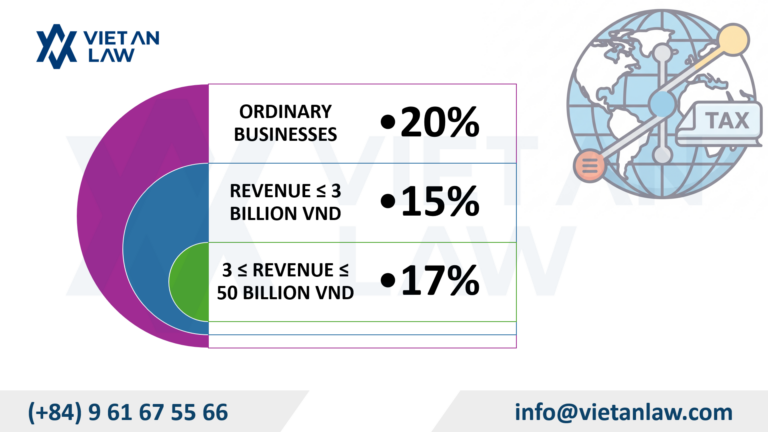
    According to Article 11 of Decree 320/2025/ND-CP, the corporate income tax rates are as follows:

    • Standard corporate income tax rate: 20%;
    • The tax rate applicable to businesses with total annual revenue not exceeding 3 billion VND is 15%.
    • The tax rate applicable to businesses with total annual revenue from over 3 billion VND to not exceeding 50 billion VND is 17%.

    Previously, businesses were primarily subject to a 20% tax rate (excluding oil and gas exploration, rare resources, and cases with preferential tax rates). Under the new regulations, many small and medium-sized enterprises (SMEs) will be subject to tax rates of 15% or 17%.

    The shift from 20% to 15% and 17% tax rates is a reasonable adjustment, aligned with the actual market segment. Specifically, approximately 94% of businesses today are small and micro-sized, and lowering the tax rate directly for this group helps the policy become more practical, increasing fairness and access to business opportunities.

    On the other hand, revenue-based support policies avoid a “one-size-fits-all” approach, focusing on supporting the right group of small and struggling businesses. Reducing corporate income tax rates helps increase profitability and capital accumulation, creating incentives for startups and enabling small businesses to accumulate capital and develop into medium-sized and larger enterprises.

    New points regarding preferential CIT rates in Vietnam

    Article 19 of Decree 320/2025/ND-CP guides preferential corporate income tax rates with the following levels depending on the subject:

    • A tax rate of 10% for 15 years;
    • A tax rate of 10% will be applied throughout the operating period.
    • A tax rate of 15% will be applied throughout the operating period.
    • A tax rate of 17% for a period of 10 years;
    • A tax rate of 17% will be applied throughout the operating period.

    Accordingly, the new regulations have added the incentive of a “10% tax rate throughout the operating period,” including: certain specially prioritized industries (journalism, publishing, social services, cooperatives, etc.); and businesses in specially prioritized areas operating in priority industries. Previously, Decree 218/2013/ND-CP stipulated that the 10% preferential tax rate only applied for a limited period (15 years, maximum 30 years in special cases).

    Furthermore, compared to the old regulations, Article 19 of Decree 320/2025/ND-CP has expanded the scope of incentives according to new investment areas such as: Concentrated digital technology zones; High-tech agricultural zones; and the method of determining incentives based on the percentage of project area located within the incentive zone (>50%).

    This aims to resolve obstacles for projects located on the boundaries of the area; and to facilitate large-scale economic zones and industrial parks.

    Many businesses will be exempt from corporate income tax for 4 years, and receive a 50% tax reduction for the following 9 years

    According to Clause 1, Article 20 of Decree 320/2025/ND-CP, tax exemption for 4 years and a 50% reduction in tax payable for the following 9 years apply to the income of enterprises in the following cases:

    • High-tech applications, venture capital investment in high-tech development (a priority category), application of strategic technologies, high-tech incubation, and establishment of high-tech incubation facilities.
    • Software product manufacturing; cybersecurity products and services; key digital technology products and services; electronic equipment; research, design, and manufacturing of semiconductor chips; construction of artificial intelligence data centers.
    • Production of supporting industrial products (in the priority category).
    • High-tech enterprises, high-tech agricultural enterprises, science and technology enterprises.
    • Areas with particularly difficult socio-economic conditions (except for certain cases).

    Previously, the National Assembly issued Resolution 198/2025/QH15 on a number of special mechanisms and policies for the development of the private economy with many tax incentives for businesses, including exemption from corporate income tax for small and medium-sized enterprises for the first 3 years, exemption from corporate income tax for 2 years and a 50% reduction in the tax payable for the following 4 years for income from innovative startup activities of innovative startup businesses, innovative startup investment fund management companies, and intermediary organizations supporting innovative startups.

    The new regulations in Decree 320/2025/ND-CP, which guides the implementation of the Corporate Income Tax Law, regarding a 4-year tax exemption and a 50% reduction in tax payable for the following 9 years, clearly reflect Vietnam’s orientation towards developing the digital economy, high technology, and innovation in the new phase.

    Newly established SMEs converted from household businesses are exempt from CIT for 02 consecutive years

    According to Clause 4, Article 21 of Decree 320/2025/ND-CP, enterprises with total annual revenue not exceeding VND 3 billion or from over VND 3 billion to not exceeding VND 50 billion, newly established from household businesses (including individual businesses converting to enterprises), are exempt from corporate income tax for two consecutive years from the date they generate taxable income.
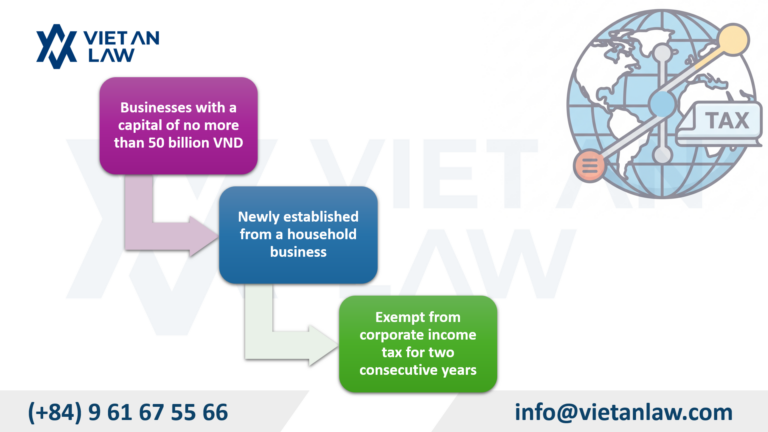
    Newly established small and medium-sized enterprises converted from household businesses are exempt from corporate income tax for two consecutive years.

    Newly established small and medium-sized enterprises converted from household businesses are exempt from corporate income tax for two consecutive years.

    Accordingly, this regulation is guided as follows:

    • The tax exemption period is calculated continuously from the first year in which taxable income is generated. If there is no taxable income in the first three years, the tax exemption period will be calculated from the fourth year after the first year of revenue generation.
    • Household businesses and individual businesses must register and operate legally, with a continuous production and business period of at least 12 months up to the date of initial issuance of the Business Registration Certificate.
    • Newly established businesses are only exempt from tax if it is their first time registering. The tax exemption does not apply if the legal representative (unless they are not a contributing member), a general partner, or the person with the highest capital contribution has previously been involved in another business (whether currently operating or dissolved within the last 12 months).

    This policy aims to support household businesses in transitioning to a more favorable business model, reduce financial pressure in the initial stages, and encourage the corporatization of their business operations.

    Amendments related to deductible and non-deductible expenses when determining CIT

    Articles 9 and 10 of Decree 320/2025/ND-CP, which guides the implementation of the Corporate Income Tax Law, contain many new provisions related to deductible and non-deductible expenses when determining taxable corporate income, such as:

    Deductible expenses

    Adding a mechanism for “super-deductible” research and development (R&D) costs.

    The most notable new feature is that, for the first time, it allows R&D costs to be deducted up to 200% of the actual costs incurred for scientific research, technological development, innovation, and digital transformation.

    Previously, Decree 218/2013/ND-CP only allowed for the deduction of 100% of actual expenses, with no mechanism for additional deductions. This new regulation aims to encourage businesses to invest in R&D.

    Expand the list of deductible expenses even if no revenue has been generated.

    While Decree 218/2013/ND-CP previously stipulated rigid regulations, with many items excluded because they “had not yet generated revenue,” Decree 320/2025/ND-CP has added many expenses that “pre-generate revenue,” including:

    • Costs incurred when participating in a tender but failing to win the bid;
    • Costs incurred from market research and new product development that were unsuccessful;
    • Costs of land and infrastructure rental before production begins;
    • Depreciation costs of leased assets when there are no tenants;
    • Costs of establishing a business, branch, or business location;
    • Marketing and product promotion costs before sale;…

    Non-deductible expenses

    Adding more cases where expenditures are disqualified due to non-compliance with specialized laws.

    For example:

    • Overtime pay exceeding the limits stipulated in the Labor Code.
    • Advertising of prohibited goods and services.
    • Expenditures exceeding the limits set by specialized laws.

    Expanding the list of non-deductible expenses related to capital increases/decreases.

    Please clarify:

    • Expenses for issuing shares
    • Purchase of treasury shares
    • Expenses directly related to equity adjustments.

    No deductions related to capital increases/decreases will be allowed.

    The above is an update on CIT Law Implementation in Vietnam: Key Insights into Decree 320/2025. If you have any related questions or require consultation on corporate income tax regulations, please contact Viet An Law Firm for the best advice and support!
    Related Acticle

    Procedures for investment in Burundi

    Procedures for investment in Burundi

    Complete guide on procedures for investment in Burundi. Learn registration steps, required documents, company types, and legal requirements for foreign investors entering Burundi's market.
    Change business registration in Bach Mai Ward

    Change business registration in Bach Mai Ward

    Change business registration in Bach Mai Ward after administrative merger. Complete guide on procedures, required documents, fees, and tax finalization for enterprises.
    Change business registration in Cua Nam Ward

    Change business registration in Cua Nam Ward

    Change business registration in Cua Nam Ward after administrative boundary merger. Complete guide on procedures, documents, and legal requirements for enterprises in Hanoi.
    Change business registration in Giang Vo Ward

    Change business registration in Giang Vo Ward

    Change business registration in Giang Vo Ward after administrative merger. Complete guide on procedures, requirements, and whether updates are mandatory for enterprises.
    Change business registration in Dong Da Ward, Hanoi City

    Change business registration in Dong Da Ward, Hanoi City

    Change business registration in Dong Da Ward, Hanoi after administrative merger. Complete guide on procedures, documents, fees, and legal requirements for enterprises.

    CONTACT VIET AN LAW

    In Hanoi: (+84) 9 61 67 55 66
    (Zalo, Viber, Whatsapp, Wechat)

    WhatsApp Chat

    whatsapp-1

    In Hochiminh: (+84) 9 61 67 55 66
    (Zalo, Viber, Whatsapp, Wechat)

    WhatsApp Chat

    whatsapp-1

    ASSOCIATE MEMBERSHIP