On March 12, 2026, the Ministry of Finance issued Circular 20/2026/TT-BTC: new guidance on Vietnam corporate income tax (CIT), implementing the Law on CIT 2025 and Decree 320/2025/NĐ-CP. Effective immediately and applicable for the 2025 tax period onwards, this Circular introduces critical regulatory changes affecting both domestic and foreign enterprises operating in Vietnam or deriving income from the country. Below, Viet An Law provides a comprehensive summary of the key updates within the Vietnam CIT updates.
Table of contents
Expenses deductible under points b and c, Clause 1, Article 9 of the Law on Corporate Income Tax must have sufficient invoices and supporting documents as prescribed and the required documentation as guided in Article 3 of Circular 20/2026/TT-BTC. Specifically, for expenses with sufficient invoices and non-cash payment documents, the following documents are required for deduction when determining taxable corporate income:
For expenses related to production and business operations that the enterprise directly pays to employees using non-cash methods, the required documentation includes:
| Document components | Required documents |
| Invoices and receipts | It must comply fully with the legal regulations on accounting. |
| Power of Attorney | Financial regulations, internal regulations, or company decisions regarding the authorization/permission for employees to make payments on behalf of employees. |
| Employee payment documents | Non-cash payment documents for the purchase of goods and services under authorization. |
| Enterprise payment documents | Non-cash payment documents issued by enterprises when making payments (reimburses) to employees. |
For invoices for goods and services purchased individually with a value of 5 million VND or more but not yet paid at the time of expense calculation, businesses are allowed to include them as deductible expenses if they meet the following conditions:
Specifically, the documentation for expenses included in deductible costs must be the original, a certified copy, a copy bearing the company’s seal, or an electronic document as prescribed by law. Enterprises must retain complete documentation for inspection and auditing purposes.
Please contact Viet An Law for the latest form updates.
The procedures and dossiers for tax exemptions, tax reductions, preferential tax rates, and tax exemption/reduction periods (stipulated in Articles 4, 13, 14, and 15 of the Law on Corporate Income Tax 2025) are implemented under a self-declaration and self-responsibility mechanism by enterprises, without the need for prior registration or assessment, but mainly through post-audit.
Circular No. 20/2026/TT-BTC provides guidance on the documentation for applying for corporate income tax incentives and continues to emphasize the self-determination mechanism for taxpayers; however, meeting the incentive conditions is still subject to review by the tax authorities during periodic inspections and audits. Specifically:
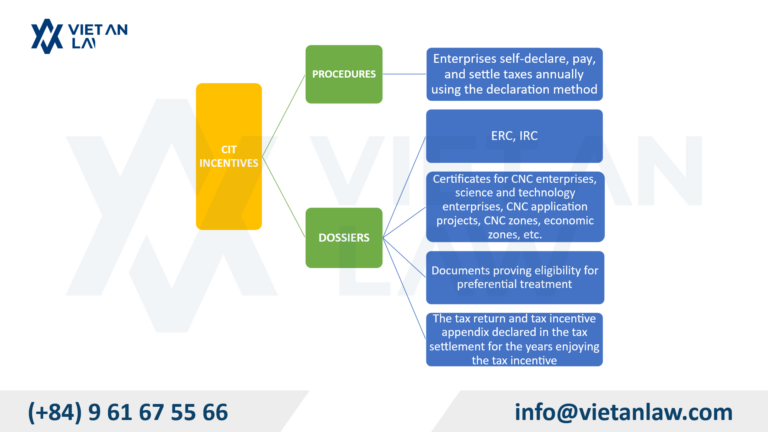
Dossier and procedures for Vietnam corporate income tax incentives
In accordance with the general provisions of the law on tax administration (Law on Tax Administration 2019 and guiding documents): Enterprises self-declare, pay taxes, and settle taxes annually using the declaration method.
There are no separate, complicated procedures (such as pre-registering for incentives with the tax authorities or obtaining confirmation of incentives before application, except in some special cases such as large projects requiring a Prime Minister’s decision).
Enterprises determine and declare the following:
Declare tax incentives directly on the corporate income tax return (form 03/TNDN) and the corporate income tax incentive appendix (an appendix attached to the return, clearly stating the income eligible for incentives, tax rate, exemption/reduction period, and the amount of tax exempted/reduced).
Enterprises do not submit separate applications for preferential treatment in advance, but only prepare and retain documents to serve as proof when the tax authorities conduct inspections or audits (the documents must be complete and valid according to tax management regulations).
The main documents to prepare and store include:
The timing for determining taxable revenue for corporate income tax purposes in certain specific cases is guided in Article 5 of Circular No. 20/2026/TT-BTC as follows:
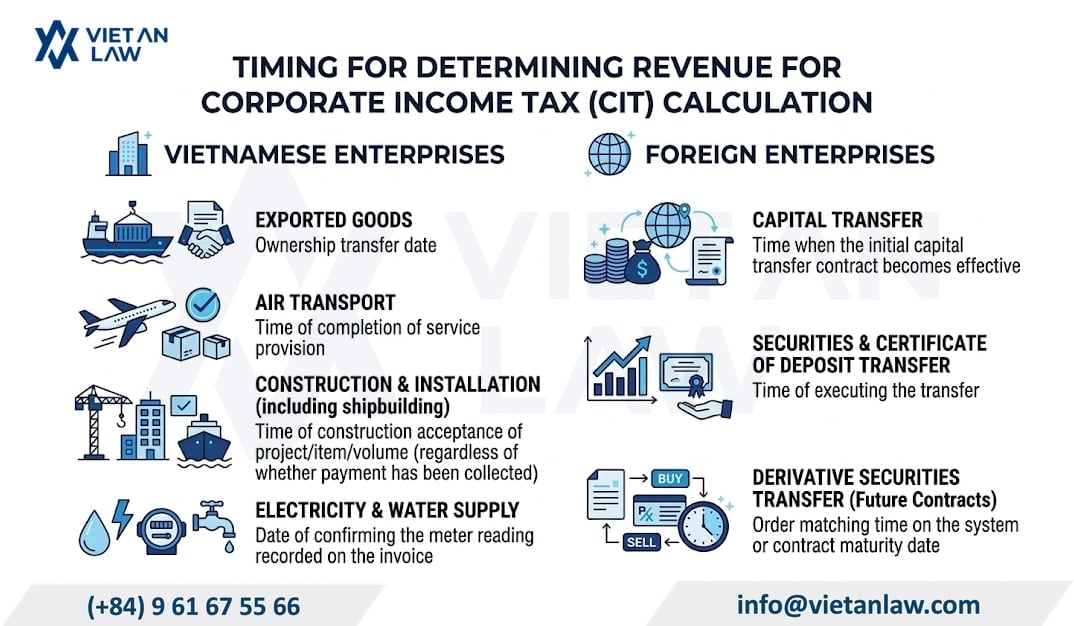
Specific timing for revenue recognition for CIT Purposes in certain cases
Article 7 of Circular No. 20/2026/TT-BTC clarifies the tax obligations of foreign enterprises, focusing on modern business activities not previously covered in Circular 78/2014/TT-BTC. Specifically:
Foreign contractors (with or without a permanent establishment) doing business in Vietnam, including:
Please note that the following are not subject to tax under this provision:
How to calculate taxes for foreign enterprises
CIT = Taxable revenue × Percentage of revenue
In which:
| Object | Percentage |
| Services | 5%, except for restaurant, hotel, and casino management services: 10%; in cases where the service is associated with goods, the goods are calculated at a rate of 1%; in cases where the value of the goods cannot be separated from the value of the service: 2%; |
| Supply and distribution of goods in Vietnam through on-site export and import or according to international trade terms (Incoterms) | 1%; however, in the case of foreign enterprises selling goods that are raw materials, supplies, and components at bonded warehouses or free trade zones for import into Vietnam to serve the production of export goods or processing of export goods under contract, foreign enterprises designating export processing enterprises to deliver goods that are raw materials, supplies, and components to other export processing enterprises to serve the production of export goods or processing of export goods under contract are not required to pay corporate income tax. |
| Royalties | 10% |
| Aircraft, helicopter, glider rental (including engine and spare parts rental), and ship rental | 2% |
| Rental of drilling rigs, machinery, equipment, and transportation vehicles | 5% |
| Securities transfer; overseas reinsurance | 0,1% |
| Derivative financial services | 2% |
| Capital transfer | 2% |
| Construction, transportation and other activities | 2% |
Compared to Circular 78/2014/TT-BTC, Circular 20/2026/TT-BTC has added several new regulations on the management of expanded investment capital and the Science and Technology Fund as follows:
The above is a summary of the Circular 20/2026/TT-BTC: New guidance on Vietnam Corporate Income Tax (CIT). If you have any related questions or require tax or accounting advice, please contact Viet An Law – Tax Agency for the best support and consultation!