


Company address change Vietnam is a mandatory administrative procedure that enterprises must execute when relocating to a new business location that differs from the information stated on their Enterprise Registration Certificate (ERC). In cases where the relocation involves moving to an area managed by a different tax authority, the enterprise is required to complete tax finalization and closing procedures with the current tax office prior to changing business registration.
The regulatory dossier for a corporate headquarters relocation typically comprises a notification of changes to enterprise registration information, the corresponding resolution/decision, meeting minutes, a power of attorney, and other supporting documents tailored to each specific corporate structure under Decree 168/2025/NĐ-CP. The standard processing timeline generally ranges from 3 to 10 working days, depending on whether the relocation occurs within the same district, moves across different districts, or transitions to another province. Beyond statutory state fees, enterprises must also account for essential post-relocation update costs, including adjusting electronic invoices (e-invoices), digital signatures, social insurance records, and commercial bank account information.
To assist enterprises in seamlessly navigating these regulatory requirements without legal disruptions, Viet An Law provides a comprehensive guide below on company registered address change in Vietnam 2026: Dossier, fees & timeline, covering the latest documentation, step-by-step workflows, timelines, expenses, and critical compliance notes.
Checklist for company registered address change in 2026
- Prepare the necessary documents for changing the company’s registered office address according to the new regulations;
- Issue a decision and meeting minutes regarding the company’s address change;
- Complete tax finalization procedures if the change is to a different tax authority or province;
- Submit the business registration change application through the online portal;
- Receive the updated ERC with the new address;
- Adjust electronic invoice information to reflect the new registered office address;
- Update information at banks, social insurance offices, and digital signatures;
- Notify partners, customers, and relevant agencies of the new address;
- Check and update the company website, email, contracts, and internal company documents;
- Archive the registered office address change documents for future legal review.
Note: Enterprises are not permitted to register their company address at an apartment building designated solely for residential use. Using an invalid address may result in the rejection of the application or administrative penalties.
Dossier for company address change
| Document type | Quantity | Notes |
| Application form for amendments to enterprise registration information | 01 | Original copy |
| Resolution or decision regarding the change of registered headquarters address from:
The company owner (for single-member LLCs); The Members’ Council (for multi-member LLCs, and partnership companies); The general meeting of shareholders (for joint-stock companies). |
01 | Original copy or certified true copy |
| Power of attorney to act on behalf of the enterprise to execute administrative procedures at competent authorities | 01 | Original copy or certified true copy |
| Legal identification documents of the individual directly submitting the dossier (ID Card / Citizen ID Card / Passport) | 01 | Original copy or certified true copy |
Costs for company address amendment
Fee for publishing enterprise registration information: 100.000 VND/time
According to Clause 3, Article 57 of Decree 168/2025/ND-CP, enterprises will not have to pay the above fees if they change their company’s registered address due to changes in administrative boundaries.
In addition to other costs related to changing the enterprise’s registered address such as: rent for premises, fees for relocating enterprise assets, fees for engraving a new seal, etc.
Time for company relocation procedure Vietnam
The inter-agency coordination mechanism between the Business Registration Authority and the Tax Authority under Decree 168/2025/ND-CP helps to minimize the time it takes for administrative procedures to be processed, specifically:
- Within 1 working day: From the date of receiving information about the change of location from the Business Registration Authority, the Tax Authority will send feedback on the status of the enterprise’s tax obligations.
- Within 3 working days: From the date of receiving a complete and valid application, the provincial Business Registration Authority will review and issue a new ERC to the company. If the application requires correction or supplementation, the authority will issue a written notice stating the reasons within the same timeframe.
| Stage | Timeline |
|---|---|
| Dossier preparation | 1 day |
| Tax finalization and closing (if applicable) | 3–10 days |
| Business registration | 3 days |
| Electronic invoice updates | 1–2 days |
Comparison of procedures to change company address: Within the same province vs. across provinces
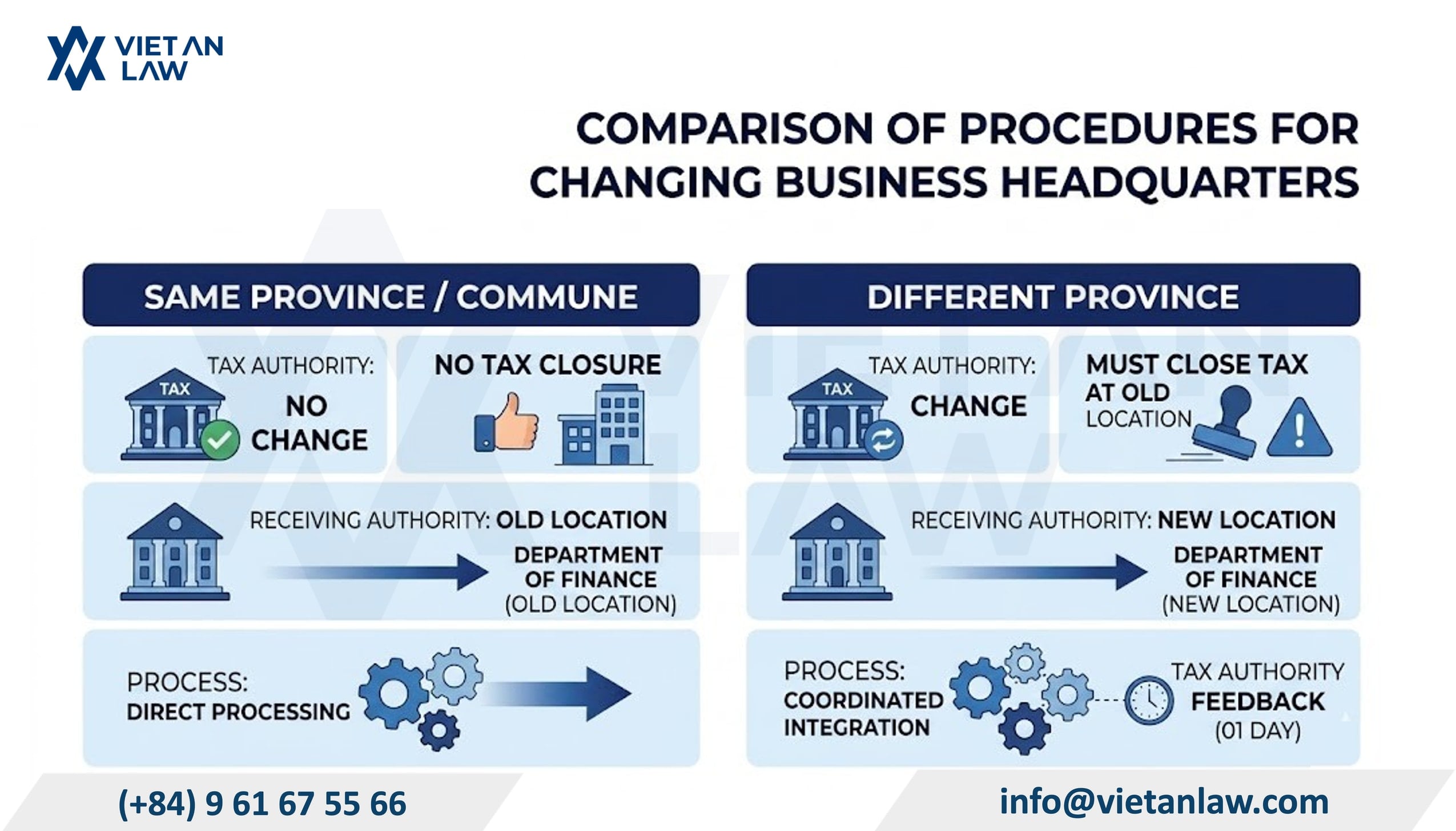
Based on the provisions of Article 40 of Decree 168/2025/ND-CP and Article 36 of the Law on Tax Administration 2019, Viet An Law would like to list some similarities and differences between the two cases of changing the business headquarters (within the same province and in a different province) as follows:
Similarities:
- Required documents
- Processing time.
Differences:
- Procedures for closing a company’s registered office:
- Within the same province and commune as the old address: No prior procedures with the tax authority are required as this does not change the tax authority managing the taxpayer.
- In a different province: It is mandatory to complete the relocation procedures with the relevant tax authority before registering with the Business Registration Authority, as this event results in a change of the tax authority managing the taxpayer.
- Receiving agency for documents:
- When changing the company address within the same commune/province: Submit documents to the Business Registration Authority under the Provincial Department of Finance where the company is currently located.
- When changing the company address to a different province: Submit documents to the Business Registration Authority under the Provincial Department of Finance where the company intends to establish its new registered office.
- Processing procedure for documents:
- Changing the company’ registered office address within the same commune/province: The Business Registration Authority reviews the validity and directly processes the application.
- Changing the company’s registered address to a different province: The business registration authority must send the relocation information to the tax authority. Within one working day, the tax authority is responsible for responding with an opinion on the completion of tax finalization procedures when relocating the company’s registered address, which will serve as the basis for resolution.
Comparison to change registered office address: Same ward & tax authority vs. across provinces & tax authorities
| Criteria | Within the same tax authority/ward | Across provinces/different tax authorities |
|---|---|---|
| Dossier to be executed | The core dossier components are identical, following the regulations on enterprise registration changes | The core dossier components are similar, but additional procedures related to the tax authority will arise |
| Processing timeline | Approximately 03–05 working days if the dossier is valid | Generally longer due to the obligation to execute tax finalization and closing procedures |
| Tax closing procedures | Tax closing procedures are not required upon relocation because the managing tax authority remains unchanged | It is mandatory to execute tax closing procedures at the current location prior to registering the address change |
| Managing tax authority | The managing tax authority of the enterprise remains unchanged | The managing tax authority changes in accordance with the new headquarters location |
| Dossier receiving authority | The Business Registration Office under the Department of Finance where the enterprise is currently headquartered | The Business Registration Office under the Department of Finance where the new headquarters will be located |
| Dossier processing workflow | The Business Registration Office directly reviews and processes the dossier | The Business Registration Office coordinates with the tax authority to verify the completion of tax relocation procedures |
| Procedural complexity | Simpler procedures with faster processing | More complex procedures due to arising tax obligations and liabilities |
| Commonly encountered risks | Inaccurate administrative address declaration or missing supporting documents | Delayed tax closing, outstanding tax liabilities, or unresolved invoice status |
| Critical notes | E-invoices and bank account information must be updated after the change is completed | Tax obligations must be fully settled and finalized before submitting the application for enterprise registration change |
Cases requiring tax closing procedures upon business address change Vietnam
According to the risk management principles of the tax sector as stipulated in the Law on Tax Administration 2019, a change of company address (including cases resulting in a change of the directly managing tax authority) is not a case that automatically requires a tax audit or settlement inspection (also known as tax finalization upon relocation) at the company’s headquarters.
Instead, according to Clause 2, Article 11 of Circular 105/2020/TT-BTC, taxpayers only need to complete the tax obligation closing procedure. Specifically, it clearly states:
“Taxpayers must fulfill their tax and invoice obligations with the previous directly managing tax authority before changing their tax registration information”.
The fulfillment of this obligation includes:
- Submitting all tax returns due up to the time of relocation.
- Paying all applicable taxes, penalties, and late payment fees (if any) to the State budget.
- Resolving the issue of invoice usage in accordance with regulations.
After the business fulfills the above obligations, the former tax authority will issue a Notice of Taxpayer Relocation (Form No. 09-MST). All unverified accounting records will be automatically transferred to the new tax authority (where the new headquarters is located) for continued management.
Therefore, when changing the head office (if to a different province or commune), the business does not need to go through the tax settlement procedure; it only needs to finalize its tax obligations with the old tax authority as stipulated by law.
Common mistakes delaying the process to update company address Vietnam
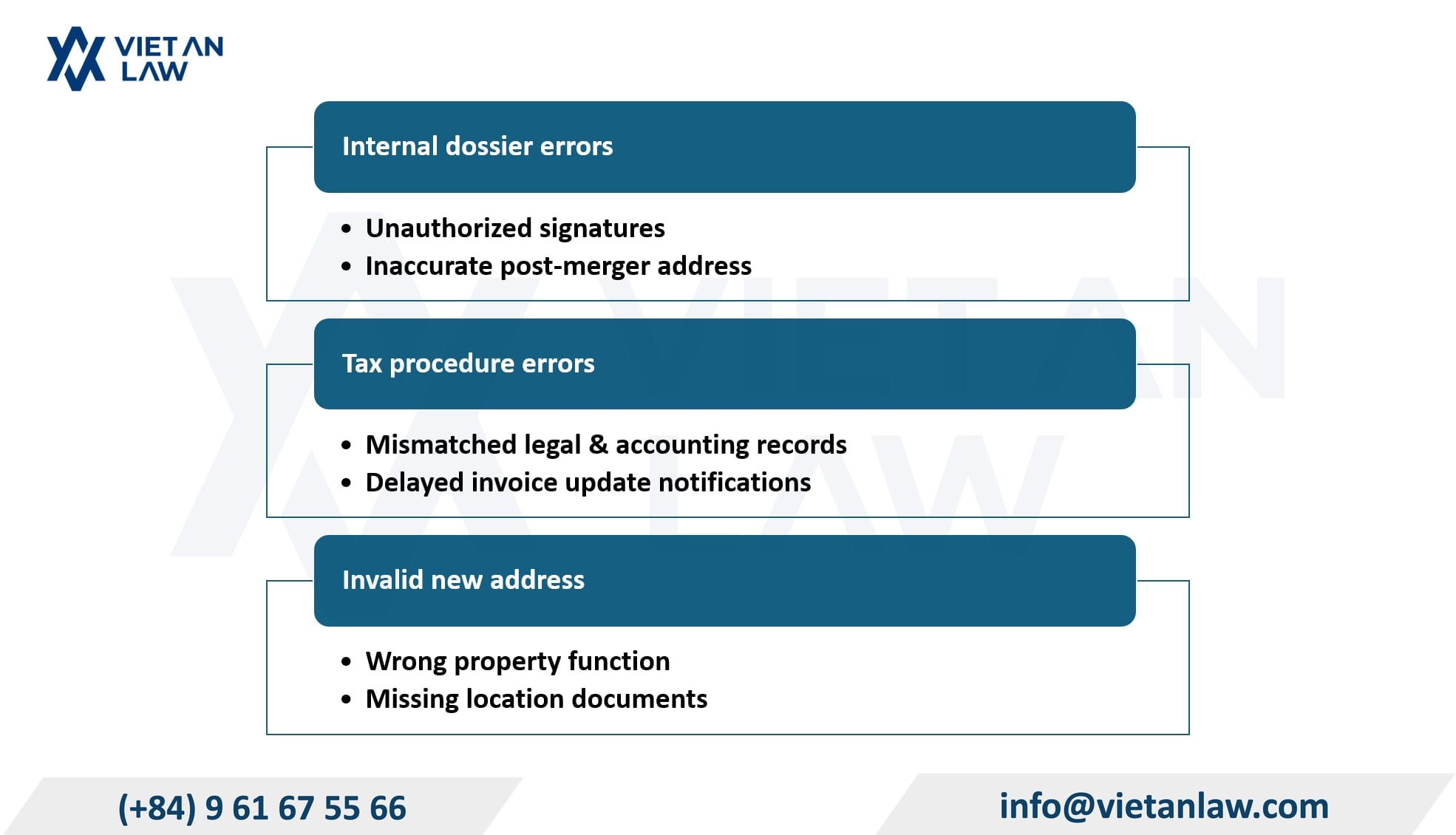
Errors in drafting meeting minutes and decisions of the Board of Members/Board of Directors
The most common errors are meeting minutes and decisions lacking signatures from authorized persons or incorrectly recording the address structure of 3 or 4 levels. Especially in the context of the current post-merger administrative units, inadvertently writing the wrong names of old wards or communes that have not been updated can cause the business registration agency to reject the application and request a resubmission.
Delays or incorrect procedures in invoice notification and tax obligation processing
When transferring to a different tax authority, a lack of synchronization between legal and accounting matters (such as tax arrears, late filing of tax returns) will slow down the process of applying for Form 09-MST at the old tax authority.
In addition, delays in notifying adjustments to electronic invoices will directly disrupt business operations and lead to the risk of penalties.
The proposed new headquarters address does not meet the required legal conditions
Registering an office in a residential apartment building violates the Housing Law.
To avoid risks, enterprises are required to request the landlord to provide documents proving that the leased area has a “commercial or service function” (e.g., the ground floor of a building) before signing the contract and submitting legal documents.
Frequently asked questions about registered office address change 2026
Can an enterprise operate at the new address before receiving a new ERC?
No. Based on Article 31 of the Law on Enterprises 2020, enterprises must register the change of their headquarters within 10 days of the decision.
Does changing the company address require changing invoices?
Yes. Enterprises must update the address information on electronic invoices after changing the company address to ensure the invoices are valid according to tax regulations.
Is it permissible to use an apartment as the headquarters?
No. Enterprises are not allowed to register their headquarters in an apartment building that is solely for residential use, except for the area designated for commercial or service purposes.
Does changing the company headquarters to a different commune/ward require tax finalization?
Yes. If changing the company address results in a change of the tax authority, the business must complete the tax finalization procedure before moving the headquarters.
Is it necessary to change the company seal when relocating the headquarters?
Not mandatory. However, enterprises should change the seal if it includes information about the old district, county, or province for legal consistency.
Is it necessary to finalize tax settlements when relocating to another province?
Tax settlements are not mandatory. Enterprises usually only need to fulfill their tax obligations and complete the tax finalization procedures with the old tax authority before relocating to another province.
What should be noted regarding electronic invoices when changing the business headquarters?
Based on Decree 123/2020/ND-CP (amended and supplemented by Decree 70/2025/ND-CP), immediately after completing the change of company address, businesses are required to submit the Declaration of Change of Information for Using Electronic Invoices (Form 01/DKTD-HDDT) to the tax authority to update data and ensure the validity of issued invoices.
Viet An Law Firm offers a comprehensive and reliable company address change service in 2026
Choosing Viet An Law’s comprehensive and reputable business relocation service in 2026 helps enterprises optimize processes and avoid risks through the following aspects:
- Initial legal consultation: Assessing the conditions and legal issues arising before relocating, helping enterprises have a safe direction and avoid problems from the start.
- Full-service representation: Directly drafting documents and working with government agencies, helping clients save maximum time and effort and shorten complex procedures.
- Comprehensive post-registration support: Advising on procedures after changes and providing detailed guidance on updating issued invoice information, minimizing the risk of administrative penalties and ensuring seamless business operations.
Why do enterprises choose Viet An Law Firm?
- Nearly 20 years of expertise in corporate and investment law, trade: Viet An Law has partnered with thousands of enterprises in procedures related to business registration changes, corporate restructuring, investment, and taxation, helping clients process documents quickly, correctly, and minimizing legal risks.
- Practical experience with complex and urgent cases: Our team of lawyers and specialists regularly handles complex cases such as relocating to a different province, tax obligations, discrepancies in business registration information, multiple rejections of documents, or cases requiring completion within a short timeframe.
- Comprehensive support for legal and tax procedures when changing headquarters: In addition to handling procedures at the Business Registration Authority, Viet An Law Firm also assists enterprises in resolving issues related to tax finalization, electronic invoices, updating the tax authority, and other obligations after changing the company address.
- Comprehensive document preparation, minimizing revisions and additions: Clients receive full support from consultation, legal review, document preparation, online declaration, submission, and result tracking, significantly saving time and internal personnel.
- Nationwide online support – flexible and cost-effective: Enterprises in Hanoi, Ho Chi Minh City, and other provinces can change company address online via email, sign documents remotely, and receive results quickly without needing to work directly with government agencies.
- Commitment to practical advice, clear roadmap, and transparent costs: Each application is specifically assessed based on its legal status and the tax authority’s management, thereby providing a suitable solution, estimated processing time, and clear costs from the outset.
Viet An Law Firm provides comprehensive ERC amendment Vietnam services in Hanoi, Ho Chi Minh City, and nationwide, supporting clients from legal consultation and tax finalization to online filing and updating electronic invoices after the change.