


During its operation, a joint stock company may change its shareholders through share transfers, the admission of new investors, the issuance of additional shares, or the inheritance or gift of shares. However, not every change of shareholders in a joint stock company, or change of capital contributors, has to be registered with the business registration authority.
Under the Vietnamese Law on Enterprise 2020 as amended in 2025 and Decree 168/2025/ND-CP, as amended by Decree 296/2026/ND-CP, businesses need to distinguish between a change of shareholders, changes in charter capital and changes to beneficial owner information. In this guide to change of shareholders in a Vietnamese joint stock company, Viet An Law Firm explains how to identify the cases requiring registration, the required dossier and forms, and the legal issues to note.
Legal basis in Vietnam
- Law on Enterprise 2020 (No. 59/2020/QH14), as amended and supplemented by Law No. 03/2022/QH15 and Law No. 76/2025/QH15;
- Decree 168/2025/ND-CP dated June 30, 2025 of the Government on enterprise registration;
- Decree 296/2026/ND-CP dated July 23, 2026 amending and supplementing Decree 168/2025/ND-CP;
- Circular 68/2025/TT-BTC dated July 1, 2025 on forms for enterprise registration and household business registration;
- Circular 121/2026/TT-BTC dated August 21, 2026 amending and supplementing Circular 68/2025/TT-BTC;
- Law on Investment 2025 (No. 143/2025/QH15) and its implementing documents, for transactions involving foreign investment.
What is a change of shareholders in a joint stock company in Vietnam?
Changing shareholders means a change in the individuals or organisations owning shares, or an adjustment to the number of shares and the ownership ratios of shareholders in the company, i.e. a change of shareholder ownership.
Under Article 111 of the Law on Enterprise 2020, the charter capital of a joint stock company is divided into equal portions called shares. The company must have at least three shareholders, with no limit on the maximum number.
In practice, a change of shareholders in Vietnam usually arises when:
- A shareholder transfers part or all of its shares to another individual or organisation;
- The company admits new shareholders through an offering of shares;
- A shareholder acquires additional shares, changing its ownership ratio;
- Shares are transferred through inheritance, gift or another lawful transaction;
- A foreign investor buys or receives a transfer of shares in the company;
- The company restructures its shareholder base in connection with an increase or decrease in charter capital.
Distinguishing a change of shareholders from a change in capital contributions in a joint stock company
In a joint stock company, it is necessary to distinguish the value of the shares owned by each shareholder from the charter capital of the enterprise.
When a shareholder transfers issued shares, the owner of the shares may change, but the charter capital normally remains the same.
Conversely, if the company issues additional shares that increase the total par value of shares sold, or reduces its capital as prescribed, it must follow the procedures for registering changes to charter capital.
Example: Company A has charter capital of VND 10,000,000,000. Shareholder X owns shares with a total par value of VND 4,000,000,000 and transfers all of them to investor Y. After the transaction, the charter capital remains VND 10,000,000,000; only the owner of 40% of the share capital changes.
This is an important distinction when determining the procedure for a change of capital contributors in a joint stock company.
Cases of change of shareholders in Vietnam
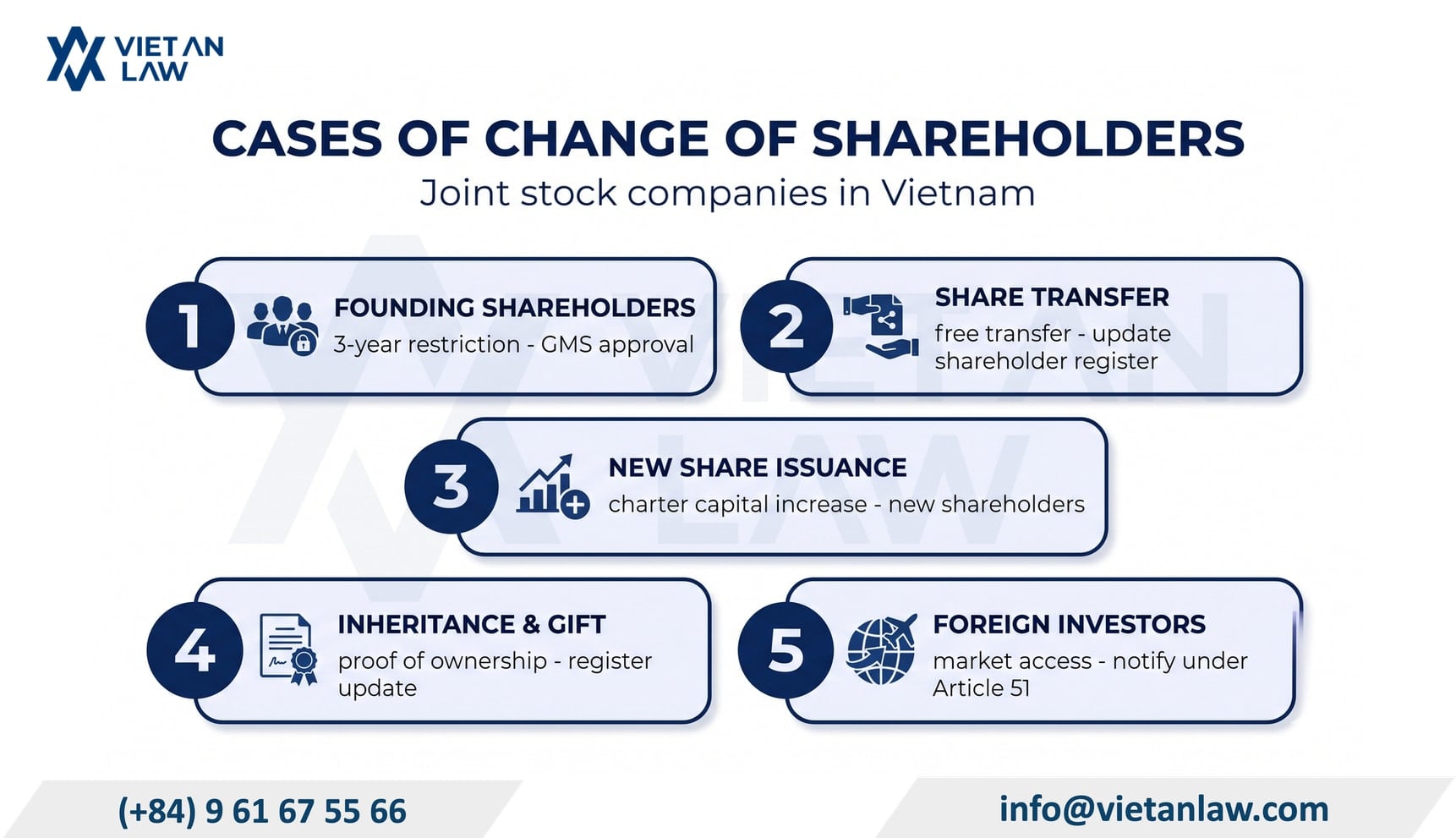
Change of founding shareholders
Founding shareholders are shareholders who own at least one ordinary share and sign the list of founding shareholders when registering the establishment of the company.
Under Article 120 of the Law on Enterprise 2020, within three years from the date of issuance of the enterprise registration certificate (ERC), ordinary shares subscribed by founding shareholders at establishment may only be transferred to persons who are not founding shareholders with the approval of the general meeting of shareholders, except where the transfer restrictions do not apply under the law.
After this period, the transfer restrictions under Clause 3, Article 120 no longer apply.
However, a share transfer by a founding shareholder does not mean that the list of founding shareholders must be re-registered.
Under Article 50 of Decree 168/2025/ND-CP, notifying the business registration authority of changes to founding shareholder information is only required where a founding shareholder has not paid, or has only partly paid, for the shares subscribed under Article 113 of the Law on Enterprise 2020.
Clients may refer to details on conditions, transfer restrictions and practical cases in our article on changing founding shareholders of a joint stock company.
Change of contributing shareholders through share transfer
The transfer of shares in Vietnam is the most common way to effect a change of shareholding structure in a joint stock company.
Under Article 127 of the Law on Enterprise 2020, shares may be freely transferred, except where restricted by law or the company’s charter.
Transactions may take place between existing shareholders or between shareholders and outside investors.
After the transfer is completed, the transferee’s information must be fully recorded in the register of shareholders. This is an important basis for determining shareholder status and exercising rights in the company.
Where the transfer does not give rise to any content that must be registered with or notified to the business registration authority, the business updates its internal records and fulfils the related tax obligations.
For contracts, payment documents, transfer conditions and how to update the register of shareholders, clients may refer to our article on change of contributing shareholders through transfer of shares in Vietnam.
Change of shareholders through issuance of additional shares
A joint stock company may admit new shareholders through an offering of shares.
Unlike the transfer of issued shares, the issuance of additional shares may increase the charter capital and change the ownership ratios of existing shareholders.
Businesses must comply with the regulations on the authority to decide on offerings, offering methods, payment for shares and registration of charter capital increases.
Change of shareholders through inheritance or gift of shares
Shares may be transferred through inheritance or gift under Article 127 of the Law on Enterprise 2020.
The company needs to check the documents proving ownership, inheritance rights or the gift contract in order to update the register of shareholders.
If the recipient of the shares is a foreign investor, or the transfer changes information subject to notification, the business must also carry out the corresponding procedures.
Foreign shareholder changes in Vietnam
When a foreign investor buys or receives a transfer of shares, the company needs to check the regulations on enterprises and investment, as well as the market access conditions.
For joint stock companies that are not listed or registered for securities trading, a change of shareholders who are foreign investors falling under Article 51 of Decree 168/2025/ND-CP must be notified to the business registration authority.
Where registration is required, businesses should obtain approval for the capital contribution or share purchase under the investment law before completing the change procedure.
Does a joint stock company shareholder change require business registration changes in Vietnam?
Not every joint stock company shareholder change has to be registered with or notified to the business registration authority.
Depending on the nature of the transaction, businesses determine their obligations according to the following table:
| Case | Procedure required |
| Share transfer between domestic shareholders | Usually only update the register of shareholders and internal records |
| A founding shareholder transfers shares | No notification of founding shareholder information is required merely because of the transfer |
| A founding shareholder fails to pay in full for subscribed shares | Notify under Article 50 of Decree 168/2025/ND-CP |
| Change of shareholders who are foreign investors | Notify under Article 51 if within its scope |
| Issuance of additional shares increasing charter capital | Register the change of charter capital |
| Change of beneficial owner information | Notify under Article 52 where prescribed |
| Change of an institutional shareholder owning 25% or more of the voting shares | Consider the obligation to provide information to identify beneficial owners |
| Inheritance or gift of shares | Update the register of shareholders and fulfil additional obligations, if any |
The table above mainly applies to joint stock companies that are not listed or registered for securities trading. Enterprises operating in the securities sector or in conditional business lines should also consider sector-specific regulations.
Note: The list of shareholders is normally not a content of the ERC under Article 28 of the Law on Enterprise 2020. Therefore, a change of shareholders does not necessarily lead to business registration changes in Vietnam or the re-issuance of the ERC.
Latest dossier for registration of shareholder changes at a joint stock company in Vietnam
The required documents depend on the type of change. Businesses need to distinguish documents kept internally from the dossier submitted to the business registration authority.
Dossier for internal share transfers
Where no notification to the business registration authority is required, the business usually prepares:
- The share transfer contract or documents proving a lawful transaction;
- Legal documents of the parties to the transaction;
- Written approval of the transfer if required by law or the charter;
- Payment documents and documents confirming completion of the transaction;
- The updated register of shareholders;
- Documents related to tax obligations.
This set of documents serves the transaction and corporate governance; it is not a dossier for registration of shareholder changes that must be submitted in full to the business registration authority.
Dossier for notifying changes to founding shareholders
Under Article 50 of Decree 168/2025/ND-CP, the dossier includes:
- A notice of changes to enterprise registration contents using Form No. 12 issued with Circular 121/2026/TT-BTC;
- The list of founding shareholders of the joint stock company using Form No. 7, Appendix I of Circular 68/2025/TT-BTC.
The list of founding shareholders does not include information on persons who have not paid for the shares they subscribed.
Businesses must complete the procedure within 30 days from the end of the deadline for full payment of the subscribed shares.
Details on preparing the dossier and completing the forms are provided in our article on registering founding shareholder changes.
Dossier for notifying foreign shareholder changes in Vietnam
Under Article 51 of Decree 168/2025/ND-CP, as amended and supplemented by Decree 296/2026/ND-CP, the dossier includes:
- A notice of changes to enterprise registration contents using Form No. 12;
- The list of shareholders who are foreign investors after the change, using Form No. 8;
- The share transfer contract or documents proving completion of the transfer; capital contribution documents when buying privately offered shares; the gift contract if the change results from a gift of shares;
- Legal documents of the organisation and the document appointing the authorised representative, for new institutional shareholders;
- Written approval of the investment registration authority if the transaction must be registered under the investment law.
The list of foreign shareholders must be signed by the shareholders whose share value changes; the signatures of shareholders whose share value does not change are not required.
Legal documents of a new shareholder that is a foreign organisation must be consular-legalised as prescribed.
Dossier for registering a change of charter capital
Where a change of shareholders results in an increase or decrease in charter capital, the dossier follows Article 44 of Decree 168/2025/ND-CP.
The basic dossier includes:
- An application for registration of changes to enterprise registration contents using Form No. 12;
- The resolution or decision of the general meeting of shareholders on the charter capital change;
- Resolutions, decisions and supplementary documents depending on the method of capital increase or decrease;
- Written approval of the investment registration authority where required by law.
Where the board of directors is authorised by the general meeting of shareholders to register the capital increase after each share offering, the dossier must meet specific requirements on the offering decision and the decision to register the capital increase.
For a capital reduction, the company must satisfy the legal conditions and ensure its ability to pay debts and other property obligations as applicable.
Enterprise registration forms applicable in 2026
| Form | Legal basis |
| Form No. 7 – List of founding shareholders | Circular 68/2025/TT-BTC |
| Form No. 8 – List of shareholders who are foreign investors | Circular 68/2025/TT-BTC |
| Form No. 10 – List of beneficial owners | Circular 121/2026/TT-BTC |
| Form No. 12 – Application/notice of changes to enterprise registration contents | Circular 121/2026/TT-BTC |
Circular 121/2026/TT-BTC takes effect from August 21, 2026, replacing the former Form No. 10 and Form No. 12 and abolishing Form No. 11 of Circular 68/2025/TT-BTC.
Businesses need to use the forms in force at the time of filing.
Shareholder change and share transfer procedures in Vietnam
Step 1: Review the conditions for changing shareholders
The business determines shareholder status, share classes, ownership ratios and transfer restrictions under the law and the company’s charter.
If the transaction involves foreign elements, market access conditions and investment approval requirements should be reviewed.
Step 2: Complete the transfer or capital contribution transaction
The parties sign the contract, make payment, hand over documents and fulfil the transaction conditions in line with share transfer procedures in Vietnam.
In the case of issuing additional shares, the business carries out the offering process and records the number of shares paid for as prescribed.
Step 3: Submit the registration or notification dossier where mandatory
The business submits the dossier to the provincial business registration authority where its head office is located.
For online submission, the applicant uses an electronic identification account to access the system, declare information, upload documents and complete authentication under the current procedure.
Under Decree 296/2026/ND-CP, online enterprise registration dossiers take the form of electronic documents or electronic data and have the same legal validity as paper dossiers.
Step 4: Receive the result and update the register of shareholders
For dossiers under Articles 50 and 51 of Decree 168/2025/ND-CP, the business registration authority reviews their validity and updates the data within 03 working days from receipt of the dossier.
Where the dossier needs to be amended or supplemented, the business registration authority will notify the contents to be completed.
After the transaction, the company must fully record shareholder information in the register of shareholders under Articles 122 and 127 of the Law on Enterprise 2020.
Step 5: Fulfil post-change obligations
Businesses need to:
- Keep transaction records and payment documents;
- Review tax declaration and payment obligations;
- Check for changes in beneficial owner information;
- Update internal governance documents;
- Fulfil investment and foreign exchange obligations, if any;
- Check notification and information disclosure obligations under sector-specific laws.
Deadlines for shareholder change procedures in Vietnam
Key deadlines under Decree 168/2025/ND-CP include:
| Content | Deadline |
| Notification of founding shareholders who have not fully paid for subscribed shares | 30 days from the end of the deadline for full payment |
| Processing by the business registration authority of changes to founding shareholder information | 03 working days |
| Processing by the business registration authority of changes to foreign shareholders | 03 working days |
| Notification of changes to beneficial owner information or declared ownership ratios | 10 days from the date of change |
| Notification of changes to institutional shareholders required to provide information to identify beneficial owners | 10 days from the date of change |
| Notification updating foreign shareholder information under Article 54 | 03 working days from the time the notifiable information arises or changes |
For charter capital changes, businesses must determine the registration deadline according to the procedures for registering changes to charter capital that apply to each form of increase or decrease.
Key legal issues when changing shareholders in Vietnam in 2026
Beneficial ownership disclosure in Vietnam after a change of shareholders
One of the key points of the Law on Enterprise as amended in 2025 is the obligation to identify, declare and keep beneficial owner information, i.e. beneficial ownership disclosure in Vietnam.
In particular, Decree 296/2026/ND-CP has amended Articles 17 and 18 of Decree 168/2025/ND-CP.
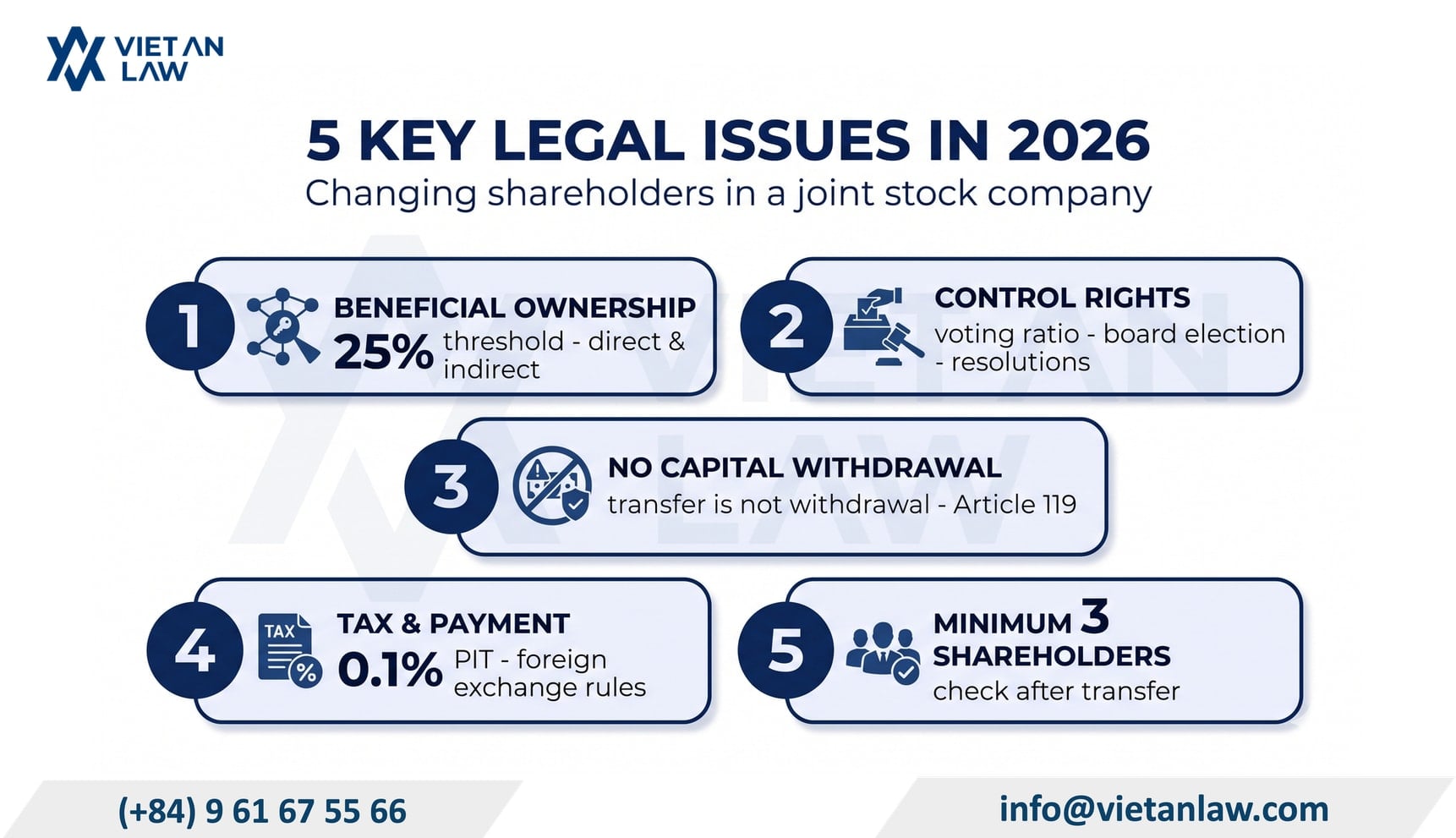
Under the new regulations, identifying beneficial owners requires considering individuals who directly, indirectly, or both directly and indirectly own 25% or more of the charter capital or 25% or more of the total voting shares.
In addition to the ownership criteria, businesses must also consider individuals with ultimate de facto control through key decision-making rights over governance, organisation, finance, investment and business operations.
Where no individual can be identified under the ownership or control criteria, the manager with the greatest authority is identified under Clause 3 of the amended Article 17.
Example: Company A has an individual shareholder X who directly owns 15% of the voting shares and indirectly owns another 15% through an intermediary company.
When reviewing the ownership structure, the business must not rely only on the 15% held directly by X but must also calculate the indirect ownership ratio as prescribed to identify the ultimate beneficial owner.
A change of shareholders may change beneficial owner information even when the company is not required to make an ordinary notification of shareholder changes.
Businesses must fulfil the notification obligation under Article 52 of Decree 168/2025/ND-CP when changes within the prescribed scope arise.
Checking control of the company after a transfer
A change of shareholder ownership ratios may directly affect voting rights and the ability to pass resolutions of the general meeting of shareholders.
When transferring shares, it is necessary to determine:
- Each shareholder’s ratio of voting shares after the transaction;
- Rights related to nominating and electing members of the board of directors;
- Conditions for passing resolutions under the Law on Enterprise 2020 and the charter;
- Agreements between shareholders on voting rights, governance and transfers.
For transfers of large shareholdings, Viet An Law Firm recommends reviewing both ownership and control rights to limit disputes in corporate governance.
Distinguishing a share transfer from a withdrawal of contributed capital
Under Article 119 of the Law on Enterprise 2020, shareholders may not withdraw capital contributed in ordinary shares from the company in any form, except where the shares are repurchased by the company or by another person as prescribed.
Therefore, a shareholder who wishes to end its investment is not entitled to require the company to directly refund the full value of the shares it owns.
The business must determine an appropriate method that protects the shareholder’s interests and the company’s ability to meet its property obligations.
Reviewing tax and payment conditions
A share transfer may give rise to tax obligations for the transferor. For individuals earning income from transfers of securities or shares, personal income tax is normally determined at 0.1% of the transfer price of each transfer under the current Law on Personal Income Tax. Where capital is transferred or the transferor is an organisation, tax obligations are determined under the corresponding regulations.
For transactions involving foreign investors, businesses should also check the payment method, the accounts used and foreign exchange management regulations.
Ensuring the minimum number of shareholders
A joint stock company must have at least three shareholders.
Therefore, when a shareholder transfers all of its shares, the company must check the number of remaining shareholders.
If the minimum number is not met within the statutory period, the business must consider appropriate reorganisation or conversion measures.
Common scenarios of change of shareholding structure in Vietnam
Scenario 1: Share transfer between two Vietnamese shareholders
Company A has four shareholders, all Vietnamese individuals. Shareholder X transfers its entire 20% shareholding to shareholder Y.
If the transaction does not give rise to any other registration or notification obligation, the company does not need to make a notification of shareholder changes but updates the register of shareholders, keeps records, and handles tax obligations.
However, if the new ownership ratio changes the declared beneficial owner information, the business must consider the notification obligation under Article 52.
Scenario 2: A foreign investor receives a transfer of shares
Company B has three Vietnamese shareholders. One shareholder transfers 30% of the shares to a foreign investor.
Before the transaction, the business must review the market access conditions and whether registration of the capital contribution or share purchase is required under the investment law.
After meeting the conditions, the business carries out the notification procedure for foreign shareholders under Article 51, if applicable, and considers its obligations regarding beneficial owners.
Scenario 3: The company admits a new capital contributor through a capital increase
Company C has charter capital of VND 5,000,000,000 and issues additional shares with a total par value of VND 3,000,000,000, fully paid for by a new investor.
The charter capital then increases to VND 8,000,000,000. The business must register the charter capital increase as prescribed and update its shareholder structure after the offering.
This is a case where a change of shareholders is linked to a charter capital change, unlike a share transfer between investors.
Frequently asked questions
Does a change of shareholders require amending the enterprise registration certificate?
Not every case requires amending the ERC. If there is only a share transfer that does not give rise to other registration contents, the business usually updates its internal records and fulfils the related legal obligations.
Is registration required for a change of founding shareholders after three years?
A share transfer after the three years does not automatically give rise to an obligation to notify changes to founding shareholder information. However, the company still needs to check other obligations arising from the transaction.
Is a shareholder who transfers all of its shares still a shareholder of the company?
A person who transfers all of its shares is no longer a shareholder once the transfer is completed and the transferee’s information is fully recorded in the register of shareholders as prescribed.
Is tax payable on a change of shareholders?
A share transfer may give rise to tax obligations. The specific obligations depend on the transferor and the tax regulations applicable to the transaction.
Can all shareholders of a joint stock company be changed?
A company may change all of its shareholders through lawful transactions if it meets the transfer conditions, the minimum number of shareholders and the relevant regulations on enterprises, investment, tax or sector-specific laws.
Viet An Law Firm’s services for change of shareholders in a Vietnamese joint stock company
Viet An Law Firm provides legal advice and support for the change of shareholders in a Vietnamese joint stock company, changes to capital contributors and adjustments to the ownership structure.
The scope of services includes:
- Advising on share transfer conditions and changes of shareholders;
- Reviewing the company’s charter and transfer restrictions;
- Drafting contracts and transfer dossiers;
- Representing clients in carrying out related procedures;
- Advising on completing legal requirements after share transfers and shareholder changes.
Author: Trainee lawyer Do Quynh Trang
Lawyer in charge and article reviewer: Lawyer Trung Thi Lieu.
Hotline/ Zalo/ Whatsapp: (+84) 961 571 818
Email: info@vietanlaw.com
Hanoi office: 3rd Floor, Hoang Ngan Plaza Building, 125 Hoang Ngan Street,
Yen Hoa Ward, Hanoi
Ho Chi Minh City office: Room 2.26 – 2.27, Charmington La Pointe Building, 181 Cao Thang Street, Hoa Hung Ward, Ho Chi Minh City.