


During operations, the founding shareholders of a joint stock company may transfer part or all of their shares, adjust their ownership ratios, or cease participating in the company. However, a change of founding shareholders in a joint stock company in Vietnam involves distinct legal characteristics, particularly regarding share transfer restrictions within the first three years and the determination of founding shareholder status following a transfer.
Under the current Vietnamese Law on Enterprises and Decree 168/2025/ND-CP, as amended and supplemented by Decree 296/2026/ND-CP, a share transferee does not automatically become a founding shareholder, and not every change involving founding shareholders requires notification to the business registration authority. Viet An Law analyzes the relevant conditions, rights, and obligations to help enterprises ensure full legal compliance to change of founding shareholders in Vietnam.
What are the legal characteristics of founding shareholders in a joint stock company in Vietnam?
Pursuant to Clause 4, Article 4 of the Law on Enterprises, a founding shareholder is a shareholder who owns at least one ordinary share and has signed the list of founding shareholders submitted for business registration at the time of the enterprise’s incorporation.
Under Article 120 of the Law on Enterprises, founding shareholders are characterized by the following:
- A newly established joint-stock company must have at least three founding shareholders, unless otherwise provided by law;
- Founding shareholders must collectively subscribe for at least 20% of the total number of ordinary shares authorized for issuance at the time of incorporation;
- The transfer of ordinary shares held by founding shareholders may be restricted for the first three years;
- The status of a founding shareholder is established at the time of the enterprise’s incorporation and is not determined solely by the proportion of shares held.
A joint-stock company formed through the conversion of a state-owned enterprise or a limited liability company, or one created via the division, split-off, consolidation, or merger of other joint-stock companies, is not required to have founding shareholders.
Distinguishing between founding shareholders and ordinary shareholders
A founding shareholder is an individual or entity that meets legal requirements and is included in the list of founding shareholders at the time of the company’s incorporation.
An ordinary shareholder may join a company after its incorporation by purchasing shares, receiving a transfer of shares, or through other lawful means.
An investor who acquires a 60% stake in a company does not automatically become a founding shareholder, even if they hold control over the business.
Conditions for changing founding shareholders within the first three years in Vietnam
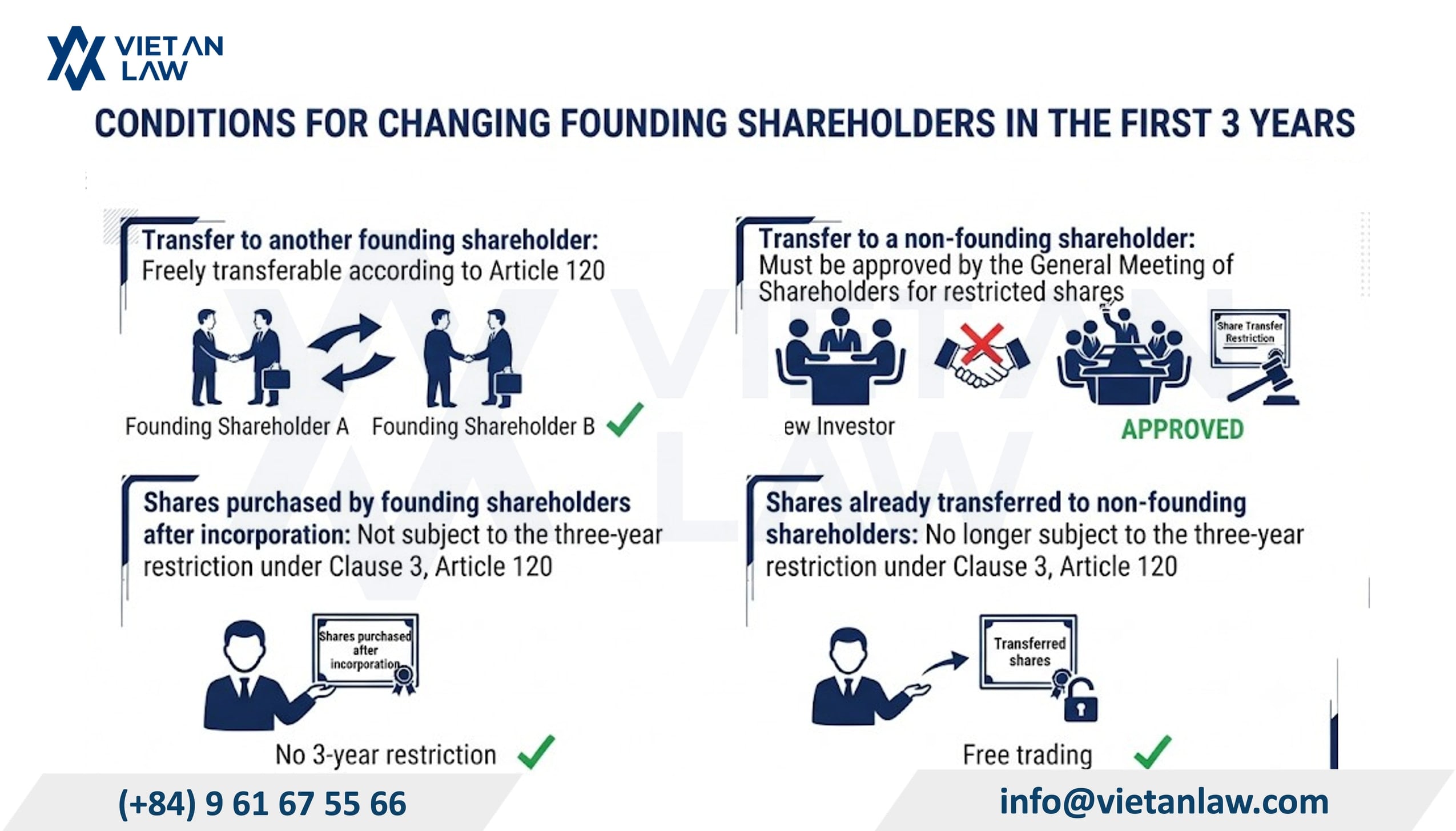
Pursuant to Clauses 3 and 4 of Article 120 of the Law on Enterprises, the transfer of shares by founding shareholders during the first three years is distinguished based on the transferee and the origin of the shares.
| Case | Transfer conditions |
| Transfer to another founding shareholder | Freely transferable pursuant to Article 120 |
| Transfer to a non-founding shareholder | Must be approved by the General Meeting of Shareholders for restricted shares |
| Additional shares acquired by founding shareholders after incorporation | Not subject to the three-year restriction under Clause 3, Article 120 |
| Shares already transferred to a non-founding shareholder | No longer subject to the three-year restriction under Clause 3, Article 120 |
The above cases remain subject to any other applicable legal restrictions, if any.
Transfer of shares among founding shareholders
Within three years from the date of issuance of the Enterprise Registration Certificate, founding shareholders are free to transfer their ordinary shares – as defined under Article 120 – to other founding shareholders.
Such transfers between founding shareholders do not require the approval of the General Meeting of Shareholders, notwithstanding the three-year restriction stipulated in Article 120.
Nevertheless, shareholders should review the company’s Charter and any other applicable conditions regarding share transfers.
Transfer of shares to persons outside the list of founding shareholders
For ordinary shares subject to restrictions during the first three years, a founding shareholder may only transfer such shares to a person who is not a founding shareholder if the General Meeting of Shareholders grants its approval.
The founding shareholder intending to make such a transfer shall not have the right to vote on the approval of the transfer of those shares.
Example: Company A is established on March 1, 2025, with three founding shareholders: X, Y, and Z.
In November 2026, X wishes to transfer all the ordinary shares they subscribed for at the time of incorporation to investor M, who is not among the founding shareholders.
Since X can not process the transfer of founding shares within three years from establishment, this transfer must be approved by the General Meeting of Shareholders in accordance with Article 120. X is not permitted to vote on the approval of the transfer of those shares.
Are additional shares subject to a three-year share transfer restriction?
Not all shares held by founding shareholders are subject to a three-year transfer restriction.
According to Clause 4, Article 120 of the Law on Enterprise, the restrictions stipulated in Clause 3 do not apply to common shares acquired by founding shareholders after the company’s incorporation.
For example: Suppose founding shareholder X holds 100,000 common shares subscribed for at the time of incorporation and subsequently acquires an additional 50,000 shares after one year of operation.
If, within the first three years, X wishes to transfer shares to a party other than a founding shareholder, a distinction must be made:
- The 100,000 shares subscribed for at the time of incorporation are subject to the restrictions under Clause 3, Article 120.
- The 50,000 additional shares are not subject to the three-year restriction.
Are changes to founding shareholders still restricted after 03 years in Vietnam?
Three years after the issuance of the Enterprise Registration Certificate, the transfer restrictions stipulated in Clause 3, Article 120 of the Law on Enterprises no longer apply.
Founding shareholders may transfer their shares in accordance with the general principles set forth in Article 127 of the Law on Enterprises, unless other lawful restrictions remain in effect under the company’s Charter or relevant legislation.
Note: the expiration of this three-year period does not mean that all transfer restrictions have ceased.
If the company’s Charter stipulates valid transfer restrictions – and the conditions for their application are met in accordance with Article 127 of the Law on Enterprises – shareholders must continue to comply with them.
Furthermore, if a founding shareholder holds preferred shares, or shares subject to restrictions under specialized regulations, any transfer must be evaluated based on the specific class of shares and the applicable legal requirements.
Therefore, prior to transferring shares after the three-year period, it is necessary to examine the class of shares, the company’s Charter, and any other relevant agreements.
Can founding shareholders be added, replaced, or removed in Vietnam?
The addition or replacement of founding shareholders is a common occurrence when a business brings in new investors, undergoes a full transfer of shares, or experiences a change in its control structure.
However, it is necessary to distinguish between the status of a “founding shareholder” – established at the time of the company’s incorporation – and the status of a current shareholder.
Is it possible to add founding shareholders after a company has been incorporated?
In principle, an investor who joins after a company has been incorporated does not automatically become a founding shareholder.
There is no standard legal procedure that allows a business to unilaterally add individuals who purchase shares post-incorporation to the original list of founding shareholders.
While such individuals acquire shareholder rights through their transactions and in accordance with the law, this does not confer upon them the status of a founding shareholder.
Can a founding shareholder be replaced by a transferee?
A founding shareholder cannot be automatically replaced by a transferee solely on the basis of a share purchase agreement.
For example: Company B is established by three founding shareholders – A, B, and C. After four years, A transfers all of their shares to D.
D becomes a current shareholder upon meeting legal requirements and being duly recorded in the company’s register of shareholders.
However, D does not automatically become a founding shareholder in place of A. The transfer does not alter the historical information regarding the founders of the business.
Are founding shareholders removed from the record if they sell all their shares?
When a founding shareholder transfers all of their shares, they no longer hold the shareholder rights associated with those transferred shares.
However, a distinction must be made between:
- The list of founding shareholders: This records information about founding shareholders as of the time of incorporation, along with any changes as prescribed by law;
- The register of shareholders: This records the share ownership information of current shareholders, in accordance with Article 122 of the Law on Enterprises.
Therefore, the transfer of all shares does not automatically trigger an obligation to remove the transferor’s name from the registered list of founding shareholders.
The company must update its register of shareholders to accurately reflect the current ownership structure.
Is a company required to retain its three founding shareholders?
Following its incorporation, a company is not required to maintain the original three founding shareholders.
Founding shareholders may transfer their shares and cease to be shareholders, provided that the requirements under the law are met.
Nevertheless, a joint-stock company must still ensure it meets the minimum number of shareholders as stipulated in Article 111 of the Law on Enterprises.
Thus, the law distinguishes between the requirements for founding shareholders at the time of incorporation and the requirements regarding the number of shareholders throughout the company’s ongoing operations.
Does a change of shareholders in a joint stock company require notification to the business registration authority in Vietnam?
Pursuant to Article 50 of Decree 168/2025/NĐ-CP, for a joint-stock company that is neither listed nor registered for securities trading, the requirement to notify changes in information regarding founding shareholders applies only in cases where a founding shareholder has not yet paid, or has only partially paid, for the shares they registered to purchase, in accordance with Article 113 of the Law on Enterprises.
In the event that a founding shareholder transfers shares for which full payment has been made, such a transfer does not automatically trigger an obligation to notify changes in information regarding founding shareholders.
Nevertheless, the enterprise must still assess whether other registration or notification obligations arise – for instance, if the transaction involves foreign elements, results in a change to the charter capital, or alters information concerning the ultimate beneficial owner(s).
If a founding shareholder fails to contribute the full amount of capital
If a founding shareholder fails to pay – or only partially pays – for the shares they registered to purchase within the statutory time limit, the company must handle the situation in accordance with Article 113 of the Law on Enterprises and provide notification as required by Article 50 of Decree 168/2025/NĐ-CP.
This scenario involves specific mechanisms regarding shareholder rights, liabilities concerning the unpaid portion of capital, and the adjustment of charter capital. It is important to distinguish this from a standard share transfer transaction.
For information regarding the required documentation, forms, and the procedural steps for notification, please refer to our article on Registration of changes to founding shareholders.
Should any other changes to the enterprise registration information arise, please refer to the changes to business registration service offered by Viet An Law.
Legal considerations when changing founding shareholders in Vietnam
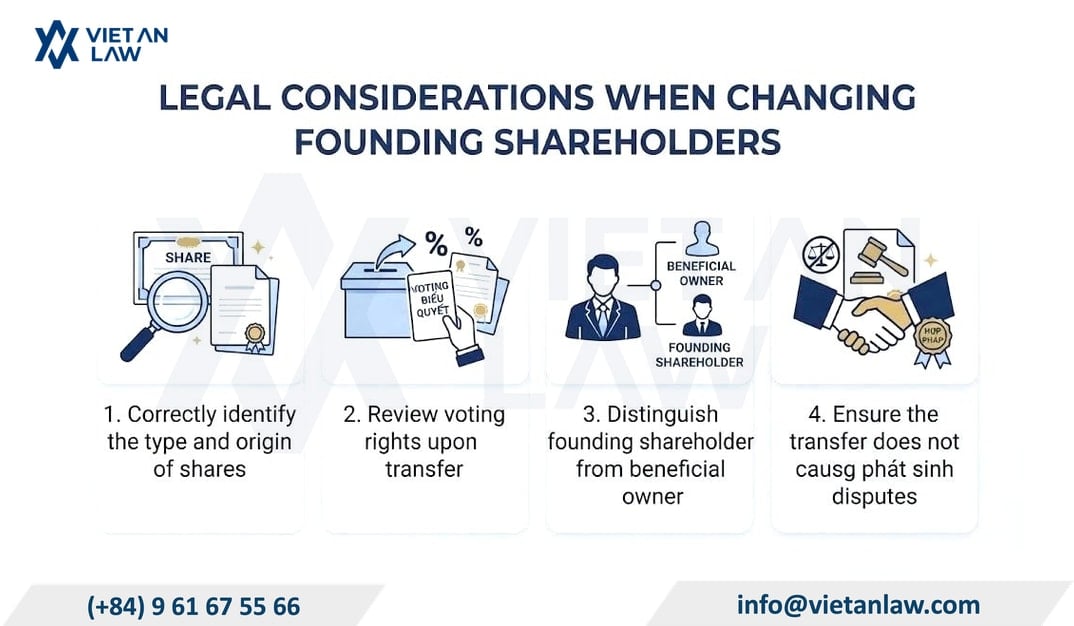
Accurately identify the type and origin of shares
For founding shareholders, distinguishing between shares subscribed for at the time of incorporation and shares acquired subsequently is crucial for determining the applicability of transfer restrictions.
Companies must maintain records of share issuances, ownership details, and documentation substantiating the origin of the shares.
In particular, if a shareholder holds different categories of shares, any transfer agreement must clearly specify the quantity, type, and origin of the shares being transferred.
Reviewing voting rights upon share transfer
The status of a founding shareholder does not automatically confer greater voting rights than those of other common shareholders.
Voting rights and management authority are determined by the class of shares held, the number of shares owned, the Law on Enterprises, and the company’s Charter.
When a founding shareholder transfers a significant portion or all of their shares, the structure of voting rights and the ability to control the company may change substantially.
Distinguishing between founding shareholders and beneficial owners
The status of a “founding shareholder” is established at the time of a company’s incorporation. In contrast, a “beneficial owner” is determined based on criteria related to ultimate ownership and control, as defined by law.
An individual who is not a founding shareholder may still qualify as a beneficial owner of a company if they meet the relevant legal criteria.
In the event of a transfer of shares or equity that results in a change of control over the company, the entity must verify its obligations regarding the declaration and updating of information concerning its beneficial owners, in accordance with Decree 168/2025/ND-CP, as amended by Decree 296/2026/ND-CP.
Ensuring share transfers are free from disputes
Disputes among founding shareholders often arise when a transaction lacks proper authorization, the origin of the shares is not clearly established, or ownership records are not updated following the transfer.
Before finalizing founding shareholder share transfer, businesses should review the conditions for the transfer, the authority required for approval, and the specific point in time at which shareholder rights are established.
For guidance on contractual documentation, payment records, and relevant tax obligations, please refer to our article on “Change of shareholders through share transfers”.
Change of founding shareholders in a joint stock company in Vietnam services at Viet An Law
Viet An Law provides legal consulting services to joint-stock companies and their shareholders regarding changes in ownership structure, share transfers, and matters concerning the status of founding shareholders.
Our scope of services includes:
- Advising on the determination of founding shareholder status and share ownership rights;
- Reviewing restrictions on share transfers—both within the initial three-year period and thereafter;
- Advising on the conditions for transferring shares to other founding shareholders or third parties outside the company;
- Defining the rights and obligations of founding shareholders following the transfer of all or a portion of their shares;
- Advising on the admission of new investors, as well as the addition or replacement of founding shareholders;
- Reviewing the company’s Charter, resolutions, and other relevant legal documentation;
- Assisting with the procedures for notifying changes in founding shareholder information, as required by law;
- Providing counsel on the prevention and resolution of disputes regarding shareholder status, share ownership, and corporate governance rights.
Changes to the founding shareholders of a joint-stock company must be evaluated by considering legal status, transfer conditions, and ownership rights in tandem. In particular, it is essential to distinguish between the act of transferring shares and the procedural requirement to notify changes in founding shareholder information, ensuring that no legal obligations are overlooked or incorrectly fulfilled.
Should you require assistance with founding shareholder changes of a joint-stock company, navigating share transfers during the initial three-year period, or addressing other legal issues related to founding shareholders, please contact Viet An Law to receive tailored support from our lawyers.
Author: Trainee Lawyer Do Quynh Trang
Supervising and reviewing: Lawyer Trung Thi Lieu
Hotline/ Zalo/ Whatsapp: (+84) 961 571 818
Email: info@vietanlaw.com
Hanoi Office: 3rd Floor, Hoang Ngan Plaza Building, 125 Hoang Ngan, Yen Hoa Ward, Hanoi
Ho Chi Minh City Office: Units 2.26–2.27, Charmington La Pointe Building, 181 Cao Thang, Hoa Hung Ward, Ho Chi Minh City