Cashless Payments 2026: Key Compliance Updates for Companies
In the context of rapid digital transformation and the increasing demand for financial transparency, numerous new regulations on non-cash payments are continuously being introduced. These changes directly impact the financial management, accounting, tax, and banking activities of both organizations and individuals. To help enterprises navigate this evolving landscape, the following article by Viet An Law will provide a comprehensive summary of cashless payments 2026: key compliance updates for companies, ensuring your operations remain aligned with the latest legal standards.
Table of contents
Hide
What are non-cash payments or digital payments?
According to Clause 1, Article 3 of Decree 52/2024/ND-CP, non-cash payment services include:
Payment services through customers’ payment accounts: Providing payment instruments; performing payment services such as checks, payment orders, payment authorizations, collection orders, collection authorizations, bank cards, money transfers, collection services, disbursement services, and other payment services for customers through their payment accounts.
Payment services not through customers’ payment accounts: Providing payment services and conducting payment transactions without going through customers’ payment accounts.
Non-cash payment methods are payment instruments issued by payment service providers, financial companies authorized to issue credit cards, and payment intermediary service providers offering e-wallet services, and used by customers to conduct payment transactions. These include: checks, payment orders, payment authorizations, collection orders, collection authorizations, bank cards (including debit cards, credit cards, and prepaid cards), e-wallets, and other payment methods as prescribed by the State Bank of Vietnam.
“Cashless payment” can be understood as a payment method that does not require direct cash transactions, usually provided by financial institutions through electronic means such as credit cards, bank transfers, QR code scanning, etc.
Accordingly, proof of non-cash payment is demonstrated through non-cash payment documents.
Summary of non-cash payment regulations effective in 2026
General provisions on non-cash payments
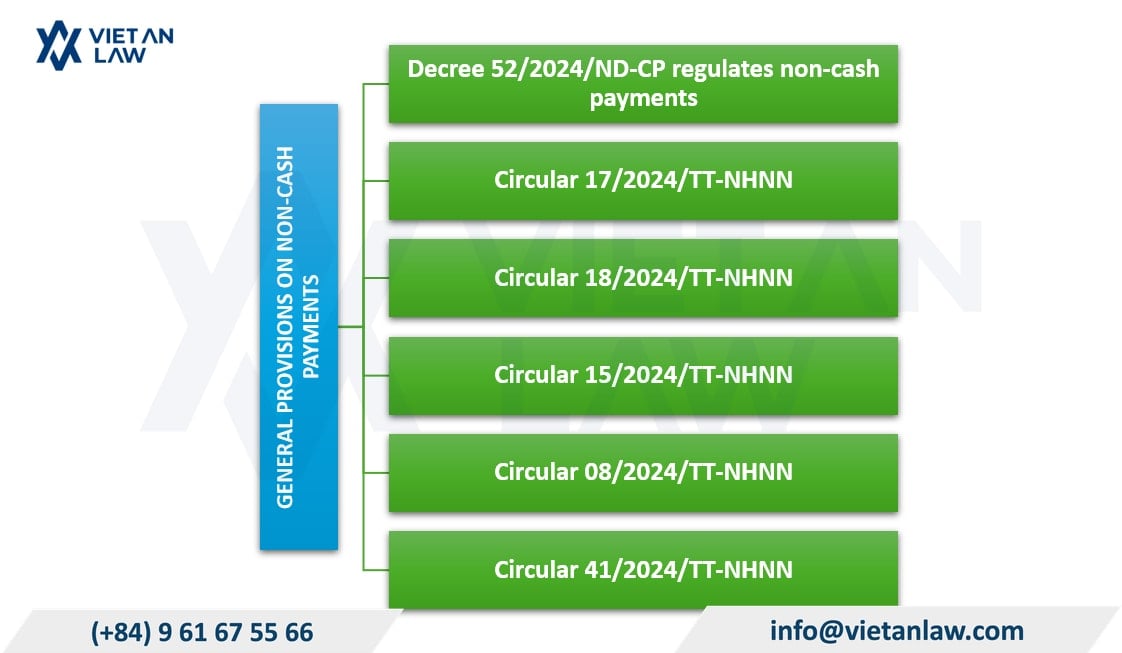
Decree 52/2024/ND-CP regulates non-cash payments
Decree 52/2024/ND-CP regulates non-cash payment activities, including: opening and using payment accounts; non-cash payment services; payment intermediary services; organization, management and supervision of payment systems.
Some important new points of Decree 52/2024/ND-CP include:
Adding some regulations on electronic money (e-money);
Adding regulations on international payments;
Amending and supplementing some contents related to opening and using payment accounts to better suit practical needs;
Adding regulations on the provision of payment services not through payment accounts;
Simplifying administrative procedures for applying for licenses to operate payment intermediary services; …
Decree 52/2024/ND-CP dated May 15, 2024, regulating cashless payments, ensures transparency, strictness, and compliance with the law, resolving practical difficulties, meeting the requirements of digital transformation, and promoting cashless payments in the economy; while also being consistent and unified with the effective date of the Law on Credit Institutions 2024.
Circulars guiding Decree 52/2024/ND-CP
In order to provide guidance on Decree 52/2024/ND-CP regulating non-cash payment activities, the State Bank of Vietnam has issued several guiding circulars, specifically:
Circular 17/2024/TT-NHNN regulates the opening and use of payment accounts at payment service providers, amended and supplemented by Circular 25/2025/TT-NHNN;
Circular 18/2024/TT-NHNN regulates bank card operations, amended and supplemented by Circular 45/2025/TT-NHNN;
Circular 15/2024/TT-NHNN regulates the provision of non-cash payment services, amended and supplemented by Circular 30/2025/TT-NHNN;
Circular 08/2024/TT-NHNN regulates the management, operation, and use of the National Interbank Electronic Payment System;
Circular 41/2024/TT-NHNN regulates the supervision and monitoring of important payment systems and payment intermediary service providers, as amended and supplemented by Circular 30/2025/TT-NHNN; …
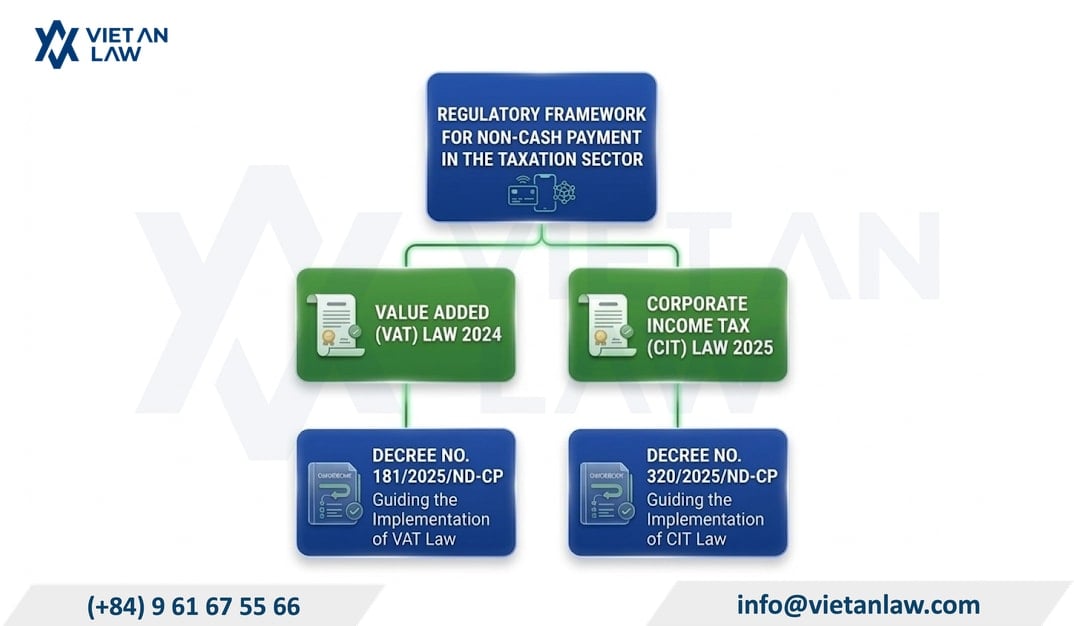
Non-cash payment regulations in the field of taxation in 2026
Value-add Tax Law 2024
One of the conditions for deducting input value-added tax is “having non-cash payment documents for purchased goods and services, except for certain specific cases as prescribed by the Government” (Clause 2, Article 14, Point b).
Therefore, while the Value-added Tax Law 2008 allowed tax deductions for transactions under 20 million VND even if paid in cash, the Value-added Tax Law 2024, effective from July 1, 2025, stipulates that “non-cash payment documents” are required for input VAT deduction.
Decree 181/2025/ND-CP provides guidance on the Value-added Tax Law
One of the conditions for goods and services exported to be subject to a 0% tax rate under Article 18 of Decree 181/2025/ND-CP is the presence of “non-cash payment documents”.
Furthermore, Article 26 of Decree 181/2025/ND-CP also provides detailed guidance on non-cash payment documents for input VAT deduction as follows:
Businesses must have non-cash payment documents for purchased goods and services (including imported goods) worth 5 million VND or more, including value-added tax. Specifically: Non-cash payment documents are documents proving non-cash payment as stipulated in Decree No. 52/2024/ND-CP on non-cash payments, excluding documents where the buyer deposits cash into the seller’s account.
Some specific cases:
In cases where goods and services purchased are paid for through a third party using non-cash payment methods (including cases where the seller requests the buyer to make non-cash payment to a third party designated by the seller), the payment by authorization or payment to the third party as designated by the seller must be specifically stipulated in the contract in written form, and the third party must be an organization or individual operating in accordance with the law.
For goods and services purchased on deferred payment or installment plans with a value of 5 million VND or more, businesses shall base their input value-added tax deduction on the written purchase contract, value-added tax invoice, and non-cash payment documents for the goods and services purchased on deferred payment or installment plans. If non-cash payment documents are not yet available because the payment due date according to the contract or contract addendum has not yet arrived, the business is still entitled to deduct input value-added tax.
In cases where the value of imported goods and services per transaction is less than 5 million VND, or the value of goods and services purchased per transaction, including value-added tax, is less than 5 million VND (including VAT), and in cases where the business imports goods as gifts, samples, or items not requiring payment from organizations or individuals abroad, non-cash payment documents are not required for the purchased goods and services.
In cases where goods or services are purchased from a single taxpayer with a value of less than 5 million VND, but multiple purchases are made on the same day with a total value of 5 million VND or more, tax deductions are only allowed if there is non-cash payment documentation.
Corporate Income Tax Law 2025
According to point c, Clause 1, Article 9 of the Corporate Income Tax Law 2025, one of the conditions for enterprises to deduct expenses when determining taxable income is that “Expenses must have sufficient invoices and non-cash payment documents as prescribed by law”.
Decree 320/2025/ND-CP provides guidance on the Corporate Income Tax Law
Point b, Clause 1, Article 9 of Decree 320/2025/ND-CP stipulates that “Expenses with non-cash payment documents for the purchase of goods, services and other payments with a value of 5 million VND or more per transaction” will be deductible when determining taxable income. Therefore, from December 15, 2025, non-cash payments made by the company will be deductible when calculating corporate income tax for the purchase of goods, services and other payments with a value of 5 million VND or more per transaction.
Key considerations for specific deductible expenses and payment documents
Making multiple purchases in one day
If you make multiple purchases from the same seller, each purchase being less than 5 million VND but the total value for the day is 5 million VND or more, non-cash payment documentation is mandatory for the expense to be included.
Purchase on credit (Not yet paid for)
The expense is recognized immediately upon purchase.
Note: If the enterprise later repays the debt in cash, the expense must be adjusted downwards (removed from deductible expenses) in that tax period.
Business trip expenses (paid by the employee)
Expenses of 5 million VND or more paid by employees using their own credit cards/personal bank transfers are still accepted as legitimate business expenses if they meet all three conditions:
Valid invoices and supporting documents.
Official travel authorization.
Financial/internal regulations allowing employees to pay in advance and then the company reimburses them.
Capital transfer
Capital transfer transactions of 5 million VND or more must be conducted in cash only.
If cash is used, the tax authorities have the right to determine the transfer price.
Additional spending on labor
For additional labor expenses to be eligible for corporate income tax reduction, non-cash payment documentation is required.
The above is a summary of cashless payments 2026: Key compliance updates for companies in cashless trends. For any related questions or to request advice on taxes and invoices, Financial Compliance, please contact Viet An Law – Tax Agency for the best advice and support!
Fast & Reliable Legal Assistance
Fill out the form below and get connected with a lawyer quickly.
Latest Updates on Tax Administration for Associated Transactions in Vietnam 2026. Complete guide covering transfer pricing, CbCR requirements, and compliance obligations.
Enterprise Formation & Registration Services in Binh Duong, HCMC. Expert guidance on company setup, legal compliance, tax incentives, and FDI procedures. Contact us today!
Complete step-by-step guide to company dissolution in Vietnam. Learn legal procedures, required documents, tax finalization, and debt settlement for closing your business compliantly.
Corporate Setup & Registration in Phu My Ward, HCMC guide. Complete procedures, required dossiers, tax incentives, and legal compliance for establishing your enterprise in 2025.